Fleet Commander: Nimitz – Total War
Fleet Commander: Nimitz – Total War Rulebook
Table of Contents
Table of Contents
Rules
This expansion details the US Resupply step in the Sequence of Play:
US Resupply Step
- Advance and Delay Forces Under Construction
- Gain Supply Points
- Allocate Supply Points and Rush
- Place Newly Started Forces on Tracks
These rules focus on the Shipyard production line. The Basic Training and Assembly Lines use the same rules. The Home Front Morale modifies the 3 production lines.
Components
Reinforcement Sheets - There is one sheet for each year of the war: 1942, 1943, 1944, and 1945.
Setup the game as normal using the 1942 sheet. All Japanese Battalion counters go into the Battalions box. If you must draw a Battalion, and none are available, do not draw a Battalion.
Each Turn, instead of gaining the standard Reinforcement and Supply points, gain the Supply Points listed on the sheet for the current game turn.
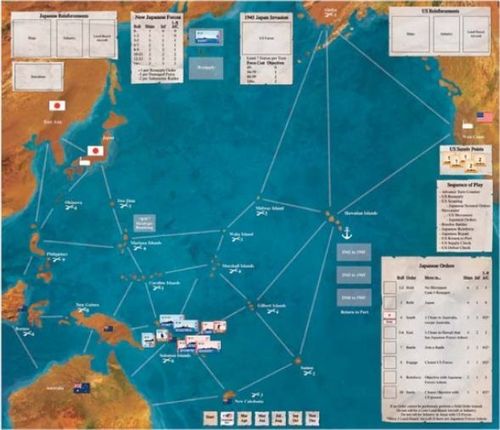
Do not use the US Reinforcements area on the map. The Infrastructure sheet in this expansion replaces that area, and the standard US Reinforcement rules. Place your Reinforcement Force counters for 1942 and all US Battalions, next to the Infrastructure sheet for easy access.
Infrastructure Sheet - This sheet tracks your investments into your naval production (Shipyards), infantry mobilization (Basic Training), land-based aircraft manufacturing (Assembly Lines), as well as your efforts to boost the civilian morale back home (Home Front Morale).
Your Infrastructure starts with the lowest category in all 4 production columns for Shipyards, Basic Training, Assembly Lines, and Home Front Morale already "Built".
SP - When you pay the number of SP noted next to the "Standard" box for a production line, you receive the benefits of having a "Standard" production line. When you pay the noted SP for "Superior", the production line improves to "Superior". Each box also notes the Max (maximum) number of SP you can allocate to the current box each Campaign Turn. Each box must be "Built" before you can spend SP toward the next box.
Shipyards, Basic Training, and Assembly Lines are rated in 2 categories: Capacity and Rush.
Capacity notes the maximum Cost of Force counters that you may have on that production line at one time.
Rush notes the SP cost to advance a Force under construction a 2nd time during a Campaign Turn.
Example: At the start of the first turn of 1942, your Built "Inferior" Shipyards have a capacity of 20, and a Rush cost of 3. The 20 Capacity means you cannot have more than 20 SP of Ship counters total in the line's 6 production boxes. The Rush cost of 3 means that if you want a Ship to advance a 2nd time during a turn, you need to pay 3 SP.
Example: To gain the benefits of having "Standard" Shipyards, you will need to spend 15 SP to upgrade the line to "Standard", but you cannot spend more than 8 SP on the Shipyard upgrade each turn. Once you have spent 15 SP you have "Standard" Shipyards. You then begin spending SP to attain "Superior" Shipyards.
Advance - During the Advance Forces Under Construction step, move each Force counter down one box in its production line. During this step on the first turn of the game, you do not have any Forces in the production lines.
When you advance a Force from a "1" box off the bottom of the production line, it has finished production and is ready to deploy. Move the counter to the West Coast on the map.
If you are suffering Delays due to the Home Front, do not advance the counters you select to be Delayed.
Gain - Gain the number of SP noted on the Reinforcement sheet for the current year and game turn.
Allocate - Allocate your SP to building new Forces, Repairing Forces, and upgrading your Infrastructure. The rules for Repairing Forces remain the same.
Use the Supply Point counters to record the SP spent for each box. Once you have spent all the SP needed to complete the box, replace the SP counters with a "Built" counter.
Example: On the first turn of 1942, you receive 20 SP. You decide to build a cost 5 Aircraft Carrier, a cost 3 Cruiser, and three cost 1 Infantry. You also allocate 5 SP to upgrading your Basic Training, and 2 SP to upgrading your Assembly Lines. You save 2 SP to buy Battle Plans later in the turn during Battles.
Each time you pay a Rush cost, advance a Force one box. You may not Rush the same Force more than once each turn.
Place - To build a new Force, place it in the appropriate production line box of the same value as its Cost.
Example: If you are building a Ship with a cost of 4, you would placed the Ship counter in the Shipyard production line box with the "3-4". An Infantry with a cost of 2 would be placed in the Basic Training box with a "2". A Land-Based Aircraft with a cost of 3 would be placed in the Assembly Line box with the "3".
You may build Battalion counters. Treat them as having a cost of 1. You may only purchase a Battalion if there is a US Battalion counter available.
At this same time, you allocate SP to Home Front Morale in the same way as you allocate SP to the 3 production lines.
Here is an example of how your Infrastructure sheet might look several turns into the game:
Example: Previously, you paid 15 SP to upgrade your Shipyards from Inferior to Standard. You paid 10 SP to upgrade your Basic Training from Inferior to Standard, and then 20 more SP to upgrade it to Superior. You also spent 2 SP toward upgrading your Assembly Lines to Standard, but you need to spend 8 more SP to complete the upgrade. You also have spent 4 SP upgrading your Home front track. When you spend 11 SP more, it will upgrade to "Hitting Their Stride".
Last turn, you started construction of a cost 5 Aircraft Carrier. At the time, you placed the counter in the "5-6" box. During the Advance step, you move it to the "3-4" box. You also choose to spend 2 SP to Rush it to the "2" box.
You had other ships also under construction. This turn, they are in the "1" box. You advance them off the sheet and to the West Coast area of the map.
Similar placements, advancements, and completions are also happening on the other 2 production lines.
The Home Front Morale Section
The Home Front Morale track modifies the actions that take place on the other 3 production lines.
Your Home Front begins with an "Organizing" status. You need to spend 15 SP to complete the "Coming Up To Speed" box to upgrade. While you are "Organizing", each of your production lines suffers 2 Delays each turn. This means that 2 counters that would have advanced in each line, do not advance.
Example: In your Shipyards, you have a Battleship in the "2" box, and a Cruiser and Submarine in the "1" box. Due to the Delay of 2, you select 2 of those counters not to advance this turn.
You may pay to Rush after suffering Delays.
Example: You elected to have your Battleship and Submarine get Delayed, and not advance. Later in the Turn, you pay the Rush cost to advance the Battleship to the "1" box.
Once your Home Front is sufficiently advanced, you gain free Rushes each turn. Use these as normal Rushes as detailed previously.
Fortification Counters
If the Japanese Hold the Island, the Japanese begin each Campaign Turn with the noted number of Fortification counters on the Island, even if some were discarded in a previous Campaign Turn.
Discard 1 Fortification counter each time a Japanese Infantry is about to suffer a Hit, instead of inflicting the Hit on the Infantry.
Post-War Life
Each Home Front box also notes your career path after the war. The better you make life for the civilians during the war, the more grateful they will be to you after the war.
Entering into a New Year
At the end of the 6th turn of 1942, note the number of Objectives you Hold with Supply Point counters off to the side, and continue on with 1943, and beyond, until the end of the 4th turn of 1945.
At the start of each new year, reference the new year's Reinforcement sheet. Add the noted Japanese Forces to their Ship, Infantry, and Land-Based Aircraft sections of their Reinforcements area of the map.
Add your Forces to those available for production.
If the US starts the new year with any Destroyed Submarine Groups, Destroyer Groups, or CVE Groups, add the current year's counters of the same name to your pile of US Ships available for production.
Example: During the 1942 Turns, the US Sub Gp 2 was Destroyed. When starting the 1943 years, add the 1943 Sub Gp 2 to your pile of US Ships available for production.
All destroyed US Land-Based Aircraft are returned to your pile of US Land-Based Aircraft available for production.
Use the appropriate year of Carrier-Based Aircraft as the War enters each new year.
End of the War
At the end of the war, total the number of Objectives you Held at the end of each year and compare that total to the Evaluation chart on the Reinforcement sheets.
| Objectives Held | Evaluation |
|---|---|
| 50 to 51 | Great |
| 45 to 49 | Good |
| 35 to 44 | Historical |
| 26 to 34 | Poor |
| 25 or less | Dismal |
Optional Rule
As the war progressed, some Force counters have their values adjusted. If you like, you may freely swap out an existing counter on the map for its revised counter reflecting its new year's values.
Most Forces retain the same values, but some counters, such as Aircraft Carriers, have notably improved values.
If you decide to use this rule, use it for both the US and Japan.