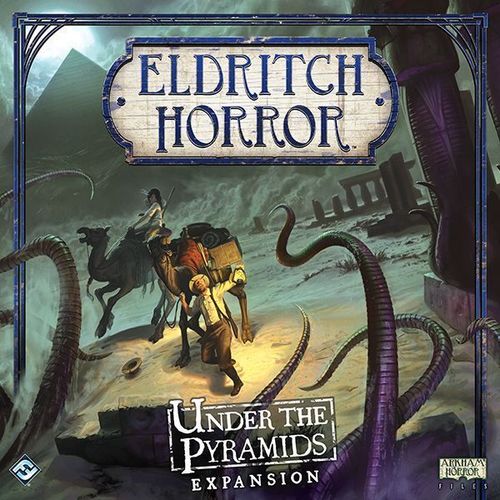
Eldritch Horror: Under the Pyramids
Eldritch Horror: Under the Pyramids Rulebook
Table of Contents
Table of Contents
Expansion Overview
The Under the Pyramids expansion leads investigators on an expedition beneath the pyramids of Giza to uncover the dark history of the Black Pharaoh, a cruel ruler of ancient Egypt who was stricken from all records. It includes new investigators, Ancient Ones, Monsters, and encounters to be used with Eldritch Horror. It also introduces new mechanics including a new side board, Unique Assets, Impairment tokens, and an adventure Under the Pyramids.
Using This Expansion
When playing with the Under the Pyramids expansion, add all expansion components to their respective decks or pools of Eldritch Horror components except for the components described below.
- Before setup, players draw one random Prelude card. These cards alter game setup and make each game feel unique.
- The Egypt side board, Egypt Encounter cards, Africa Encounter cards, and the six Clues and three Gates that correspond to spaces on the Egypt side board are used by the Nephren-ka Ancient One and the Under the Pyramids Prelude card included in this expansion. Otherwise, these components are returned to the game box. See the Egypt Side Board section for rules regarding these components.
- The Adventure cards included in this expansion are used by the Under the Pyramids Prelude card. Otherwise, they are returned to the game box. See the Adventures section for rules regarding Adventures.
- Add all Impairment tokens and the Adventure token to the general token pool. See the Impairment Tokens section for rules regarding these components.
- Shuffle all Unique Assets to create the Unique Asset deck. Place this deck faceup near the Asset deck.
Some components in this expansion require other components introduced in this expansion. For this reason, all expansion content should be included when playing with this expansion.
Expansion Icon
Each card in this expansion is marked with the Under the Pyramids expansion icon to distinguish these cards from the cards in other Eldritch Horror products.
Components
- 1 Egypt Side Board
- 8 Investigator Sheets with Matching Tokens and Plastic Stands
- 2 Ancient One Sheets
- 22 Mythos Cards
- Encounter Cards: 4 Americas, 4 Europe, 4 Asia/Australia, 16 Egypt, 16 Africa, 4 General, 12 Expedition (9 unique backs), 6 Other World, 48 Research (2 unique backs), 40 Special (4 unique backs)
- 12 Mystery Cards (2 unique backs)
- 6 Adventure Cards
- 6 Prelude Cards
- 7 Monster Tokens and 5 Epic Monster Tokens
- 4 Artifact Cards
- 16 Asset Cards
- 24 Spell Cards
- 35 Unique Asset Cards
- 16 Condition Cards
- 12 Health and Sanity Tokens
- 6 Clue Tokens
- 20 Impairment Tokens
- 1 Adventure Token
- 1 Active Expedition Token
- 6 Gate Tokens
The booklet shows the components as illustrations only. The printed text of the Prelude cards, the Ancient One sheets (including Nephren-Ka's "Nephren-Ka Awakens!" effect on its reverse), the investigator sheets, and the Mythos and Mystery cards is printed on those components themselves and is not reproduced in this booklet.
Prelude Cards
When playing with this expansion, players draw one random Prelude card before setting up the game. These cards alter game setup and make each game feel unique.
The card's effect is resolved immediately after drawing the card, unless it specifies different timing, such as "after resolving setup."
The Under the Pyramids Prelude card instructs players to setup the Egypt side board. The rules for setting up and using this side board are described below.
Egypt Side Board
The Egypt side board featured in this expansion allows investigators deeper access to Egypt and the region surrounding the Great Pyramids. These areas contain a bountiful wealth of ancient knowledge and relics.
This side board is used only if Nephren-ka is the Ancient One or when using the Under the Pyramids Prelude card.
While the side board is in play, "game board" refers to both the main board included in Eldritch Horror and the side board. "Side board" refers to the side board but not the main board.
Side Board Setup
Follow the steps below to set up the Egypt side board.
1. Place Side Board. Unfold the side board and place it near the main board within reach of all players.
2. Add Clues and Gates. Add the six Clues and three Gates that correspond to spaces on the side board to the Clue pool and Gate stack, respectively, and randomize the Clue pool and Gate stack.
3. Set Aside Monsters. Set aside the following Monsters from the Monster cup: 1 Mummy Monster, 1 Sand Dweller Monster, and 1 Spawn of Sebak Monster.
If any of these components would be returned to the Monster cup, it is set aside instead.
4. Separate and Place Decks. Separate all Egypt Encounters and Africa Encounters into decks and shuffle both decks. Place these decks near the side board.
Side Board Rules
The following rules relate to the Egypt side board.
Moving to the Side Board. A number of spaces on the main board and side board are connected by Local or Ship paths, allowing investigators to move onto and off of the side board with the Travel action or any other effect that allows an investigator to move. See "Local Paths" below for rules regarding Local paths.
Below is a list of spaces on the main board and the spaces they connect to on the side board.
- The Pyramids is connected to each of the following spaces by a Local path: Alexandria, Cairo, Tel el-Amarna, and The Bent Pyramid.
- The Heart of Africa is connected to The Nile River by a Local path.
- Space 10 is connected to The Sahara Desert by a Local path.
- Space 17 is connected to Cairo by a Ship path.
Location Encounters
Investigators on the Egypt side board have access to thematic encounters related to those locations. Each space on the side board has a brief description below its name that explains the most common effect that appears on encounter cards for that space.
- During the Encounter Phase, an investigator on Alexandria, The Bent Pyramid, or Cairo may encounter that space by drawing an Egypt Encounter and resolving the effect that corresponds to his space.
- During the Encounter Phase, an investigator on The Sahara Desert, Tel el-Amarna, or The Nile River may encounter that space by drawing an Africa Encounter and resolving the effect that corresponds to his space.
Research Encounters
When an investigator encounters a Clue on the Egypt side board, he draws a Research Encounter for the chosen Ancient One and resolves the effect that corresponds to his space's type as normal.
Local Paths
A number of spaces on the Egypt side board are connected to other spaces by Local paths. Spaces connected by Local paths are so close to each other that moving between them does not require an action.
- During the Action Phase, an investigator may move along any number of interconnected Local paths.
- Each investigator may perform this movement only once per round.
- This movement does not require an action but cannot be performed by a Delayed investigator.
Adventures
The Adventure cards in this expansion represent a multi-part expedition that investigators can undertake for various rewards, such as retreating Doom or advancing the active Mystery. The Museum Heist Adventures are used only if the Under the Pyramids Prelude card is drawn at the beginning of the game. Adventures are split into four stages, shown as a trait on the card's front (I, II, III, IV), and tell the story of the unfortunate Erich Weiss who has been framed for the theft of a valuable Egyptian relic.
When an Adventure is drawn, the active investigator places it faceup in play and resolves that card's "when this card enters play" effect.
Each Adventure has an effect that allows investigators to complete the Adventure. When an Adventure is completed, the active investigator resolves that card's "when this Adventure is completed" effect, which often includes drawing another Adventure representing the next chapter of the story. Then the active investigator discards the completed Adventure, any tokens on it, and any tokens placed by its effects.
The booklet's sample Adventure card (Framed for Theft, Museum Heist — I, shown on page 3) reads:
Framed for Theft. Museum Heist — I. The Talisman of Wadjet, an amulet meant to protect the pharaohs in the afterlife, has been stolen. The police suspect a man named Erich Weiss, but your gut tells you he is innocent.
When this card enters play, place an Adventure token on Cairo. When this Adventure is completed, the active investigator gains the Erich Weiss Unique Asset; then draw a random Museum Heist II Adventure.
As an encounter, an investigator on Cairo may attempt to convince the police that Erich has been framed (Influence test). If he passes, the police release Erich into his custody under the condition that he apprehends the thief; complete this Adventure.
Unique Assets
Some encounters in this expansion reward investigators with various Unique Assets. Like Spells or Conditions, Unique Assets are double-sided cards. An investigator cannot look at the back of Unique Assets unless an effect allows him to.
- Unique Assets are possessions and may be traded using the Trade action. There is no limit to the number of Unique Assets an investigator can have.
- "Asset" refers to both Assets and Unique Assets. "Non-Unique Asset" refers to Assets but not Unique Assets.
- When a Unique Asset is discarded, also discard all tokens on it.
Impairment Tokens
This expansion introduces a new mechanic that interacts with Improvement tokens and investigators' skills. Impairment tokens represent a permanent impairment to an investigator's skills.
- When an investigator impairs a skill, he gains an Impairment token for that skill with the "–1" side up.
- If an investigator already has an Impairment token for that skill, he flips that token to the "–2" side instead. Each "–2" Impairment token counts as two "–1" Impairment tokens.
- Improvement tokens and Impairment tokens negate one another. If an investigator has both an Improvement token and an Impairment token for the same skill, he discards both tokens.
- An investigator cannot impair a skill if doing so reduces that skill's modified value to below 1.
- An investigator cannot choose to impair a skill if doing so would reduce that skill's modified value to below 1.
- An investigator cannot impair a single skill more than twice.
- An investigator cannot choose to impair a skill if that skill has already been impaired twice.
Additional Rules
This section lists additional rules regarding Combat Encounters and Mysteries.
Combat Encounters
During the Encounter Phase, an investigator must encounter each non-Epic Monster on his space before encountering each Epic Monster on his space.
Alternate Combat Tests
If a Monster has another skill icon in place of either the Will or Strength test indicators, the player tests the indicated skill in place of the skill it replaced.
Magical Resistance
Some Monsters and Epic Monsters in this expansion have the Magical Resistance ability. When resolving a Combat Encounter against a Monster with the Magical Resistance ability, an investigator cannot apply any bonus to his die pool from Magical possessions or Spells.
Effects that allow the investigator to reroll dice or manipulate dice results can be used as normal.
Physical Resistance
Some Monsters and Epic Monsters in this expansion have the Physical Resistance ability. When resolving a Combat Encounter against a Monster with the Physical Resistance ability, an investigator cannot apply any bonus to his die pool except from Magical possessions and Spells.
Effects that allow the investigator to reroll dice or manipulate dice results can be used as normal.
Mystery
This expansion introduces a new mechanic: "advance the active Mystery." Due to the complexity of Mysteries, this can result in a number of different effects. When investigators are instructed to advance the active Mystery, the active investigator resolves one of the following effects that applies:
- If the active Mystery requires one or more tokens to be placed on the card, place one token of that type on the card.
- Clues, Gates, and Monsters placed on the active Mystery in this way are drawn from the Clue pool, Gate stack, and Monster cup, respectively.
- If the active Mystery requires an Epic Monster to be defeated, place two Health on the card. The Epic Monster's toughness is reduced by one for each Health on the active Mystery.
- If the active Mystery requires an investigator to spend one or more Clues, place one Clue from the Clue pool on the card. Any investigator may spend Clues placed on the active Mystery when resolving an effect of that card.
Skill Values
Some effects in this expansion, such as Harvey Walters's action ability or Rex Murphy's passive ability, reference an investigator's skills as a value. A skill's value is equal to its printed value as modified by Improvement tokens and Impairment tokens.
- A skill's value is not affected by bonuses from possessions or other effects, since those effects are applied only when resolving a test.
For example, Rex Murphy has a printed Influence of 3 and a single "+1 Influence" Improvement token. As such, his Influence value is 4 (3 from its printed value plus 1 from his Improvement token). The bonus to Influence that Rex would gain from the Personal Assistant Asset does not affect the skill's value.
Effects that allow the investigator to reroll dice or manipulate dice results can be used as normal.
Optional Rules
Some players may wish to have more control over how Prelude cards affect the game. This section lists optional rules regarding Preludes.
Control Your Fate
Instead of drawing a random Prelude card before setup, players as a group may choose one Prelude card, following the card's effects as normal.
Alternatively, players may choose to not use a Prelude card.
Frequently Asked Questions
Q. Are two spaces connected by a Local path adjacent? A. Yes. Two spaces connected by a Local path are adjacent.
Q. Can an investigator have multiple copies of the same Unique Asset? A. Yes. There is no limit to the number of Unique Assets an investigator can have.
Q. Can an investigator gain a random Unique Asset when told to gain a random Asset? A. No. If an effect says, "gain 1 random Asset from the deck," the investigator gains the Asset from the Asset deck, not the Unique Asset deck. An investigator gains a Unique Asset only if the effect specifically calls for a Unique Asset.
Q. Can investigators trade Task Assets? A. Yes. Task Assets, like other Assets, may be traded using the Trade action. If a Task Asset has one or more tokens on it, those tokens remain on the card when traded.
Q. If an investigator with a Record of Knowledge Unique Asset gains more than one Clue during a Research Encounter, can he place multiple Eldritch tokens on his task? A. Yes. An investigator places one Eldritch token on a Record of Knowledge Unique Asset for each Clue he gains as part of a Research Encounter.
However, Clues gained from other effects, such as Mandy Thompson's passive ability, are not gained as part of the Research Encounter and do not allow the investigator to place an Eldritch token on the Record of Knowledge Unique Asset.
Q. What happens if an investigator gains a Treasure Map Unique Asset and there are no Clues in the Clue pool? A. The investigator should discard the Clue on the nearest space containing a Clue, placing that Clue faceup on his Treasure Map Unique Asset.
Q. Does an investigator recover additional Sanity from effects, such as the Psychoanalyst Asset, if he has a Despair Condition? A. No. An investigator with a Despair Condition does not recover Sanity from a Rest action nor does he recover additional Sanity from other effects during a Rest action.
However, effects that cause an investigator to recover Sanity without performing a Rest action, such as the Private Care Asset, affect that investigator as normal.
Q. How does Hank Samson's passive ability work? A. When Hank Samson encounters a Monster, if that Monster has both a Will test and a Strength test, he resolves the Strength test first. Then he resolves the Will test only if he lost one or more Health from the Strength test.
If the Monster has a Lore test or other test in place of the Strength test, Hank resolves that test first, and then he resolves the Will test only if he lost one or more Health.
If the Monster has an Observation test or other test in place of the Will test, Hank's passive ability has no effect on the encounter.
Q. How does Harvey Walters's action ability work? A. As an action, Harvey Walters chooses another investigator on his space. That investigator improves one skill of his choice if Harvey's value for that skill is equal to or higher than his own. This comparison is made using the skill's modified value, including Improvement tokens and Impairment tokens. Bonuses to skills, such as from Assets, do not affect a skill's modified value.
Q. Is the additional Clue gained with Mandy Thompson's passive ability gained from the Research Encounter? A. No. After resolving a Research Encounter, Mandy's passive ability could allow her to gain an additional Clue. However, this Clue is gained from her passive ability, not the Research Encounter.
Q. Can Minh Thi Phan use her action ability to gain a travel ticket even if her space is not connected to another space by the appropriate path? A. Yes. Minh's action ability allows her to gain a travel ticket of her choice, even if she could not gain that type of travel ticket using the Prepare action. Furthermore, Minh can use her action ability even if she is not on a City space.
Q. How does Rex Murphy's passive ability work? A. If at any time, Rex Murphy does not have a Cursed Condition, he immediately gains one Clue and improves one skill of his choice and then gains a Cursed Condition.
Q. If an investigator defeats a Cultist Monster as part of a Spawn of Abhoth Special Encounter during the Encounter Phase, can he resolve another encounter? A. Yes. Spawn of Abhoth Special Encounters are considered Combat Encounters. If an investigator defeats every Monster on his space during the Encounter Phase, he may resolve an additional encounter of his choice.