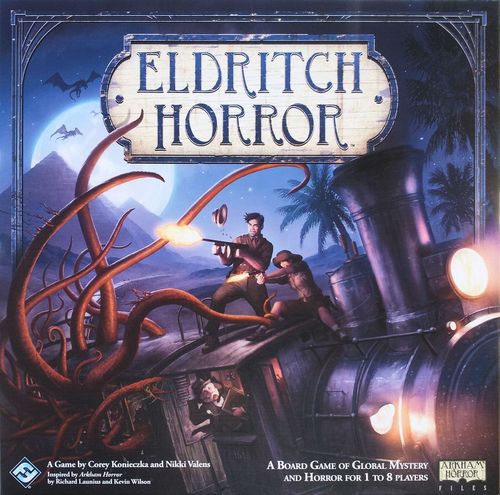
Eldritch Horror
Eldritch Horror Rulebook
Table of Contents
Table of Contents
Game Overview
Each player controls an investigator (the word "investigator" refers to both the player and the in-game character). The game is played over a series of game rounds, each consisting of three phases resolved in order:
- Action Phase: Investigators perform actions to move about the board and prepare for the tasks ahead.
- Encounter Phase: Investigators fight Monsters or resolve encounter cards on their current space.
- Mythos Phase: The Lead Investigator resolves one Mythos card—often advancing Doom, spawning Gates, or raising other challenges.
At the end of each Mythos Phase, the Lead Investigator may pass the Lead Investigator token to any player, then a new round begins. Players continue until they win or lose.
Investigators must deal with threats appearing as Gates (which spawn Monsters and can awaken the Ancient One) and Rumor Mythos cards (which harm investigators and can end the game prematurely).
Setup
Perform these steps in order:
- Choose an Ancient One sheet as a group (Azathoth is recommended for a first game). Place it faceup near the board and resolve any setup effect.
- Each player chooses an investigator, taking its sheet, token, and matching plastic stand.
- Place each Investigator token on its starting space.
- Each investigator receives starting possessions (Assets/Spells listed on the back of the Investigator sheet) and takes Health and Sanity tokens equal to his maximums.
- Prepare decks: shuffle all Expedition Encounter cards into one deck; shuffle Spell and Condition cards into two separate faceup decks; set Mythos cards aside; separate other cards into decks by card back and shuffle each.
- Choose an opaque container (e.g. the box lid) as the Monster cup, and place all Monster tokens in it.
- Place the top four cards of the Asset deck faceup in the reserve.
- Build the Mythos deck following the instructions at the bottom of the Ancient One sheet.
- Resolve starting effects:
- A. Place the Reference card for the number of players near the Mythos deck.
- B. Place the Doom token on the Doom-track space listed on the Ancient One sheet (Azathoth starts at "15").
- C. Place the Omen token on the green (comet) space of the Omen track.
- D. Place four Asset cards in the reserve slots.
Phase 1: Action Phase
Each investigator resolves up to two actions, starting with the Lead Investigator and proceeding clockwise. Each action can be performed only once per round (you cannot perform the same action twice).
Spaces and Paths: Spaces include named locations (e.g. Arkham) and numbered locations. Each space connects to adjacent spaces by paths, each with a type (color) matching a travel-ticket type.
The available actions:
- Travel: Move your Investigator token to any adjacent space. After moving, you may spend travel tickets to move one additional space each (Train Tickets along Train paths, Ship Tickets along Ship paths). If you ever have more than two travel tickets, discard down to two.
- Prepare for Travel: If on a City space, gain one travel ticket of your choice (you can only gain a ticket type that connects to your space).
- Acquire Assets: If on a City space, test Influence and gain Assets from the reserve with total value ≤ your successes. If you gain nothing, you may discard one reserve card. Refill the reserve afterward.
- Rest: Recover 1 Health and 1 Sanity. You cannot Rest if a Monster is on your space.
- Trade: Trade possessions (Assets, Artifacts, Clues, Spells, and travel tickets) with another investigator on your space.
- Component Actions: Perform an action printed on one of your components (preceded by "Action" in bold). You may also perform a "Local Action" using components held by other investigators on your space. You cannot perform a component action from the same component more than once per round, but may use different components.
Phase 2: Encounter Phase
Each investigator resolves one encounter, starting with the Lead Investigator and proceeding clockwise. If one or more Monsters are on your space, you must resolve a single Combat Encounter against each Monster (one at a time, in any order). If there are then no Monsters on your space, you may resolve one of:
- Location Encounter: Draw an encounter card matching your space's artwork (or from the General Encounter deck) and resolve the effect matching your space.
- Token Encounter: Resolve an encounter for a token on your space—Clue tokens give Research Encounters; Gate tokens give Other World Encounters; the Active Expedition token gives Expedition Encounters; Rumor tokens resolve the encounter on the referring Rumor card; Defeated Investigator tokens resolve the encounter on the back of that investigator's sheet.
If you have multiple encounter options, you choose which deck to draw from.
Phase 3: Mythos Phase
The Lead Investigator draws the top Mythos card and resolves its effects in order (left to right, top down). Only the effects displayed on the card are resolved. The seven possible effects:
- Advance Omen: Move the Omen token one space clockwise, then advance Doom by 1 for each Gate matching the Omen's new space.
- Resolve Reckoning Effects: Resolve all effects preceded by a reckoning icon, in order: Monsters, Ancient One sheet, Ongoing Mythos cards, then investigator possessions and Conditions.
- Spawn Clues: Spawn Clues per the Reference card.
- Spawn Gates: Spawn Gates per the Reference card.
- Monster Surge: At each Gate matching the Omen's space, spawn the listed number of Monsters (if no matching Gate exists, spawn one Gate instead).
- Place Eldritch Tokens / Place Rumor: Place the listed Eldritch tokens on the card, or a Rumor token on the listed space.
- Resolve Effect: If the card has the Event trait, resolve and discard it; if Ongoing, place it in play until discarded by a game effect.
Doom & Omen tracks: The Doom track measures time until the Ancient One awakens. Advancing Doom moves the token toward "0"; retreating moves it away. The Omen track's purpose is to advance Doom.
Tests and Skills
Each investigator has five skills (Lore, Influence, Observation, Strength, Will); the number below each is the dice rolled for a test of that skill. To resolve a test, roll dice equal to your skill (minimum 1), modified by effects. A "5" or "6" is a success; at least one success passes the test (the number of successes is the test result). Follow the effect's pass/fail instructions.
- Improvement tokens: improving a skill adds +1 (or +2 if improved again).
- Skill bonuses: you may use only one card effect providing a skill bonus per test (use the highest).
- Tests on cards: a skill icon in parentheses (possibly with a modifier like "–1") means test that skill immediately.
- Rerolling dice: after rolling, you may spend a Clue token to reroll one die (repeatable). Determine pass/fail after all rerolls.
Complex Encounters (Expedition, Other World, Special) have three effects: resolve the initial effect (top box), then the pass or fail effect accordingly, then discard the card.
Combat Encounters
The main way to defeat Monsters. Flip the Monster token to read its back, then resolve two tests:
- Will Test: Resolve the Monster's Will test. If the Monster's horror is greater than your successes, lose Sanity equal to the difference.
- Strength Test: Resolve the Monster's Strength test. If the Monster's damage is greater than your successes, lose Health equal to the difference. The Monster loses Health equal to your successes; when it has lost Health equal to or greater than its toughness, it is defeated and returned to the Monster cup.
Ambush: "A Monster ambushes you" means draw a random Monster from the cup and encounter it immediately; afterward return it to the cup (even if not defeated—if not defeated, it stays on your space with its Health tokens).
Epic Monsters are treated like Monsters except they cannot be moved, discarded, or returned to the cup; an Epic Monster is defeated only when it loses Health equal to its toughness (then returned to the box). They are spawned by name and never placed in the cup.
Gates, Monsters, and Clues
- Gates represent tears in reality; they are the main way Doom advances. To close (discard) a Gate, resolve an Other World Encounter card that instructs you to "close this Gate" (discard the Gate token from your space). Spawning a Gate takes the top Gate token and places it on its indicated space, spawning a Monster there too.
- Spawning a Monster: draw a random Monster token from the cup and place it on the indicated space; if it has the spawn icon, resolve its back immediately. Defeated or discarded Monsters return to the cup (then shake to randomize).
- Clues represent secrets and lore; collect them via Research Encounters. Use Clues to solve Mysteries and Rumors and to reroll dice. Spawning a Clue places a random Clue token facedown on the space indicated on its face.
Health, Sanity, and Conditions
Each investigator starts with Health and Sanity equal to his maximums (you cannot exceed them). Losing Health/Sanity discards tokens; recovering gains them.
- Spells and Conditions have hidden information on their backs—you may only look at the front until an effect flips the card, at which point you resolve the back.
- Delayed investigators cannot perform actions; instead of acting during the Action Phase, they stand their token up and are no longer Delayed.
- Gaining possessions/Conditions places them faceup near your Investigator sheet.
Defeated Investigators: When you reach zero Health or Sanity, you are defeated: (1) advance Doom by 1; (2) move your token to the nearest City space, laid on its side with a Health token (lost all Health) or Sanity token (lost all Sanity); (3) collect your possessions on your sheet (discard Conditions, Health, Sanity, and Improvement tokens); (4) pass the Lead Investigator token if you had it. At the end of the Mythos Phase, choose a new investigator. Investigators can later encounter a defeated investigator's token to retrieve possessions and possibly retreat Doom (resolving the "Crippled" or "Insane" encounter on the sheet's back), then that sheet/token is removed.
Devoured investigators follow only steps 1 and 4 above, then discard all Conditions, possessions, Health, Sanity, and Improvement tokens and remove their sheet/token; they choose a new investigator at the end of the Mythos Phase.
Mysteries, Rumors, and Winning
Mysteries: To win, investigators must solve three Mysteries. Draw one Mystery card during setup; as soon as one is solved, immediately draw a new one on top. Each Ancient One has its own Mystery deck.
Rumors: Rumor Mythos cards place Rumor tokens; an investigator on a Rumor token's space may encounter it (resolving the Mythos card's effect) instead of an encounter card. When a Rumor is "solved," discard the card, its tokens, and the Rumor token.
Random space: Draw one Clue token from the pool and use the space on its back, then discard the Clue.
Winning and Losing
Investigators win immediately upon solving three of the Ancient One's Mysteries. If the Ancient One has awakened, they must also solve the Final Mystery.
Investigators lose if any of the following occur:
- The Doom token reaches "0", awakening the Ancient One (the back of the Ancient One sheet describes how they can then lose).
- All investigators are eliminated.
- A card effect (often a Rumor Mythos card) causes them to lose.
- They must draw a Mythos card but the deck is empty.
The Ancient One Awakens: When Doom reaches "0," flip the Ancient One sheet and resolve its "Awakens" effects; the back replaces the front for the rest of the game and describes how to lose. After awakening, a defeated or devoured investigator's player is eliminated and does not select a new investigator; if all players are eliminated, they lose. To win after awakening, investigators must solve the Final Mystery described on the sheet's back (usually confronting the Ancient One head-on), in addition to three Mysteries.
Reminders: when calculating half of a number, round up; the Lead Investigator decides all disputes; possessions that affect "an investigator" may be used on oneself unless they specify "another investigator."