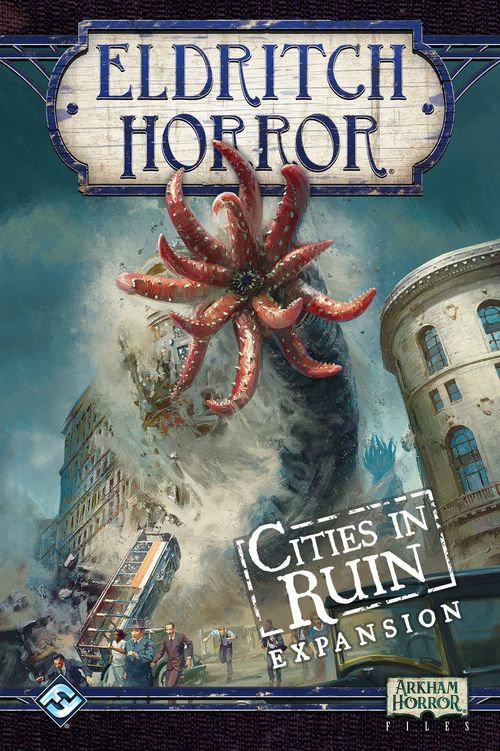
Eldritch Horror: Cities in Ruin
Eldritch Horror: Cities in Ruin Rulebook
Table of Contents
Table of Contents
Expansion Overview
In the Cities in Ruin expansion, investigators must discover the cause of the unnatural disasters: terrifying earthquakes that shake cities to rubble, devastating typhoons that flood the coastlines, and torrential storms that wreak havoc on the mainlands. This expansion includes a new Ancient One and new investigators and encounters to be used with Eldritch Horror. It also introduces entirely new mechanics including Disasters, Devastation Encounters, and Unique Assets.
Components
The Cities in Ruin expansion contains these components:
- 4 Investigator Sheets
- 1 Ancient One Sheet
- 76 Encounter Cards: 4 General, 4 America, 4 Europe, 4 Asia/Australia, 6 Expedition, 6 Other World, 16 Devastation, 24 Research, 8 Special
- 6 Mystery Cards
- 24 Mythos Cards
- 16 Disaster Cards
- 4 Prelude Cards
- 4 Artifact Cards
- 16 Asset Cards
- 20 Condition Cards
- 12 Spell Cards
- 24 Unique Asset Cards
- 4 Investigator Tokens with plastic stands
- 10 Monster Tokens (4 normal, 6 epic)
- 8 Devastation Tokens
- 8 Health Tokens
- 6 Sanity Tokens
- 8 Eldritch Tokens
Using This Expansion
When playing with the Cities in Ruin expansion, add all expansion components to their respective decks or pools of Eldritch Horror components except for the components described below.
- Before setup, players draw one random Prelude card. These cards alter game setup and make each game feel unique.
- Shuffle the Disasters and Devastation Encounters to create their two respective decks. Place the Disaster deck facedown with the Mythos deck and the Devastation Encounter deck facedown with the other encounter decks. Add the Devastation tokens to the general token pool.
- Shuffle all Unique Assets to create the Unique Asset deck. Place this deck faceup near the Asset deck.
Some components in this expansion require other newly introduced components. For this reason, all expansion content should be included when playing with this expansion.
Expansion Icon
Cards in this expansion are marked with the Cities in Ruin expansion icon to distinguish these cards from the cards in other Eldritch Horror products.
Prelude Cards
When playing with this expansion, players draw one random Prelude card before setting up the game. These cards alter game setup and make each game feel unique.
The card's effect is resolved immediately after drawing the card unless it specifies different timing, such as "after resolving setup."
Devastation Encounters
Some effects in this expansion, notably those of Disasters, can cause named City spaces to be devastated. When a space is devastated, discard all Clues and defeated investigator tokens on that space, search the Expedition Encounter deck for each card that corresponds to that space and return them to the game box, then place a Devastation token on the space.
- If a Clue would be spawned on a devastated space, discard that Clue instead. A Clue cannot be moved to a devastated space.
- A devastated space does not have a space type; it is no longer a City space.
- An investigator on a devastated space cannot resolve a General Encounter or a location encounter that corresponds to his space. Instead, during the Encounter Phase, an investigator on a devastated space may encounter that space by drawing and resolving the top card of the Devastation Encounter deck.
- Devastation Encounters are complex encounters that may require an investigator to resolve multiple tests.
- If all nine named City spaces on the main board would be devastated, the investigators lose the game.
Unique Assets
Some encounters in this expansion reward investigators with various Unique Assets. Like Spells or Conditions, Unique Assets are double-sided cards. An investigator cannot look at the back of a Unique Asset unless an effect allows him to.
- Unique Assets are possessions and may be traded using the Trade action. There is no limit to the number of Unique Assets an investigator can have.
- "Asset" refers to both Assets and Unique Assets. "Non-Unique Asset" refers to Assets but not Unique Assets.
- When a Unique Asset is discarded, also discard all tokens on it.
Disaster Cards
Disasters represent natural or unnatural destructive forces that act on the cities of the world or other locations.
Some effects cause the investigators to draw and resolve one or more Disasters. To do so, the Lead Investigator draws the top card of the Disaster deck, then he reads the card aloud to all investigators, resolving the card's effects as instructed.
The card's effect is resolved immediately. After resolving the card's effect in its entirety, the card is discarded to a faceup discard pile by the Disaster deck.
Additional Rules
This section lists additional rules regarding Combat Encounters and Mysteries.
Combat Encounters
During the Encounter Phase, an investigator must encounter each non-Epic Monster on his space before encountering each Epic Monster on his space.
Physical Resistance
Some Monsters and Epic Monsters in this expansion have the Physical Resistance ability. When resolving a Combat Encounter against a Monster with the Physical Resistance ability, an investigator cannot apply any bonus to his dice pool except from Magical possessions and Spells.
Effects that allow the investigator to reroll dice or manipulate dice results can be used as normal.
Mystery
This expansion introduces a new mechanic: "advance the active Mystery." Due to the complexity of Mysteries, this can result in a number of different effects. When investigators are instructed to advance the active Mystery, the active investigator resolves one of the following effects that applies:
- If the active Mystery requires one or more tokens to be placed on the card, place one token of that type on the card.
- Clues, Gates, and Monsters placed on the active Mystery in this way are drawn from the Clue pool, Gate stack, and Monster cup, respectively.
- If the active Mystery requires an Epic Monster to be defeated, place two Health on the card. The Epic Monster's toughness is reduced by one for each Health on the active Mystery.
- However, if the active Mystery requires more than one Epic Monster to be defeated, place only one Health on the card. The toughness of each Epic Monster spawned by the Mystery is reduced by one for each Health on the card.
- If the active Mystery requires an investigator to spend one or more Clues, place one Clue from the Clue pool on the card. Any investigator may spend Clues placed on the active Mystery when resolving an effect of that card.
Skill Values
Some effects in this expansion reference an investigator's skills as a value. A skill's value is equal to its printed value as modified by Improvement tokens and Impairment tokens.
- A skill's value is not affected by bonuses from possessions or other effects, since those effects are applied only when resolving a test.
For example, "Ashchan" Pete has a printed Observation of 3 and a single "+1 Observation" Improvement token. As such, his Observation value is 4 (3 from its printed value plus 1 from his Improvement token). The bonus to Observation that Pete would gain from the Private Investigator Asset does not affect the skill's value.
Optional Rules
Some players may wish to adjust the game's difficulty. This section lists optional rules for adjusting the game's difficulty and setup instructions of Prelude cards.
Insane Game Difficulty
If players wish to have a more challenging game experience than Hard game difficulty from the base game, they can make the game significantly more difficult by building the Mythos deck using only hard Mythos cards.
Note: This optional rule may require additional expansions depending on the chosen Ancient One.
Control Your Fate
Instead of drawing a random Prelude card before setup, players as a group may choose one Prelude card, following the card's effects as normal.
Alternatively, players may choose to not use a Prelude card.
Frequently Asked Questions
Q. If Doom starts on a space containing an Eldritch token placed by the "Apocalypse Nigh" Prelude, do you resolve a Disaster?
A. No. The Prelude states that a Disaster is resolved only when Doom advances to a space containing an Eldritch token. Doom must advance for the effect to trigger.
Q. Are devastated cities still "named city spaces"?
A. Devastated spaces are no longer City spaces; they have no space type. However, a devastated space does retain its name. An effect that refers to a "named City space" means a space that is both a City space and a named space. As such, a devastated space is not a named City space because it is no longer a City space.
Q. Can an investigator have multiple copies of the same Unique Asset?
A. Yes. There is no limit to the number of Unique Assets an investigator can have.
Q. Can an investigator gain a random Unique Asset when told to gain a random Asset?
A. No. If an effect says, "gain 1 random Asset from the deck," the investigator gains the Asset from the Asset deck, not the Unique Asset deck. An investigator gains a Unique Asset only if the effect specifically calls for a Unique Asset.