El Grande: König & Intrigant – Unverkäufliche Sonderkarten
El Grande: König & Intrigant – Unverkäufliche Sonderkarten Rulebook
Table of Contents
Table of Contents
- Setup and Use
- Special Cards
- Alliance
- Bridge Construction
- Revolt
- Risk of Collapse
- Quarantine
- Hurricane
- Mistress
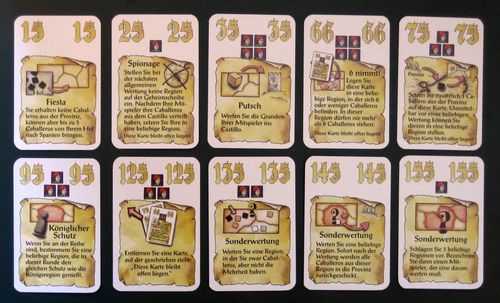
- Fiesta (value 15)
- Espionage (value 25)
- Coup (value 35)
- Table for Six (value 66)
- Province (value 75)
- King's Guard (value 95)
- Card 125 (value 125, no printed title)
- Special Scoring (value 135)
- Special Scoring (value 145)
- Special Scoring (value 155)
Setup and Use
The Special Cards module is an optional add-on to the King & Intrigue rules. You may choose to add cards from the Player's Edition and/or Special Cards modules. This will increase the selection of Power cards and introduce new facets of the game to discover.
The Special Cards module consists of 50 additional Power cards (10 per colour) and is marked with the Special Cards symbol (printed as a crown-with-pieces icon in the insert).
The rules for this expansion are otherwise identical to the base game.
Special Cards
The Special Cards are listed in the order printed in the insert. Lines marked "Card text" are the rules text printed on the card face. Lines marked "Explanation" are the rulebook's explanation of the card.
The top of this section is the first set of Special Cards as printed: Alliance, Bridge Construction, Revolt, Risk of Collapse, Quarantine, Hurricane and Mistress. The rest of the section continues with Fiesta, Espionage, Coup, Table for Six, Province, King's Guard, the unnamed 125 card, and the Special Scoring cards.
Alliance
Card text: You may place the 2 alliance markers in the regions of your choice. In the next general scoring, these 2 regions will be scored together: the Caballeros and points from both regions will be combined.
Explanation: You may not place either of the markers in the King's region.
During general scoring, all players count and combine the number of Caballeros they have in the two marked regions. The rewards for each region are combined (e.g., the player with the most Caballeros scores first place points according the scoreboards of both regions, etc.)
If one of the regions is the King's region, or a player's home region, bonus points are awarded accordingly. After general scoring is completed, remove the alliance markers. If another player plays the Alliance card before the next general scoring, they may move the Alliance markers to different regions.
Bridge Construction
Card text: Place the bridge tile between 2 adjacent regions. Place a Caballero from your Court on this bridge. You may move as many of your Caballeros between these two regions. During general scoring, you score 1 point for the bridge. Only one bridge may be in play.
Explanation: Place the bridge between two adjacent regions. Neither of these regions may be the King's region. In addition to the 3 Caballeros you will place this turn, you will also place a Caballero from your Court onto the bridge itself.
As long as the bridge remains: directly before your turn in following rounds, you may freely move your Caballeros between these two regions.
In each general scoring, the player who controls the bridge scores 1 point.
If you remove the Caballero from the bridge, the bridge is returned to the supply.
If another player plays the Bridge card, they take the bridge. If you have a Caballero on the bridge at this time, return it to your Court.
Revolt
Card text: You may rotate a mobile scoreboard in any region 180 degrees. Whenever this region is scored, it is the player with the least Caballeros in this region (at least 1) that will score the most points, etc.
Explanation: When reversed, the 8/4/0 mobile scoreboard becomes a 0/4/8 scoreboard, meaning that the player with the fewest Caballeros (at least one) scores 8 points. The player with the second fewest Caballeros scores 4 points.
The same applies to the 4/0/0 mobile scoreboard. If another player plays the Revolt card, they may return a mobile scoreboard to its original position or reverse the other scoreboard.
When a player moves a reversed scoreboard, it remains reversed.
Risk of Collapse
Card text: Players may not place Caballeros in the Castillo. Players may place Caballeros beside the Castillo instead. After the next general scoring, use of the Castillo returns to normal. Place the collapse marker on the Castillo.
Explanation: Caballeros already inside the Castillo remain in the Castillo, and will be scored normally during general and special scorings.
Quarantine
Card text: You may place the quarantine marker in a region adjacent to the King's region. This region is protected from change in the same manner as the King's region. This quarantine lasts until the end of the next general scoring or until a player moves the quarantine token.
Explanation: Any region hosting the quarantine marker may not be changed in any way. It is taboo just like the King's region. For further details, see the base game rules (King's region, page 5).
Hurricane
Card text: After all players have played their cards, but before the players take their actions, choose a region on your secret disc. When your turn begins, reveal the chosen region. Each player must return half of their Caballeros (rounded up) from this region to their Court. All Caballeros you place in this round must be placed in the chosen region.
Explanation: You reveal your secret disc at the beginning of your turn.
Mistress
Card text: You may place your Caballeros in the region of your choice. There is no King's bonus this round.
Explanation: You may not place Caballeros in the King's region.
If there is a special scoring in the King's region this round, the King's bonus will not be awarded. Also, if there is a general scoring directly following this round, the King's bonus will not be awarded. Home region bonuses score as usual.
Fiesta (value 15)
Card text: You may place 5 Caballeros.
Explanation: You do not receive any Caballeros from the Province into your Court. In addition to the Caballeros your Caballero card allows you to place, you may also place another 5 Caballeros.
Espionage (value 25)
Card text: During the next general scoring, you may choose to have your opponents choose where to move their Caballeros from the Castillo without you. Then, you must choose a region to move your Caballeros from the Castillo. Keep this card in front of you until its effect is complete.
Explanation: This card has no effect on your use of the secret disc during a special action. After the next general scoring, discard this card.
Coup (value 35)
Card text: You may place an opponent's Grande in the Castillo. A Grande still gives its bonus in the Castillo.
Explanation: You may not take a Grande from the King's region.
During the next general scoring, any player whose Grande is found in the Castillo is relocated (along with his Caballeros) to the region chosen on that player's secret disc.
In this way, it is possible for a player to score their home region bonus twice during a general scoring (once for the Castillo and once for the region to which the Grande is relocated).
Table for Six (value 66)
Card text: You may place the 6-Limit table in a region containing no more than 6 Caballeros. This region may no longer contain more than 6 Caballeros.
Explanation: You may not place the limit table in the King's region. A player using the Intrigue card may move Caballeros to or from the limit table. If (e.g., by secret disc) more Caballeros are placed in the region than there is space on the limit table, these newer, excess Caballeros are returned to the players' Courts.
Province (value 75)
Card text: You may place a Caballero from the Province on this card. Immediately before a region is scored, you may move the Caballero on this card to that region. Keep this card in front of you until its effect is complete.
Explanation: You may move the Caballero on this card to a region directly before a region is scored during a special or general scoring. You may not move this Caballero to the Castillo or the King's region.
King's Guard (value 95)
Card text: You may place the King's marker in the region of your choice. This region is protected from change in the same manner as the King's region for the rest of the round.
Explanation: Any region hosting the King's marker may not be changed in any way. It is taboo just like the King's region. For further details, see the base game rules (King's region, page 5).
If the King's marker is placed in a round immediately preceding a general scoring, it remains on the board during general scoring, adding the King's bonus to the region it occupies.
Card 125 (value 125, no printed title)
The card face shows no name and the insert's text layer does not print one for this card, so it is listed here by value only.
Card text: You may choose a card in front of a player featuring the phrase "Keep this card in front of you until its effect is complete." That card is discarded without effect. OR You may remove a limit table from the board.
Explanation: With this card you may discard a 25 or 75 card placed in front of another player or remove a limit table.
Optional rule: You may choose to allow this card to cancel effects represented by tokens and tiles. (e.g., alliance markers, risk of collapse tile, the bridge).
Special Scoring (value 135)
Card text: Choose a region where you have one or more Caballeros, but not the most Caballeros. Score this region immediately.
Explanation: You may only choose a region in which you have at least 1 Caballero.
Special Scoring (value 145)
Card text: Choose a region to be scored immediately. Afterwards, return all Caballeros in this region to the Province.
Explanation: You may choose a region in which you have no Caballeros.
Special Scoring (value 155)
Card text: Choose 3 regions and 1 opponent. That opponent must choose 1 of those 3 regions. Immediately score the chosen region.
Explanation: You give your opponent the choice of 3 regions. Of these 3 regions, your opponent chooses which will be scored.