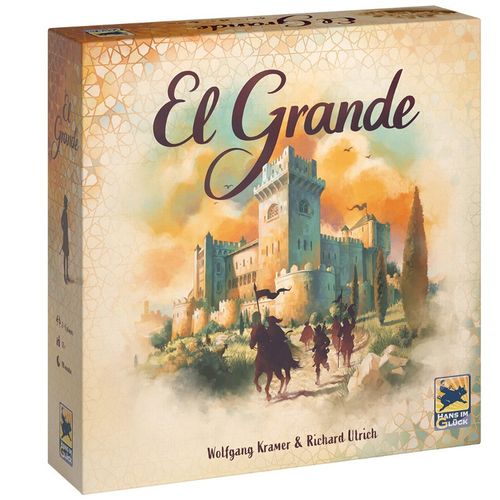
El Grande
El Grande Rulebook
Table of Contents
Table of Contents
Contents
- Game board
- 5 Grandes (large cubes) in 5 colors
- 155 Caballeros (small cubes) in 5 colors (31 per color)
- 1 King (large black pawn)
- 1 Round marker (small black cube)
- 65 Power cards in 5 colors (numbered 1–13 in each color)
- 45 Action cards
- 9 Region cards (with rule summary on the backs)
- 5 Secret disks with pointers
- 1 Castle (Castillo)
- 2 Mobile scoreboards ("8/4/0" and "4/0/0")
- 1 Sample game sheet, 1 rulebook
Object of the Game
Each player is the Grande in one region, allied with 30 Caballeros. Each Grande attempts to extend his influence across Spain by controlling the majority of Caballeros in as many regions as possible. The Grande who progresses furthest along the success track wins.
The Game Board
The board shows the 9 regions of Spain, 1 space for the Castillo, the success track along the edge, and a round track with 9 rounds and 3 horizontal scoring tracks. In each region a scoreboard shows 3 values: the player with the most Caballeros scores the highest value, the second-most the second value, etc.
Game Length
The game may be played in 9 or 6 rounds (about 2 hours or 1 hour). For the short game, skip rounds 1, 4, and 7 on the round track.
Preparation
- Castillo: Place the castle on its space.
- Region cards: Shuffle the nine region cards; turn up the top card and place the King there. Then each player takes a card to determine his home region.
- Grande: Each player takes the Grande in his color and places it in his home region.
- Caballeros: Each player takes 10 Caballeros. The rest form the reserve, known as the provinces. Place 2 next to your Grande in your home region, 1 on the first space of the success track, and the remaining 7 before you as your court.
- Secret disk: Each player takes a secret disk (shows every region except the Castillo).
- Power cards: Each player takes his set of 13 power cards (value 1–13 on top/bottom; middle shows 0–6 Caballeros).
- Action cards: Sort by the number on the back (1–5). The eleven 1-cards form the "1 stack," etc.; the "5 stack" is just the King card. Shuffle each stack separately, face down.
- Mobile scoreboards: Place beside the board.
Playing the Game
A round consists of: move the round marker forward; turn over the top action card in each stack; play the power cards; each player takes a turn (order determined by the power cards played).
Round marker: Starts on space 1 (space 2 in the short game); each round after the first, move it one space. General scoring occurs at the end of the 3rd, 6th, and 9th rounds.
Turn over the action cards: Turn the top card in each stack face up.
Play the power cards: In the first round, players choose who begins; afterward, the player who played last in the previous round begins, then clockwise. Power cards are played face up, and once a value has been played, later players may not play that value this round—all power cards played must have different values. Played cards stay face up in a stack (only the top visible) and determine the turn order (highest value goes first) and the number of Caballeros the player may move from the provinces to their court.
Player Turns
The player who played the highest power card goes first. A turn consists of, in order:
- Move Caballeros from the provinces to the court — at most the number shown on your power card. If you lack enough in the provinces, you may remove Caballeros from the board to make up the difference.
- Choose an action card from those face up. Each action card allows two actions: move the stated number of Caballeros from your court to the board, and execute (or prevent) the special action. You may place your Caballeros before or after executing/not executing the special action.
- Move Caballeros from the court to the board — up to the number along the bottom of the action card, into any region adjacent to the King and/or into the Castillo, divided as you wish. (Steps 3 and 4 may be done in either order.)
- Execute the special action (or not).
- Lay aside the chosen action card so later players cannot choose it. Then the next-highest power card takes a turn.
Next round: After all turns, discard remaining face-up action cards, move the round marker forward, and turn up 5 new action cards. The King card is turned up each round and never permanently discarded.
The King and the King's Region
The region where the King stands is the King's region, which has three meanings:
- a) Placing of Caballeros: It determines which regions may receive Caballeros from courts—those adjacent to the King's region and the Castillo. (Special actions can allow moves to any region.)
- b) The King's region is taboo: No changes allowed—no Caballeros, Grande, or mobile scoreboard may enter or leave it, except actions that move the King.
- c) King's Bonus: The player with the most Caballeros in the King's region receives +2 points whenever that region is scored (lost if tied for first).
The Castillo
- Caballeros may be placed in the Castillo any time you add or move Caballeros, regardless of where the King stands. When adding, call out the number (contents are hidden).
- During each general scoring (after rounds 3, 6, 9), the Castillo is completely emptied—Caballeros move to other regions (per each player's secret disk) and may change majorities there.
Scoring
General scorings occur after the 3rd, 6th, and 9th rounds. The round marker is placed on the secret-disk space, then moves right. A general scoring consists of:
- Select a region with the secret disk: Each player secretly records where his Castillo Caballeros will go (any region except the King's), then places the disk face down. All of a player's Castillo Caballeros must move to the single region on his disk.
- Score the Castillo: Lift the Castillo and count the Caballeros inside; score as for other regions.
- Move the Caballeros from the Castillo to the regions: Reveal disks and move accordingly. Anyone who chose the King's region returns his Caballeros to his court. Return the empty Castillo.
- Score the Regions: Move the round marker right along the scoring track so no region is missed. Each scoreboard shows points for the most, second-most, and third-most Caballeros. Grandes only mark home regions and are not counted for majority.
Player counts: With 2 players, only the first number scores; with 3 players, the first two numbers. If players tie for a rank, they each get the points of the next rank down.
King's Bonus: +2 to the player with the most Caballeros in the King's region whenever it is scored (including special scorings); lost on a tie for first.
Home region bonus: +2 if you hold the majority in the region where your Grande stands when it is scored; lost on a tie for first. Some action cards let you move your Grande, changing your home region.
Mobile scoreboards enter play via action cards and alter a region's values.
Game End
The game ends after the third general scoring. Whoever has progressed furthest along the success track wins and earns the title "El Grande."
The Action Cards
Each card allows two actions: moving a number of Caballeros onto the board, and the special action (picture and text). The player decides which to do first; an action may not be split. General rules: the King's region is always taboo (any "any region" excludes it); Caballeros moved normally go to regions adjacent to the King or the Castillo, while special actions may move them to any region except the King's; Caballeros leave the Castillo only during a general scoring; and the special action may always be skipped (a card may even be chosen just to prevent its special action).
1 Stack — Intrigue cards
All 1-cards move at most 1 Caballero to a region adjacent to the King or the Castillo. Only these cards let a player move another player's Caballeros. Special actions include:
- Move all of your own Caballeros from any one region to other regions/Castillo.
- Move 2 more of your Caballeros from your court to any region(s).
- A choice of the two actions above.
- Move up to 5 Caballeros (yours and/or foreign) from one region (×2 cards).
- Move any 3 foreign Caballeros on the board.
- Move any 3 Caballeros on the board.
- Move 2 of your and 2 foreign Caballeros on the board (×2 cards).
- Move any 4 of your own Caballeros on the board.
- Move any 4 Caballeros on the board.
2 Stack
All 2-cards move at most 2 Caballeros to a region adjacent to the King or the Castillo. Special actions include:
- Veto! (×2) — prevent one special action this round or the next; announce your objection as the player starts it. You can prevent only one, and only the special action (not the Caballero placement). Discarded when used or at the end of the next round.
- Decay of Authority — your fellow players send all Caballeros in their courts back to the provinces.
- Decay of Authority — each fellow player sends 3 court Caballeros back to the provinces.
- The King returns! — each fellow player sends 3 Caballeros back to the provinces (from any region and/or court, not the King's region or Castillo), starting to the left of the active player.
- Send 1 Caballero from any region from each player (including one of your own) back to the provinces.
- Fellow players secretly remove 2 of their Caballeros from a region (of at least 2) back to the provinces.
- Fellow players secretly send all Caballeros from one chosen region back to the provinces.
- Special Scoring: pick one region to be scored (×3) — any region, including the King's region and Castillo.
3 Stack
All 3-cards move at most 3 Caballeros to a region adjacent to the King or the Castillo. Special actions are special scorings:
- Score all "4" regions (×2), all "5" regions (×2), all "6 and 7" regions. (Mobile scoreboards override the printed values.)
- Score the Castillo (×2) — uncover and score; Caballeros return to the Castillo afterward.
- Score only the first position in all regions (no score if tied for first; Castillo not scored).
- Score the region(s) with the most Caballeros; with the least (regions without Caballeros excluded); or any region you choose (including the King's region and Castillo).
4 Stack
All 4-cards move at most 4 Caballeros to a region adjacent to the King or the Castillo. Special actions include:
- Mobile scoreboard (×3) — place or move a mobile scoreboard (not into/out of the King's region; may go to the Castillo; placed right-side-up).
- Royal Adviser — move the King one region.
- Movement — choose a region; fellow players secretly move all their Caballeros out of it (those choosing the King's region or the same region return them to court).
- Grande (×2) — move your Grande to any region except the Castillo and King's region; it becomes your new home region.
- Power Cards (×2) — take one of your played power cards back into your hand.
- The Court — move 2 of your Caballeros from the provinces to your court.
- Special Scoring — each player secretly chooses a region; regions chosen by multiple players are not scored.
5 Stack — The King card
The single 5-card moves at most 5 Caballeros to a region adjacent to the King or the Castillo. Special action: put the King into any region (except the Castillo).