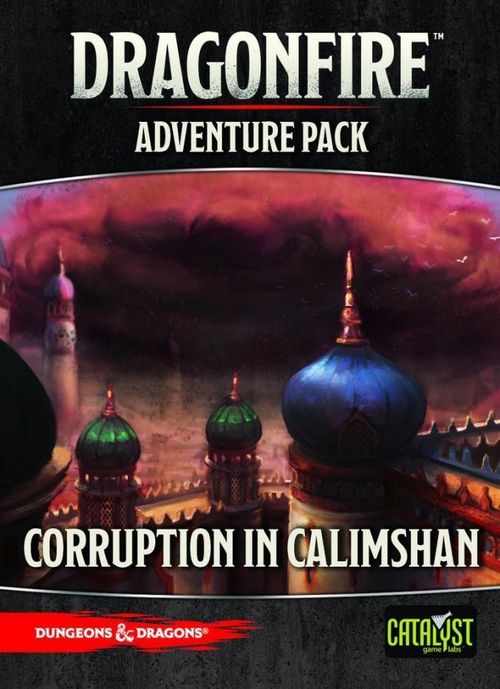
Dragonfire: Adventures – Corruption in Calimshan
Dragonfire: Adventures – Corruption in Calimshan Rulebook
Table of Contents
Table of Contents
Alternate Card Art
Additional Basic cards with alternate art will be included in various releases. For example, the Stealth in Calimshan. Except for the alternate art, these cards are identical to the versions from the base game.
Ally Encounter
An Ally is a new type of encounter card; in this Adventure, it's Tumult: Calishite Headmaster. Allies follow all the standard rules for encounters: they are placed facing a player; a Scene cannot end unless they've been defeated; and so on. There is one exception, however: the Encounter Type of these cards is "Ally." While they are in play, the Ally ability can be used, as directed by the card.
Corruption
The Corruption keyword on an encounter is always accompanied by the Surprise keyword, and has the following effect: Place a clip on your highest XP Feature (if tied, you choose). You cannot use that Feature until all Corruption encounters facing the party are defeated. (If you have no Features with an XP cost, discard one card.)
The following provides additional clarifications:
- Corruption clips cannot be applied to any of the following Features:
- Background Features (they do not have an XP cost).
- Features with "Continuous" on them.
- Primary Subclass Feature (see Requires, under Features, p. 24, Dragonfire Rulebook).
- If a Corruption must be applied and any of these types of Features are all that is available on your Character screen (either because it's a starting character or all other Feature types have Corruption clips), you must discard one card.
- All Corruption is cumulative. If multiple Corruptions occur either simultaneously or across a Scene, you must continue to add clips to the highest XP Feature still available on your Character screen.
- As noted above, if all of your applicable XP Features are Corrupted and a new Corruption effect is applied, you must discard one card.
- Some encounters include other Surprise effects, as well as Corruption. In those instances, apply Corruption first, then apply the second effect.
- If the text on an encounter with Corruption is negated (e.g., Hex), that Corruption's effect is ignored, and that encounter is no longer considered a Corruption encounter for the purposes of defeating all Corruption encounters to remove Corruption effects.
Greater Corruption: All the rules above apply for Greater Corruption, except that a clip is placed on every Character screen in the party when the encounter with this keyword is first revealed.
Market Cards
The following rules govern the new Market cards:
- Players can add Melodrama to any Adventure using the Building the Market rules (see p. 28, Dragonfire Rulebook), provided a Bard is included in that game (as indicated on the card).
- Unless specifically stated otherwise, colorless cards do not count as any color for Skill Checks.
Poisoner Crafting
Poisoner Crafting Features and Crafted Poison cards introduce a new style of play for Deception characters. The rules from the Poisoner Crafting Features and cards are included here, allowing players to review the rules for Poisoner Crafting at a glance.
The following covers the use of these new Features and cards:
- Poisoner (Apprentice) Crafting is not a primary Subclass Feature (see Features, p. 24, Dragonfire Rulebook).
- Each Poisoner Crafting Feature indicates the total gold value that can be spent on Crafted Poison cards, and which card types may be purchased. Each additional value on the next-level Feature replaces the previous level's value, e.g., Master Crafting allows the purchase of up to 5 gold in Crafted Poison cards.
- Crafting Poison purchases are made before a game begins, and the cards are added to a player's Equipment Pack, not the Market.
- Crafted Poison cards are Consumed when played, but they are not Magic Items. Remove all Crafted Poison cards (Consumed or not) from your deck at the end of every Adventure.
- Poisoner Crafting cannot be used to purchase Magic Items.
Additionally, such purchases use the player's starting gold; e.g., if they spend all their starting gold on Poison cards, they will start the game without any gold.
The three Poisoner Crafting Features are:
- Poisoner (Apprentice) Crafting (Requires Deception Class; 20 XP). Crafting: Before the game starts, purchase up to 2 gold in Apprentice Poison card(s) and add them to your Equipment Pack.
- Poisoner (Journeyman) Crafting (Requires Deception Class & Poisoner (Apprentice) Crafting; 30 XP). When Crafting, purchase up to 3 gold, which may include Journeyman Poison card(s). You may set one of these cards aside then add that card to your starting hand. (Does not require a Feature slot.)
- Poisoner (Master) Crafting (Requires Deception & Poisoner (Journeyman) Crafting; 30 XP). When Crafting, purchase up to 5 gold, which may include Master Poison card(s). Additionally, the gold cost of all Poison cards is reduced by 1, to a minimum of 1. (Does not require a Feature slot.)
The Crafted Poison card included in this pack is:
- Spite (Deception-Crafted Poison (Apprentice)). Requires Poisoner (Apprentice) Crafting. Consume: Permanently reduce next colorless level on one encounter by 1. That encounter must Save. Failure: Deal 2 to that encounter.
The card's flavour line is omitted.
Glossary
The following is a new addition to the Glossary (see p. 29, Dragonfire Rulebook):
Trash: Completely remove from the game for the current Adventure, placing back in the box.
Dragonfire Cards
When playing the Calimshan Adventure, after shuffling the Dragonfire Deck, take the top twelve cards of the deck, shuffle in the five new Dragonfire cards, and then place them back on top of the Dragonfire Deck.
When playing other Adventures, players can include any of the non-X Dragonfire cards in the full Dragonfire Deck.
Magic Item Cards
Shuffle the nine new Magic Item cards into their respective rarity decks, to be awarded per the standard rules (see p. 26, Dragonfire Rulebook).
Milestones
Not all Adventures will be a part of the An Ancient Evil Arises campaign from the base game. Nevertheless, all Adventures you play are intrinsically linked by the passage of time. Experience Points do not arise in a vacuum. Instead they represent hard-earned knowledge as your fortunes wax and wane and the seasons change.
To help this immersion there are Milestone Dragonfire cards, which include the ampersand icon (&). For this pack, that card is Insidious Corruption. Once a character has completed the Corruption in Calimshan Adventure, that player must always include this Dragonfire card in the Dragonfire Deck for any Adventure they play, even if other players in the party have not yet completed that Adventure.
Don't Read the Fiction!
The fiction in Corruption in Calimshan assumes players have completed the An Ancient Evil Arises campaign from the base game and all the previous Adventure Packs, as well as the Moonshae Storms Campaign Box, so it contains spoilers for those Adventures. You are free to play the Calimshan Adventure once you've reached Party Level 4, even if you've not completed the campaign or the other Adventures, hence why there are no indicators on the Corruption in Calimshan Adventure card for reading the fiction. But if you want to avoid spoilers, wait to read the Calimshan fiction until after you've completed the An Ancient Evil Arises campaign and other Adventures.
Modifying Adventure Levels: If your Party Level is different than this Adventure Level, you can adjust the Adventure using the following rules:
- Party Level Is Below Adventure Level: For every Party Level below the recommended Adventure Level, apply a −1 Dragonfire level.
- Party Level Is Above Adventure Level: For every Party Level above the recommended Adventure Level, apply a +1 Dragonfire level.
However, it is not recommended you play at a −4 or −4 Dragonfire level. (The printed text reads "−4 or −4"; it is transcribed as printed.)
Corruption in Calimshan: Prologue
The prologue fiction is omitted. The boxed rule printed at its end is reproduced below.
Divide the party's total Campaign Score by 5, rounding down. The party may assign that many extra gold among the characters before the Adventure begins. No one may receive more than 1 gold.
START ADVENTURE
Adventure: Corruption in Calimshan
The following is the printed text of the "Corruption in Calimshan" Adventure sheet (Adventure Level 4), transcribed from the scans. The flavour text under the Adventure title is omitted.
Your party will face off against encounters in three Scenes. Each Scene ends when you have defeated all encounters facing characters. Once the third Scene ends, the party completes the Adventure!
Adventure Setup
Use Desert 1 from Calimshan and Adventurers 2 from the base game as the Primary Encounter Deck, and use City 2 and Desert 3, both from Calimshan, as the Secondary Encounter Deck.
When creating the Market, take a number of Desert Dweller cards equal to the number of players, and place the stack into a new, single Market Slot. If the last Desert Dweller card is purchased, that slot is now empty for the rest of the game. The following additional rules apply:
- Purchasing a Desert Dweller does not cycle a new card into the Market, and Market cards cannot be cycled into the Desert Dweller Market slot.
- The Desert Dweller cards in that Market slot are immune to any discard effects regardless of whether they are generated by a Feature (Caravan), a Dragonfire card (A Powerful Mirage), and so on.
- Any card effect that modifies the cost of a Desert Dweller card only applies to the top card.
- Cards that can be traded for a Market slot—such as Encore—cannot be used in conjunction with the Desert Dweller Market slot.
Encounters
At the start of each Scene, reveal encounters as indicated in the chart below. First reveal encounters from the Secondary Deck equal to the Dragonfire level. Then, if you still need to draw more encounters, reveal remaining encounters from the Primary Deck. Place the first revealed encounter facing the character whose Class Type color matches the encounter's color, and distribute the rest to the left from that character.
| Scene | Reveal Encounters Equal To |
|---|---|
| 1 | Number of Characters +1 |
| 2 | Number of Characters +2 |
| 3 | Number of Characters +3 |
Difficulty 3 Encounters: All Difficulty 3 encounters have no gold value.
Saves: Saves are made by the deck the encounter was drawn from: e.g., Adventurers encounters reveal Saves from the Primary Deck, Difficulty 3 encounters draw from the Secondary Deck, and so on.
Five- and Six-Player Games: Use the standard rules, with the following changes:
- In five-player games, when revealing the additional card from the Primary Encounter Deck, bury any Difficulty 2 cards until a Difficulty 1 card is revealed.
- In six-player games, when revealing the final card from the Secondary Encounter Deck, bury any Difficulty 3 cards until a Difficulty 2 card is revealed.
Adventurer Mercenaries
As soon as any Adventurers 2 encounter is revealed, immediately apply the following Surprise effect (players choose whether to apply the effect before revealing the next encounter):
The player facing the encounter may pay 3 HP to discard that card and apply the following additional effects.
- Immediately pay out the encounter's gold value, starting with the player who paid the 3 HP.
- Reveal the top card of the Market: If it matches the color of the discarded encounter, nothing else occurs. If it doesn't match, reveal a card from the Secondary Deck and place it facing that player.
Players cannot use any cards or Features to shift this Surprise effect.
Note that this Surprise occurs before any Surprise effect on an Adventurers 2 card. If a player chooses to apply this Surprise, the printed Surprise effect is ignored. If the player chooses to not apply this Surprise, the printed Surprise effect is immediately applied before revealing the next encounter.
Ashul bin Naar and Yuan-ti Anathema
During Scene One and Scene Two only, at the end of any turn, if the Ashul bin Naar and/or Yuan-ti Anathema are the only encounters facing players, both immediately flee: shuffle them back into the Secondary Deck; there is no gold payout and the Scene immediately ends.
Ending a Scene
The standard rules apply for the Short Rest after each Scene.
Corruption in Calimshan: Epilogue
The epilogue fiction is omitted. The boxed rule printed at its end is reproduced below.
If any party member carries the Devil's Horns Trophy, right now they may trade it—remove the Feature from their Character screen—for one random draw from the Rare Magic Items Deck, and attune to it, regardless of Character Level; Character Magic Item Limitations still apply.
Completing the Adventure
After Scene Three, the party has completed the Adventure!
Awarding XP & Magic Items
For each Scene that you start, each player receives 2 XP. If the party completes the entire Adventure, the players each receive a bonus of 1 XP, for a total of 7 XP.
The standard rules apply for awarding Magic Items.
Optional Scenarios
- The Price Is High: When using the Surprise rule for Adventurer Mercenaries (see above), instead of 3 HP, pay half your max HP (round down): +1 XP upon Adventure completion.
- A Lair Is Near: All encounters gain Save +1: +1 XP upon Adventure completion.
Upon Adventure completion of either Optional Scenario, in addition to the standard Magic Item awards, the party finds Quaal's Feather Token: Whip. One person may attune to it, regardless of Character Level; Character Magic Item Limitations still apply.