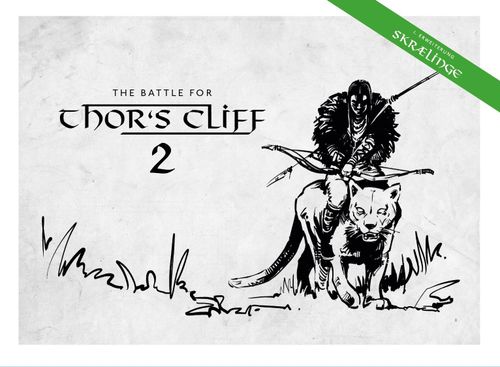
Die Schlacht um Thors Kliff 2
Die Schlacht um Thors Kliff 2 Rulebook
Table of Contents
Table of Contents
Components for one Skræling player
- 1 hero figure on foot (miniature)
- 1 hero figure mounted (miniature)
- 4 hunters (wooden triangle)
- 5 camps (wooden triangle)
- 1 eagle (miniature)
- 1 wolf (miniature)
- 1 bear (miniature)
- 3 poison markers, for Shuman only (wooden cube, pink)
Two-player start rule change
With the expansion "Thors Kliff 2", the starting rules for a 2-player game change. Please observe this already when testing the SKRÆLINGE:
Whoever chooses the starting position and the character first may also take the first turn. In return, the second player may take one protection potion or one healing potion before the game begins. This rule was changed because it became clear how important the first turn is.
General
The SKRÆLINGE pursue the same victory goals as the Vikings: they, too, have heard of the mighty child and want to share in her power. They know nothing of the Nordic world of gods, but there is no doubt that this child has supernatural powers!
However, the SKRÆLINGE are based on a somewhat different game mechanism than the Vikings. They have fewer units, but these can shoot with bows and, in some cases, climb. The rules for their silver phase are different (see HUNTING). And the SKRÆLINGE can control animals that fight for them!
All rules that are NOT specifically highlighted remain in force!
One rule that easily causes confusion is highlighted here already: when SKRÆLINGE need resources, for example to buy a mount, then, unlike the Vikings, it is not the position of the warriors or hunters that matters but the position of the camps!
Attention: the culture of the SKRÆLINGE forbids enriching oneself from the dead. They receive no talers from plundering!
Hunting
For regular income, the SKRÆLINGE rely on their hunters. In the silver phase you earn one taler for every hunter that has no other hunter and no enemy figure nearby. "Nearby" means in its own field or in an adjacent field. In this case:
- You may hunt anywhere except in the centre of the island.
- Trolls do not count as enemies in this case: they do not prevent hunting!
Example: in this setup, only the hunter (black triangle) on the kobold field would earn a taler, because the other two hunters block each other. The hunter on the meadow would also be prevented from hunting by the opposing white figures. Where your own camps and your own hero figure stand does not matter for hunting!
Recruiting hunters
Hunters must be recruited in camps! In this case: only one hunter per camp per turn.
Camps
The SKRÆLINGE build camps in which unarmed members of the tribe live. Camps have three functions:
- Only in camps can hunters and animals be recruited.
- By placing camps, that is, by enlarging your tribe, abilities are unlocked.
- The camp dwellers extract the resources.
Camps have 2 life points and cost 2, 3 or 4 talers. Camps cannot move and cannot defend. Camps can be built on any field, except in the centre of the island; and there is one rule: only one camp per field.
Camps are built by hunters or by the hero figure IN THE ACTION PHASE. However, building a camp is not an action! Whether it happens before or after the action is freely chosen. For example, a camp could already be built before the action, so that all landscapes are occupied for buying the mount. Or a game of chance could be played first in order to have enough talers to buy a camp.
At the start of the game, 3 camps are placed on the upper spaces of the camp track. The 4th and 5th camps are kept ready on the amber track and only placed on the camp track once the first amber has been handed in.
Camps (continued)
-
RECRUITING: Hunters and animals can only be recruited at camps. In this case: only one hunter or animal per camp, per turn.
-
UNLOCKING ABILITIES: The camps block the abilities of the SKRÆLINGE on the camp track. Only when camps are put into play are these abilities unlocked. If camps are removed from the board again or destroyed by opponents, they must refill the camp track from below. In doing so, the spaces for the 4th and 5th camp are ignored until the first amber has been handed in.
For animals the following applies: 1) Each tribe may have each animal only once! 2) Once they have been recruited, they remain in play until they are defeated, no matter how many camps are in play.
The abilities in detail:
I – Healing As soon as one or more ("1+") camps are in play, your hero may, in the silver phase, regenerate 2 life points on a camp field.
II – Climbing As soon as 2+ camps are in play, in each turn one of your figures may climb with one step, that is, cross any number of height levels. This also applies to HASTE! Heroes, hunters and animals may be selected for this.
III – Eagle As soon as 3+ camps are in play, you may call the eagle in the recruit phase. The EAGLE fights with one large die and has 3 life points. The eagle costs 3 talers and 2 meadow, that is, when buying it, a camp must stand on 2 different meadow fields. The eagle is placed at any one of your camps. It can fly 3 fields, that is, regardless of height differences and enemy figures it can move 3 fields in the movement phase. In combat, however, it carries out a normal melee and receives a counterstrike. Even when it is not the active player's turn, it can be attacked in the regular way with melee and ranged combat! If the eagle must retreat after an attack, it must step back along its flight route, step by step, and carry out as many further combats as necessary until it either finds a free or its own field on which to land, or dies.
IV – Wolf As soon as at least 4+ camps are in play, you may call the wolf in the recruit phase. The WOLF fights with 2 large dice and has 4 life points. The wolf costs 4 talers and 2 meadow, that is, when buying it, a camp must stand on 2 different meadow fields. The wolf is placed at any one of your camps. In the movement phase it can move 2 fields.
V – Bear When all 5 camps are in play, you may call the bear in the recruit phase. The BEAR fights with 3 large dice and has 5 life points. The bear costs 5 talers and 2 meadow, that is, when buying it, a camp must stand on 2 different meadow fields. The bear is placed at any one of your camps. In the movement phase it can move 1 field.
-
EXTRACTING RESOURCES: The SKRÆLINGE extract resources at camps. When they need resources for the puma, eagle, wolf or bear, camps must stand on the required landscapes!
-
NOMADISM: Each turn in the silver phase, one camp may be taken off the board again and placed back on the camp track. Regardless of how many camps are already in play, the SKRÆLING receives 2 talers for this.
The heroes
Heroes of the SKRÆLINGE also have different special abilities and different numbers of life points. But all of them fight at the start of the game in melee with a KNIFE (2 small dice) and in ranged combat with the SHORT BOW (one medium die). Both weapons can each be developed into a large weapon at the market for 7 talers; they are then turned over to the reverse side.
The mount of the SKRÆLINGE is the PUMA.
PUMA: When pumas came to the island over the ice, the farmers of Thors Kliff caught some of the big cats and locked them in cages. The heroes of the SKRÆLINGE buy their mount, the puma, just as the Vikings buy their bison: the hero figure must stand on a farm, and they must pay 5 talers and all 4 resources, that is, 4 camps must stand on the corresponding landscapes. With a puma, the hero figure can move 2 fields in each turn; the same rules apply as for the Vikings on a bison. The only difference: the puma fights with its fangs using one black die, and it may use this die both in attack and in defence.
The heroes of the SKRÆLINGE begin the game, like the Vikings, with 5 talers on a beach field. Even if they are knocked out, the same rules apply to them as to the Vikings: after a turn without income, they return to play on a farm with 3 talers and half-full life points.
Ranged combat
The SKRÆLINGE can also fight in melee, but above all they are good archers. The rules for ranged combat are the same as for the Viking gode's lightning strike, except that the SKRÆLINGE (as a rule) do not shoot with black dice but with medium dice. In what follows, hunters are spoken of, but the same rules also apply to the heroes:
- A hunter that is not in a melee may shoot in the combat phase (only once per turn).
- For this, choose a field adjacent to the hunter in which opponents stand. Height differences do not matter.
- If several of your hunters shoot in one turn, you must decide, for all of them before rolling, who shoots into which field.
- The hunter takes the shot from a safe distance; no counterattack takes place.
- If 2 or more hunters attack the same field, and/or a melee takes place in the attacked field as well, then all dice must be rolled together.
- No talers from plundering! Important: SKRÆLINGE do not plunder, neither in melee nor in ranged combat.
- And also important: the potion of strength CANNOT be used in ranged combat!
Example: in the setup shown, the hunter on the light grey scree field could only shoot at the warrior on the farm. The hunter on the light green meadow would have to decide whether to support the attack on the farm or to shoot at the forest field with the two warriors. Only when it has been decided for all hunters where they shoot are the dice rolled.
The four heroes
Honovi
Honovi is a dancer and spirit conjurer. He lives in direct communication with the animal world. Honovi has the regulatorily simplest ability and is therefore a good entry character for the SKRÆLING.
Animal spirit (Tiergeist): For Honovi, all animals cost one taler less than usual! So the eagle costs only 2, the wolf only 3 and the bear only 4 talers.
Anaba
Anaba is called the Quiet One. She is still young; she lives in the shadows, is taciturn, tall and wiry. She can sneak unnoticed into the sanctuary, and when she rides on her puma she becomes almost invisible ...
SNEAK 1: Anaba can sneak unnoticed into the sanctuary and therefore hand in ambers already on a market field, even when the sanctuary is occupied by enemies. However, the market field must, as the sanctuary otherwise must, be free of enemies. If she uses this ability, she receives only 4 instead of 7 talers.
SNEAK 2: When Anaba rides on her puma, she may pass through enemy fields with the first step of the movement phase! If an enemy stands on the second field, however, she must fight against it. If she is forced to retreat in this combat, she must, like the eagle, carry out further combats on her retreat route.
Shuman
Shuman is an old warrior. He is wise in all things and is the only one who has mastered the art of making poison from mushrooms!
POISON ARROWS: Shuman shoots with poison arrows. For the short bow he rolls one black die; for the large weapon, the longbow, he rolls one medium and one black die. If he wounds a hero with his arrows, that hero is poisoned! The victim exchanges its life marker for a yellow marker and from then on loses one life point directly before each of its turns. Only when it drinks a healing potion is the marker exchanged back. The healing potion cures the poison and, as usual, also restores 4 life points.
Special case: If the victim becomes unconscious at the start of its turn because of the poison, it finishes that turn normally with all its other units, but it cannot earn any talers in it! Only in the following turn is the life marker moved to the X and the hero figure placed on a farm.
And important: after unconsciousness, the poison is no longer in the victim's body!
Choga
Choga is still a child. With her cauldron she bustles through the forests and brews her own potions. And to catch a puma, too, she has developed her own technique! Choga has the regulatorily most complex abilities; she is best learned in play alongside the other characters.
HERB LORE: Choga may, as an action on a forest field, take any one potion for one taler.
TRAP SETTING: Choga catches her puma herself! The character tableau shows how. The story behind it: Choga sets a trap in the mountains (on a dark grey rock field) and uses a forest field as wood; she equips it with bait, where a meadow field stands for the goat; and then she finishes off the captured big cat herself (potion of strength).
Honovi character tableau
The tableau for Honovi, as printed on page 6 of the prototype, reads as follows:
- Talers / start: 5
- Weapons / start: short bow and knife
- Hero name: Honovi the Dancer
Hunters (JÄGER): Starting number 3, with +0 and +1 printed as the later additions (see the components section). Life points: 3. Melee: one small die; ranged: one medium die.
- Recruit phase: Hunters are recruited in camps.
- Hunting (silver phase): Each hunter that has no other hunter and no enemy unit in its vicinity earns one taler. Not in the centre!
Camps (LAGER): Starting number 3, with +2 and +0 printed as the later additions. Life points: 2.
- Action phase: Camps are placed by the hero or by hunters. Only one camp per field. Not in the centre!
- Camp track, I: Healing +2 – on a camp, in the silver phase.
- Camp track, II: Climbing – one unit.
- Camp track, III: Eagle – 3 flight (3 fields).
- Camp track, IV: Wolf – movement 2.
- Camp track, V: Bear – movement 1.
- Nomadism: Silver phase: each turn, one camp may be taken off the board. The taler value printed beside it is +2.
Animals: For Honovi, animals cost one taler less than usual. Printed costs: eagle 2, wolf 3, bear 4 talers (each plus 2 meadow fields).
Note printed on the tableau: For the animals, 2 camps must stand on meadow!
The tableau also shows a numbered box grid (1 to 8), a row of potion markers and a weapons row. The prototype text does not explain these, so they are not transcribed beyond the labelled entries above.
Weapons and mount cards (page 7 of the prototype)
- Knife (Messer), starting weapon: 2 small dice.
- Short bow (Kurzbogen), starting weapon: 1 medium die.
- Spear (Speer): 4 small dice. It is the large weapon for the knife and is bought at the market for 7 talers.
- Longbow (Hornbogen): 2 medium dice. It is the large weapon for the short bow and is bought at the market for 7 talers.
- Puma: movement 2 (arrow icon 2); it fights with one black die (fangs).
Page 7 of the prototype also shows a small, unlabelled marker strip ("SKRÆLING", with a star and two green triangles priced at 7). Its function is not explained in the prototype text, so it is not transcribed.