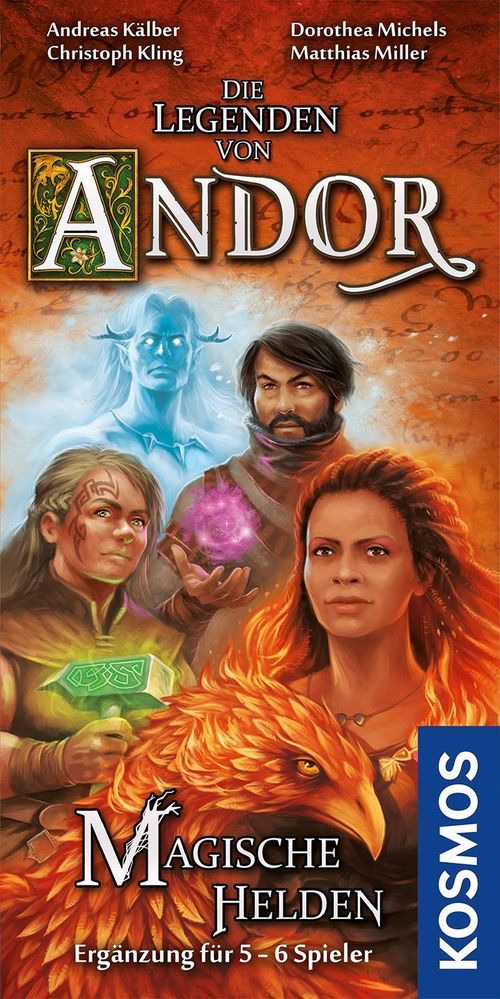
Die Legenden von Andor: Magische Helden
Die Legenden von Andor: Magische Helden Rulebook
Table of Contents
Table of Contents
- Overview
- Components
- Setup
- Rules for the Base Game and All Expansions with Five to Six Players
- Special Rules for Legends 1–5 of the Base Game
- Special Rules for "The Last Hope" with Five to Six Players
- The Circle of Choranat (Der Bannkreis von Choranat)
- The Moonberries (Die Mondbeeren)
- Special Rules of the Magical Heroes
Overview
Important: If you are playing Legends of Andor for the first time, begin with the quick-start instructions of the base game with Legend 1. Play this legend only with up to four heroes, using the heroes from the base game. If you do not own the base game but own "The Last Hope" (Die letzte Hoffnung), begin with its quick-start instructions with Legend 11. Play that legend also only with up to four heroes and without the Magical Heroes.
The manual is divided into three parts:
- Pages 2–3: the base game and all expansions with 5–6 heroes.
- Pages 4–5: "The Last Hope" with 5–6 heroes.
- Pages 5–8: the special rules of the Magical Heroes.
Components
- 36 legend cards
- 8 hero figures
- 1 Rune Disc (front side and back side)
- 1 Fire Takuri
- 1 Steppe Lizard
- 1 tulgorian stone flute
- 2 takuri feathers
- 1 set of mirror shards (Spiegelscherben)
- 1 rune helmet
- 4 hero shields (front side)
- 6 magical powders
- 1 ice crystal
- 8 ice bolts
- 6 moonberries
- 1 banishing fire (2 pieces)
- 8 dice (2 orange, 4 pink, 1 dark-blue rune die, 1 white pyramid die)
- 8 wooden discs in hero colours (2 orange, 2 pink, 2 dark blue, 2 white)
- 5 wooden pieces (2 orange, 1 pink, 1 dark blue, 1 white)
- 10 plastic holders (3 orange, 3 pink, 2 dark blue, 2 white)
- 4 hero boards (each with a Magical Heroine on one side and a Magical Hero on the other side)
- 1 sunrise token
- 4 black wooden discs (= neutral time markers)
- 4 minus strength tiles (−0, −2, −4, −5)
Setup
- Carefully punch the parts out of the six punch boards. Put all figures into the plastic holders of the matching colour.
- If you want to use the Magical Heroes in the base game, you do not need the 4 hero shields.
- From the legend cards, for the game with the base game and possibly the expansions, only these 5 cards are needed: "The Power of the Runes" (Die Macht der Runen), "The Cold" (Die Kälte), "The Fire Takuri" (Der Feuertakuri), "The Magical Powders" (Die Magischen Pulver), and "The Steppe Nomad" (Der Steppennomade).
- All other legend cards are meant only for the legends in "The Last Hope". Sort these additional legend cards with the respective legends in "The Last Hope".
- The card "Rule Adjustments for 5–6 Players for Legends 13–17" (Regelanpassungen für 5–6 Spieler für die Legenden 13–17) lists, for each legend in "The Last Hope", which special adjustments apply at the higher player count. If you play with the Magical Heroes with fewer than 5 players, do not use this card.
- The card "The Circle of Choranat" (Der Bannkreis von Choranat) is used with 5–6 heroes in all legends (see page 4).
Rules for the Base Game and All Expansions with Five to Six Players
- With more than four heroes in the base game, the heroes' coloured time markers are not used. Instead, place the 4 black wooden discs as neutral time markers on the sunrise space.
- Also set out the sunrise token.
The Neutral Time Markers
With five or six players the heroes have no time markers of their own. Instead, for each action a hero uses any one of the neutral black time markers.
- Moving: For each space a hero enters, one neutral time marker is advanced one hour on the day track. It is not allowed to split an action across several time markers. This also applies to actions in later legends, such as moving the Prince or moving the Shield Dwarves.
- Fighting: Each combat round, the hero must advance a neutral time marker by one hour. In the next combat round it may be a different time marker.
- Fighting together: Each hero taking part in a fight must be able to advance a neutral time marker by one hour per combat round. Several heroes may advance the same time marker.
- Important: If a hero moves a neutral time marker into the overtime area, he must pay Will Points for it as usual.
Ending the Day
With five or six players, a hero who wants to end his day no longer places his time marker on the sunrise space (the heroes have no time markers of their own any more). Instead, to show that he is ending his day, he lays down his figure. The hero who does this first receives the sunrise token as the new starting player; it shows the rooster.
When all hero figures are lying down, all black time markers are placed on the sunrise space. Only after the symbols on that space have been carried out as usual do all heroes stand their figures up again. Then the hero with the sunrise token begins the new day.
With five or six players the Circle of Choranat is also used (see page 4).
Further Rule
With five or six players, always use the values for four players:
- For the shields on the castle: use the picture for 4 players (= 1 shield).
- For the setup: example, Legend 5: the "N" tile is placed on space L of the legend track with five or six players, as with four players.
- For the strength of a final enemy: example, Legend 2: the Skral in the tower has 40 strength points with five or six players, as with four players.
Special Adjustments for Event Cards
- Some event cards apply to heroes who "stand" on certain spaces. This includes heroes whose figures are already lying down.
- Some event cards apply only to heroes whose time markers are currently on the sunrise space. Because heroes have no time markers of their own with more than four players, the heroes meant here are those whose figures are lying down.
- Some event cards refer to a particular hero, such as the Magician or the Warrior. The Magical Heroes are never meant by these.
- If the hero group can give up gold or Will Points to ward off a negative event, always use the value for four players.
- Special case, event card "Secret Lake" (Geheimer See) No. 6: if the event was not warded off, all neutral time markers are set to the fifth hour, since there are no personal time markers of the heroes. All hero figures that have already been laid down remain lying down. They cannot return to the game.
Special Rules for Legends 1–5 of the Base Game
The following special rules for the individual legends only need to be read when you play that legend.
Legend 1: This legend is not suitable for play with more than four players, because it explains the basic rules for four heroes. Only the heroes from the base game should be used, not the Magical Heroes. All other legends of the base game can be played with up to six players and with the Magical Heroes.
Legend 2: On legend card A2, the hero figures are placed on the spaces matching their rank numbers. Magical Heroes taking part are placed on the spaces matching their rank numbers too. Example: if Barz, the Steppe Nomad, is taking part, he is placed on space 38.
Legend 3:
- Fate No. 5 "The Peasant Wedding" (Die Bauernhochzeit) is removed from the game with 5 or 6 players.
- Legend card A3 says "Each hero now receives a fate card and ...". With five or six players, however, only 4 fate cards in total are dealt. The two players with the highest rank each receive one fate card, and so do the two players with the lowest rank. Only these 4 heroes must fulfil their fate.
- On fate cards No. 7 and No. 10 it says that a hero must defeat creatures "alone". With five or six players, however, the rule is: "You must be involved in the victory over these creatures."
- On legend card A3 the hero figures are placed on the spaces matching their rank numbers. Magical Heroes taking part are placed on the spaces matching their rank numbers too. Example: if Barz, the Steppe Nomad, is taking part, he is placed on space 38.
Legends 4 and 5: There are no changes for these legends.
Special Rules for "The Last Hope" with Five to Six Players
- As with 2–4 heroes, in "The Last Hope" with 5–6 players the heroes' coloured time markers are used. The neutral time markers (black wooden discs) and the sunrise token are not needed. The normal rules for ending a day apply.
- Some event cards refer to a particular hero, such as the Magician or the Warrior. The Magical Heroes are never meant by these.
- Special rule for Legend 11: This legend is not suitable for play with more than four heroes. However, with 2–4 heroes you can already use the Magical Heroes. Legends 12–17 can be played with the Magical Heroes with more than four players.
- Special rule for Legend 15: With more than four heroes, the six "Bewitched" (Verhext) cards of this expansion replace the cards from "The Last Hope". With five heroes, one of these cards is not used. Make sure that the card with a large "!" on its back is in play in any case.
Further Rules
With five or six players, always use the values for four players (unless a card gives a different value).
Example: in Legend 16, four players must place logs with a value of 10 on space 208. This also applies to five and six players.
The Golden Shields (Die Goldenen Schilde): on the card "The Golden Shields", the picture for four players (= 1 shield) also applies to five and six players.
The Circle of Choranat (Der Bannkreis von Choranat)
With five or six players, the Circle of Choranat is used. With this card you can adjust the difficulty to your player count.
- Slide this card under the creature track below the game board, so that the picture of the Circle remains visible. Make sure that the side facing up matches your player count.
- At the start of the legend, place the banishing fire (Bannfeuer) on the quarter of the Circle at the top left. With five players it goes next to the −2; with six players it goes next to the first −4.
- In combat, the value shown by the Circle is subtracted from the heroes' combat value.
- After each fight, regardless of its outcome, the banishing fire moves one space clockwise.
- In the next fight, the new value is subtracted from the heroes' combat value, and so on.
Variant for All Hero Numbers
For an extra challenge you can also use the Circle of Choranat with fewer heroes. Place the card with the side for 5 players facing up next to the game board. Take the minus strength tiles and cover the values on the card so that these arrangements result:
| 2 heroes | 3 heroes | 4 heroes |
|---|---|---|
| −0, −2, −4, −4 | −0, −2, −4, −6 | −2, −2, −4, −6 |
The Creative Heroes' Circle
For even more variety, get creative: for example, distribute the tiles at random and draw them face down! For this you also have a "−5" tile available.
The Moonberries (Die Mondbeeren)
With the moonberries you can reduce the difficulty of the game somewhat. You may use them in every legend and with every number of heroes. In Part III – The Last Hope they are strongly recommended with 5 and 6 heroes, so that all heroes have enough food.
- At the start of a legend, place the card "The Moonberries" with the arrow on the 5th hour of the day track. As soon as the first time marker reaches this hour, the card is activated.
- Then stack as many moonberries on the rooster of the sunrise space as there are heroes in the game.
- Whenever a hero is the first to end his day, he immediately takes 1 berry and then places his time marker on the stack. The berries are placed on the area of the hero board where gold is also placed.
- A hero who gives up a berry gains 1 strength point or moves his time marker back 2 hours. Berries can be passed on and sent with a falcon. A hero may give up any number of berries at once.
Special rules for Part III – The Last Hope:
- A hero may use one berry as food (like apple nuts or star herb).
- Moonberries do not regrow.
- The Dwarf receives no strength points for moonberries.
- The Archer cannot brew a Witch's potion (Trank der Hexe) with moonberries.
- The Half-Skral (from the expansion "Dark Heroes") cannot plant moonberries.
Special Rules of the Magical Heroes
Note: Wherever the text speaks of a "heroine", the same applies to the corresponding "hero", and vice versa.
Barz / Yaza
Steppe Nomad from the eastern lands, rank 38.
The Steppe Nomad has 5 magical powders. At the start of a legend he chooses any 3 powders and places them on the powder storage spaces of his hero board (on his clothing). The remaining 2 powders are placed on the Steppe Lizard.
- In combat, the Steppe Nomad rolls his dice one at a time, one after another, and decides when to stop (like the Archer in the base game). Only the last die rolled counts. He may attack a creature on an adjacent space.
- Using a magical powder is a free action. Each use costs him one die, which is placed on the corresponding powder. That powder and die are not available to the Steppe Nomad for the rest of the day. At the start of the day he gets all powders and dice back.
The Steppe Lizard: The Steppe Nomad is accompanied by his faithful pack animal, the Steppe Lizard Sabri.
- At the start of each legend, Sabri starts on the Steppe Nomad's space. In Part II – "The Journey to the North", this may also be the ship.
- The Steppe Lizard carries the remaining 2 powders.
- If the Steppe Lizard and the Steppe Nomad stand on the same space, any number of powders may be exchanged. Important: the powders can still only be used once per day.
- The Steppe Lizard may stand on the same space as creatures.
- Movement: Whenever the Narrator moves, the Steppe Lizard moves one space towards the Steppe Nomad. It always chooses the shortest route. If several routes are possible, the Steppe Nomad decides.
- Part II: If the Steppe Lizard is on the ship, it leaves the ship only when the ship is adjacent to a land space. The Steppe Lizard may use the boats.
The Magical Powders
The properties of the different powders can be read on the card "The Magical Powders" (Die Magischen Pulver).
- Meditation Powder: The Meditation Powder can only be used when the time markers of both heroes are on the day track.
- Banishing Powder:
- Part II: The Banishing Powder can be used against sea creatures. For this, the Steppe Nomad must stand on a sea space with the creature.
- Part III: The Banishing Powder can be used against skeletons.
- Weakening Powder:
- Part II: The Weakening Powder can only be combined with the nixie dust (Nixenstaub) if the creature does not fall to 0 Will Points.
- Part III: The Weakening Powder can be used against skeletons.
- Variant: The Experiment Powder: Replaces any one powder with the Experiment Powder. Note: there are always exactly 5 magical powders in the game! Its property is not fixed – not yet! You can design this powder according to your own wishes and preferences.
Iril / Ilar
Rune Master from Silberhall, rank 52. Special ability (hero board): Iril rolls the rune die and turns the rune disc as many spokes clockwise as the roll shows. Depending on her Will Points, she may turn the disc 1 or 2 spokes further. In combat she uses the number the hammer points to as her die value. Iril may also use the rune disc outside of combat (see card "The Power of the Runes").
- At the start of each legend, place the rune disc with its front side up (from Legend 12 with its back side up) on the hero board, so that it fills the recess and the hammer on the hero board points to 1 on the rune disc.
- In combat the Rune Master rolls the rune die. She then turns the rune disc as many spokes clockwise as the roll shows. Depending on her Will Points row, she may turn the disc 1 or 2 spokes further, but never backwards.
- She must always turn the disc at least as far as her roll shows. The number the hammer on the hero board now points to is her combat value.
- The rune disc stays where it is after use, so that the next roll starts from a new position.
- For 1 hour on the day track, the Rune Master may also roll the rune die outside of combat and turn the disc. She may then immediately use once the effect the hammer points to. The individual effects can be read below and on the card "The Power of the Runes".
The effects are:
- Three Will Points: The Rune Master immediately receives 3 Will Points (in Part III, 2 or 5 Will Points).
- Reveal: The Rune Master may reveal all revealable tiles on any one space.
- Wells: The Rune Master may refresh any one well (in Part III, spring).
- Rune stone: If the Rune Master carries a rune stone (in Part III, gem) of the colour shown on the spoke on her hero board, she immediately receives 1 strength point.
Special rule for Part II – The Journey to the North: The Rune Master may, instead of the wind strengths on the current wind card, roll once for 1 hour and turn the rune disc according to the rules. She may then move the ship by the value shown in any wind direction. For this she must be on board the ship. If she does so, she must take this value and may no longer use the wind card.
Aćh / Aćhan
Pronounced Ack / Ackan. Takuri Keeper from Tulgor, rank 26. Special ability (hero board): with the help of the Tulgorian stone flute, Aćh may move the takuri once per day to any space.
- The Takuri Keeper starts each legend with the Fire Takuri (hereafter just "takuri") on the same space.
- The takuri does not activate tiles. It cannot move farmers or other figures. The takuri may enter or pass all spaces that are "blocked" for the movement of heroes (for example rockfall spaces or broken bridges) or whose entry is tied to conditions (for example spaces with Arbaks or the trolls' camp).
- The takuri may not enter the river.
- The tulgorian stone flute and the mirror shards may be sent with a falcon. Other heroes can carry the flute or the mirror shards, but only the Keeper can use them.
- If the Narrator is set back (for example by the event card "Secret Lake" No. 4), the takuri marker on the hero board is not moved.
- Using the flute costs no hours on the day track. Afterwards the flute is turned to its back side, and at sunrise it is turned back to its front side.
- If the heroine wants to use the flute a second time on the same day, she may, for 2 hours on the day track, turn the flute back to its front side (also several times per day). Turning the flute is a free action.
- If the takuri marker stands on space +7, the Keeper may give up 5 Will Points to set the marker back to space +5. A hero may not bring himself to 0 Will Points.
Special rule for Part II – The Journey to the North: If the Keeper starts on the ship, the takuri is also placed on the ship board. The takuri cannot enter water spaces.
Special rules for Part III – The Last Hope:
- Only the Keeper can carry and use the takuri feathers.
- The takuri cannot move farmers, other figures or the supply wagon. It is not held by skeletons or cave sprites.
- Legend 15: The flute may also be activated and turned on space "k" on space 219, without moving the takuri.
- With the help of the mirror shards, heroes may be moved across jump spaces, even if they do not have enough Will Points for it. Watch-trolls cannot be moved across jump spaces.
Ijsdur / Ijsdora
Ice Demon from the Kuolema Mountains.
Ice crystal:
- At the start of a legend, the ice crystal tile is placed with its blue side up, above the 1st symbol of the sunrise space.
- If the blue side is up at sunrise, the Ice Demon receives as many ice bolts as are shown next to his Will Points marker (at 7–9 Will Points, 1 ice bolt; from 10 Will Points, 2 ice bolts).
- If the orange-red side is up, at sunrise all ice bolts that the Ice Demon has placed (on the strength point track of his hero board and on the game board) are returned to the supply.
- After this action, the ice crystal is turned to its other side at each sunrise.
Ice bolts:
- The ice bolts the Ice Demon receives during a legend are placed on the designated storage spaces of his hero board. If all 3 storage spaces are occupied, he receives no new ice bolts from the supply.
- Once placed, an ice bolt cannot be moved again.
- The Ice Demon may place ice bolts at any time during his turn.
Combat bolt:
- If an ice bolt lies to the right of the strength point marker, the value the ice bolt points to is added to the Ice Demon's die value in combat.
- Only 1 ice bolt may lie on the strength point track. If the Ice Demon has 8 or more strength points, he cannot place an ice bolt there.
- Example: The Ice Demon has 4 strength points and places 1 ice bolt to the right of his strength point marker. The ice bolt covers strength points 5 to 8 and points to 9. As long as the bolt lies there, this value is the Ice Demon's new strength point value.
Ice bridge:
- An ice bridge may consist of 1 ice bolt or of 2 ice bolts placed one after the other.
- It spans a board space or a board section, and thus connects board spaces that are not adjacent.
- For the connected spaces, all known rules for adjacent spaces apply.
- Example: The Archer stands two spaces away from a creature. The Ice Demon builds an ice bridge from the space the Archer stands on to the space the creature is on. The Archer is now adjacent to the creature and may fight it or take part in the fight.
- An ice bridge must clearly begin and end on a board space.
- If 2 ice bolts are placed one after the other, they must touch each other.
- An ice bridge may also be built over the river, over bridges, and over mountains or rocks.
Special rule for Part II – The Journey to the North: From the ship, an ice bridge may be built over a sea space to another sea space or to a land space.
Special rule for Part III – The Last Hope: Ice bridges may also be built over the gorges and jump spaces.