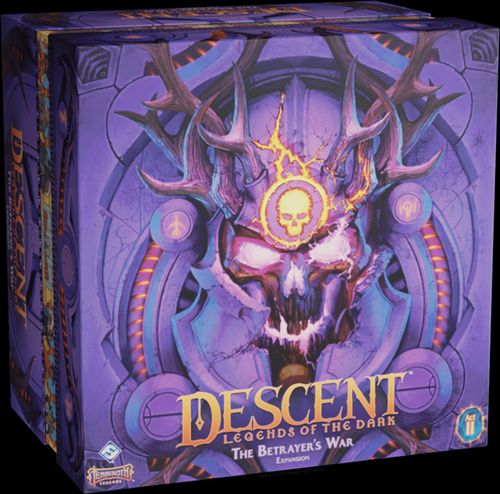
Descent: Legends of the Dark – The Betrayer's War
Descent: Legends of the Dark – The Betrayer's War Rulebook
Table of Contents
Table of Contents
Using This Expansion
Before playing with this expansion for the first time, assemble the terrain pieces following the instructions on the Terrain Assembly insert that is included in the game box.
Before playing the first quest in The Betrayer's War, update the Descent: Legends of the Dark App and add this expansion to the collection in the app's collection manager. The new figures, tokens, and terrain pieces appear in quests, as instructed by the app and by card abilities. The new cards are unlocked and added to the party inventory as the heroes progress through the campaign.
The Collection Manager
Each card and tile in this expansion is marked with The Betrayer's War expansion icon to distinguish these components from other cards and tiles in Descent: Legends of the Dark.
Starting a New Act
To continue the campaign and start The Betrayer's War, load a completed Blood and Flame save file and select the "Travel to Archaut" event in Frostgate.
Campaign Transition Event
When creating a new campaign, the app presents the choice to begin with Act 1, Blood and Flame, or to start a new save in Act 2, The Betrayer's War, following a short story scene to establish the events of Act 1.
Components
- 1 Terrain Assembly Guide
- 3 Map Tiles
- 2 Underlays
- 6 Hero Cards
- 27 Weapon Cards
- 26 Plastic Figures (1 Companion, 19 Enemies, 6 Heroes) and 1 Riser
- 9 Armor Cards
- 34 Terrain Pieces
- 24 Skill Cards and 1 Companion Card
- 18 Legend Cards
- 8 Trinket Cards
- 12 Consumable Cards
- 1 Riser Insert
- 60 Condition Tokens (20 Shroud, 20 Stress, 4 Focus, 4 Infect, 4 Prepare, 4 Scar, and 4 Terrify)
- 3 Umbra Tokens
- 21 Fatigue Tokens
- 2 Explore/Sight Tokens
The Heroes
The six playable heroes in Descent: Legends of the Dark continue their adventures, with stronger incarnations to reflect their continued growth. All six heroes are available from the start of The Betrayer's War.
Brynn, the Human Baroness
Brynn was once a Marshal of the Citadel, but after the death of her aunt, Brynn reluctantly finds herself thrust into the position of leadership for the barony of Forthyn. Her ascension comes as Forthyn now endures its darkest trial, for the barony has been lost to the armies of Dragonlord Levirax and the Uthuk Y'llan. Brynn seeks to defend the refugees of Forthyn with her mastery of the battlefield!
Brynn continues to lead from the front, punishing her enemies and defending her allies. Her new abilities use the Technique keyword to unleash potent new effects, depending on which type of weapon she wields. (See "Technique (Keyword)" below.)
Chance, the Hyrrinx Shadow Walker
A reformed thief, Chance has escaped his miserable servitude to the dastardly Outlaw Prince for a life of adventure with his newfound friends. But that adventure is a perilous one, as war, devastation, and sinister magics all threaten to destroy any life Chance might build for himself.
Chance must utilize his criminal talents and harness new powers to protect himself—and his friends.
Chance is an unparalleled master of stealth and surprise, and the shadows are his faithful allies. His new abilities place and move umbra tokens around the map, which he can use to elude his enemies, help his friends, and strike from the darkness. (See "Umbra Tokens" below.)
Galaden, the Elf Far Ranger
After months of relentless searching, Galaden at last has the name of the demon that murdered his friends and family: Baelziffar. But Baelziffar is dangerous and elusive prey, and the demon's connection to the Uthuk hordes ravaging the land is just one part of his centuries-long machinations.
All of Galaden's training—as hunter and diplomat—will be put to the test as he continues on the trail of his deadliest foe.
Galaden excels at using his adaptability and tactical skill to aid his allies with useful conditions and hinder his enemies with debilitating statuses. He makes easy use of the shroud condition and the confused status to control and hamper enemy attacks. (See "Confuse (Status)" and "Shroud (Condition)" below.)
Kehli, the Dwarf Inventor
Now ousted from both the Smith's Guild and the Alchemist's League, Kehli Deepfire is hard at work crafting her life's masterwork: her own heroic story. Kehli has always known that she was destined for heroism and greatness, and she won't let a little thing like a devastating war that threatens both her homelands slow her down.
Her hammer, her crossbow, and her ingenious creations are just the tools Kehli needs to build a better future.
Kehli expands her arsenal of tricks and tools to support her friends and put pressure on her enemies. She uses her new skills to place mechanical contraptions that make her presence felt across the map. (See "Contraptions" below.)
Syrus, the Human Arcanist
As Terrinoth is threatened by its worst crisis in eight hundred years, Syrus Indahlu struggles to rise to the occasion. What the world needs now is a second Timmorran Lokander, a peerless sorcerer who led the Free Peoples out of the First Darkness, whose legacy is still unfolding today. If Syrus can't step into that role, then who?
With support from his friends and the phoenix spirit, Indris, Syrus hones his magical might and pursues Timmorran's legacy. As Syrus's mastery over elemental magic has grown, so has his bond with Indris, his phoenix companion. Indris can now move independently across the map, working in concert with Syrus to perform remarkable deeds. (See "Companions" below.)
Vaerix, the Dragon-Hybrid Prophet
Some scars take a long time to heal, and Vaerix's wounds run deep. Yet despite their pain, Vaerix has found some dragon hybrids open to their message of finding a new path for their people. Now Vaerix has unlocked the potential of the Words of Creation within themself and that path is full of more possibility than ever before.
The old world is dying, and Vaerix's wisdom and power stands ready to deliver the future.
Vaerix has proven capable of speaking the Words of Creation, potent manifestations of pure draconic magic. Their new Word skills feature powerful but costly effects, placing stress on other cards after use. (See "Stress (Condition)" below.)
Expansion Rules
The following sections describe new rules for material in this expansion, presented in alphabetical order.
Companions
A companion is an allied character that is controlled by a hero and is represented by both a figure and a double-sided card. Companions are neither enemies nor heroes, but a separate type of figure. Indris is the only companion in Act 2.
After a hero is placed on the map, if they have a companion's card equipped, they may place that companion's figure in an empty adjacent space. When a hero is removed from the map, they must also remove their companion's figure.
Companion cards are double-sided, with different abilities and stats on each side. Heroes can place fatigue and conditions on their companion cards. When a companion gains a condition (by moving into an ember space, for example), the controlling hero places the condition token on that companion's card, if able. Otherwise, that hero may place it on any of their cards.
A hero can use the ready action or a prepare token to flip a companion's card. When a hero flips a companion's card, they discard all tokens on that card.
Indris (the card shown in the rulebook): the card labels Speed, Health, Defense and Fatigue Limit. Its printed values are speed 6, health 3, defense of two orange dice, and fatigue limit 3. The side shown reads: "While Indris is moving, she ignores elevation, terrain, and underlays, and she cannot be impeded. DEFEAT: Syrus suffers 5 damage. Then flip this card." The card is marked COMPANION with 0 XP.
Moving Companions
A companion may spend one movement point to move into an adjacent space. When a hero performs a maneuver action, each of their companions gains movement points equal to the speed shown on the companion's card.
A companion cannot move into a space that contains an enemy or a piece of 3D terrain, but they can move into a space that contains a hero or another companion if they can immediately move out of that space. A companion is Impeded if they are adjacent to an enemy. Companions obey all terrain and elevation rules that apply to heroes.
Companions and Enemies
When an enemy is adjacent to a companion, that enemy is Impeded. Enemies cannot move into or through a companion's space. When an enemy activates, it will target a companion only if it cannot attack any hero with its activation. If an enemy's activation includes multiple targets, it will only include companions as targets if it cannot attack any heroes.
When an enemy attacks a hero's companion, that hero makes a defense roll by rolling the defense dice shown on the companion's card. For each success they roll, they reduce the damage of that attack by 1. The hero can spend one or more surges from this roll to activate surge abilities on their other cards. After the defense roll, they compare the attack's reduced damage to the companion's health.
If the reduced damage equals or exceeds the companion's health, they resolve the Defeat keyword on the companion's card. If an attack does not defeat a companion, that companion suffers no damage from the attack.
Companions do not track or suffer damage from any source; instead, they can only be defeated by enemy attacks as described here.
Attacking a Companion Example
- During the orange mercenary's activation, it cannot reach Syrus or Galaden because it would become impeded by Indris. Since it cannot reach a hero, the mercenary moves adjacent to Indris and attacks her instead.
- The mercenary's attack deals 7 damage, so Syrus rolls two orange dice to make a defense roll using Indris's defense.
- Syrus places 1 fatigue token to convert the advantage to a success, and spends the surge to use the surge ability on his hero card and add 1 success. The defense roll totals 5 successes and reduces the damage from 7 to 2.
- Indris's health is greater than the damage dealt, so Indris is not defeated.
Confuse (Status)
Confuse is a new status that can be applied to enemies by attacks and abilities. When a hero confuses an enemy, they apply the status to the enemy in the app. When a confused enemy next activates, it will perform a special activation, possibly preventing its attack or even making it attack another enemy.
Example: this doomcaller is confused. When it activates, it performs the displayed activation instead of its normal activation. (The example card is shown as an image in the rulebook.)
Contraptions
A contraption is a special type of 3D terrain piece that is not tracked in the app. Several of Kehli's new skills allow her to place contraptions on the map, and those skills define what effects and abilities the contraptions have, in addition to the properties defined here.
Because contraptions are terrain, they cannot share a space with figures, tokens, or other terrain pieces. Contraptions block movement, but do not block line of sight. If a figure would be placed in a space with a contraption, the heroes move the contraption to the nearest empty space of their choice.
See also "Stack (Keyword)" below.
Defeat (Keyword)
When a single attack deals damage to a companion that equals or exceeds its health (after the defense roll), the controlling hero resolves the ability text preceded by the Defeat keyword on that companion's card. See "Companions" above.
Hero Cards
When playing The Betrayer's War, heroes use their Act 2 hero cards, which feature new abilities, increased health, and improved stats. While heroes must use the Act 2 hero cards, they can continue to use any other cards they unlocked in the previous campaign, such as their skills and weapons.
The heroes tab shows which companions, legends, and skills each hero has unlocked and can equip at the start of a quest.
Additional Surge Ability
The Act 2 hero cards provide each hero with an additional Surge Ability. A hero can spend surge results during any of their rolls to activate surge abilities on their hero card. A hero may activate one surge ability for each surge result they spend. Each surge ability can be used only once per roll.
Kehli's hero card has two different surge abilities. When she spends a surge during a roll, she can use that surge to activate either ability.
Legends
Legends are a new card type introduced in The Betrayer's War. These cards are double-sided, but unlike many other cards in the game, they cannot be flipped during play.
Unlocking Legends
During the campaign, each hero may unlock up to three unique legends based on their decisions or quest performance. Heroes can unlock only one side of each legend card for use in the campaign; the other side of the card cannot be equipped or used during that campaign.
Using Legends
During a quest, legends provide various passive and ongoing abilities. Abilities on legends do not cost fatigue to use and are available whenever the card is equipped. Unlike skills, legends cannot be flipped, and tokens cannot be placed on legends.
Each legend has an Experience (XP) cost. When the heroes prepare for a quest, each hero may choose to equip a combination of unlocked cards with a total XP cost equal to their current XP. Companions, legends, skills, and weapons can all have XP costs.
Resistances
Enemies can gain resistances to one or more damage types. During a hero's attack, each success spent causes one less damage for each of their weapon's damage types that the enemy is resistant to. This is calculated by the app.
The damage types that an enemy is resistant to are displayed as "?" until the resistance is discovered. The first time an enemy suffers damage of a type that they are resistant to, that resistance is revealed for the duration of the campaign.
Example: this enemy is weak to weapons that have the crush damage type and resistant to weapons that have the mortos damage type. (The example is shown as an image in the rulebook.)
Shroud (Condition)
Shroud tokens are a type of hero condition that can be placed on cards by various effects that instruct a hero to "shroud" a card.
When an enemy activates, each hero may discard one shroud token. For each hero that does so, until the end of the activation, that enemy cannot target that hero, and is not Impeded by that hero.
Shroud example: when the salamander activates, Chance discards a shroud token (1). Because he did so, the salamander targets Brynn instead and is not Impeded by Chance. The salamander moves two spaces away from Chance and attacks Brynn (2).
Stack (Keyword)
The unique actions on Kehli's new skills instruct her to Stack her contraptions, if able. If there is already a contraption in play, instead of placing a second one in a new space, she resolves the Stack keyword by placing the new contraption on top of the existing one. Until one or more of those Stacked components are removed, they are treated as a single component.
Stress (Condition)
Stress tokens are a type of hero condition that can be placed on cards by various effects that instruct a hero to "stress" a card.
Before a hero discards one or more condition tokens from a card that has a stress token on it, they must suffer one fatigue. This fatigue can be suffered on any of the hero's cards. (As normal, the hero suffers one damage for each fatigue token that cannot be placed this way.)
Technique (Keyword)
An ability with the Technique keyword gains an additional effect if the hero's attack card has the indicated damage type. If the hero's attack card has multiple damage types that could be used to activate more than one additional Technique effect, they choose one of those effects to activate.
Example: the Citadel Blade (Sword, Archaut; 2 surge: During a hero's attack or defense against an enemy that is adjacent to you, that hero adds 2 success; Weapon, 4 damage, 3 fatigue limit) and the Counterswing skill (Aggression, Technique; 2 XP; "2 surge: After you defend, attack an enemy with Technique": Crush or Terros: During this attack, add 1 success, and if you suffered 3 or more damage after your defense, add 3 success instead. Slash or Anemos: After this attack, you and each adjacent hero may flip 1 other card.) Brynn uses her Counterswing skill to attack an enemy. Because her Citadel Blade has the slash damage type, after she attacks, Brynn and each adjacent hero may each flip one card of their choice.
Terrain
Ladders
The Betrayer's War introduces several new types of 3D terrain. If a terrain piece is interactable in the app, heroes can perform an explore action to interact with that terrain. Additionally, a few types of terrain include special abilities that do not require heroes to interact with them in the app.
Heroes can select a piece of 3D terrain in the app to display information about that terrain.
Figures can use ladders to move between different levels of elevation. When a figure moves, they may use two movement points to move from a space adjacent to a ladder to another space adjacent to that ladder, ignoring elevation. When a figure Shifts, they may spend two spaces of that movement to use a ladder.
Ladder example: Vaerix performs a maneuver action and gains 3 movement points, as determined by their speed. They move 2 spaces and are now adjacent to the ladder (1). Since they only have 1 movement point left, they do not have enough left to use the ladder. They perform another maneuver action and gain 3 more movement points. Then, they use 2 movement points to climb the ladder (2). They have 2 movement points left and may continue moving.
Blocking Terrain
The 3D terrain pieces shown below are blocking terrain. This terrain blocks line of sight, and heroes cannot count range through blocking terrain. The blocking terrain pieces are the Bell, the Shrine, the Great Pillar, and the Statue (shown as images in the rulebook).
Fire
Heroes and enemies alike can use fires to make their attacks more powerful.
If a hero adjacent to a fire attacks an enemy, that hero adds one success to their attack.
If an enemy adjacent to a fire attacks a hero, that enemy adds one damage to its attack.
Additionally, the number of fires on the map can increase the amount of damage that afflicted enemies suffer during the darkness phase, as calculated by the app.
A Burning Barricade
Fire terrain can be placed during a quest, or can be added to other terrain pieces, creating burning terrain (for example, a barricade with fire attached to it is a "burning barricade"). When instructed by the app to add fire to terrain, attach a fire piece to the indicated terrain. Burning terrain pieces have new interactions available, and count as fire for all purposes, including the effects described here.
The Platform and Vault
The lower box insert is used as a 3D terrain piece in some quests, and can be placed as either a platform or a vault, depending on its orientation. Figures, tokens, and other terrain can be placed in and move into spaces on either the platform or the vault.
The surface of the platform and the wall of the vault are spaces at elevation level 3 (the same height as a tile inserted into the second set of notches on a pillar). Range and line of sight can be traced to or from the top of the platform or wall.
The Statue
The statue features three spaces. Small figures can move into these spaces from adjacent spaces of the same or higher elevation, but they cannot move into these spaces from a lower elevation. A figure can move normally from a space on a statue to any adjacent space at the same or lower elevation. Small figures that ignore elevation while moving (Indris or Fae enemies, for example) can enter these spaces while moving from any adjacent space. Large figures cannot enter spaces on a statue.
When heroes interact with a statue, they may be placed in one of the spaces on that statue. Spaces on a statue are considered adjacent to that statue, so a hero that is already standing on a statue may interact with it.
Umbra Tokens
Several of Chance's abilities allow him to place and move umbra tokens on the map. The ability on his hero card allows him to place up to one umbra token; additionally, some of his new skill cards increase the number of umbra tokens he can have at any one time. Before Chance would place an umbra token with an ability, if he does not have any available, he may discard one umbra token from the map to allow him to place the new token.
When an ability allows an umbra token to Shift X, it moves up to the number of spaces specified. While moving, umbra tokens obey all terrain and elevation rules that apply to heroes. Tokens cannot be Impeded and may move into and through spaces with other figures, but not 3D terrain. Similarly, umbra tokens may be placed in a space occupied by a figure, and figures may move into or be placed in a space with an umbra token.
Frequently Asked Questions
Can I discard a prepare token to flip my attack card during an attack? No. Effects that occur "during" a timing event can't be resolved while another game effect is being resolved. In this instance, the attack roll is a game effect being resolved (by spending the results rolled) and so a hero cannot trigger abilities that occur "during their turn" until they have finished resolving the effect of the roll (including dealing damage).
What happens when I flip a card that has multiple condition tokens on it, including a stress token? Do I suffer 1 fatigue for each condition token I discard? When multiple effects happen simultaneously, the heroes can choose the order in which to resolve them. So, when they discard multiple conditions, including a stress token, they can choose to resolve the effect of discarding the stress token first and suffer only one fatigue. That fatigue can be suffered on the card that is about to flip (assuming that card is not at its fatigue limit), in which case it will be discarded immediately, or they can suffer that fatigue to another card. As always, if they have no card that can hold another fatigue without exceeding the card's fatigue limit, they must suffer 1 damage instead.
What happens when I gain a consumable during a quest? When a hero gains a consumable during a quest, they place the card in their play area, even if they already have the three consumables they equipped during setup. They may use that consumable during the quest. All equipped consumables are lost at the end of each quest, although heroes can re-equip those for which they have recipes when they choose their equipment at the start of each quest.
When I find a new weapon card during a quest, can I equip it immediately? No. When a card is added to the party inventory (for example, a weapon or a trinket), it can be equipped the next time the heroes prepare for a quest. When a hero "gains" a card (for example, a consumable), they add it directly to their play area.
Quick Reference
Enemy Statuses
- Afflicted: During the darkness phase, each afflicted enemy suffers four or more damage.
- Confused: When a confused enemy activates, it performs an alternate activation.
- Dazed: When a hero attacks a dazed enemy, the secondary abilities on the hero's weapon are 10% more likely to trigger.
- Doomed: At the end of the round, a doomed enemy's "Doomed" status is removed, but all of its other statuses remain on the enemy for another round.
- Enfeebled: An enfeebled enemy's attack damage is reduced by 20%.
- Exposed: An exposed enemy suffers 20% more damage from attacks.
- Slowed: A slowed enemy's speed is reduced to one.
Hero Conditions
- Infected: When time passes during the darkness phase, the hero suffers damage equal to the number of infection tokens on their cards.
- Scarred: When a hero flips a card that has a scar token on it, that hero suffers two damage.
- Stressed: Before a hero discards one or more condition tokens from a card that has a stress token on it, they must suffer one fatigue. (As normal, the hero suffers one damage for each fatigue token that cannot be placed this way.)
- Terrified: When time passes during the darkness phase, the hero suffers one fatigue on each of their cards that has a terrify token on it. (As normal, the hero suffers one damage for each fatigue token that cannot be placed in this way.)
- Focused: During an attack, defense, or test, a hero may discard a focus token from a card to reroll one of their dice.
- Prepared: During their turn, a hero may discard a prepare token from one of their cards to flip that card without performing a ready action.
- Shrouded: When an enemy activates, each hero may discard one shroud token. For each hero that does so, until the end of the activation, that enemy cannot target that hero, and is not impeded by that hero.
Actions
During a hero's turn, they can perform one maneuver action and two additional actions. A hero can perform the same action multiple times (including multiple maneuver actions).
- Maneuver: The hero gains movement points equal to their speed.
- Fight: The hero attacks an enemy.
- Explore: The hero interacts with an explore token or piece of 3D terrain.
- Ready: The hero flips one of their cards.
- Unique: The hero resolves any ability that is prefaced by the action icon.
Keywords
- Charge: After a card is flipped (which includes when it is placed in a hero's play area at the start of a quest), if the faceup side of that card has the "Charge" keyword, the type and number of tokens specified by the keyword are placed on the card. When there are no tokens of that type on that card, that card is flipped.
- Defeat: When a single attack deals damage to a companion that equals or exceeds its health (after the defense roll), the controlling hero resolves the ability text preceded by the "Defeat" keyword on that companion's card.
- Reach: A weapon with this keyword can be used to attack a figure that is up to two spaces away (if line of sight is not blocked).
- Reveal: After a card is flipped (which includes when it is placed in a hero's play area at the start of a quest), if the faceup side of that card has the "Reveal" keyword, the effect that follows the keyword must be resolved immediately.
- Shift: This keyword allows a figure to move up to the number of spaces specified. When a figure is moved in this way, it ignores the rules of impeding, but it still obeys all terrain rules.
- Stack: When a hero is instructed to Stack a component, they place it on top of another component of the same type. Until one or more of those components are removed, they are treated as a single component.
- Technique: When a hero resolves an ability with the "Technique" keyword, they may resolve an additional effect if the hero's attack card has the indicated damage type.