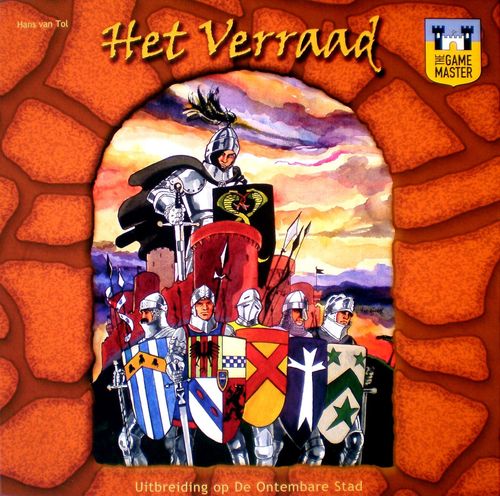
De Ontembare Stad: Het Verraad
De Ontembare Stad: Het Verraad Rulebook
Table of Contents
Table of Contents
- Objective of the game
- Game materials
- Hint before starting the game
- More strategic
- Start
- Purpose
- New game elements
- Changes in basic operation
- Preparation
- The Game Play
- Explanation per game phase
- End of the game
- Winner
- Exceptional situation
- Strategic considerations
Objective of the game
Acquire the most influence in The Indomitable Citadel. This influence is kept track of by means of a score, kept on the edge of the game board.
Game materials
All the playing materials from The Indomitable Citadel are used, except for the event cards. Furthermore, the following game materials are added:
- 1 game rulebook
- 5 castle cards
- 3 major force cards (watchtowers, dark and good force)
- 1 overview map with summary of game rules
- 20 income blocks (5x purple, 5x green, 5x brown and 5x blue)
- 1 Dark marker (black wooden disk)
- 25 Dark knights (black wooden rods)
- 1 Dark master (black wooden play figure)
- 12 watchtowers (grey octagonal staffs)
- 1 black die
- 1 white die
- 30 Dark (dark) force counters (cardboard cards)
- 30 white (good) force counters (cardboard cards)
Hint before starting the game
The Game Master recommends that you only play Treason if you already know the strategic version of The Indomitable Citadel. Treason offers even more strategic options than The Indomitable Citadel.
More strategic
In Treason, the players themselves choose a building card from three open cards. In this way, they directly influence the income of all the players, and whether capital tax is levied. The events cards are not used in Treason. The introduction of the Dark Master, investment options in black and white force counters and watchtowers provide new strategic alternatives. Each time you play Treason, you will discover new possibilities and will improve. But the same also applies to your opponents.
Start
Treason starts in almost the same way as The Indomitable Citadel. The players receive 25 knights, 5 building blocks, and a maximum of 3 areas are chosen with a total maximum value of 10 building blocks. In addition, each player also receives a watchtower, which he/she places on one of his/her 3 starting areas. And the Dark Master could enter the city at any time, right from the start.
Purpose
In Treason, the players must also increase their influence in the city. This influence is kept track of by means of the score section around the outside of the game board. The black point marker keeps track of the influence of the Dark Master. At any moment in the game, the players themselves can determine whether they support the Dark Master or not. It only becomes clear whether the Dark Master has won or not at the end of the game, however, when the identity of this dark figure is also revealed.
New game elements
The most important additions to the basic game of The Indomitable Citadel are:
- The watchtowers, which offer protection against attacks by the Dark Master and influence cards;
- The castle cards, which provide a simple method for keeping track of your income and for keeping track of good and dark forces;
- New major powers of watchtowers, dark and good force;
- The arrival of the Dark Master, whose influence and power can be determined by the various players;
- The possibility that the Dark Master wins, after which the identity of the Dark Master is revealed.
Changes in basic operation
There are also a number of small changes:
- At each turn: the players each choose a building card, thereby determining the distribution of the income between the players, and the tax; if a building card is not chosen, a building block is laid for the next player; this takes place each time that a building card is not chosen;
- Event cards are not used in the game;
- Game end: Each player has an equal number of turns, game ends when the final round of play is completed.
Preparation
Treason can only be played together with the materials of The Indomitable Citadel.
Set up
Fold open the round game board of The Indomitable Citadel and place it open in the middle of the table. In the picture of the original rules you can find the following materials:
- Game board
- Castle card (1 per player)
- Building cards (face-down pile and 3 face-up cards)
- Major powers
- Influence cards
- Free Market and Pawn Shop
- Starting capital (2 building cards and 5 building blocks)
- Dice (1 black and 1 white)
- Good and Dark Force (white and black counters)
- Knights (25 per player)
- The Dark Master
- Watchtowers (12)
- Black knights (25)
- Point markers
- Building blocks
- Income blocks (4 per player, 1 of each colour)
Choosing colour and distributing properties
The players each choose their own colour and receive in their own colour.
- 1 castle card
- 25 knights
- 1 point marker
Each player takes his/her own castle card. After this, each player places his/her point marker in the '0' position on the score section of the game board.
Determining first player
The players draw lots to determine who is the first player. Note: all players have an equal number of turns in Treason.
Paying out building blocks
At the start of the game, each player receives 5 building blocks from the Bank.
Building cards
The building cards are divided into A, B and C cards. The C cards are shuffled and form a face-down pile. After this, the B cards are shuffled and placed on top of the C card pile. Finally, the A cards are shuffled and each player is dealt three A building cards face down. Any remaining building cards with an A are placed on top of the pile of building cards. After this, the top three building cards of the pile are placed on the table face up.
Influence cards
The influence cards are shuffled and form a face-down pile next to the game board.
Black game pieces
The black point marker (wooden disk) is placed on the '0' on the score section. This is used to keep track of the influence of the Dark Master. The Dark Master (black wooden figure) and the black knights (wooden bars) are placed next to the game board.
The force counters
The black and white force counters are sorted by colour. After this, the black counters are shuffled. A face-down drawing pile is made for each colour. Both dice are also placed next to the game board.
Choosing areas and placing knights
Each player chooses a total of a maximum of 3 areas with a total maximum value of 10 building blocks (round dots on the areas of the game board). The player to the right of the starting player first chooses one area on the game board and places one of his/her knights on it. The other players then follow in turn, in an anti-clockwise direction. The players place a knight on an area in turn, until all the players have reached their maximum number of areas (3) or the maximum number of building blocks (10). It is not permitted to place knights on areas which horizontally or vertically adjoin another area owned by the same player. It is permitted to choose areas which adjoin areas of other players.
Placing watchtowers
The players place one watchtower on one of their areas. A tower protects against attacks by the Dark Master and influence cards. The Dark Master is also not permitted to move through an area with a tower of one of the Grand Masters, unless the Grand Master has given permission for him to do so (during the Grand Master's own turn). The watchtowers do not, however, offer full protection against influence cards of other Grand Masters. And in the event of isolation of an area with a tower, the tower switches owner! The player to the right of the starting player is the first to be allowed to place a tower, followed by the other players in an anti-clockwise direction. The remaining watchtowers are placed next to the game board.
Other game pieces
The 7 major power cards are placed face up next to the game board. The pawn shop and the free market are also placed face up next to the game board. Both markets are operational in Treason. Finally, each player receives four blocks with which to keep track of their income in the four different building categories: brown, green, purple and blue. They place these next to their castle cards.
The Game Play
The starting player has the first turn. He proceeds through the following game phases in the sequence shown below:
- Income phase
- Action phase
- Influence phase
- Dark Master phase
Game phase 1: Income phase
Choose building card
The active player chooses one of the three face-up building cards. It is possible that there are one or more building blocks on this building card, which he/she receives.
Tax
If the player chooses a city building (purple category), capital tax must first be levied. Each player who has more than 5 building blocks at this moment must transfer the surplus to the Bank. The tax is only levied on the capital before the income from that round. The revenue from the buildings on the game board and any building blocks on the building card do not count for the purposes of calculating the tax.
Receiving income
The building card chosen determines which of the four categories (colours) of buildings on the game board provide income (building blocks). Each player who has a building of the same category on the board receives building blocks from the Bank for one of his/her buildings in this category. The level of the income is determined by the value of the building, any bonus revenue from the area and major power bonus. All players (even if it is not their turn) can receive income.
Please note! The players never receive more than the income for a single building in the category drawn!
Building cards
The active player adds the building card to his/her hand at no charge. One building block is placed on / added to the two building cards not chosen. After this, the number of face-up building cards is supplemented to three by drawing the top building card from the pile and placing it face up.
Three buildings from the same category
If there are three buildings of the same category (colour) face up, all three are placed on the discard pile and three new building cards are drawn. Any building blocks which were on the cards are returned to the Bank. There are no building blocks on the new cards. If there are three buildings from the same category again, new cards are drawn until such a time as there are buildings showing face up of at least two different colours.
Game phase 2: Action phase
During this phase of the game, the active player is permitted to carry out the following actions in any order they wish:
A. Buying areas
Buy a maximum of 2 neutral areas which adjoin his/her own areas. After the purchase of the area, he/she places one of his/her knights on the area, which makes it visible that this area belongs to him/her. Players can isolate an area by capturing all the areas adjoining that area. The player who buys the last area, as a result of which the isolation is complete, replaces the knight on the isolated area with one of his/her own knights. If there is a building on this area, this player is allocated the points for this building and the number of points of the player who loses the building is reduced accordingly.
B. Placing buildings
Place a maximum of 2 buildings. A building card is necessary to be able to place a building. The building card is placed on an area of the player. The construction costs of the building are equal to the number of turns that the building card is displayed. Placing a building immediately results in allocation of points (equal to the number of dots on the building card) which are added by moving the points marker forward the appropriate number of squares on the score area of the game board. Buildings may only be built on areas owned by the player. Buildings may not be built on an area on which the Dark Master is located at that moment.
Important! If the player's income increases, because he/she has placed one or more buildings, he/she places or moves the income block on his/her castle card. This shows at a glance how many building blocks a player will receive if he/she chooses a building of this colour. In the example above, the best utility building (green) results in the player being allocated three building blocks. The green income block is therefore at position three. The best commercial building (blue) results in the player being allocated five building blocks, which can be seen because of the blue block at position 5.
C. Placing a watchtower
Place a maximum of 1 watchtower. It costs 5 building blocks to buy a watchtower, which must immediately be built on an area owned by the player. It is possible to have a building and a tower on the same area. The watchtower offers protection against attacks by the Dark Master, limits the power of certain influence cards and protects adjoining areas with its archers (see game phase 4 for details). Furthermore, the player with the most towers receives the Watchtower Major Power. It is not permitted to build a watchtower on an area on which the Dark Master is located.
D. Increasing good and dark force
Purchase white and black counters. By making a contribution to the church, a player increases his/her good force, as a result of which his/her areas and buildings are better secured against attacks by the Dark Master. A donation to the Dark Master strengthens the dark force of a player, as a result of which a player has more chance of carrying out successful takeovers with the Dark Master. The player pays the Bank the number of building blocks stated on the lowest available square on his/her castle card to the dark side or good side. As a result, he/she receives a white or Dark force counter from the pile, and places it on the lowest empty square. If a player wants to buy a force counter, he/she pays the amount shown on the lowest open square of the track in question. The first counter therefore costs three building blocks, and subsequent counters cost an increasing amount. It is not permitted to purchase more than two force counters during one turn. For example, it is permitted to purchase two white counters, two black counters or one white counter and one black counter. It is also permitted to buy one counter or no counters at all. The Dark force counters are placed on the dark side of the castle card, covered so that only the player him/herself can determine the value. The player is permitted to choose to exchange a force counter for 5 building blocks for a new Dark force counter, which he/she draws blind from the face-down pile of black counters. Each black counter which a player purchases ensures that the influence of the Dark Master is increased by one position: the black marker is moved forward by one square on the score section!
E. Trading building cards
An unlimited number of building cards can be bought from or sold to the Pawn Shop, or – if the player has built a trade building – the Free Market. The yield from a building at the Pawn Shop is half of its value, rounded up. On the Free Market, this is the actual value of the building. Buying a building card at the Pawn Shop always costs 5 building blocks, while on the Free Market the cost of a building card is the same as the actual value of the building.
F. Buying influence cards or building cards
An unlimited number of influence cards or building cards can be purchased for 5 building blocks per card. However, a player may only hold a maximum of two influence cards in his/her hand. A purchased influence card may be played straight away. If the player buys an influence card, as a result of which he/she is holding three cards, he/she has to discard one of the three.
G. Playing influence cards
Playing one or more influence cards. Purchased influence cards can be played immediately. Influence cards which were acquired during an earlier turn may also be played. It is not permitted to have more than two influence cards in your hand!
Game phase 3: Influence phase
If the active player does not want or is unable to carry out more actions because an increase in his/her number of points means that he/she is on a red square on the score section, he/she receives a free influence card. It is permitted to play this influence card during the same turn in game phase 4. Only the 'protection' and 'blockade' influence cards can be played during another player's turn.
Game phase 4. Dark Master Phase
A player can only move the Dark Master (1) and then carry out attacks (2) if he/she has one or more force counters on his/her castle card. If a player does not have any black counters, the player's turn ends immediately.
1. Moving
At the start of the game, the Dark Master is not yet present in the city. He can only enter the city through one of the 3 city gates. If the player has dark force (one or more Dark force counters), he/she can move the Dark Master in one of two ways:
- He/she throws the black die: the number of spots determines the maximum number of steps that the Dark Master can take; or
- He/she does not throw the die and counts the number of black counters he/she owns: this number determines the maximum number of steps the Dark Master can take.
A step is a cross-border move between two horizontally or vertically adjoining areas. The Dark Master can move via a city gate to another city gate, enabling him to gain access to a different part of the city. The Dark Master is not permitted to enter the central area of the game board. The player can also choose not to move the Dark Master. The Dark Master is not permitted to enter an area with a watchtower, and may also not attack areas with a tower or towers. An exception to this rule is if the active player gives the Dark Master permission to move through one or more of his/her areas with a watchtower. The Dark Master must in any event not end in an area with a watchtower. If all of the areas at the city gates are blocking the entrance for the Dark Master due to the presence of the watchtowers, the Dark Master cannot (yet) enter the city until these towers have been destroyed or one of the owners of these towers allows him to enter.
2. Attack
If the Dark Master is located in an area which is owned by one of the Grand Masters, the active player may carry out an attack on the Dark Master. If the Dark Master is in his own area or in a neutral area, nothing happens. He can never attack an area with a watchtower. The attack is carried out as follows:
- The active player throws the black die. He/she counts the number of black counters on his/her castle card on his/her turn, in order to determine the attack value of the Dark Master;
- The defending player throws the white die and counts the number of white counters he/she has on his/her castle card on his/her turn. Finally, he/she adds the number of watchtowers owned by him/her located in the areas adjoining the attacked area (each owned tower increases the defence value by 1); this value is the total defence value.
Possible results of an attack
- If the attacker has a higher value than the defender, the area is taken over by the Dark Master: the knight in the area is replaced by a black knight. If the area taken over has a building on it, the black point marker is moved forward by as many squares as the value of the building, and the player is moved backwards as many squares;
- If the defender has a higher value than the attacker, the area remains the property of the defending player;
- If the attack and defence values are the same, then the knight disappears from the area; if a building is located on the area where the attack was carried out, then the defending player loses the points value of the building.
The Dark Master remains on the attacked area in every situation.
Isolation
The Dark Master can isolate an area by carrying out a successful attack. If an area becomes isolated as a direct result of this attack, the Dark Master takes over the isolated area (including the building, if appropriate). The points are immediately adjusted on the score section. In this way, the Dark Master can also acquire watchtowers.
Major powers
The Dark Master can ensure that a player loses his/her major power. Furthermore, he/she can also acquire a major power. The points of the major power are added to the score.
Archers
Each area that horizontally or vertically adjoins an area owned by a player which has a watchtower on it with the same owner is protected by the archers in the tower. The defence value per tower is + 1. It is possible that an area is defended by more than one tower. Example: a player attacks an area of the purple player during the Dark Master phase of his/her turn. He/she throws a 6 with the black die and adds 2 to this, because he/she has 2 Dark force counters. The purple player throws a 1 with the white die and adds 3 to this: he/she has 2 white force counters and the battle adjoins one of his/her watchtowers. The Dark Master wins with an attack of 8 (6+2) against a defence of 4 (1+3). He/she takes the area by placing a black knight on it. Because the adjoining area (with the Toll House) of the purple player is now isolated, the Dark Master also takes this area, including the building and the watchtower. The purple player loses 3 points because he/she has lost his/her Toll House. The Dark Master is awarded 3 points.
End of a play turn
At the end of game phase 4, the turn of the player ends. It is now the turn of the player to the left of the active player. The players then take turns in clockwise sequence.
Explanation per game phase
Game phase 1: Income phase
Influence cards
If a player plays the influence card 'the wizard', he/she can choose which of the top two face-down building cards are placed face up. The unselected building card is then placed at the bottom of the pile.
Building cards
It is possible that the building cards run out before the game has ended. In such cases, all the discarded building cards are gathered together and shuffled. These are then used to form a new pile. Additions to the face-up cards are then made from this pile.
Game phase 2: Action phase
Placing buildings
A maximum of one building card can be placed on an area. A watchtower can stand on an area with a building card. It is possible to place a new building on an area where a building is already located. The old building is then demolished at no charge and the card is removed from the game. This can only take place with your own buildings, of course. The player pays to the Bank the number of building blocks for the new building shown on the building card.
Defending against isolation
A player can stave off the danger of isolation by taking at least 2 adjoining areas. This is because an area can only be isolated if it is completely surrounded by hostile areas. An area can only be isolated by buying an area or by conquering it with the Dark Master. An area cannot be isolated as a direct result of using an influence card.
The watchtowers
A player can purchase a watchtower from the general stock for 5 building blocks. He/she must build this tower immediately, it cannot be held in stock. Occasionally, all the watchtowers will be on the game board. In such cases, the player cannot build a watchtower. It is not possible to build more than one watchtower during a single turn. The watchtower protects the area (and any building on it) against an attack by the Dark Master. The Dark Master can also not move across an area with a watchtower on it. It is possible, however, for the Dark Master (or another Grand Master) to isolate an area with a watchtower on it, as a result of which he/she takes over the watchtower.
Protection by watchtower against influence cards
If one of the following influence cards - 'Fire', 'Robbery', 'Infiltrator' or 'Witchcraft' - are used to attack an area with a watchtower on it, the attack must first be to the detriment of the watchtower. Buildings and knights remain in place in this case, as a result of which the tower has beaten back the first attack. The watchtower is removed from the game board and returned to the general building stock.
Major powers
A player can acquire a major power in:
- four categories (colours) of buildings (value 1 – 4);
- good force (white counters, value 5 points);
- watchtowers (military major power, value 4 points);
- dark force (black counters, value 3 points);
A player can acquire a major power by owning 3 or more buildings in a single category or having 3 watchtowers on the game board. It is also possible to acquire a major power by collecting 3 or more white counters on the player's own castle card or 3 or more black counters on the player's own castle card. The player can lose his/her major power if he/she loses buildings or watchtowers. It is also possible for another player to take over a major power from him/her, if this player owns more realised buildings, watchtowers or counters of this category. The player who acquires a major power receives the major power card. The points earned are immediately added using the points marker. If a player loses a major power or a building, his/her points are also immediately deducted.
Money shortfall
If a player has to pay building blocks as a result of an influence card and the player does not have them, he/she does not have to sell buildings or other properties in order to pay these costs. He/she pays as many building blocks as he/she has in his/her possession.
Influence cards
A player may play an unlimited number of influence cards, but he/she may never hold more than two. An influence card can be played before or after each action.
Explanation of game phase 4. Dark Master Phase
General: The Character of the Dark Master
The Dark Master is a special type of player in Treason. He can gain points, but he does not have any resources in the form of building blocks or building cards. During the game, it is not clear who has the most dark force, until the players slowly but surely reveal themselves and it becomes clear who supports the Dark Master and who doesn't. Only if the Dark Master wins is it worthwhile showing the dark force by turning over the black counters. This gives players who are in a difficult position the opportunity to switch identity at the end of the game and thereby nevertheless to win with the Dark Master.
The power of the Dark Master
The Dark Master can have more turns in a single round of play than the individual players. As a result, his influence can grow quickly. The power of this dark figure is determined by the Grand Masters, however, How many players are supporting him? The Dark Master is not permitted to attack or travel across an area with a watchtower. But if there are one or two players who are sympathetic to him, he can travel through a line of watchtowers or reach his goal via a detour: more areas, more buildings and more influence. The Dark Master can isolate areas of Grand Masters. The Dark Master can acquire a Major Power and benefit from influence cards of players who are sympathetic to the dark side. Furthermore, each black counter on the castle cards provides influence to the Dark Master.
Limitations of the Dark Master
If the Dark Master has insufficient players who make him stronger, he can live a moribund life. A risk he is running is that areas of the Dark Master can also be isolated if he acquires widely spread-out areas.
The dark force
The Dark force counters have values of 1, 2, 3 and 4. As a result, it is unclear during the game who the real Dark Master is, and therefore who has the greatest interest in a victory for the black side.
The good force
By giving donations to the church, the players can protect their areas against the aggressor. Right-minded Grand Masters who do not like aggression strengthen their defence by investing in the goodness of the Indomitable Citadel, and receive white force counters for this.
Playing influence cards
The players can play influence cards in game phase 4. This is also permitted with an influence card which the player has received in game phase 3 of the same turn. The influence cards only benefit the Dark Master and do not (directly) benefit the active player. A card such as 'Pioneer' or 'Robbery' works in exactly the same way as when it is deployed in game phase 1 or 2, except the area is transferred to the Dark Master. Influence cards such as 'Donation' and 'Golden trade' do not provide any benefit, because the Dark Master cannot own any building cards or building blocks. Watchtowers on areas also offer protection, during game phase 4, against attacks by influence cards such as 'Fire', 'Robbery', 'Infiltrator' or 'Witchcraft'. Again, the watchtower must first be removed from the board. An influence card can be played before or after an attack by the Dark Master.
End of the game
As soon as one of the players has reached a certain number of influence cards, the round of play is completed so that all the players have had an equal number of turns. The number of influence points which must be achieved is:
- In the case of 2 players: 50 points
- In the case of 3 players: 35 points
- In the case of 4 players: 30 points
- In the case of 5 players: 25 points
If the player who has the last turn (the player to the right of the starting player) achieves the required number of points, then the game ends at the end of his/her turn. However, if the player who achieves this number of points is the starting player, for example, then the other players each have one more turn. After this round, the game ends, even if nobody still has the requisite number of points after the end of the final round.
Winner
Victory of good
The player (Grand Master) who has achieved the most points on the score section at the end of the game is the winner of Treason. In the event of a draw, the player with the most good force (white counters) wins. If this still does not clarify matters, the player with the least dark force (black counters) wins.
Victory of evil
If the black points marker is the highest on the score section at the end of the game, the Dark Master wins. The player with the most black counters is the Dark Master and thereby wins Treason. If there is more than one player with the most number of black counters, it must be revealed who is the real Dark Master. The players turn over their black counters to show how great their dark (black) force is, by adding up the values on the underside of the counters. In such cases, the player with the highest value of dark force wins. If this still does not clarify matters, the number of points on the score section is decisive.
Exceptional situation
If a player does not own any more areas on the game board, he/she is evicted from the city. In such cases, he/she also cannot win with the Dark Master.
Strategic considerations
In Treason, the players can choose from various strategies. A number of examples are given below:
- Offensive strategy: specialisation in dark forces by quickly purchasing black counters in order to become the most powerful in this respect; bear in mind possibility of attacks by other players, if appropriate by protection with a number of watchtowers or good force;
- Defensive strategy: specialisation in good forces by rapidly purchasing white counters in order to protect the areas owned by the player against attacks by the Dark Master; this enables the player to quickly build his/her influence in the city.
- Fortress strategy: form a fortress of watchtowers for the protection of the areas you own, and to form a blockade against the Dark Master;
- Spread: traditional strategy for The Indomitable Citadel; by building different categories (colours) of buildings in the city, the player ensures that the player at least receives income; as a result, he/she always has enough building blocks at the start of his/her turn to be able to carry out various actions at the start of his/her turn.