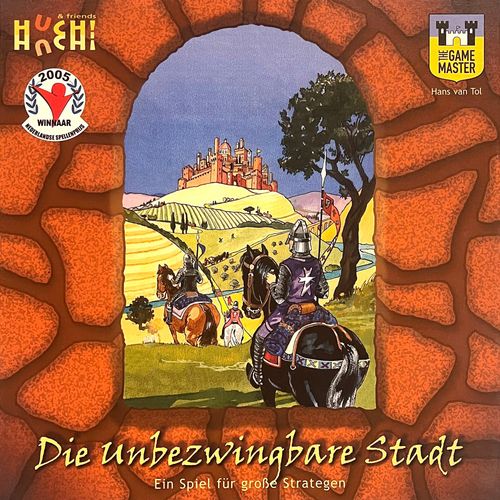
De Ontembare Stad
De Ontembare Stad Rulebook
Table of Contents
Table of Contents
Choose the right strategy and win!
Invest in strategically well-positioned territories and profitable buildings to insure a growing income. Be sure you diversify your interests. You accumulate points by putting buildings on your plots. Prestigious ones such as a Stock Exchange or a Town Hall for example yield 5 points. However, building a Pig Sty or a Flour Mill (1 point each) may well turn out to be strategically and economically positive investments. Moreover, acquiring one or more Great Powers may give you exactly the points needed to ensure your leadership. The most influential player (in points) of the Citadel is the winner.
Winning scores according to the number of players are:
- 5 players: 20 points
- 4 players: 25 points
- 3 players: 30 points
- 2 players: 40 points
Victory is there as soon as one of the players reaches the score (or more).
If, when the last territory has been occupied, there is still no winner, then this round of the play goes on. The player who, at the end of the round, has the highest score is declared winner. In case points are the same for several players, the number of occupied territories is decisive and if there is still a tie-break, bricks are counted.
Everything you'll need is mentioned in these Rules of the Game, but if you wish for more information or still have questions, remember our website: www.thegamemaster.nl
Equipment
The following equipment is needed:
- 1 round playing board
- 60 Building Cards
- 15 Event Cards
- 30 Influence Cards
- 4 Great Power Cards (strategic version)
- 2 Trade Cards: "Pawnshop" and "Free Market" (strategic version)
- 1 The Game Master Information Card
- 5 Coloured Grand Masters
- 125 Coloured Knights (25 x 5 colours - wooden sticks)
- 60 small bricks (mini disks)
- 20 big bricks (mini disks)
Some information about the equipment
The playing board. It is divided into 48 plots surrounding the centre. Buildings can only be placed in these territories. On each plot 1 to 8 dots indicate the bricks to be paid for acquiring the plot. In the lower right hand side corner we find its profit-earning premium: +1, +2 or +3. Scores are marked on the surrounding wall.
Bricks. In The Indomitable Citadel the brown wooden brick is the barter. You can use it to buy plots, place buildings on the board, buy and sell Building Cards etc. 1 big brick equals 5 small ones.
Cards and symbols. Each Card carries a distinctive symbol on its back:
- Building and Event Cards show a little wall. On the front side, the Building Card shows a building, the Event Card a printed text.
- A sword backs up the Influence Cards
- Grand Master Cards distinguish themselves by a shield
- Trade Cards carry gold ingots
Building Cards. Each Building Card shows from 1 to 5 bricks indicating the price of the building. Building Cards come in 4 categories:
- Citizenry (20 pc): these can be built on any location
- Crafts (18 pc): workshops cannot be built in the inner circle, as industry is not carried out in the city itself
- Municipal Buildings (16 pc): cannot be built near the water, flooding being too risky for these costly buildings
- Trade (14 pc): a road is a prerequisite for the location of trade buildings to ensure the free movement of products
All Building Cards moreover show mini-icons referring to specific meanings:
- in the upper left hand corner you can see where buildings can be placed or are forbidden. On the Citizenry buildings there is no icon as they can be built everywhere
- in the upper right hand corner appears A, B, or C, referring to the historical epoch. These indications only apply to the strategic version.
Playing Board
On the Playing Board you can find 48 different areas on which you can build. It is not allowed to build in the centre of the Board.
Area Premium. On each area, you can find the Area Premium, which is important when the cards are being drawn: this Premium indicates the extra income of a plot when it carries a building in the colour drawn by players. Example: purple is drawn. Revenue from a (purple) Chapel: 2 + 2 (premium) = 4 bricks
The inner circle, roads and rivers. For every category of buildings there are specific instructions where to build them:
- Buildings in the Category Crafts are not permitted in the inner circle;
- No Municipal Buildings allowed to be built on a river;
- Trade buildings must be built along a road.
Cost of buying area's. On the Playing Board you can find areas with these different qualifications, but also you can find a number of dots on each area, which counts for the number of bricks you should pay into the Bank to buy it.
The Indomitable Citadel (Basic Game)
A quick start for beginners
First carefully read these two pages, and then start preparations. As soon as the starting plots have been chosen, the round starts and the first player uncovers a card from the stock (see summary Proceedings of the game).
Purpose of the game
To acquire points by placing buildings. The number of bricks on the Building Card represents the price in points of the building. The first player to reach the necessary number of points wins. In 'Choose the right strategy and win!' you'll find a table of the scores.
Preparations
In the basic game all the equipment is used except the "Free Market" and the 4 Great Power cards. Each player chooses his colour and receives his Grand Master and 25 Knights. Building and Influence cards are shuffled, the "Pawnshop" is placed face up near the board. The Grand Masters' starting point is the drawbridge just opposite box nr 1 in the score board on the wall. Each player gets 3 Building cards and 5 bricks. The remaining Building and Event cards are shuffled. Face down – the little wall is visible –, they constitute the stockpile placed in the centre of the game board.
Choosing the first plots
Designate the starting player, perhaps by tossing. Each round of the game is played clockwise except for the initial choice of lands: here it is the last player who starts, and the sequence goes against the clock.
In turn, the players choose one territory on which they place one of their Knights to symbolize ownership. The game proceeds in this way until the moment each player owns 2 or 3 territories which together do not exceed 10 dots and which are not bordering on each other.
A tactical tip. When choosing your territories keep in mind the possible limitations for certain categories of buildings. See the explanations entitled "placing of buildings" or look at the upper left hand corner mini-icons on the Building Cards.
Quick start for experienced players
Read the Summary to remember the essentials. Give each player 5 bricks and 3 Building cards. Choose 3 territories each with a maximum value of 10 dots; the starting player draws the first card.
Summary
1. Income and events. The first player picks up the top card of the pile and shows it around. Players who possess a building in the colour shown receive income for one building at choice. The income (in bricks) equals the number of stones on the Building card plus the premium, if any. If a Municipal building is drawn, players possessing more than 5 bricks pay taxes by turning in the bricks in excess of 5, prior to receipt of income. Event card instructions apply to all the players. Cards are drawn from the stockpile until another Building card turns up.
2. Trading and building. The player who has drawn the card keeps it and can proceed, in whatever order, to
- Trading Building cards: the buying and selling of Building cards
- Buying Land: acquiring plots (max. 2 in each turn) bordering on one's own property, and placing one's Knights
- Raising Buildings: on one's own property and no more than 2 in each turn
- Buying additional Influence cards: by paying 5 bricks apiece
3. Scores and Influence cards. A player's turn is over as soon as his (building) points have been added to the city wall score. If the score reaches a red box, one Influence card can be drawn. This means the end of this player's turn and the player on his left starts with phase 1 "Income and events" by drawing the top card in the pile.
Detailed information on the phases of the game
Phase 1: Income and events
Each player owning at least one building in the drawn colour chooses one building and receives the number of its bricks plus the plot premium (+1, +2 or +3) if any. It is not possible in one turn to collect income for more than one building. If a Municipal building card is drawn, taxes are collected: prior to income, players may keep only 5 bricks, the rest being turned over to the bank.
Event card instructions apply to all players. Cards are drawn from the stockpile until another Building card turns up.
Phase 2
Trading Building cards (unlimited). During one's turn, one can trade Building cards with the banker:
- Selling. Whenever you sell a Building card to the Pawnshop, you'll collect half (round off upwards) of its nominal value in bricks from the banker. The Building card is laid face up near the Pawnshop.
- Buying. Paying 5 bricks, you can acquire a card from the Pawnshop whatever its nominal value. One can also pay 5 bricks and draw a Building card from the pile. If the first card is an Event, its instructions are immediately carried out.
Buying Land plots (limit for each turn: 2)
- (Neutral) territories must be bought if expansion is wanted. The dots (1 to 8) indicate the price in bricks to be paid to the banker. The player puts his Knight on the acquired plot. You can only buy a territory bordering on one of your own plots.
- Playing an Influence or an Event card may oblige a player to remove his Knight from a territory. Perhaps a building is still standing on this vacated land. To acquire this neutral plot (with its building) you only have to pay for the land, the building is "free of charge". Of course in this case the territory must also border on one of your own plots.
Setting up Buildings (limit for each turn: 2)
- New construction. A building can be set up only on one's own plot and after payment of the building's price (1 to 5 bricks) into the bank. The mini-icon on the card will tell you where you can and cannot build.
- Reconstruction. If your expansion potential is limited you can demolish an existing building on your land – the cost is 5 bricks. Its Building card is discarded. You can then build a new building (thanks to a Building card you own) against payment of the brick price mentioned on the card.
- Turnpike. The board has three roads, all leading to the centre. No more than one tollhouse can be built on one road.
Phase 3: Scores
In the basic game the total number of bricks on placed Building cards always equal the scores on the wall. Loosing a building means loosing points but this never entitles you to an Influence card even if you have to step back to a red box.
Influence cards (maximum 2 cards in hand). An Influence card is allotted when at the end of your turn your Grand Master stands on a red box. One can also buy Influence cards from the banker by paying 5 bricks, but don't forget: you can't accumulate more than 2 – if you draw or buy another one and have 3, you choose the one to be discarded. Influence cards can only be played during your own turn except if otherwise mentioned on the card. But you decide in which phase of the game to play it. You can even start off by playing an Influence card.
Variants in the basic game
For 2 players
If you are two to play The Indomitable Citadel, add to the excitement by applying one of the following variants:
- each player starts off with 5 plots totalling a maximum of 20 dots and receives 5 Building cards and 10 bricks.
- each player chooses two Orders of Knights bringing their number up to 4; play following the rules for 4 players.
Equal opportunity: completed last round
To give equal opportunity to all players, you can decide to complete the last round, ensuring the same number of turns for all. As soon as a player scores the necessary points, he wins the game.
The basic game – A sample
Mark (blue), Mary (purple) and Peter (yellow) play The Indomitable Citadel. A fair toss designates Mark as the start player. The players pick up their respective Grand Masters and Knights. The Grand Masters are put on box "0". Each player now receives 3 Building cards and 5 bricks. The remaining Building cards are shuffled with the Event cards and placed as a face-down pile in the centre of the board. The Influence cards are shuffled and constitute a face-down pile besides the board. The card "Pawnshop" is displayed.
Peter is the last player and is therefore the first to choose a territory. Mary chooses hers and now it's Mark's turn.
These are the cards Mark has been dealt and which he hides from the other players. Mark needs a plot with a road for the eventual building of his Turnpike. He therefore buys a territory with a road which costs 5 dots. The plot moreover yields a profit-making premium of +2. Now Peter and Mary each choose their second plot and it's Mark's turn again. He acquires one with 3 dots. His third buy, following Peter's and Mary's, is a 2 dots plot. He now owns a total of 10 dots (points). He could also have bought only 2 plots or used up less than 10 points.
Mark now draws a card from the stock and shows it around. It is a Town house (Citizenry). Nobody has as yet placed such a building so there is no income. Mark keeps the card. Paying 3 bricks he builds his Turnpike on the plot with the road. The remaining 2 stones pay for a Chapel. On the score wall, he advances his Grand Master by 5 boxes; the last one not being a red box he does not get an Influence card.
It's Mary's turn. She draws a Stable (Citizenry). Nobody has as yet put a building in this category on the board so there is no income. Mary builds a Mill (1 building stone) and the Stable (1 stone). Paying 1 stone she acquires a (cheap) adjacent plot. She's still got 2 bricks. Her Grand Master advances by 2 steps and attains box nr 2 which is a red box. She receives an Influence card. She's not allowed to play it immediately.
Her turn is over.
Peter draws the Event card "Excellent Harvest": 3 bricks for every Mill, so Mary gets 3 stones. He draws another card: Warehouse (Trade). Mark's Turnpike is in this category and he receives 5 stones (3 for the building itself + 2 profit-making plot premium). Peter decides to sell his Donjon (1) and receives half its value rounded off upwards, i.e. 1 building stone, from the bank. The Donjon card is placed near the Pawnshop and is for sale at 5 bricks. He invests his 6 bricks: he builds an Opera House (4) and Commons (2 bricks). Peter's Grand Master advances to box 6. He is heading the score but does not get an Influence card.
Mark draws a (purple) Municipal Building. Taxation! Bad luck for players with more than 5 bricks: the excess is turned over to the bank. With their 5 stones prior to taxation Mary and Mark are lucky this time.
Mark is paid 2 bricks for his Chapel (on a plot without profit premium) and Peter 5 (4 + 1) for his Opera House. After settling the accounts, Mark proceeds with his turn…
The Indomitable Citadel - Strategic Version
New challenges for Grand Masters
To make the game more exciting, the following elements are added:
- Historical growth: the growth of the Citadel over 3 historical epochs
- Isolation: isolate a territory and take it over
- Great Powers: acquire extra points and economical power
- Free Market: extension of the trade potential
The strategic version of the game takes about half an hour more than the basic version.
Historical growth (A, B and C)
In the upper right hand corner, all Building and Event cards carry a letter corresponding to phases in the game:
- A – early Middle Ages
- B – height of Middle Ages
- C – Renaissance
Building and Event cards are distributed as follows: separate A, B and C-cards, shuffle each pack. Put the C-cards at the bottom of the pile, the B-cards on top of them. Distribute the A Building cards and put the remaining cards on top of the stock pile.
Taking over through isolation
In the strategic version one of your properties may find itself surrounded by enemy Knights: this is isolation. You should turn over the lot (and its building if any) to the player who completed the siege.
An enemy Knight takes over from yours. Isolation can be realized only when one single lot is surrounded by other players' territories and the last neutral plot (= ownerless territory) is conquered. Of course you may also isolate other players' territories.
Important. Isolation can only be achieved when a player conquers a territory in phase 2 of his turn. It can never be the immediate consequence of an Influence card nor occur in the initial positioning.
Great Powers
The first player achieving 3 or more buildings in the same category obtains Great Power. He puts the Great Power card of his master category face up on the table. Great Power yields points and extra income; according to colour from 1 to 4 points are involved. Moreover, the bearer of Great Power receives higher income from buildings in its colour via an extra profit-making premium (on top of a possible territorial bonus).
Two ways in which a player can loose his Great Power:
- one of the other contestants plays an Influence card, or a territory with building is isolated and the required number of 3 in the same category does no longer apply;
- one of the other players has placed more buildings than you in the same category. The first player to have acquired Great Power keeps its card (with its points and income) in case of equal numbers.
These are the four Great Powers and their privileges.
(The English PDF ends here. The following list is translated from the publisher's German rules.)
- Great Power Citizenry (brown): 1 point and income premium +1.
- Great Power Crafts (green): 2 points and income premium +1.
- Great Power Municipal Buildings (purple): 3 points and income premium +2.
- Great Power Trade (blue): 4 points and income premium +2.
Buying and selling in the Free Market
In the strategic version the Free Market is open for trading. Only players owning a commercial building can buy and sell Building cards in this market at their real value; the sale of a Town Hall (5 points) produces 5 full bricks. Buyers can also acquire Building cards cheaper than at the Pawnshop. So don't make it too easy for others to buy low cost Building cards.
Strategic tips
Diversify your interests and buy different categories of buildings. Beware of isolation and increase your influence in the Citadel by acquiring Great Power(s).
How to win in the strategic version
The number of possibilities is much larger in the strategic version and choices are sometimes hard to make.
Players should plan more steps in advance. The introduction of Great Powers adds a new dimension to the evolution of the game and the fight for these can just tip the scales in the battle for the crown. The points to be scored being higher, the likely winner is the true strategist who plays his cards with cunning.
In the strategic version one of the Grand Masters of the Indomitable Citadel has access to the throne with:
- 25 points – 5 players
- 30 points – 4 players
- 35 points – 3 players
- 50 points – 2 players