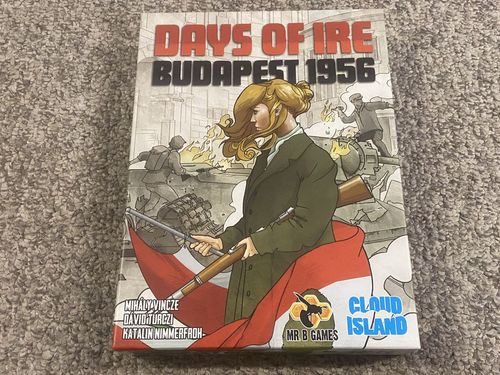
Days of Ire: Budapest 1956
Days of Ire: Budapest 1956 Rulebook
Table of Contents
Table of Contents
- Introduction
- Learning This Game
- Overview and Goal of the Game
- Components
- Setup
- Promo Component Rules
- A Brief History of the Revolution
- Zhukov Ruleset (Cooperative or Solo, 1-4 Players)
- Conflict Ruleset (1 vs Many, 2-4 Players)
- Appendix A: Headline Cards
- Appendix B: Event Cards
- Appendix C: Fighters and Revolutionary Tanks
- Appendix D: General Zhukov Cards
Introduction
Days of Ire: Budapest 1956 is a game for 1-4 players inspired by the real-life history of the 1956 October Hungarian Revolution. The game begins as the revolution first sparks to life on the evening of October 23rd.
Learning This Game
When you play the game for the first time, start with this booklet. In this booklet, you will find everything you need to know before the game starts, but nothing about what you need during play. Don't worry, you only need to get to the end of the Setup section on page 6, – after that you will find the Appendix, which you only need to read if you are interested in a specific card or the history of the Hungarian revolution. When you have set the game up, just continue by reading either the booklet labeled "Zhukov ruleset" or "Conflict ruleset", depending on which mode you have chosen to play.
Overview and Goal of the Game
The game plays through the first seven days of the revolution. The Revolutionaries have to resolve the notable events of the revolution on the city map, fight with the tanks of the Soviet Army and units of the State Protection Authority of Hungary. The Revolutionaries win the game if all of them survive and no more than 4 events remain unresolved by the end of the week. They can also win if they are able to drive out the opposing forces from the city, but they lose if their morale falls too much.
If the Revolutionaries achieve victory, the Soviet forces agree on a ceasefire on the 30th of October and leave the country – as they did in history for almost a week. But, if one ringleader falls, the fighters' morale plummets, or the city is left in the rubble by the time the fighting is finished, history takes a darker turn. The regime extinguishes this candle of freedom before it gleams bright enough for the world to see.
Components
- 1x Game board (620x480 mm)
- 3x Marker for Day, Morale, and Support (transparent)
- 2x Die (6-sided)
3x Booklets
- Starting rulebook & Appendix (210x285 mm)
- Conflict rules (210x285 mm)
- Zhukov rules (210x285 mm)
135x Cards (57x89 mm)
- 42x Headline cards
- 33x Event cards
- 8x State Protection Authority cards
- 38x Revolutionary cards
- 14x General Zhukov cards
101x Cardboard tiles, markers & tokens
- 22x Fighter tiles (human silhouette)
- 3x Revolutionary tank tiles (tank silhouettes)
- 11x Inactive fighter markers (dark teal circle)
- 14x Militia tokens (triangle)
- 5x Sniper tokens (square)
- 8x Soviet tank tokens (hexagon)
- 2x Barricade tokens (octagon)
- 9x Resolution markers (rectangle)
- 13x Injury markers (red circle)
- 5x Action markers (teal circle)
- 5x Free movement markers (orange circle)
- 1x Blue player token
- 1x Yellow player token
- 1x Red player token
- 1x Green player token
The game board is a map of Budapest, the capital of Hungary. The photos represent the 11 locations that were most important during the revolution.
The calendar shows the 7 days in October 1956 when actual firefights took place. The sides agreed to a ceasefire on the 30th which also marks the end of the game.
Setup
Before setting up the game, decide if you want to play with the Conflict ruleset for 2-4 players or the Zhukov ruleset for 1-4 players.
Conflict ruleset: Select one of you to play as the Soviet commander - a player can demand to do so by banging their shoe on the table. The rest of you will be the team of the Revolutionary players.
Zhukov ruleset: All players are in the Revolutionary team.
Setting Up the Board
- Place the board on the middle of the table, with the Revolutionary players sitting on the bottom side and the Soviet commander sitting on the top side.
- Place the day marker on the "October 23rd" space of the calendar on the board.
- Place the morale marker on the underlined 2 space of the morale track on the board.
- Place the support marker on the underlined 4 space of the support track on the board.
- Take the 3 revolutionary tank tiles and place them next to the board.
- Take the 22 fighter tiles and randomly place 2 on the right side of each location on top of each other, face down. Then, flip the top one face up in each location and place an inactive marker on all 11 of them.
- Place the following tokens on the right side of the locations listed below: a) Kossuth Square: 1 sniper, 1 Soviet tank b) Radio: 1 sniper, 1 Soviet tank c) HWPP Headquarters: 1 sniper d) Stalin Square: 2 militia e) Csepel: 1 militia f) Széna Square: 1 militia
- Place the 3 starting event cards on the left side of the following locations on the board: a) Students' demands at University of Technology b) Petőfi Circle organizes protest at Bem Statue c) Civilians Armed in Corvin Passage
Setting Up the Revolutionary Side
- Form a draw deck from the revolutionary cards, place it next to the board and deal 5 cards to each Revolutionary player.
- Each player may pick a player token in one of the available colors (red, blue, yellow, green) and place it in the plastic standee.
- The Revolutionary players, as a group, decide on which locations each of them will start. Place the player tokens on the right side of the chosen location. Depending on the number of the Revolutionary players, they start in the following locations: a) 1 Revolutionary player: University of Technology b) 2 Revolutionary players: University of Technology (1 player), Bem Statue (1 player) c) 3 Revolutionary players: University of Technology (1 player), Bem Statue (1 player), Corvin Passage (1 player) d) 4 Revolutionary players (Zhukov ruleset only): University of Technology (2 players), Bem Statue (1 player), Corvin Passage (1 player)
- Place all remaining tokens, markers and tiles (10x militia, 2x sniper, 6x tank, 2x barricade, 13x injury, 9x resolution) and 2 dice next to the board.
Setting Up the Soviet Side
This part of the setup is different for the Conflict ruleset and the Zhukov ruleset.
Playing with the Conflict ruleset
- Separate the event cards into 4 decks by the 4 timing icons on the bottom right corner on their front. The icons are: 1, 2, 3, X. Note: ignore the big numbers in the top left corner, they serve no purpose during setup.
- Take the deck of 11 cards marked X. Shuffle 3 of them randomly into the event deck marked with 1, 4 into the event deck marked with 2. Put none into the deck marked 3. This will leave the deck marked X with 4 cards in it.
- Put the 4 newly formed decks face down on top of each other (X on the bottom, 3 over it, 2 over it, 1 on the top), forming the event deck.
- Fill up the 6 slots of the event market on the top of the game board starting from the (+0 CP) slots. Place one event card drawn from the top of the event deck in each slot, face up.
- Separate the headline cards by their backs, shuffle and place them next to the play area: a) 1 - Day of the Revolution b) 2 - Armed Uprising c) 3 - The Turning Tide
- Deal 4 headline cards to the Soviet commander from the deck "Day of the Revolution".
- Give all 8 State Protection Authority cards to the Soviet commander and form the SPA pool by placing them all face up next to his area.
The General Zhukov cards will not be needed in this game mode. Put them back in the game box.
Playing with Zhukov ruleset
- Separate event cards into 4 decks by the 4 timing icons on the bottom right corner on their front. The icons are: 1, 2, 3, X. Note: ignore the big numbers in the top left corner, they serve no purpose during setup.
- Shuffle the decks marked 1, 2 and 3. Stack them next to the board on top of each other (3 on the bottom, 2 over it, 1 on top) forming the major event deck.
- Shuffle the remaining event cards marked X and place them face down next to the board forming the minor event deck.
- Shuffle the General Zhukov cards and place them next to the play area.
The State Protection Authority cards and the 3 types of headline cards will not be needed in this game mode.
Starting the Game
Congratulations, you have set up the game!
Now it is time to learn the rules of play for the game mode you have chosen. The rules of the Zhukov ruleset and the Conflict ruleset can be found in the booklet with the same title. If you feel ready, take it in your hand and start reading!
If you have any Promo components, continue with the next section where you can find out how to set them up and use them.
If you wish to learn more about the history of the 1956 revolution of Hungary, keep reading this book! You will find plenty of interesting information and stories.
Whenever you have questions about a card in the game, you can find it in the Appendix section at the end of this booklet.
Promo Component Rules
You might have 9 additional promo cards not listed in the Components section, which provide additional strategic options and replayability. The game is fully playable using none, some or all of these cards.
AK-47
"AK-47" is an extra Revolutionary card that adds more variety to the weapons arsenal.
Setup: Shuffle the "AK-47" card into the Revolutionary card deck.
Rules: This card counts as both a food and a molotov resource when discarded for collecting icons. When using the ability, remove 3 militia from your current location. After doing so, no card is drawn as a reward as in "Action 3: Attack militia". However discarding the card for the ammunition resource when performing "Action 3: Attack militia" the reward is collected as normal. If there are only 2 or one militia present, remove them all. Snipers may not be removed. Using the ability is not an action.
Last Stand
"Last Stand" is an extra Revolutionary card with powerful "once per game" effect.
Setup: Shuffle the "Last Stand" card into the Revolutionary card deck.
Rules: When using the ability, immediately resolve an event in your current location in the same manner as outlined in "Action 2: Resolve an event" ignoring the event's resource requirements. No revolutionary card needs to be discarded for their icons, and the reward section's text effect is executed. This ability is an action, and can only be used if you have exactly one action remaining. If the reward of the action generates an additional action (see E#19, E#22 in the appendix) it is lost and may not be used.
Once played, keep the card in front of you as a reminder. If until the end of the day a hit is dealt to your location (even after using Transportation), you cannot choose to distribute it on anything else than injuring you. Remove this card from play at the end of the day.
Alternative Starting Events
The promo pack comes with 3 new starting events marked with A. The players may swap out the 3 default starting events for the 3 new ones. We don't recommend mixing and matching.
The alternative events mostly provide morale and cards for the Revolutionaries: thereby raising the Revolutionary players' effectiveness without reducing their opponent's, thus providing a much more "explosive" game.
Note: one of the 3 events contain an event penalty. If that event is still on the board at the end of the game the Revolutionaries automatically lose the game.
Setup: Remove the 3 starting events from the board and place the 3 alternative starting events on their respective locations a) Growing social discontent at University of Technology b) Remembering Poznań at Bem Statue c) SPA members suspected in Corvin Passage
Player Powers
The promo pack comes with 4 cards, matching the 4 player standees in the game. The powers are compatible with both Zhukov and Conflict rulesets, but some of them might be quite challenging when used against a live Soviet commander.
Setup: Give each card to the player with the matching standee before drawing starting cards. Then, each player (after discussing together) may elect to use the side of their card with a power printed on them. It is possible for some players to use the powers and for some not to. Mix and match as you please.
Difficulty settings: Each player power has a benefit and a disadvantage. By default, both must be applied. Optionally, they can be used to adjust the difficulty:
- Neglecting one or more disadvantages favors the revolutionary players
- Neglecting one or more benefits favors the Soviet commander (or General Zhukov)
A Brief History of the Revolution
After WWII, Hungary became a part of the Soviet sphere of influence with a permanent presence of the Red Army troops. Since 1945, Moscow had been sending Hungarian Communists to Hungary who were to be in charge of transforming the country into a Communist state. This also meant that key decisions would be made in Moscow; The Hungarian Communists would have mainly been acting as proxies to fulfil the Soviet agenda.
The whole process happened slower than expected: the Hungarian Communist Party failed to grab the power in the general elections of 1945 and 1947. Despite all of this, the Communists were getting more and more powerful. Due to the presence of the Soviet troops and the pressure they had exercised, key ministries (e.g. the Ministry of Interior) fell into the hands of the Communists. Those politicians who raised their voices against the creeping Communist takeover were either removed from their parties, forced to leave the country, or taken to the Soviet Union by force.
In 1949, the Hungarian Communist Party and the Social Democratic Party merged and the Hungarian Working People's Party (HWPP) was created. This marked the beginning of a one-party system, an era of blossoming personal cult and central planning in industry and agriculture. The new rulers were ruthless not only towards those who were treated as enemies of the system but sometimes towards their own comrades as well.
Following the Soviet example, a secret police (overseen by the Party) was created whose sole role was to ensure the Party is in power. The secret police was made up of a few former members of the secret service of the Hungarian Fascist government, and many penniless peasants. Secret forced labor camps were established on Hungarian soil; their inmates being political prisoners and/or enemies of the Communist state (including members of the intelligentsia, the clergy, and former owners of larger farmlands). History turned to be unbelievably cruel for some: amongst those imprisoned in the camps were people who had barely escaped the horrors of Nazi concentration camps. Between 1950 and 1953, the terror continued.
In 1953, Stalin died and the labor camps were closed. The regime began to soften as key Party members who played a central role in the past years were being replaced. There was, however, a continuous internal struggle in the ranks of the Party for influence and power. In general, the Hungarian society was not in a good state, as poverty became an everyday experience due to central planning, wages were hitting a new low and frequent food shortages started to occur.
A possible conflict was not evident but some had heard of the 1953 Berlin uprising and had learned of the bloody few days of June 1956 in Poznań. The latter played an important role for Hungarians who, getting fed up with the living standards and the regime in general, took to the street on October 23rd, 1956. By chance, the weather was exceptionally beautiful on that day compared to mid-autumn Hungary. Countrywide, the need for change slowly built up in the groups of society.
The Party was cornered from both sides: they needed to calm down the masses by fulfilling some of their demands but the leaders wanted to remain in power. In the midst of this, the Soviet troops stationed near Budapest were ordered to enter the capital. From the evening of October 23rd, sporadic fire fights broke out between locals and units of the hated State Protection Authority (SPA), who were soon becoming more widespread through the whole city.
Anger, fueled by the death of many unarmed civilians (shot by Soviet or SPA troops), turned the city and the country upside down: people were getting rid of symbols of the hated regime (e.g. red stars, statue of Stalin etc.) and were fighting against the oppressors with Molotov cocktails and "borrowed" weaponry (pistols, SMGs, Howitzers). Throughout the country, authorities were opening fire on the crowd. Until October 30th, these shootings had happened in 52 different locations not including Budapest.
The new government led by the moderate Communist Imre Nagy failed to regain control over the events and for days was swimming with the stream. Some important decisions were made which could have been good steps towards a regime in peace; The SPA was dissolved, political prisoners were released and preparations were done for a multi-party political system. Even though a ceasefire was reached by the end of October, a military intervention called Operation Whirlwind erased everything on November 4th.
The Soviet-backed new regime led by János Kádár got its revenge: till mid-December, civilians kept getting shot by authorities; in 1958, key figures of the revolution were executed (such as Imre Nagy, who was buried in an unmarked grave in the outskirts of Budapest). For the average citizen, participating in the revolution often meant getting a harsh sentence, sometimes even death penalty. Kádár remained in power for more than 30 years.
On June 16th 1989, nearing the downfall of the Soviet Union, Nagy was reburied with a big state celebration. Two and a half weeks later, Kádár died.
The international recognition of the event was tremendous. United Nations (UN) meetings were called for discussion on the rising tension between the SU and the Western countries. Danish UN diplomat Povl Bang-Jensen, secretary of the special committee investigating the events refused to release the names of witnesses testifying in front of the committee, to protect their identity from the Soviets. His 1959 death still remains a mystery. The "Hungarian freedom fighter" was Person of the Year 1956 on Time magazine. Ironically, the next year, Nikita Khrushchev won the title, the man who crushed the revolution in November.
The story of the 1956 Hungarian revolution is about a great web of joint interactions between fighters, locals of Budapest, and citizens living outside of the capital. Students distributed food in districts of the city, locals offered their motorbikes to transport the wounded to hospitals, tons of food was sent to Budapest on a daily basis. The revolution also spread to the countryside; information was distributed to the citizens mostly with the help of the personnel of the Hungarian State-Owned Railway Company.
The heaviest fights were happening in districts where mostly blue-collar workers (approximately 60% of those killed during the revolution) lived and worked: District Csepel and Corvin Passage were two of the strongholds. The fights being local also helped, as a petrol station was nearby, fighters of Corvin Passage had an easy access to gasoline, the key component of Molotov cocktails. During the October fights, many Hungarian Roma also paid with their lives for the short freedom of the country.
According to sources, more than 1900 (mostly blue-collar workers, trainees etc.) died during the fights in Budapest, and 2700 in all of Hungary—of them, more than 670 were younger than 25, more than 150 were between the ages of 19–20, more than 30 between the ages of 14–15. About 40% of all dead were under 24.
Doctors who either treated the wounded or issued death certificates for the deceased often wrote different symptoms on these papers to protect the wounded or the family of the deceased (e.g. "pneumonia" instead of "pierced lung"). History, after the revolution was crushed proved them right, as the newly-installed regime tried to take revenge even on the families, forcing approximately 150000 people to exile.
The most vulnerable group to both sides' fire were the medics and ambulance personnel—SPA members were caught using ambulance cars to transport weapons. This, on the side of the revolutionaries lead to the assumption that all ambulances were being used this way. The shots fired at the cars left medics paralyzed, dead and heavily injured. It is notable to mention that medics and doctors treated the wounded of all sides, not only revolutionaries but Soviet soldiers and SPA personnel as well.
Between October 23rd and December 31st, approximately 20000 wounded were treated (83% of them got injured in Budapest), with an 8% mortality rate. An enormous contribution was coming from the International Red Cross and its country branches. It is estimated that about 1/3–1/4 of all aid (blood, food, bandages etc.) were arriving from Poland—people there remembered the help Hungary gave to them during WWII, and besides the efforts of the Polish Red Cross, cities like Warsaw, Cracow, Wrocław and Poznań all organized collection and transport of aid to Hungary, the first arriving on October 26th.
The significance of the Hungarian revolution, in a nutshell is threefold. First, it was the first major armed conflict to show the true, inhuman face of the Soviet Union and the rigidness of world Politics at the time. There was no real chance for Hungary to obtain her freedom in 1956, the political deals between the US and the SU did not allow that to happen. Secondly, after the revolution was crushed, Western European left-wing intelligentsia (e.g. Sartre, Albert Camus) started questioning their attitudes towards Communism as a philosophy. Finally, from a pure military standpoint, the method of besieging a city was changed forever.
Zhukov Ruleset (Cooperative or Solo, 1-4 Players)
Play alone or co-operate to stand strong against General Zhukov.
The setup of the game can be found in the Setup section above (pages 4-6 of the Starter rulebook).
First Game With Reduced Difficulty
If you are playing the game for the first time, it is recommended to make the game a bit easier for yourselves, and follow all or some of these changes after the setup:
- Place the morale marker on the 3 space of the morale track.
- Remove one sniper from Radio
- Remove the inactive marker from a fighter on any location (in short, "activate a fighter"), then flip the other fighter on that location and place the inactive marker on it.
Note: Playing the game with 4 Revolutionaries is extremely challenging! We recommend trying it with less on your first try, and when you dare to play with 4 feel free to use as many of these changes to make the game easier as you like!
Georgy Konstantinovich Zhukov, a successful WWII general, was the Minister of Defense during the revolution. Although he was commanding the troops stationed in Budapest, at first he was not supporting the idea of a full-scale invasion of Hungary and even considered withdrawing troops from Budapest after seeing the heavy losses of his own troops.
Game Structure
The game plays through the first 7 days of the revolution. Each day has 3 main phases:
- Soviet phase: General Zhukov orders the units of the Soviet army and spreads new events on the board.
- Revolutionary phase: The Revolutionary players move on the board, deal with the events, call the people of the street to their side, fight the Soviet Army and the State Protection Authority.
- State Protection Authority phase: The State Protection Authority attacks the Revolutionaries.
After the end of the 7th day, the game ends with an evaluation where victory conditions for the Revolutionary side must be checked. The game can also end before the end of the 7th day if special victory conditions are met by either the Revolutionary or the Soviet side.
The phases are explained in the next sections.
Phase 1: Soviet Phase
The Zhukov deck represents the Soviet commander in the absence of a player taking on the role. The General Zhukov cards can be either red or green on their front. Green cards help the Revolutionaries while red cards have a negative effect. All cards have 3 headline titles and 3 corresponding headline effects which belong to the 3 time periods of the revolution and an event placement icon which is executed after the appropriate headline text effect.
At the start of the Soviet phase on each day, draw 4 cards from the General Zhukov deck, resolve them in draw order, then discard them face up in a separate discard pile. On the 4th day, the General Zhukov deck will run out after drawing the first 2 cards. In this case, shuffle the discarded cards (including the 2 just resolved) to form a new draw deck and draw and resolve 2 more cards from it.
The resolution of a General Zhukov card has 3 steps:
- Support step
- Headline step
- Event step
Support step
Check the position of the support marker on the support track.
- If the support marker is on the neutral "4" or a colored space matching the color of the General Zhukov card: proceed to the headline step (and then to the event step).
- If the support marker is on a colored space different than the color of the General Zhukov card: Move the support marker one space towards the neutral 4 space on the support track and proceed to the event step (skipping the headline step).
Support step example 1: A green General Zhukov card is drawn. As the support marker is on a green "4" (neutral or matching color) proceed to the headline step.
Support step example 2: A red General Zhukov card is drawn. As the support marker is on a green "4" (different color) move the support marker towards the neutral "4" and proceed to the event step.
Headline step
In this step, execute one of the 3 headlines on the General Zhukov card and their text effects (See Appendix D on details of specific General Zhukov cards):
- On the 1st and 2nd day resolve the top headline on the card
- On the 3rd, 4th and 5th day resolve the middle headline on the card
- On the 6th and 7th day resolve the bottom headline on the card
If a text effect has the lapsing icon next to it place the General Zhukov card itself on the board as a reminder that the text effect is enforced throughout the whole day, instead of discarding it once resolved. Discard the General Zhukov card at the end of the day.
At the end of the headline step, always proceed to the event step.
Event step
In this step, execute the effect of the event placement icon on the bottom of the card. There are 3 types of event placement icons:
- Place minor event: Draw an event card from the minor event deck and place it on its corresponding location, on the left side of the photo. If there is already an event in the target location, discard the minor event instead of placing it.
- Discard major event: Draw an event card from the major event deck and discard it.
- Place major event: Draw an event card from the major event deck, and place it on its corresponding location, on the left side of the photo. After placing the event on the board, execute the text effect in the placement section (brown arrow). If the text provides a choice, the players can make the choice.
- If there is an event card already on the corresponding location, remove that event from the board without any effect and discard it to free up the space for the drawn event card.
- "Anywhere" events have no corresponding location. They must be placed in any empty location. If there are no empty locations on the board, discard the event drawn without effect.
Event placement example 1: A major event belongs "Anywhere". It can be placed in Csepel where there is no event and cannot be placed in Corvin Passage which has an event in it.
Event placement example 2: A major event belongs in Corvin Passage but there is already another event. Discard it from the board without any effect and place the drawn event instead.
Phase 2: Revolutionary Phase
Note: the rules written here are exactly same as the Revolutionary phase described in the Conflict rulebook, with the exception that there can be 4 Revolutionary players in the Zhukov rules.
In this phase, the Revolutionary players take turns to act. At the start of each phase they are free to decide on a turn order. Each player can do a number of actions in their turn depending on the player count and the chosen turn order.
| Player count | 1st player | 2nd player | 3rd player | 4th player |
|---|---|---|---|---|
| 1 player | 4 actions | - | - | - |
| 2 players | 2 actions | 2 actions | - | - |
| 3 players | 2 actions | 1 action | 1 action | - |
| 4 players | 1 action | 1 action | 1 action | 1 action |
The players must take or pass all their available actions before the next player's turn.
Note: For every player count, the total number of actions for the Revolutionary team is 4.
Tip: Use the 2-sided action markers (Action / Spent Action) to keep track of the actions taken.
Revolutionary Cards and Fighters
Most of the actions require the revolutionary players to use revolutionary cards. Players are not allowed to show their hand to each other, but they are free to discuss them.
Every Revolutionary player has a hand limit of 10 cards. A player with 10 cards at no point in the game may receive an 11th card.
All revolutionary cards are always discarded after they are played. Discarded cards are placed face up in a revolutionary discard pile. If the draw deck runs out, the revolutionary discard pile is reshuffled to form the new revolutionary draw deck. Players may always go through the discard pile to check for specific cards.
Players can also use the help of fighters. These tiles represent those who fought in Budapest during the revolution.
Throughout the game, players may have the possibility to gain a revolutionary tank. Whenever a card instructs the players to place a revolutionary tank, select one of the available tiles randomly. Revolutionary tanks on the board are considered active fighters for all purposes. Whenever the rules or a card mentions "active fighter" it applies to a revolutionary tank as well.
Movement
A Revolutionary player may move on the board before taking each action during their turn. If the player has more than one action in their turn, they can move before each of them, but not after the last action is spent.
During movement, a player may take any number of movement steps. A movement step is taking the player piece from its current location to an adjacent location. Two locations are adjacent if their photos are connected with pinned strings.
Each turn, the first movement step of each Revolutionary is free. If a revolutionary has more than one action during their turn, only the first movement step (prior to the first action) is free. Each additional movement step requires the player to discard 1 revolutionary card (of any type).
Tip: Use the 2-sided free movement markers (Free Movement / Spent free Movement) to keep track of the free movements taken. Each player has one of these markers.
When moving, the players may take a maximum of 2 active fighters along with them.
The number of active fighters in one location cannot exceed 4 at any point. If bringing one or more would cause this number to be exceeded, that fighter must be left behind.
Fighter movement example: Blue player makes a legal move from Csepel to Corvin Passage moving 2 active fighters and having 4 active fighters on his destination.
Actions
After movement (or staying in place) the player may spend their available action(s). Most of the actions require using revolutionary cards or active fighters, but not all of them. There are 7 different actions to choose from.
- Activate a fighter to aid the revolutionary players
- Resolve an event to gain its reward
- Attack militia and draw one card at critical success
- Destroy a tank and increase morale
- Use card or fighter ability
- Give or take cards to / from another Revolutionary
- Draw one card
The actions may be taken in any order, and the same action can be performed more than once.
Action 1: Activate a fighter
Remove the inactive marker from a face up fighter tile in the same location as the player. If there is another (face down) fighter tile in the location, reveal it and place the inactive marker on it, otherwise remove the marker from the board. The "Activate a fighter" action cannot be carried out in a location with 4 active fighters already, as only 4 active fighters can be in the same location at the same time.
Note: There are 22 active fighters in the game each of them with unique names, resource icons and abilities.
Action 2: Resolve an event
Collect enough resource icons to resolve an event in the same location as the player. Event cards have resources indicated in their reward section (green tick). This indicates the resources that the revolutionaries will need to provide in order to resolve that event (See Appendix B for details of specific event cards).
The six resources and their icons are: information, medical, molotov, food, ammunition, vehicle.
The icons for resolution can be collected from active fighters in the location of the event. Additionally, the acting player may discard any number of revolutionary cards from their hand and collect the icons shown in their top-left corner. Other players, even those on the same location, cannot discard cards to help. A card with 2 of the same icons gives both of them, with the exception of the "Aid" card, which only counts as one of the icons it displays. Each icon collected through the played cards as well as active fighters must match each icon on the event reward section. Any excess icons are ignored. If players provide all of the icons on the reward section, the event is successfully resolved.
Resource icon example: A player collects resources from an active fighter and 2 discarded cards, matches them with the resources on the event card and successfully resolves the event.
Some event cards have an icon after a resource. The player must provide a number of resources equal to or more than the total number of event cards (including itself) placed on locations on the board.
An event must be resolved in one action. If successful, remove the event card from the board and discard it.
When an event is resolved the acting player executes the text effect of the reward section. Here are some important clarifications regarding rewards gained from resolving an event:
- Shift morale towards the Hungarian end or the Soviet end: Move the marker on the morale track one position towards the end with the corresponding icon on it, respectively.
- Shift support towards the Hungarian end or the Soviet end: Move the marker on the support track one position towards the end with the corresponding icon on it, respectively.
- Move / Remove enemy units such as militia, snipers or Soviet tanks, depending on the event card reward. Note: Removing units does not count as killing or destroying them, and no additional rewards are gained unlike during "Action 3: Attack militia" and "Action 4: Destroy a tank" actions.
Some event cards have one or several icons on their bottom right corner which indicate an effect to be executed upon resolving the event.
- 1, 2, 3 (time period) or X (minor event): These icons have no effect and are only important during Setup and in the Soviet phase.
- Lapsing: The reward of the event takes effect for the whole day. After it is resolved, keep the event card next to the board as a reminder and discard the card only at the end of the day.
Lapsing example: The card "First aid kit" becomes stronger for the whole day as part of the reward.
- Mark: After resolving the event place a resolution marker with the same title as the event in the ashtray on the board as a reminder that the event was resolved. Resolved events with the mark icon change the reward of other specific events and also their placement effect (See Phase 1: Soviet phase section).
Mark example: The text effects of certain cards are modified when matching markers are in the ashtray. The reward of the event "Ambulance under fire" becomes stronger because "Kilián Barracks treats the wounded" was resolved earlier.
Action 3: Attack militia
Collect 1-5 ammunition icons to attack the same number of militia (1-5) in the same location as the player. Collect icons in the same manner as seen in "Action 2: Resolve an event".
Immediately remove the attacked militia units from the board. Additionally, if at least 3 militia units were attacked, draw a card as a reward (hand limit is 10).
Note: Snipers cannot be killed this way, but they can be killed with an "Ambush" card.
Action 4: Destroy a tank
Collect 3 molotov icons to destroy one Soviet tank in the same location as the player. Collect in the same manner as seen in "Action 2: Resolve an event".
Immediately remove the destroyed tank from the board and shift morale towards the Hungarian end 2 times as a reward.
Action 5: Use card or active fighter ability
Revolutionary cards may have abilities written on them. When using a card for its ability, discard the card face up and execute the text effect. Card abilities have 2 kinds of labels:
- "Action": the player must take an action to use the ability.
- No label: the player does not have to take an action to use the ability, and simply executes the text. It can be done before movement, between 2 movement steps, before or after taking an action, but not outside of a player's turn.
Active fighters (and revolutionary tanks) may also have abilities written on them (See Appendix C on details of specific fighters and tanks). A fighter must be active in order to use its ability. Active fighter abilities have 3 kinds of labels:
- "Action": each player can use the ability by taking an action in the same location as the fighter.
- "Once per turn": each player can use the ability once per turn without taking an action, in the same location as the fighter.
- "Passive": the ability is continuously provided throughout the whole game in the active fighter's location.
Action 6: Give or take cards
A player may choose one of the following:
- Give any number of cards to one other player (hand limit is 10) in the same location.
- Take any number of cards from one other player (hand limit is 10) in the same location.
Action 7: Draw a card
A player may draw one revolutionary card from the draw deck. If already at hand limit (10 cards), this action may not be taken.
Retaliation of Soviet Tanks
If a player takes an action in the same location as a Soviet tank, it fires at the player before the action is taken. Roll a die for each Soviet tank in the location. For every roll of 1-3, deal one hit. If the hit removes an active fighter providing a resource icon necessary for the action (for example a Molotov for "Action 3: Destroy a tank"), that resource icon still counts as gathered and the action is still successful.
Barricades in a location prevent the Soviet tanks from firing and moving as well as impeding the movement of militia and snipers (see Phase 3: State Protection Authority phase). By playing a "Build barricade" card, a barricade token can be placed in a location. Note: a single barricade will stop all Soviet tanks in an area from firing before an action.
Hits
A hit is damage dealt to a location and suffered by the Revolutionaries. For each hit to a location, the Revolutionary players must choose one of the following 3 options:
- A Revolutionary player in the location takes an injury marker
- An active fighter is removed from that location
- A barricade is removed from that location
Note: Though after taking the 4th (or 5th) injury you lose the game, several cards and fighter abilities can be used to remove an injury. Fighters can also be revived sometimes. Revolutionary tanks and barricades, however are permanently out of the game once removed.
Note 2: Be careful managing your injuries! Apart from the Soviet tanks, militia and snipers, several headline cards and events can deal injuries.
Drawing Revolutionary Cards
After all the Revolutionary players have taken their turns the Revolutionary team draws revolutionary cards equal to the number indicated by the morale marker on the morale track. Without looking at the cards, they must distribute them between each other evenly. If an even distribution is not possible then a player may be given one more card than any other player.
If drawing cards would put a player above their hand limit of 10 cards, any excess cards allocated to those players are distributed between the remaining players if possible. If not, reshuffle these cards into the draw deck.
Drawing revolutionary cards example 1: Morale is 5 and there are 2 players with 5 cards in hand each. Blue player takes 2 cards and Red takes 3. The difference between taken cards is 3-2=1.
Drawing revolutionary cards example 2: Morale is 5 and there are 3 players with 5 cards in hand each. Blue player takes one card, Red takes one, and Yellow takes 3 cards. The difference between taken cards by Red and Yellow is 3-1=2. This is not legal!
Phase 3: State Protection Authority Phase
In every State Protection Authority phase, perform the following steps without playing any cards:
- Move militia: Move every militia in locations adjacent to a player into the player's location. If a militia is adjacent to multiple players, choose the player earlier in turn. Militias do not move in locations with a player or a barricade.
- Move snipers: Move every sniper one location closer to the closest player. If more players are the same distance from a sniper, either can be chosen. If multiple paths bring the sniper closer to a player, either can be chosen. The snipers do not move in a location with a player or a barricade.
- Place militia/sniper: a) Place one militia each in Csepel, Széna Square, and HWPP Headquarters. If there are less than 3 militia left, choose between these three locations. a) If no militia were placed in this step, place one sniper in Astoria instead. If there are no more snipers to place, do nothing.
- Attack: In every location calculate the total strength of militia and snipers. Snipers have a strength of 3, militia have a strength of 1. Note: Soviet tanks are not SPA units and do not add to the total unit strength. a) Fire: Roll 2 dice for all locations where a player, an active fighter or a barricade is present. If the smaller number rolled is equal or below the total strength, deal one hit (See Revolutionary phase section on hits). If the sum of both dice is equal or below the total strength, deal one more hit. b) Threaten: After firing, for each location with the total strength of 9 or more, and no barricades present, shift morale towards the Soviet end once.
State Protection Authority phase example:
- Move militia: The militia on Radio moves towards the Yellow player. The militia on Astoria is too far and the militia on Corvin Passage are already in the same location as the Yellow player – neither moves.
- Move snipers: The sniper on Astoria is 2 distance away from both players. They decide to move him to Radio. The snipers on Corvin Passage are already in the same location as the Yellow player and not move.
- Place militia: One militia is placed on Csepel (along with Széna Square and HWPP Headquarters that are not shown on the image).
- Attack: Csepel and Corvin Passage is attacked. Total strength in Csepel is 1+1=2; Total strength in Corvin Passage is 1+1+1+3+3=9. a) Fire: 2 dice are rolled for hits on all attacked locations. b) Threaten: Total strength in Corvin Passage is 9. Players shift morale towards the Soviet end.
The State Protection Authority was the main enforcer of Stalinist ideology in Hungary and therefore was used to break the Christian Churches who had considerable influence in the society. Until 1951, SPA was harassing, blackmailing or murdering priests and pastors or forcing them to collaborate with the SPA to destroy the image and work of the Clergy.
End of the Day
The SPA phase is the last phase of a day. Move the day marker on the calendar one space higher. From the 6th day (October 28th) move to the next row. When the "October 30th" space is reached (at the end of the 7th day), the game ends.
Ending the Game
The game normally ends after the 7th day (October 29th).
Event penalties
Some event cards have a penalty on them which is indicated in the penalty section (red X). (See Appendix B in the Starter rulebook for details on specific events). If such an event card is on the board unresolved at the end of the game, execute the text effect in the penalty section. Then move onto the evaluation.
Evaluation
On October 30th, the struggling sides sit down to negotiate. If 4 or less events are placed on locations on the board, the crisis is contained and the Hungarians manage to gain a ceasefire promise from the Soviet leadership, ending the revolution with a victory of the Revolutionary players.
If there are more than 4 event cards on the board, the revolution fails to live up to the promise and the Revolutionary players lose.
Immediate Defeat or Victory
The game ends in an immediate defeat for the Revolutionary players if:
- At any point in the game any one player takes the 4th injury marker in a game with 3 or 2 Revolutionary players or the 5th injury marker in a game with a single Revolutionary player.
- At the end of any day or at the end of the game the morale marker is on the last (Soviet) space of the morale track.
The game can also end in an immediate victory for the Revolutionary players, if there are no tanks and no militia present on the board at any time during the Revolutionary phase.
Difficulty Settings
Once you played the game a few times with the unmodified difficulty, it is possible to make it even more challenging:
- Shift support towards the Soviet end once, or twice after Setup.
- Add 2 militia to Astoria and / or Blaha Lujza Square during Setup
- Win the game if 3 or less event cards are on the board during Evaluation (instead of 4).
Conflict Ruleset (1 vs Many, 2-4 Players)
1 versus the others, will you lead them or crush them?
The setup of the game can be found in the Setup section above (pages 4-6 of the Starter rulebook).
Game Structure
The game plays through the first 7 days of the revolution. Each day has 3 main phases:
- Soviet phase: the Soviet commander begins the day with event cards and commands the Soviet Army to invade the city of Budapest and contain any activity.
- Revolutionary phase: The Revolutionaries move on the board, deal with the events, call the people of the street to their side, fight the Soviet Army and the State Protection Authority.
- State Protection Authority phase: The Soviet commander leads the units of the State Protection Authority to protect the buildings and hunt the Revolutionaries.
After the end of the 7th day, the game ends with an evaluation where victory conditions for the Revolutionary side must be checked. The game can also end before the end of the 7th day if special victory conditions are met by either the Revolutionary or the Soviet side.
The phases are explained in the next sections.
Phase 1: Soviet Phase
The Soviet phase has 5 steps:
- Headline step
- Event step
- Army step
- Support step
- Market step
Headline step
In the headline step, the Soviet commander may play any number of headline cards from hand in any order and keep the rest in hand. There are two types of headline cards, red and green.
Red cards help the Soviet side, while green ones are beneficial to the Revolutionaries. All cards have a title, a text effect, icons and Command Points (CP) on them. The Soviet commander can spend Command Points in the next steps of this phase.
The commander has different options on how to play headline cards, depending on their color. A headline card must be fully dealt with before the next one is played. (See Appendix A on details of specific headline cards.)
Red card options — Choose one of the following:
- Collect Command Points. The headline card is revealed and placed on the board face up. The Soviet commander gains the CP value indicated on the top left corner. The text and icon effects of the card are ignored. Keep the card in front of the Soviet commander to keep track of the CP collected.
- Resolve headline. The headline card is revealed and placed on the board face up. The text effect and icon effects of the card are executed by the Soviet commander. The CP of the headline card is ignored. Discard the card face up next to the board after the card is resolved.
Red headline example 1: The option "Collect Command Points" was chosen for the red headline "Crowd burns propaganda". The Soviet commander collects 3 CP from it. The text and icon effects of the card are ignored.
Red headline example 2: The option "Resolve headline" was chosen for the red headline "Crowd burns propaganda". The Soviet commander executes the text effect (shifts support towards the Soviet end) and then the icon effect (retrieves one SPA card). The red icon indicating the time period has no effect. The commander gathers no CP.
Green card options — Choose one of the following:
- Collect Command Points and resolve headline. The headline card is revealed and placed on the board face up. The Soviet commander gains the CP value indicated on the top left corner. The text effect and icon effects of the card are executed by the Revolutionary players. Keep the card in front of the Soviet commander to keep track of the CP collected.
- Discard. Discard the headline card face up ignoring CP and all effects.
Green headline example: The option "Collect Command Points and resolve headline" was chosen for the green headline "National guard begins organization". The Soviet commander collects 3 CP from it. Then the revolutionary players execute the text effect (they remove one militia from Csepel then draw a random revolutionary tank tile and place it on Kossuth Square). There is no icon effect to be executed on the card only the one indicating the time period (which has no effect).
Icons
After the text effect on a card is executed, the players should examine the icons on the bottom of that card. There are 4 types of icons on the headline cards, denoting different effects.
- 1, 2, 3 (time period): These icons do not have an effect and are only important during Setup.
- Lapsing: Place the card itself on the board after the Army step, as a reminder that the card's text effect is enforced through the whole day. Discard the headline at the end of the day only.
- SPA: Red headline cards always have this icon, indicating a number from 0 to 3. The Soviet commander may retrieve that number of SPA cards from the bottom of the SPA discard queue and adds them to the face up pool of available SPA cards (see Phase 3: State Protection Authority phase on SPA cards and discard queue).
- Mark: Take the resolution marker corresponding to the headline title and place it on the ashtray on the board as a reminder that this headline has been resolved. It will modify the text effects of other headline cards and events.
Lapsing example: One Revolutionary player can take one more action during the day "Pál Maléter aids the revolution" was resolved.
SPA example: The bottom card in the SPA queue is placed back to the SPA pool.
Mark example: The text effects of certain cards are modified when matching markers are in the ashtray. The text effect of "Soviets stationed at the Parliament" is modified, one more Soviet tank can be placed.
Event step
In the event step, the Soviet commander may spend the Command Points collected in the headline step to buy event cards from the event market. The base (CP) cost of an event card is indicated on its upper left corner. If the base cost of the event is "X", that card is called a minor event: its base cost is equal to the number of minor event cards currently present on locations on the board. The event cards with a specific base cost are called major events. The base cost of an event is increased by the number above the market slot it was bought from: (+0), (+1) and (+2).
Note: The base cost of the first minor event placed is 0 CP, the second placed is 1 CP, etc.
Event market example: The Soviet commander gathers 2+4+2=8 CP from headline cards then buys 3 events from the market for 2+4+1=7 CP. The base cost of the minor event is 0, because there is no minor event placed on the board yet.
Most event cards have a corresponding location on the board where they belong. Events bought are placed on the left side of the location photo. "Anywhere" events have no corresponding location. They must be placed in a location with no event in it. If there are no such locations then the event cannot be bought.
If the Soviet commander would like to buy an event card but its corresponding location is already occupied by another event, the following rules apply:
- A minor event belonging to that location cannot be bought.
- A major event belonging to that location may be bought, but the Soviet commander must discard the event that is already on the location without effect and then place the one just bought.
Event placement example 1: A major event belongs "Anywhere". It can be placed in Csepel where there is no event and cannot be placed in Corvin Passage which has an event in it.
Event placement example 2: A major event belongs in Corvin Passage but an event already is there so you must remove the event without effect and place the new.
After placing an event card, the Soviet commander must execute its text effect in the placement section (brown arrow). (See Appendix B of the Starter rulebook on details of specific event cards)
The Soviet commander may select the next card to buy after dealing fully with an event card.
Army step
In the army step, the Soviet commander may spend any remaining Command Points to move and place additional Soviet tanks. Note: tanks automatically fire before a Revolutionary player takes an action in the same location (see Phase 2: Revolutionary phase).
- 1 CP – Move a Soviet tank to an adjacent location. Two locations are adjacent if their photos are connected with pinned strings on the board (See Phase 2: Revolutionary phase for an example of adjacency). The same tank cannot be moved more than once in the army step this way. This option cannot be chosen in a location with a barricade (see Phase 2: Revolutionary phase on barricades).
- 3 CP – Place one Soviet tank in a reinforcement location (Csepel, Széna Square, HWPP Headquarters).
There can only be a maximum of 8 Soviet tanks on the board at any point in the game. Whenever a card would instruct placing units above the limit, the Soviet commander must place just enough to reach the limit. There is no limit on how many Soviet tanks can be in one location.
Support step
In the support step, the Soviet commander discards the headline cards played for the "Collect Command Points" (red card) or "Collect Command Points and resolve headline" (green card) options face up and then draws cards back up to the hand limit. The hand limit is the number indicated by the support marker on the support track.
Note: Red headline cards played for the "Resolve headline" option are already discarded at this point.
Note 2: SPA cards do not count as part of the Soviet commander's hand.
The day marker on the calendar displays the names and colors of the headline decks from which the Soviet commander can draw.
On the 1st day, cards are drawn from the 1 deck. On the 2nd day, cards can be drawn in any combination from the 1 and 2 deck. On the 3rd and 4th day, cards are drawn from the 2 deck. On the 5th day, cards can be drawn in any combination from the 2 and 3 deck. On the 6th day, cards are drawn from the 3 deck. No cards are drawn on the 7th day.
If the 3 deck runs out on the 6th day, the Soviet commander may draw from the 2 deck. If the 2 deck also runs out, cards may be drawn from the 1 deck.
Market step
After the Support step, the Soviet commander must refill the event market. They must choose exactly 2 event cards on the market to keep and move them to the (+0) slots and discard the rest of the event cards face up. Then, starting with the (+1) slots, the Soviet commander must fill up the event market with new event cards drawn from the top of the event deck. If there is only one event card remaining on the market, the Soviet commander must keep that single event and fill up the market accordingly. If there are not enough cards to refill the market, refill as much as possible. Discarded event cards never return to play, not even if the draw deck runs out.
Note: On the 7th day the event deck runs out and the market doesn't need to be refilled.
Market refill example: The Soviet commander bought 2 event cards during the event step. In the market step the commander selects 2 event cards on the market and puts them on the "+0" slots and discards the rest. Finally the commander refills the market with 4 event cards.
Phase 2: Revolutionary Phase
Note: the rules written here are exactly same as the Revolutionary phase described in the Zhukov rulebook (see above), with the exception that in the Conflict rules there cannot be 4 Revolutionary players, and players are free to discuss openly, loud enough so that the Soviet commander can hear everything.
| Player count | 1st player | 2nd player | 3rd player |
|---|---|---|---|
| 1 Revolutionary | 4 actions | - | - |
| 2 Revolutionaries | 2 actions | 2 actions | - |
| 3 Revolutionaries | 2 actions | 1 action | 1 action |
The players must take or pass all their available actions before the next player's turn. For every player count, the total number of actions for the Revolutionary team is 4.
All rules for Revolutionary cards and fighters, movement, the 7 actions, retaliation of Soviet tanks, hits, and drawing revolutionary cards are identical to those described in the Zhukov ruleset's Phase 2: Revolutionary phase above, including in the Conflict ruleset. One additional note applies to the icon effects on resolved event cards: they work in a similar manner to the headline cards (See Phase 1: Soviet phase subsection: Headline step).
Phase 3: State Protection Authority Phase
At the end of each day, the Soviet commander executes the orders for the State Protection Authority of Hungary (SPA). The SPA has two types of units: the militia and the sniper. There can only be a maximum of 14 militia and 5 snipers on the board at any point in the game. Whenever a card would instruct placing units above the limit, the Soviet commander must place just enough to reach the limit. There is no limit on how many units can be in a single location.
Note: Soviet tanks are part of the Soviet Army and they cannot be ordered in the SPA phase.
The SPA cards are placed on the table, face up, forming an SPA card pool. In the SPA phase, the Soviet commander can either:
- Play SPA cards from the SPA card pool.
- Retrieve all previously played SPA cards back to the SPA card pool.
The State Protection Authority was the dreaded secret police of the Hungarian Communist regime. Modeled after the Soviet secret service, it was an autonomous force—their orders came directly from the Party. It was comprised of dedicated Hungarians ideologically trained to protect the people from "enemies outside and inside". They had permission to act above the law: to investigate, interrogate and even kill.
Playing SPA cards
If the Soviet commander chooses to play cards, he may play any number in any order. Played cards are discarded in order of resolution in a discard queue. Put the cards into the queue partially overlapping, so previously discarded cards remain identifiable for all players.
There are 4 different SPA cards. Their effects are explained in detail below.
SPA card 1: Move sniper
A single sniper may be moved from its current location to an adjacent location. Two locations are adjacent if their photos are connected with pinned strings.
If a barricade is present in a location, the sniper may move into it but may not move out from it.
Moving sniper example 1: A sniper moves legally from Radio to Corvin Passage where a barricade is present.
Moving sniper example 2: A sniper can NOT move legally from Corvin Passage with a barricade present.
SPA card 2: Move militia
Choose one of the following options:
- Move one militia up to 3 times
- Move one militia up to 2 times and another militia once
- Move up to 3 militia once
If a barricade is present in a location, a militia may move into it but not out from it.
Moving militia example: One militia is moved once from Astoria to the Radio. A barricade is at the Radio so the militia cannot move from there. Another militia is moved once from Csepel to Corvin Passage. A third militia is left in its place as all movement by the card is optional.
SPA card 3: Place militia
Up to 2 militia may be placed together in a single reinforcement location marked with the reinforcement icon. These locations are Csepel, Széna Square and HWPP Headquarters.
Note: There can only be a max of 14 militia on the board.
SPA card 4: Attack!
Choose a location with SPA units (militias, snipers) in it to carry out the attack there. 2 Attack! cards can be played on the same day but they cannot target the same location.
Calculate the total unit strength. Snipers have a strength of 3, militia have a strength of 1. Then perform the following 2 steps:
- Fire: Roll 2 dice. If the smaller number rolled is equal or below the total unit strength, deal one hit (See Revolutionary phase section on hits). If the sum of both dice is equal or below the total unit strength, deal one more hit.
- Threaten: If the total unit strength is 9 or more shift the morale towards the Soviet end. If a barricade is present, this step does not happen.
SPA attack example: Corvin Passage is attacked. The total unit strength there is 3+3+1=7. Fire: The Soviet commander rolls 2 dice. They land a double hit and Red player chooses to remove the barricade token and take one injury marker. The active fighter is saved. Threaten: the total unit strength is below 9, the morale is not shifted (even though the barricade is removed).
- Smaller rolled number is below 7 = hit!
- Rolled sum equals 7 = hit!
Retrieving SPA cards
If the Soviet Commander chooses to retrieve cards he retrieves all of them from the discard queue to the SPA pool. Note: the Soviet commander may also retrieve SPA cards by playing headline cards on the Soviet phase (See Phase 1: Soviet phase section for details).
End of the Day
The SPA phase is the last phase of a day. Move the day marker on the calendar one space higher. From the 6th day (October 28th) move to the next row. When the "October 30th" space is reached (at the end of the 7th day), the game ends.
End of the day example: The day marker is moved from 24th to 25th.
Ending the Game
The game normally ends after the 7th day (October 29th).
Event penalties
Some event cards have a penalty on them which is indicated in the penalty section (red X). (See Appendix B in the Starter rulebook for details on specific events). If such an event card is on the board unresolved at the end of the game, execute the text effect in the penalty section. Then move onto the evaluation.
Evaluation
On October 30th, the struggling sides sit down to negotiate. If 4 or less events are placed on locations on the board, the crisis is contained and the Hungarians manage to gain a ceasefire promise from the Soviet leadership, ending the revolution with a victory of the Revolutionary players.
If there are more than 4 event cards on the board, the revolution fails to live up to the promise and the Revolutionary players lose.
Immediate Defeat or Victory
The game ends in an immediate defeat for the Revolutionary players if:
- At any point in the game any one player takes the 4th injury marker in a game with 3 or 2 Revolutionary players or the 5th injury marker in a game with a single Revolutionary player.
- At the end of any day or at the end of the game the morale marker is on the last (Soviet) space of the morale track.
The game can also end in an immediate victory for the Revolutionary players, if there are no tanks and no militia present on the board at any time during the Revolutionary phase.
Difficulty Settings
It is possible to tip the balance in the favor of either side. These options are recommended when some players have more experience with the game than others.
Favoring the Revolutionary players — Choose any or all of these options:
- Shift morale towards the Hungarian end once or 2 times after setup.
- Remove the sniper from the Radio after setup.
- Increase the limit of injuries for immediate defeat by one.
- Activate a fighter in the same location as one of the Revolutionary players.
Favoring the Soviet commander — Choose any or all of these options:
- Shift morale towards the Soviet end after setup.
- Place one militia in Csepel and/or Stalin Square after setup.
- Shift support towards the Soviet end after setup. This is a rather drastic change.
Appendix A: Headline Cards
Headline cards are used only in the Conflict ruleset (as red/green cards for the Soviet commander) and the General Zhukov cards (Appendix D) in the Zhukov ruleset. The historical notes below accompany each headline card's rules text.
H#1 Popular support (1) — modifies H#28 text effect. Note: There are 2 "Popular support" headline cards in the game. This card is unmodified by H#5.
H#2 National Song read at Bem Statue (1) — If there is no inactive fighter at either Bem Statue, Kossuth Square or Stalin Statue, do nothing.
H#3 Péter Veres reads Manifesto (1) — All players may choose to stay in place. Revolutionary tanks may also be moved.
H#4 Authorities open fire on the crowd (1) — The card takes effect even if there is a barricade token on the chosen location.
H#5 Ernő Gerő requests intervention (1) — If there is a barricade token in the chosen location, the Soviet tanks still fire. Modifies H#29 and H#30 text effects.
H#6 Antal Apró orders arrest of the "fascist mob" (1) — Events on the market row are not considered to be on the board.
H#7 Imre Nagy appointed (1) — If all revolutionaries have 9 or 10 cards in hand, do nothing.
H#8 Protests in Poland (1) — If drawing a card would put the player above hand limit, that card cannot be drawn. Modifies H#21 and H#35 text effects.
H#9 Georgy Zhukov orders entry into Budapest (1) — Modifies H#16 and H#26 text effects.
H#10 First speech of Imre Nagy (1) — Modifies H#12 and H#17 text effects.
H#11 Crowd burns propaganda (1) — If support is at the Soviet end, do nothing.
H#12 Curfew (2) — H#10 resolved: Shift morale towards the Soviet end.
H#13 News blockade in Romania (2) — The Soviet commander is not a "player with no injuries".
H#14 Organizing Worker's Militia (2) — Events on the market row are not considered to be on the board.
H#15 March of the Bloodied Flag (2) — Revolutionary tanks are considered active fighters.
H#16 Soviets stationed at the Parliament (2) — H#9 resolved: Another Soviet tank may be placed on Csepel, Széna Square or HWPP Headquarters.
H#17 Sympathetic Soviets (2) — Remove up to one Soviet tank anywhere. H#10 resolved: This card cannot be discarded.
H#18 Retake the Radio (2) — The card takes effect even if there is a barricade token on the chosen location. If there is no target to hit at the Radio, the Soviet tanks do not fire.
H#19 Soviet units confused (2) — Only one militia is removed from locations with multiple Soviet tanks.
H#20 Pál Maléter expels civilians from Kilián Barracks (2) — The card takes effect even if there is a barricade token on Corvin Passage. Do not remove inactive fighters, revolutionary tanks and barricade tokens from Corvin Passage.
H#21 Polish Aid (2) — H#8 resolved: One revolutionary may remove an injury or draw a card.
H#22 John Dulles calls UN Security Council (2)
H#23 Authorities open fire on the crowd (2) — The card takes effect even if there is a barricade token on the chosen location.
H#24 Offer of amnesty (2) — «or» means that all effects either before it or after it in the sentence may be chosen. Revolutionary tanks are considered active fighters.
H#25 Local Party leader shot (2) — The icon must be chosen before the revolutionary players reveal their hand. There are 6 resource icons that can be chosen: information, medical, molotov, food, ammunition, vehicle.
H#26 Radio Free Europe (2) — Revolutionary tanks are considered active fighters. H#9 resolved: This card cannot be discarded.
H#27 Fighters with heavy weaponry (2) — The effect applies for both "Resolve an event" and "Destroy a tank" actions.
H#28 CIA asset in Budapest (2) — H#1 resolved: Shift support towards the Soviet end. H#29 resolved: Shift support towards the Hungarian end.
H#29 Popular support (2) — modifies H#28 text effect. H#5 resolved: This card cannot be discarded.
H#30 Bloodbath in the countryside (2) — H#5 resolved: The Soviet commander removes one active fighter or revolutionary tank from any location.
H#31 Hungarian Army units join (2) — The revolutionary tank is chosen randomly from the available tokens. If there are 4 active fighters in Corvin Passage, the tank may not be placed. All revolutionary tanks on the board (including the new one in Corvin Passage) count towards the 5 active fighters.
H#32 Political prisoners released (3) — A revolutionary tank may not be chosen to be placed on the board, even if it was removed from the board earlier. Fighters removed by "President Eisenhower refuses to help" (H#41) may be chosen.
H#33 SPA dissolved (3) — Snipers and militia may not be moved from locations with a barricade token on them. Modifies #E13 placement text effect.
H#34 National Guard begins organization (3) — The revolutionary tank is chosen randomly from the available tokens. If there are 4 active fighters in Kossuth Square, the tank may not be placed.
H#35 Polish fact-finding mission (3) — H#8 resolved: On the current day all "Aid" cards are considered to have icons on them when played for "Resolve event" action.
H#36 Pál Maléter aids the revolution (3) — The revolutionary tank is chosen randomly from the available tokens. If there are 4 active fighters in Corvin Passage, the tank may not be placed.
H#37 Party leaders flee the country (3) — The new headline card must be drawn from the "The Turning Tide" headline deck, if possible. If that deck is empty, the other headline decks may be chosen.
H#38 News from Suez (3) — Retrieved SPA cards are placed into the SPA pool from the SPA discard queue.
H#39 Truce betrayed (3) — Soviet tanks can move to an adjacent location. On barricaded locations the Soviet tank may not move out, but it may fire there. Events on the market row are not considered to be on the board. Revolutionary tanks are considered active fighters.
H#40 Discord in revolutionary groups (3) — Do not execute the text effect in the reward section of the event card when removing it. The player with one less action may be left with zero actions. That player still takes a turn and may play cards and active fighter abilities that do not say "Action:", but may not move.
H#41 President Eisenhower refuses to help (3) — Do not remove active fighters and revolutionary tanks.
H#42 Authorities open fire on the crowd (3) — The card takes effect even if there is a barricade token on the chosen location.
Appendix B: Event Cards
E#1 Students' demands (University of Technology) — starting event (0 cost).
E#2 Petőfi Circle organizes protest (Bem Statue) — starting event (0 cost).
E#3 Civilians armed (Corvin Passage) — starting event (0 cost). Reward: Both "Resolve an event" and "Attack militia" actions are affected. The icons are collected even if there were no cards and no fighters with icons were used in the action.
E#4 Stalin's statue removed (Stalin Square) (1) — modifies E#5 placement and reward effect.
E#5 Stalin's head dragged across town (Blaha Lujza Square) (1) — Placement: When playing with the Zhukov ruleset, ignore the placement effect and place the card on the board. Reward: H#10 resolved: The reward is gained, otherwise ignore the reward effect.
E#6 Siege (Radio) (1) — Placement: «or» means that all effects before it or after it in the sentence may be chosen. Reward: When playing with the Zhukov ruleset skip the Attack step of the SPA phase. When playing with the Conflict ruleset, the Soviet commander may play no "Attack!" card during the SPA phase.
E#7 Fire in the National Museum (Astoria) (1) — Reward: If the revolutionary discard pile is empty, no cards can be drawn.
E#8 Spreading the news to the countryside (Anywhere) (1)
E#9 Government building occupied (Anywhere) (1)
E#10 Bloodbath (Kossuth Square) (2) — Reward: «or» means that all effects before it or after it in the sentence may be chosen. Morale is shifted towards the Soviet end 2 times in either case. Note: The placement effect of the event "Multi-party government demanded" (E#19) is modified if it replaces this event.
E#11 Fighter group organized (Széna Square) (2) — Reward: If the revolutionary discard pile is empty, no cards can be drawn.
E#12 Aid from Warsaw distributed (Anywhere) (2) — Reward: If the revolutionary discard pile is empty, no cards can be drawn.
E#13 SPA units disguised as policemen (Anywhere) (2) — Placement: H#33 resolved: Place one sniper anywhere. Note: When playing with the Zhukov ruleset, "SPA dissolved" will never happen. Reward: Militia may not be moved from locations with a barricade token on them.
E#14 Kilián Barracks treats the wounded (Corvin Passage) (2) — Placement: the hit may be distributed to any valid target in the chosen player's location. Modifies E#21 reward effect.
E#15 Weapons confiscated (Anywhere) (2)
E#16 Red star removed from buildings (Anywhere) (2)
E#17 SPA resupplies (Anywhere with a sniper) (2) — Placement: This card cannot be placed if there is no sniper on the board. Reward: When playing with the Zhukov ruleset skip the Move snipers step of the SPA phase. When playing with the Conflict ruleset, the Soviet commander may play no "Move sniper" card during the SPA phase.
E#18 Defense of the Iron Works (Csepel) (2) — Placement: Militia may not be moved from locations with a barricade token on them. Reward: When playing with the Zhukov ruleset skip the Move militia step of the SPA phase. When playing with the Conflict ruleset, the Soviet commander may play no "Move militia" card during the SPA phase.
E#19 Multi-party government demanded (Kossuth Square) (3) — Placement: A location with a barricade token can be chosen. The hit is distributed by the Revolutionary players. "Replaced" means that the event "Bloodbath" is removed from the board because this event is placed on Kossuth Square. All revolutionaries must discard 2 cards each. Reward: «or» means that all effects before it or after it in the sentence may be chosen. The first option may not be chosen when playing with the Zhukov ruleset. Penalty: The Revolutionary team loses the game if there are 3 more events on the board along with this one.
E#20 International Red Cross supplies (Anywhere) (3) — Placement: If tied, choose from the tied players. Reward: If the revolutionary discard pile is empty, no cards can be drawn.
E#21 Ambulance under fire (Anywhere) (3) — Placement: If tied, choose from the tied players. Reward: E#14 resolved: Remove one other injury from yourself.
E#22 Battle (HWPP Headquarters) (3) — Reward: Only the player resolving the event may take the extra action. Penalty: When playing with the Zhukov ruleset, execute the Attack step of the SPA phase. When playing with the Conflict ruleset the Soviet commander may execute the effect of an "Attack!" card choosing any location, regardless of how many "Attack!" cards were played in the last day and on which locations.
E#23 Secret prisons suspected (HWPP Headquarters) (X, minor event)
E#24 Tanks in sight (Astoria) (X, minor event)
E#25 Medic gravely injured (Széna Square) (X, minor event)
E#26 Fake anti-tank mines (Corvin Passage) (X, minor event)
E#27 Barricades built from trams (Blaha Lujza Square) (X, minor event)
E#28 Crowd surrounding SPA prison (Bem Statue) (X, minor event)
E#29 Looting Party district HQ (Csepel) (X, minor event)
E#30 SPA smuggling weapons (Radio) (X, minor event)
E#31 Péterfy Hospital treats the wounded (Stalin Square) (X, minor event)
E#32 Students distribute food (University of Technology) (X, minor event)
E#33 Radio station in the Parliament (Kossuth Square) (X, minor event)
Appendix C: Fighters and Revolutionary Tanks
Fighters with text abilities
- Péter Hajas: He only cancels the retaliation of Soviet tanks. If a text effect causes a Soviet tank to fire it is not cancelled. The ability is in effect even if there is no player in his location.
- Sándor Jampec: You can remove the injury from yourself or from another player in the same location as him. The player using the ability discards the card, regardless of whose injury was removed.
- József Kormányos: You get the free movement if you start your movement from a location with him and you bring him along.
- Márton Kalapos, dr.: The -3 applies to the total strength of the units. The ability affects both attack rolls and threatening. The effect still applies if there are no players in his location.
- Ilona Kék: You can remove the injury from yourself or from another player in the same location as Ilona.
- János Rézon: He cannot be moved this way to a location with 4 active fighters.
- Anna Syrenka: Discard 1, 2 or 3 revolutionary cards and draw the same amount from the draw deck.
- Júlia Tollas: Applies for all Soviet tank rolls, both retaliation and text effect that allows Soviet tanks to fire.
- Marta Wawelska: The -1 applies to the total strength of the units. The ability affects both attack rolls and threatening. The ability is in effect even if there are no players in her location.
Fighters with no text abilities
Zoltán Bizsu, Imre Colos, Róbert Fekete, Károly Kicsi, Margit Kócos, István Kopasz, Ottó Lakatos, Mária Lisztes, Valéria Pille, Erzsébet Piros, Krzysztof Polak, Ferenc Potyka, Jerzy Ślązak
Revolutionary tanks
- Howitzer: When a hit is dealt to its location, the players cannot choose to distribute it on anything else than destroying this tank. The ability is in effect even if there are no players in its location.
- T-34: No ability.
- T-55: All rules of a barricade token apply: Soviet tanks, militia and snipers cannot move out of its location and Soviet tanks do not automatically fire. Whenever a text effect mentions a barricade, it also applies to this tank. The ability is in effect even if there are no players in its location.
Appendix D: General Zhukov Cards
The General Zhukov deck is used only in the Zhukov ruleset. Each card carries three headline titles/effects (top, middle, bottom, resolved on different days — see Zhukov ruleset, Phase 1: Soviet phase) and an event placement icon.
Top headlines
- Z#3 Péter Veres reads Manifesto: If there are less than 3 active fighters, only those can be moved.
- Z#4 Imre Nagy appointed: The hand limit is 10 cards. Excess cards may not be drawn by the chosen player.
- Z#5 Protests in Poland: When used for the "Resolve an event" action, one information, medical and food icon may be collected from a discarded "Aid" card.
- Z#6 March of the Bloodied Flag: The hand limit is 10 cards. Excess cards may not be drawn by the chosen player.
- Z#9 Georgy Zhukov orders entry into Budapest: If there is only one event on the board, place both Soviet tanks on that location. If there are no events, place the Soviet tanks on any 2 different locations.
- Z#10 First speech of Imre Nagy: A player with no revolutionary cards in hand may ignore the effect.
- Z#11 Ernő Gerő requests intervention: If there are no events on the board place the Soviet tank in any location.
- Z#12 Antal Apró orders arrest of the "fascist mob": If there is no event on the board do not place the sniper.
- Z#13 Curfew: The player with one less action may be left with zero actions. That player still takes a turn and may play cards and active fighter abilities that do not say "Action:", but may not move as there is no action to move before.
- Z#14 Authorities open fire on the crowd: The card takes effect even if there is a barricade token on the chosen location.
Middle headlines
- Z#2 Hungarian Army units join: The revolutionary tank is chosen randomly from the available tokens. If there are 4 active fighters in Corvin Passage, the tank may not be placed.
- Z#4 Fighters with heavy weaponry: The hand limit is 10 cards. Excess cards may not be drawn by the chosen player.
- Z#8 Bloodbath in the countryside: If there are no events on the board place the Soviet tank in any location.
- Z#10 Local Party leader shot: A player with less than 2 cards in hand may be chosen. That player discards all cards from their hand.
- Z#11 News blockade in Romania: The card takes effect even if there is a barricade token on the location of a Soviet tank. If there are no players, active fighters, revolutionary tanks or barricades on a location of a Soviet tank, it does not fire.
- Z#12 Soviets stationed at the Parliament: The sniper and the Soviet tank may be placed on different events. If there are no events on the board, place the sniper and the Soviet tank anywhere.
- Z#13 Offer of amnesty: A revolutionary tank can be chosen to be removed. If a Soviet tank is the same distance from multiple events, any of them may be chosen as a target. If a Soviet tank is already on an event, it may not be moved. If there are no events on the board, do not move the Soviet tanks.
- Z#14 Pál Maléter expels civilians from Kilián Barracks: The card takes effect even if there is a barricade token on Corvin Passage or a location adjacent to it. Do not remove inactive fighters and barricade tokens from Corvin Passage.
Bottom headlines
- Z#1 Sympathetic Soviets: Militia or Soviet tanks cannot be moved from a location with a barricade token on it.
- Z#4 Radio Free Europe: The hand limit is 10 cards. Excess cards may not be drawn by the chosen player.
- Z#9 Truce betrayed: After placing the Soviet tanks, any location with an event on it may only have one Soviet tank more than any other location with an event. If there are no events on the board, place the Soviet tanks on a location with the least Soviet tanks possible, in the same manner.
- Z#10 President Eisenhower refuses to help: Do not remove active fighters and revolutionary tanks.
- Z#11 Party leaders flee the country: If there are no events on the board, place the Soviet tank anywhere.
- Z#12 Organizing Worker's Militia: If there is only one event on the board, place both snipers on that location. If there are no events on the board, place the snipers anywhere.
- Z#13 Discord in revolutionary groups: The player with one less action may be left with zero actions. That player still takes a turn and may play cards and active fighter abilities that do not say "Action:", but may not move. If the players have less than a total of 4 cards, they must discard all of them.
- Z#14 Authorities open fire on the crowd: The card takes effect even if there is a barricade token on the chosen location.