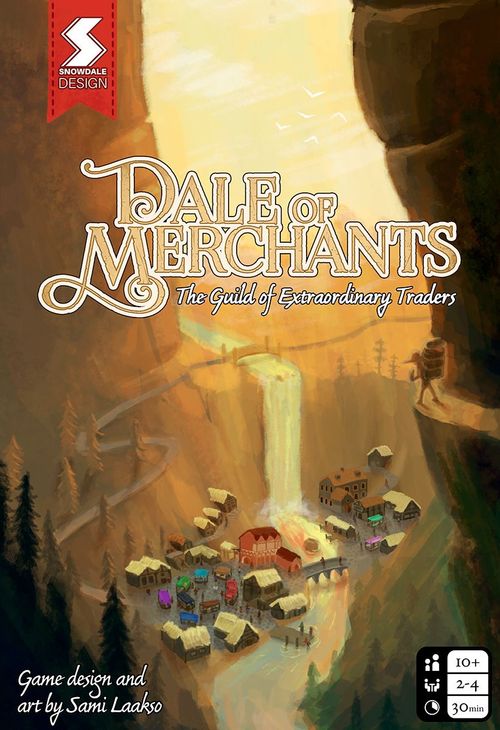
Dale of Merchants
Dale of Merchants Rulebook
Table of Contents
Table of Contents
Components
- 110 cards
- 6 animalfolk decks with 15 cards in each
- Snappy scarlet macaws
- Dealing giant pandas
- Thieving northern raccoons
- Hoarding flying squirrels
- Lucky ocelots
- Adapting veiled chameleons
- 20 junk cards
- 6 animalfolk decks with 15 cards in each
- 1 market board
- 1 ocelot die with sides 0, 1, 1, 2, 2, and 3
More Dale of Merchants?
This game comes with 6 unique animalfolk decks which offer a great deal of variability. After several games you might still be wanting for more. We have good news for you, because there's more where this came from.
Dale of Merchants 2 is a stand-alone expansion. It includes 6 new decks which can be combined seamlessly with this game.
The expansion has such animalfolks as Intimidating dwarf crocodiles, Reckless marbled polecats, and Observant snowy owls. It is available from selected retailers and our website.
More decks, more variety, more fun!
Game overview
Players take the roles of animalfolk merchants learning new techniques, trading goods, and managing their stocks. The player who first manages to finish their astounding merchant stall by building 8 ascending stacks of cards in front of them, is the winner of the game and gets access to the guild!
The Guild of Extraordinary Traders operates from Dale, amongst the Alps. Although the guild is well-known, it is quite mysterious as the guild's leader and vast majority of its members are unknown to the public. The guild's famous associates act as diplomats in notable countries and courts, offering deals and favours.
Card overview
- Value, set icon and possible bonus action icon (bonus action)
- Card and set name
- Type
- Effect and flavour text
- The Guild of Extraordinary Traders icon (guild)
Card types
There are three types of cards in the game. Two of them are animalfolk cards and the last one is a rubbish card named junk.
Technique
Technique cards can be played as a technique action. A bonus action icon (bonus action) in the card rewards the active player with a bonus action.
Passive
Passive cards have effects which apply when you have the card in your hand or when using the card for other actions unless stated otherwise on the card text. Show the card to other players when using its effect.
Rubbish
Players start the game with multiple rubbish cards named junk in their decks. Usually you can only use junk to purchase new animalfolk cards.
Market keepers accept junk as payment only because they know they can resell it. It's actually quite easy to sell pretty much anything to the uninformed citizens as long as you're persuasive enough.
Game setup
Choose as many animalfolk decks as there are players, plus one deck. Put the other animalfolk decks back in the game box. You can change the feel of the game by choosing animalfolks whose abilities match with your group's playing styles. For example, Thieving northern raccoons push towards more player interaction while Lucky ocelots bring total chaos! There's a list describing all the animalfolks on the last page of this rulebook.
- Build each player's deck by giving each player one 1 valued card from each of the chosen animalfolk decks and a number of junk cards until they have a total of 10 cards. Shuffle the decks and place one next to each player. Place the remaining junk cards near the playing area to form a separate junk pile.
- Put the remaining 1 valued animalfolk cards back in the game box. Shuffle the remaining animalfolk cards. This becomes the market deck.
- Place the market board next to the market deck. Draw 5 cards from the market deck and place them on the board to form the market.
- Each player draws 5 cards from their own deck to form their starting hand.
In the setup diagram: A is the player's discard pile, B is the player's merchant stall, and C is the market's discard pile.
The player who woke up the earliest today should start the game. When playing consecutive games, one of the losers should be the starting player of the next game.
There sure seems to be a connection with being first at the market and getting the best deals. I wonder why.
Turn overview
- Action phase - Do one of the following actions
- a) Market action - Purchase a card from the market
- b) Technique action - Play a technique card
- c) Stall action - Build a stack in your stall
- d) Inventory action - Discard any number of cards from your hand
- Clean-up phase
- Fill your hand back to 5 cards
- Fill empty market slots
1. Action phase - Do one action
Start your turn by choosing one of the four available actions. You do not get to do the other actions this turn unless you're awarded with a bonus action.
When a card tells you to throw away something, it does not go to your own discard pile. Instead, junk cards are placed in the junk pile and animalfolk cards are placed in the market's discard pile.
NOTE: Cards are placed face up in all discard piles. Players may look through all discard piles at any time but not reorder them.
a) Market action - Purchase a card from the market
Buy 1 card from the market by paying its price in a combination of any cards from your hand. Your cards are worth their printed value when used to purchase new ones. The rightmost card's price in the market is equal to its value. Moving to the left, prices increase one by one: +1, +2, +3, and +4, as indicated on the market board slots. Place the cards you used to purchase in your discard pile and then place the newly purchased animalfolk card into your hand.
NOTE: You are allowed to pay more than needed for a card, if you can't pay less with the cards you are making the purchase. In other words the amount you overpay must be smaller than the value of each card you pay with. For example, you're allowed to buy a card costing 5 with two fours even with a five card in hand, but are not allowed to use additional ones when buying the same card with a five or a three plus a two.
All players start the competition with junk and a couple of trading techniques. The key to victory is to know when to acquire new techniques and when to build up the variety of your stall.
b) Technique action - Play a technique card
Play 1 technique card. Every technique card can be played as the trading technique printed on the card's bottom half. Show the card and do the action described on the card. The effects always happen in the order they are written on the card. Place the card in your discard pile after the card effects have been resolved unless told otherwise.
NOTE: If you can't draw, take, or exchange the defined amount of cards specified in the effect, perfom the action with the maximum amount of cards possible.
Every animalfolk has its own way of trading. Some animalfolks are especially good at gathering goods to their stall while others resort to less respectable methods.
If the card has a bonus action icon (bonus action), you may do another action after resolving all of that card's effects. The bonus action is awarded on the same turn the card is played. Your bonus action can be any of the four usual actions. If you use your bonus action to play another technique card that has a bonus action icon, you can then play another action – and so on.
You're able to hurry and get more things done if you plan your schedule accordingly! At least if you stick to less time-consuming habits...
NOTE: The bonus action is only awarded when a card is played for its technique - not if it's used to purchase from the market or played in your stall.
If you need to discard or throw away multiple cards at the same time, you choose the order they go to the designated discard pile. The played technique card goes to the discard pile after its effects have been resolved.
c) Stall action - Build a stack in your stall
Your merchant stall consists of 8 stacks of cards with ascending values. The total value of your first stack must be exactly 1, the next 2, and so forth. They have to be built in ascending order. Keep in mind that you can't play those cards for any other effects later once they're in your stall.
You might be wondering why you can't put junk in your stall for sale. We're here to build our reputation not destroy it. Although some animalfolks can get away with a little bit of rubbish in their booth...
To build a stack, choose any number of cards from one animalfolk set from your hand and place them in front of you in your stall with all the card values visible. You can't build a partial stack and continue to add to it later.
In some cases certain card effects can modify your stacks' values. That's fine. When building up your next stack, it should always be valued the same as its sequence number in your stall. Once a stack is finished, it doesn't matter what values and cards it has in it, it's considered finished.
Once you put an item on display, you shouldn't keep using it. Wearing down your own merchandise is a surefire way of losing the little reputation you have.
d) Inventory action - Discard any number of cards from your hand
Place any number of cards from your hand into your discard pile.
2. Clean-up phase
Clean-up happens after the player has made the chosen action and possible bonus actions.
1) Fill your hand back to 5 cards
Draw cards from your deck until you have 5 cards in hand. There's no maximum hand size, in case you had more cards in hand before. Only the active player fills their hand. If other players hold less than 5 cards for any reason, they fill up only at the clean-up phase of their own turn.
Folks need time to organize their stuff after a generous visit after all... Guests could be considerate and clean up after their mess, but where's the fun in that?
Any time your deck runs out and you or anyone else needs to draw new cards from it, shuffle your discard pile and use it to form a new deck. If your deck and discard piles ever run out at the same time when you need to draw new cards, draw junk cards from the junk pile to fill your hand to 5 cards. In the rare case the junk pile runs out, use the cards from the decks not in play as substitutes. Junk cards are the only ones of which there are considered to be an unlimited amount.
In case you can't find anything more suitable for sale, I bet you have piled up some rubbish here and there for the rainy day.
2) Fill empty market slots
If there are empty slots in the market, move all cards to the next empty slot to the right if it's possible to do so. Draw new cards from the market deck and fill the slots with them from right to left until the market has 5 cards in it.
The fresh stuff is guaranteed to be overpriced. Hope you have some extra currency to spare. Once the market keepers see the demand isn't quite there, they will humble themselves and discount the prices. A little.
If the market deck ever runs out and you need new cards from the deck, shuffle the market discard pile and use it to form a new market deck. If the market deck and discard pile run out at the same time, nothing happens.
There's no such thing as infinite resources. Once everything is gone, it's gone. Well, technically you could just wait for the next shipment of goods that's bound to come tomorrow, but you need to finish your stall today! If you won't, I bet someone else will.
Winning the game
Once you place the 8th stack in your merchant stall, you're immediately celebrated as the winner of the game.
When one stall is finished, the owner is declared to be the winner of the competition and rewarded with a membership to the guild. There's only one winner each year so losers have plenty of time to hone their skills!
4 player team rules
Merchants can join forces with others to form teams when playing with 4 players. This reduces downtime and greatly improves gameplay. We recommend using team rules after a couple of games with normal rules, which familiarizes you with the game's core mechanisms.
On a rare occasion the guild accepts two new members at the same time. These unconventional events need unconventional methods. To save everyone's resources, it has been decided that all participants form teams which take part in the competition. The winning team isn't just best at trading, they also excel at communicating.
Changes to the normal rules
There are two teams with both containing two players. Two of the players sit opposite to each other and are in the same team. The other two players, who also sit facing each other, are in the other team. Thus, each player has an opponent on both sides and a teammate across the table.
During setup, choose 4 animalfolk decks instead of 5 to include in the game.
NOTE: The game comes with 20 junk cards. You need 4 more for the team rules, if you don't own Dale of Merchants 2. In that case, take all 1 valued cards from a single deck not used in the current game and use those as substitutes for junk.
Each team shares a stall. The first team to finish their 10th stack wins the game immediately.
When you build a stack, your teammate can help you by adding one or more cards to the stack. Remember to fill your hand only after your own turn.
When a card affects "another player", you are allowed to choose your teammate. Card effects affecting "other players" only affect players in the opposing team. For example, discarding cards and paying extra for cards. "All players" and "each player" still refer to everyone.
All communication is public.
In order to keep the competition as fair as it can be with such imaginative folks, there has to be some rules in place. Tricks are allowed as long as everyone is in plain sight. Then you can only blame yourself, if you got outplayed by a more cunning individual.
Examples
- You're not allowed to swap Acorn (Hoarding flying squirrels 4) with a card from your team's stall as it's considered yours.
- Your teammate doesn't discard a card, when you play Nuisance (Thieving northern raccoons 2).
- Exception, Blindfold (Lucky ocelots 5): You're not allowed to ask from your teammate.
The animalfolk decks
Snappy scarlet macaws
Hand management - Macaws help you manage your hand of cards. New players like their opportunistic nature while seasoned players use them to optimize their play.
Dealing giant pandas
Market proficiency - Pandas are close friends with the market keepers and benefit from that. They're great for beginners and players wanting a more peaceful game.
Thieving northern raccoons
Direct conflict - Raccoons are a great addition for players wanting some conflict. They don't care about the definition of "ownership". You have been warned!
Hoarding flying squirrels
Stall manipulation - No one can set up their stall faster than squirrels. Inexperienced players like these hoarders, while experts can pull off nice combos with them.
Lucky ocelots
Chaos and luck - Ocelots can give you an edge if luck is on your side. Add these to the game when you want to introduce a little havoc to your contest!
Adapting veiled chameleons
Imitation - Chameleons make you play your cards as if they're other cards in the game. They are recommended for more experienced players with long-term plans.
A passive chameleon card you use is an identical copy of one valid card for all purposes of play. If there is a valid card, you must copy it before using the chameleon card. If there are no valid cards or the copying effect loops back to the original card, the chameleon card is considered to have its own set icon and value. The copying effect lasts the current turn or as long as the copied card's effects last, whichever last longer.