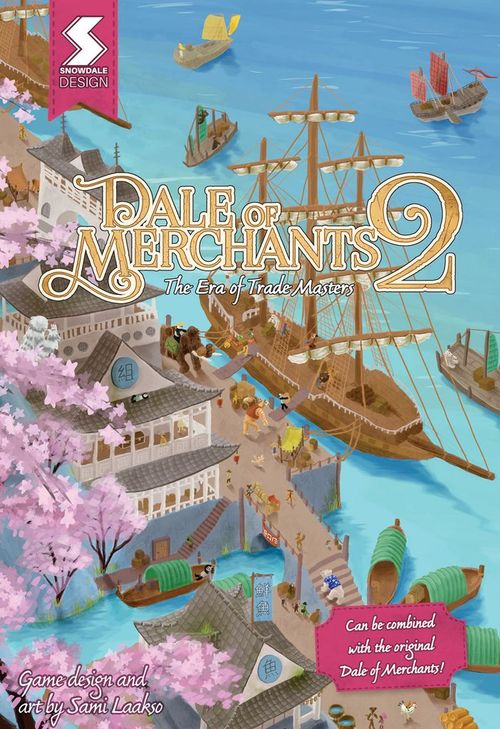
Dale of Merchants 2
Dale of Merchants 2 Rulebook
Table of Contents
Table of Contents
Components
- 110 cards
- 6 animalfolk decks with 15 cards in each
- Experimenting Platypuses
- Diligent Pale-throated Sloths
- Intimidating Dwarf Crocodiles
- Friendly Fennec Foxes
- Restless Marbled Polecats
- Observant Snowy Owls
- 20 junk cards
- 6 animalfolk decks with 15 cards in each
- 1 market board
- 1 polecat die with sides 1, 1, 2, 2, 3, and 3
Other games in the series
Dale of Merchants 2 is fully compatible with the entire Dale of Merchants series. You can freely mix and match the animalfolk sets between all of the games.
If you have only played the original Dale of Merchants before, make sure to check out the sections in this rulebook highlighted in green (like this one).
Every time we thought that there weren't any new decks to come up with, one single idea emerged and we quickly built a whole set around it. Of course there was a lot of balancing, streamlining and reworking before we were fully happy with the results. If you combine both games, there's countless fun combos available for you to find. We hope you enjoy these new decks as much as we enjoyed creating them!
Game overview
In Dale of Merchants, players take the roles of animalfolk merchants learning new techniques, trading goods, and managing their stocks. The first player to finish their astounding merchant stall is the winner of the game and the new Trade Master!
There are only twelve free trade cities in the world. Yengzuh near Pandala is one of the oldest. The Guild of Extraordinary Traders from Dale promoted the founding of the city after the trade wars in Asia had spread too wide. The city's harbour holds dozens of great ships at all times, loading and unloading passengers and cargo.
Card overview
- Value, set icon, and possible bonus action icon (plus)
- Card and set name
- Card type
- Effect and flavour text
- Game icon (The Era of Trade Masters)
Card types
There are different card types in the game: technique and passive animalfolk cards and also rubbish junk cards. Some card effects allow you to bend the rules of the game. In case of such rule conflicts, the text on the cards overrides the rulebook. Always resolve a card's effects in the order they are written.
Technique
Technique cards can be played as a technique action. A bonus action icon (plus) on the card rewards the active player with a bonus action after using the technique.
Passive
Most passive cards have effects which apply when you have the card in your hand. Some passive cards can provide their effects elsewhere if their effect text states so. When you use a card for its passive effects, show the card to other players and fully resolve its effects.
Rubbish
Players start the game with multiple junk cards in their decks. Junk is primarily used to purchase new animalfolk cards from the market.
Going on an expedition sure is exciting. Polecatfolks love to get their blood flowing and heart pumping. Finding a rare relic is secondary to an epic adventure in the wild! More often than not they come back with only junk. But at least they have new and fresh stories to share with foxfolks.
Game setup
Choose as many animalfolk decks as there are players, plus one deck. Return the other animalfolk decks into the game box. You can change the feel of the game by choosing animalfolks whose playstyles match your group's. For example, Diligent Pale-throated Sloths reward careful planning while Observant Snowy Owls make you keep an eye on your opponents. There's a list describing all of the animalfolks and special rules regarding the Snowy Owls on the last page of this rulebook.
An online deck selection tool can also be used to pick the decks for your game effortlessly. You can access it at snowdaledesign.fi/decks.
The player who woke up the earliest today should start the game. When playing consecutive games, one of the losing players should be the starting player of the next game.
Official contestants have owl supervisors watching them a couple of days prior to the campaign. A head start might not be worth it, if you stayed up all night.
- Form each player's starting deck by giving everyone one card valued 1 from each of the chosen animalfolk decks and a number of junk cards until each player has a total of 10 cards. Shuffle the decks. The remaining junk cards form a separate junk pile.
- Return the unused animalfolk cards valued 1 to the game box. Shuffle the remaining animalfolk cards valued 2–5 together to form the market deck.
- Place the market board next to the market deck. Draw 5 cards from this deck one by one and place them faceup on the slots on the board (starting from the right) to form the market.
- Each player draws cards from their own deck equal to their hand size, which is 5 by default, to form their starting hand.
Also in the play area:
- A. Player's discard pile
- B. Player's merchant stall
- C. Market's discard pile
Turn overview
During the game the players take turns in a clockwise order. A player's turn consists of an action phase followed by a clean-up phase.
1. Action phase - Perform one of the following actions
- a) Market action - Purchase a card from the market
- b) Technique action - Play a technique card
- c) Stall action - Build a stack in your stall
- d) Inventory action - Discard cards from your hand
2. Clean-up phase
- Fill your hand back to 5 cards
- Slide cards and fill empty slots in the market
1. Action phase – Perform one action
Perform one of the following four actions.
When a card tells you to throw away something, it does not go to your own discard pile. Instead, junk cards are placed in the junk pile and animalfolk cards are placed in the market's discard pile.
NOTE: Cards are placed faceup on all discard piles. Players may look through all discard piles at any time but not reorder them.
a) Market action - Purchase a card from the market
Buy 1 card from the market by paying its price in a combination of any cards from your hand. Your cards are worth their printed value when used to purchase new ones. A card's price in the market is equal to its value plus the (possible) added cost printed on the market board above the slot. Moving to the left, the added costs increase one by one from +0 to +4.
Place the cards you used to purchase on your discard pile and then place the newly purchased animalfolk card into your hand.
NOTE: You may overpay, but all cards you use for the purchase must be necessary for reaching the price of the new card. If you could withhold one or more cards and still be able to pay the price, you must do so. Cards left in your hand do not matter. For example, you are allowed to buy a 5 cost card using two cards each valued 4 (totalling 8) even if you have a card valued 5 in your hand. However, you cannot use the 5 and 4 together, because the 4 would be redundant.
b) Technique action - Play a technique card
Play 1 technique card from your hand. Show the card and resolve the effects described in its effect text. The effects always happen in the order they are written on the card.
Place technique cards in front of you for the duration of their effect. These cards are in your schedule. They are unaffected by other effects until they are fully resolved. In case multiple effects of cards in your schedule resolve at the same time, you choose the order those effects resolve in. After a technique card's effects have been fully resolved, place it on your discard pile unless told otherwise.
Some animalfolks sure take their time. For example, sloths are notoriously precise with each move they make. Most of their methods involve slowness in one form or another. This saves energy and can actually be used for your own benefit, if you plan efficiently.
NOTE: If you cannot draw, take, or exchange the exact amount of cards specified by the effect, perform it with the maximum amount of cards available. However, if any deck runs out and you or anyone else needs new cards from it, shuffle its discard pile and use it to form a new deck. Searching a deck (even if it has 0 cards) never triggers the forming of a new deck.
If the card has a bonus action icon (plus), perform another action after resolving that card's immediate effects. The bonus action is always awarded on the turn the card is played, even if the card remains in your schedule and has delayed effects. Your bonus action can be any of the four usual actions. If you use your bonus action to play another technique card that also has a bonus action icon (plus), you then perform another action – and so on.
NOTE: The bonus action is awarded only when a card is played using its technique – not if it is used to purchase from the market or played into your stall.
It's important to find the balance between stalking your competitors and actually doing work. Gathering info is beneficial, but you're not going to win without building up your stall.
When you need to discard or throw away multiple cards at the same time, you choose the order in which they go to their designated destination.
Whenever an effect lets you guess something about a card, show the card to everyone so they can confirm the result.
c) Stall action - Build a stack in your stall
Each player's individual merchant stall has room for 8 stacks of cards that have ascending total values. The total value of your first stack must be exactly 1, the next exactly 2, and so on. They have to be built in ascending order from 1 to 8. The cards you use to build stacks in your stall can no longer be used for other actions.
To build a stack, choose any number of cards that belong to a single animalfolk set from your hand, whose values add up to the required amount, and place them in front of you into your stall. Stacks are placed faceup with all card values visible. You cannot build a partial stack and continue to add to it later.
In some cases certain card effects can modify your stacks' values or manipulate the cards in them. That is fine. After a stack is finished, it does not matter what its value is or what cards are in it. The total value of your next stack is only determined by the number of stacks you have already built.
d) Inventory action - Discard cards from your hand
Place any amount of cards from your hand into your discard pile. You may use this action to discard 0 cards.
If your plan doesn't go fully the way you envisioned in your head, it may be better or easier to just start again from a clean slate.
2. Clean-up phase
Clean-up happens immediately after the active player has performed their chosen action and possible bonus actions. Clean-up is still considered a part of the active player's turn and they may use passive effects of certain cards.
1) Fill your hand back to 5 cards
Draw cards from your deck into your hand one by one until you reach your hand size, which is 5 by default. If the number of cards in your hand already exceeds your hand size for any reason, do not discard the extra cards. You should always reach at least your hand size by the end of this part of the clean-up phase, even if cards are removed from your hand during it. Only the active player fills their hand.
Whenever your deck runs out and you or anyone else needs new cards from it, shuffle your discard pile and use it to form your new deck. Searching a deck (even if it has 0 cards) never triggers the forming of a new deck.
If your deck and discard pile run out at the same time and you need to draw new cards during clean-up (and only during clean-up), draw junk cards from the junk pile to fill your hand to your hand size. Unlike all other card types, there is considered to be an unlimited number of junk cards. In the rare case the junk pile runs out, use cards from the decks that are not in play as substitutes for junk cards.
Have you ever wondered where junk ends up? It's actually far from useless. It's mostly a matter of perspective. Folks desire what they don't have and overlook the value of goods they have abundance of.
2) Slide cards and fill empty slots in the market
Move the cards in the market to the rightmost empty slot one by one starting from the right. Then draw new cards from the market deck one by one to fill the empty slots, again starting from the right.
You can sometimes get free tasters from the market keepers. This isn't even that rare. You just need to keep in mind that they don't do that out of generosity.
If the market deck ever runs out and you need cards from it, shuffle the market's discard pile to form a new market deck. If the market deck and discard pile run out at the same time, the market will be only partially filled.
Winning the game
Once you build the 8th stack in your merchant stall, the game ends immediately and you are celebrated as the winner.
There's a short duration where the previous Trade Master supervises the newly selected one. The winner of the competition is then left to lead the city after this familiarizing period. The first few years are truly stressful.
4 player team rules
In 4 player games the players can join forces to create teams. This reduces downtime and also introduces additional depth to the gameplay. We recommend trying out the team rules after playing a couple of games using the normal rules.
Setup
Form 2 teams of 2 players. Teammates should sit opposite each other so that each player has an opponent on both sides and a teammate across the table.
During setup, choose 4 animalfolk decks instead of 5 to include in the game.
NOTE: The game comes with 20 junk cards. You need 4 more for the team rules. If you do not have additional junk cards from other Dale of Merchants games, take 4 cards valued 1 from a single animalfolk deck not used in the current game and use those as substitutes for junk cards.
Trade Masters need a reliable right hand in order to be able to handle the vast plethora of tasks they are trusted with. Sometimes they get to choose their First Secretary by themselves, sometimes both are chosen in a single competition. Below this duo, there is the Trade Council who performs all the necessary administrative work.
Changes to the normal rules
Players in the same team share a merchant stall. The number of stacks needed to win the game is increased to 10, with the values of stacks increasing from 1 to 10 similarly to the normal rules. The team that first builds their 10th stack wins the game.
When you build a stack, your teammate can help you build by adding one or more cards to the stack. However, the active player must contribute at least 1 card to the stack. Remember to fill your hand only during the clean-up phase of your own turn.
Some cards refer to opponents. All other players (excluding your teammate) are your opponents.
All communication is public.
While you can't talk in private, you're not expected to be telling the truth all the time. If you're sly enough you can use this fact to your advantage.
Animalfolk decks
Experimenting Platypuses
Card control - Platypuses get the right cards into their hands at the right time. Rookies grasp platypuses quickly and experienced players like to try out new things with them.
Diligent Pale-throated Sloths
Delayed actions - Sloths focus on efficiency in the long run. You need to make plans if you don't want to waste their delayed effects. Feel free to include them even in your first game – just don't expect to be able to unleash their full potential right away!
Intimidating Dwarf Crocodiles
Threatening and harassing - Crocodiles bully other competitors by stealing their property and making threats. Invite crocodiles if you want interaction and conflict!
Friendly Fennec Foxes
"Helping" others - Foxes love to get everyone involved. Other folks are wary of their seemingly friendly gestures, but can't resist foxes' tempting aid. Playing with them requires skill as timing is critical when trying to get the most out of these fellows.
Reckless Marbled Polecats (polecat die)
Taking risks - No mountain is too tall or ocean too deep for polecats! These brave adventurers live for danger and aren't afraid of taking chances. Feeling lucky?
Observant Snowy Owls
Reacting to others - Owls wait patiently for their target to make a move before making their own. They are great at adding more interaction between players and will keep you on your toes. Be sure to stay vigilant when playing with them.
You may activate an owl card once each time its trigger happens – even multiple times in a turn. Wise Spy (Owl 1) is an exception as it can only be used once in your own turn.