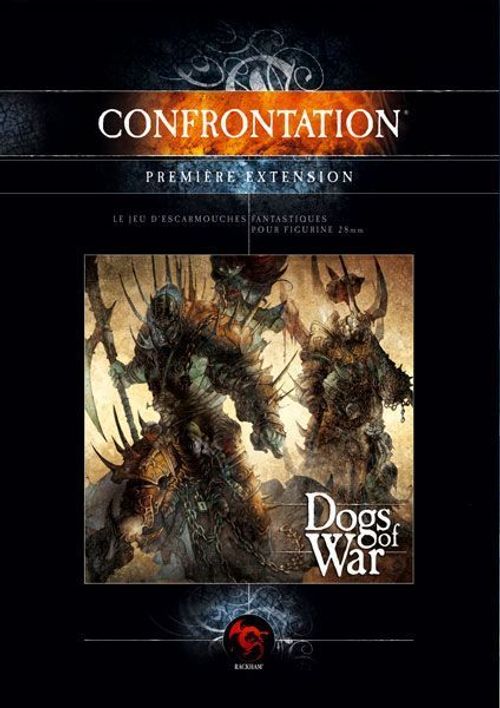
Confrontation: Dogs of War
Confrontation: Dogs of War Rulebook
Table of Contents
Table of Contents
- Book I: The Free Companies
- Chapter 1: Aarklash, A Land of Adventure
- Chapter 2: On the Way to Glory
- Chapter 3: Going on a Mission
- Chapter 4: After the Battle
- Book II: Fortifications, Nexuses & Titans
- Chapter 1: In War as in War
- Chapter 2: Fortifications
- Chapter 3: Nexuses
- Chapter 4: Titans
- Book III: Appendices
Book I: The Free Companies
Chapter 1: Aarklash, A Land of Adventure
This first part provides the capability to manage the progress of a group of fighters designated by the term "free company."
There are many companies on the continent of Aarklash: mercenaries, faithless and lawless bandits, renegades looking for vengeance, you name it. Whatever their origins may be, there are certain similarities that are shared by all companies.
The companies are formed around strong personalities who are very often their founders. Military veterans of numerous campaigns, magicians with strange powers or charismatic faithful, many among these archetypes have become captains of such an armed force. They are assisted in their job by other experienced individuals who play important roles. The lieutenant and the sergeants help the captain maintain order and discipline among their soldiers. The medic takes care of the wounded, the quartermaster manages the company's resources, and the military advisor gives his counsel to the captain. And these aren't the only positions available in a company; there are many others.
And finally there are the soldiers, wandering warriors with an oft-shady legacy looking for riches and glory or simply trying to escape their past.
A free company is thus characterized by the individuals that make it up, but also by several parameters that define it as a group.
The Soldiers
A free company is made up of soldiers defined by data specific to them.
Characteristics and Abilities
When he is recruited, a soldier joins the company with the characteristics and abilities printed on his reference card as well as with any special capacities he may have. From then on, thanks to the experience gained in combat, he can improve his characteristics, learn new abilities, take on a secondary role, or even get the status of champion.
Value
Each soldier has an individual value that represents his potential and his efficiency. When he is recruited, this value is equal to the amount of A.P. printed on his reference card. From then on it evolves when he improves his characteristics, learns an ability or takes on a new role.
Attributes
The term "attribute" designates artifacts, spells and miracles. A soldier can join a group with one or several attributes, but he can especially acquire new ones at the end of each mission. A soldier's attributes are not taken into account when calculating his value. They are subject to a cost in resources (see further) which is equal to the amount of A.P. printed on their reference card.
Particular Attributes
- Immobile machines: These machines are company attributes. They are bought in the same way as other attributes even though they are not bound exclusively to a specific soldier.
- Liturgy: Consecrations and virtues are attributes.
- Familiars: Familiars are attributes.
- Treatments: The alchemists of Dirz's treatments are attributes.
Experience
With every battle they participate in and thanks to their brilliant feats, the members of a company become tougher and perfect their techniques. This is expressed through the acquisition of experience points (EP) (see p. 75). These are then used to let the fighters evolve.
Key Roles
The vast majority of the company's members are simple warriors, but some of them can also take on additional responsibilities. There are two types of roles within a company: principal roles and secondary roles.
- The principal roles are essential for the whole company. There are two of them: the captain and the soldiers.
The captain is the personality around whom the whole company is structured. His presence is primordial. The more the captain is experienced, the higher the number of soldiers under his command can be. If he should happen to disappear, then the company suffers from lack of discipline due to his absence.
Note: Despite his particular status, the captain is a soldier.
- Under certain conditions a soldier can be given a secondary role in the group. The secondary roles include all the functions that can be useful in a company. This goes from lieutenant to recruiting sergeant to medic, military advisor and quartermaster.
What Are We Talking About?
Dogs of War provides a new gaming mode, the free companies, which uses notions that are specific to it.
Free Company and Assault Group
It's important to clearly define the difference between these two primordial notions: the "company" and the "assault group."
- The company designates the community of soldiers as a whole, as well as all the parameters bound to it, such as its renown or its resources, for example.
- The assault group only represents the fighters who are sent to combat for a specific mission. An assault group can therefore be made up of only a part of the company's members.
Soldiers and Fighters
There is a difference between the term "soldier" and the term "fighter." To understand this difference, one should know that it is possible to call on warriors who are not members of the company. Thus, for the duration of a battle, other fighters (Mercenaries, Characters, etc.) can join the assault group.
- "Soldier" exclusively designates members of the company.
- The word "fighter" can represent any individual involved in a battle, including soldiers.
Champion, a Special Status
Champions have a special status. They aren't really Characters, yet they can be given artifacts and be targeted by effects that normally only affect Characters.
Value and Cost
The terms "value" and "cost" have very specific meanings in the rules of this first part.
- Value is used only to estimate the potential of a fighter, a company or an assault group.
- The word "cost" is only used to evaluate the attributes, meaning artifacts, spells, miracles and certain war machines.
The Free Companies
Free companies are not just a series of values. That's why the following chapters will present their role in the various cultures of Aarklash, as well as famous captains and patrons. The characteristics of these captains can be defined thanks to the rules explained in this part while being based on a suitable profile (for example a dwarven armorer for a dwarven captain who once was an armorer).
Whatever the company that is created and whatever its people of origin, it is defined by four parameters that evolve from one game to the next: its strength in numbers, its value, its renown and its resources.
Value and Renown
A free company's value is the equivalent of the army points in a regular game of Confrontation. It represents the global potential of its members.
A company's renown represents how it is seen by its members as well as by those who are not in it. It often precedes the company wherever it goes and many warriors are willing to join a prestigious company. The greater it is, the higher the number of warriors who come to offer their services. A company's renown varies depending on its results in combat and on the presence of certain types of soldiers in its numbers. It defines the maximum that the sum of its members' values can reach.
Example: If a company's renown is equal to 125, then the sum of the values of all the soldiers in it cannot be greater than 125.
Attention! The cost of the soldiers' attributes is not counted in the company's value. It is only taken into account when forming an assault group (see further).
At its creation a company's renown is set at 125, but it can increase from mission to mission.
This allows a company to enlist new soldiers if its renown grows at the end of a mission.
The acquisition of attributes (artifacts, spells, miracles) doesn't depend on the renown. To give a soldier an attribute, the player has to use resource points (see further).
A company's value can be less than its renown. With some exceptions, it cannot be greater.
Strength in Numbers
Commanding is not an easy task and only experienced leaders of men can maintain discipline within a large troop.
The maximum strength of a company defines up to how many soldiers it can be made up of. This number depends on its captain's rank and on the presence of officers (see p. 60).
The actual strength of the company corresponds to the number of members it is actually made up of. This number should not be higher than the maximum strength.
Resources
Resources are the means used by the company to meet its needs: gold, food, mana gems, etc. They are essentially used to recruit certain fighters, such as Allies and Mercenaries, and to acquire attributes (artifacts, spells, miracles and certain war machines).
Confrontation 3 limits an army's contingent to five fighters for every even incomplete 100 A.P. (see Confrontation 3, p. 126). This limit does not concern the strength of a free company. On the other hand, it does apply to the contingent of assault groups sent on a mission.
Company Sheet
The company sheet is an indispensable tool that allows you to keep track of the company's evolution. It is recommended to use a pencil when filling out this sheet since its information regularly changes. The numbered entries refer to the following items:
- Name of the company.
- Its affiliation, meaning the people and any community it belongs to.
- The name of its captain.
- The maximum strength as defined by the captain's rank as well as by the various bonuses bound to this parameter.
- The actual strength of the company. In no way may this be greater than its maximum strength.
- The number of resource points held by the company.
- The list of roles held in the company.
- The company's renown.
- The company's current value.
- The recruitment points indicate the company's margin of progress in terms of value. These points represent the difference between the company's renown and its current value.
- This section is reserved for the company's statistics. This data includes the number of missions carried out as well as the results gotten (victories, draws and defeats).
- The name. The player chooses a name for each soldier. This name lets the soldiers be distinguished but does not make them Characters. Also, when it comes to the game's rules it's the type of soldier that counts. For example, calling a forge guardian "Torim, the Hammer of Uren" does not allow him to benefit from effects reserved to fighters of Uren.
SOLDIER'S VALUE = INITIAL VALUE + (EP USED x 0.1)
- On the "Aftereffects" line there are three boxes corresponding to the soldier's state of health: Light Wound, Serious Wound and Critical Wound.
- And finally, the "Missions Carried Out" box is used to note the number of missions the soldier has gone on.
Example: The book illustrates these items with the company sheet of "The Fangs of Jackal" (Orcs of Bran-Ô-Kor), printed as a photograph of a filled-in sheet; that sheet is not transcribed here.
The Ways of Light
The companies of the Ways of Light are, in the image of certain heroes of Alahan, tragic figures. Though their captains usually remain loyal to the Principle of Clarity, these groups are generally viewed with mistrust or disliking. The peoples of Light are wary of the companies and question the motives of those who, in their opinion, have deserted the battlefields of the Rag'narok to go on personal quests.
The Meanders of Darkness
Setting prose for the peoples of Darkness is not reproduced here: this section covers each people's call to arms, reputation, famous companies and captains, and patrons. The mechanical text of Chapter 1 (above and below) is transcribed in full.
The Paths of Destiny
Setting prose for the peoples of Destiny is not reproduced here: this section covers each people's call to arms, reputation, famous companies and captains, and patrons. The mechanical text of Chapter 1 (above and below) is transcribed in full.
Cadwallon
Setting prose for the City of Thieves is not reproduced here: this section covers its call to arms, reputation, famous companies and captains, and patrons.
Chapter 2: On the Way to Glory
When building a company, each player has 125 renown points, 50 resource points and 90 experience points at his disposal, which he can use to recruit his first soldiers, acquire their attributes and give them previous experience. The soldiers who originally found a company are usually experienced warriors. As they fight ever more battles, some of them can acquire a status or power worthy of a Character.
The formation of a company goes through certain steps whose order must be respected.
- "O Captain! My Captain!" to choose a captain.
- "Hi guys!" or how to recruit soldiers.
- "Been there, done that," or how to give and use the first experience points.
- "Captain! We need material," or how to acquire attributes.
Who Can Become the Member of a Company?
Any type of fighter can become a member of a company, with only three exceptions: Characters, Elementals and Immortals.
Incarnated Characters
Incarnates are unique. They pursue personal goals and don't intervene without a good reason to do so.
Therefore they cannot be recruited by a free company, neither when it's being formed nor by being recruited later on. It is, however, possible to call on their services on an exceptional basis.
Furthermore, the soldiers can get the status of champion during their evolution. Champions can be given artifacts and can be targeted by effects that are normally reserved to Characters.
Elementals and Immortals
The bonds that link Elementals and Immortals to their summoners are not as strong as those that subjugate Familiars, and are consequently more ephemeral.
Elementals and Immortals cannot be recruited as full-fledged members of a company. Instead, a company can call on them in the same way that it can hire the services of Mercenaries.
Exception: Immortals whose rank includes a specific people, such as the mountain-warrior of Tir-Nâ-Bor, can join a company of this people as soldiers.
1. O Captain! My Captain!
The creation of a free company always starts with the choice of the non-Character miniature that will be promoted captain. All fighters, with the exception of the ones mentioned below, can take on this role.
- Fighters without DIS (meaning "DIS -") unless they have a POW value, an aura of faith or the "Leadership/X" ability.
- Musicians and standard-bearers.
- War machines with a Weight value (such as the armored chariot of Tir-Nâ-Bor).
- Familiars.
The captain's value is the first one to be added to the company's.
Example: A Jackal master of rites is chosen to be the captain of a company of orcs of Bran-Ô-Kor. His value being 32, the company's value is therefore also 32. Because the company's renown is 125, it is still possible to recruit soldiers for a maximum value of 125 - 32 = 93.
The choice of captain conditions the company's people of origin and any possible faction, as well as its maximum strength in numbers (see p. 60). It's better to avoid naming a captain of "Irregular" or "Regular" rank, for the company would risk quickly reaching its strength limit.
If the captain and/or lieutenant has the "Leadership/X" ability, then the company additionally gets a bonus* in its maximum strength.
*: This bonus doesn't apply if the "Leadership/X" ability is limited to a certain type of fighter (such as Cypher Lukhan's leadership, which only applies to Keratis warriors).
Disappearance of the Captain
When a company's captain is killed, there are two possibilities.
If the company has a lieutenant in its ranks, then this soldier can immediately be named to be the new captain. He gives up his role of lieutenant and takes on that of captain. If there is no lieutenant in the company, then it suffers from certain penalties until a soldier acquires the role of lieutenant and is named captain:
- During missions the soldiers suffer from -1 on the final result of their Discipline tests, including for Tactical rolls.
- A company without a captain cannot recruit any new members.
Discharge of the Captain
The captain can be dismissed to be replaced by the lieutenant after phase 3.
The dismissed captain is immediately replaced by the lieutenant, who therefore loses his old role. The captain cannot be discharged if there is no lieutenant in the company.
There is a risk that the captain reacts badly to his demotion.
When a captain is discharged, the player rolls 1d6:
- 1: The discharged captain immediately leaves the company.
- 2: The captain remains in the company, yet he loses two points of Discipline (with a minimum of DIS 0) as well as the "Leadership/X" ability if he has it (unless it is bound to an attribute other than the scepter of authority).
- 3 to 6: The captain stays in the company without suffering any penalties.
If the dismissed captain has a scepter of authority, then it is immediately given to the new captain. If the latter already has the "Leadership/X" ability, then this attribute has no effect.
Note: When a new captain is named at the head of an existing company, then he does not acquire the status of champion. The dismissed captain, however, keeps this status.
Change of Captain and Strength in Numbers
If the company's strength is greater than the authorized maximum after a change of captain, then the soldiers in excess are not removed. However, no other soldiers can be recruited until its actual strength in numbers becomes less than the authorized maximum.
Maximum Strength by Rank
The numbers given in the table below indicate the maximum number of soldiers that can be listed on the company sheet, including the captain.
Example: A company led by an Elite captain endowed with Leadership/10 and assisted by a Veteran lieutenant can have a maximum strength in numbers of 9 + 2 + 1 = 12.
| Rank | Max. Strength Depending on Captain's Rank | Bonus Strength Depending on Lieutenant's Rank |
|---|---|---|
| Creature, Irregular | 5 | - |
| Regular, Veteran | 7 | +1 |
| Initiate, Devout, Special, Elite | 9 | +1 |
| Adept, Zealot | 11 | +2 |
| Living Legend, Master, Dean | 13 | +4 |
| Major Ally, Virtuoso, Avatar | 15 | +5 |
Bonus in the maximum strength provided by Leadership/X: Captain: +2, Lieutenant: +1.
Note: Though a fighter is not forced to use all of his attributes during a mission, he still benefits from their effects between two battles. This is why, if the captain (or the lieutenant) benefits from Leadership/X thanks to an attribute, then the company benefits from the associated bonus in strength.
Special Case: Reinforcement
All soldiers with Reinforcement, no matter how they get it, benefit from Survival Instinct instead. This modification is considered to be printed on their reference cards.
If a fighter already has Survival Instinct, then he gets +1 on the final result of rolls bound to this ability.
New Status: Champion
Characters cannot join a company except as occasional fighters. On the other hand, the rules on free companies introduce the status of champion. This status is normally acquired when a soldier has gathered a certain amount of experience points. However, when the company's captain is chosen, he automatically acquires the title of champion.
A champion can be given artifacts in the same way as a Character.
Attention! This free promotion of the captain to the status of champion only happens during the company's formation. It can happen that a company changes captains while it evolves. In this case the new captain does not automatically become a champion.
A champion can be targeted by all effects that are normally reserved to Characters. However, this particular status does not give the fighter the other abilities and special capacities that are specific to Characters (Counter-attack, Master strike, etc.). These abilities are acquired by using experience points.
The "Solo/X" capacities reserved to Characters can be acquired by champions.
2. Hi Guys!
The free company now exists, for it has a captain. Yet he won't go on missions all alone. That's why troops have to be recruited. Most of the time they are fighters from his army of reference or its Allies. The free companies go on exciting adventures and it can happen that they attract Stateless fighters or Mercenaries.
Affiliation of the Soldiers
The people the captain comes from then determines that of his company. The other soldiers can then be chosen among the fighters of the same people as him or among Mercenaries, Stateless fighters and Allied peoples in accordance with the paths of Alliances (see Confrontation 3, p. 127).
Allies, Mercenaries and the Stateless
When it comes to managing companies, Stateless fighters and Mercenaries are considered to be Allies.
The rules on the limits of Allies, Mercenaries and Stateless fighters are different than those presented in the third edition of Confrontation. In a free company this limit depends on the company's strength and not on its value. The number of Allies, Mercenaries and Stateless fighters in a free company should not be more than one in four soldiers. If this proportion is surpassed due to an exclusion or the death of one or several soldiers, then the excess Allies, Mercenaries and Stateless fighters don't leave the company, but it cannot enlist others as long as its strength doesn't allow it.
Example: A company whose current strength is of 13 members can have up to three Allies. If there are already three of them and its strength falls to 11 or less, then it normally can only have two. The three Allies nevertheless remain in the company, yet it can't enlist a fourth one until its strength reaches 15 members. The new Ally is then considered to be the company's sixteenth recruit, which allows it to include up to four Allies.
[Scan note: the lead-in sentence that introduces the two bullets below is not legible on the page image; the bullets are transcribed as printed.]
- Mercenary captains: If a Mercenary is named captain of a company, then all Mercenaries - no matter their people - are considered to be of the same people as him. They are therefore not counted in the authorized proportion of Allies.
Example: A Griffin Mercenary is chosen to be the captain. All Griffin warriors as well as those with the "Mercenary" ability can join his company without restrictions.
Special Case: Mercenaries
Mercenaries are faithless and lawless fighters who don't care for whom they are fighting, as long as they are paid.
To represent this, there is another way to call on Mercenaries. Instead of being enlisted in a company, they can be recruited on a temporary basis just for a mission.
Mercenary musicians and standard-bearers can also be hired by a company just for a mission. However, their "Leadership/X" ability only applies to other Mercenaries of the same people as them, and not to the company's soldiers (even if the latter are of the same people).
- Musicians and standard-bearers: A company can only enlist musicians and standard-bearers of the same people as its captain.
Attention! The predators of blood of the pack of the Red Oaks are an exception to this rule. They may be bound to any other pack.
Factions
A captain can be bound to a community, a clan, a particular tribe (such as the Brotherhood of Bronze or the orcs of the Behemoth) or a faction (such as the baronies of Alahan, the Houses of Acheron, the Wolfen packs, etc.).
All rules concerning these groups apply to the free companies. Consequently, if the captain is bound to a faction, then all enlisted soldiers (except Allies) must also be bound to this faction.
The fighters bound to a particular group must be so when they are recruited.
If the captain is not bound to any particular group, then the recruited soldiers cannot be bound to any faction other than one that may be mentioned on their reference card.
Examples:
- A Wolfen player has chosen a captain bound to the pack of the Path of Opal. As a consequence, all Wolfen soldiers recruited must also be bound to this same pack. The company therefore cannot recruit a shadow tracker, since this profile is bound to the pack of the Wheel of Dreams.
- A Dwarf of Tir-Nâ-Bor player founds a company that is free of all bonds. He can therefore enlist forge guardian Veterans whose rank mentions the fortress of Kar-An-Tyr, but he cannot bind a soldier of the plains to this fortress or to any other one.
Value of the Soldiers
The value of Allies, Mercenaries and Stateless fighters is calculated in the same way as that of the other soldiers. On the other hand, they demand a bonus when they join the company, unless the captain is a Mercenary and they are of the same people. This bonus is equal to half of their value (rounded up to the higher integer) and is to be subtracted from the company's resources.
Example: The Jackal master of rites decides to enlist a goblin archer. The latter's value (10) is added to the company's, making the total become 94. Furthermore, the company has to spend 5 resource points (10 ÷ 2) to pay this recruit's bonus. The company's reserve of resources therefore goes from 50 to 45.
When a soldier is recruited, his value is equal to the amount of A.P. printed on his reference card.
Example: The first recruits of the Jackal master of rite's company are an aurochs horn blower (value: 18 A.P.) and two orc brutes (17 A.P. each). By adding their values to that of the Jackal master of rites, one gets a total of 84 of the 125 renown points that define the company's maximum value when it is formed. There are therefore 125 - 84 = 41 points left to recruit other soldiers.
Particular Affiliation
If a recruit belongs to a particular group, such as a barony of Alahan or a House of Acheron, then the additional cost in A.P. that may be linked to this affiliation is also added to his value.
Example: A black paladin of Acheron's value is normally equal to 41 A.P. However, if he is bound to the House of Vanth, then his value is increased by 2 A.P. and therefore becomes 43. If, on top of that, the black paladin pledges allegiance to the Codex of the Scourge to get the "Scourge of the Souls" aptitude, his value increases by another 5 A.P. and thus becomes 48.
Improvements Specific to the Type of Fighter
- Optional improvements with a cost: Optional equipment and capacities bound to a cost in A.P. can only be acquired when the fighter is being recruited.
Example: It is not possible to recruit an archer of Alahan and then turn him into an archer of Icquor later on.
This also applies to optional improvements that a new recruit can let other members benefit from.
Example: If an armorer dwarf is enlisted, he can let another member of the company benefit from one of his special pieces of equipment. However, this choice is to be made before the end of the recruitment phase during which the armorer dwarf was enlisted.
Special Case: Solo/X
The "Solo/X" capacities described in the Rag'Narok army card packs can be given to soldiers at their recruitment or later on. If this is done at their recruitment, then the capacity's value is simply added to theirs. If the capacity is learned later on, then this demands a certain investment of experience points.
- Free capacities and improvements: When a soldier has a choice in his characteristics (such as the Jackal master of rites with his Aspects), abilities or weapons (such as the orc brutes), then this choice must be made at the soldier's recruitment. This choice is final and only concerns the beneficiary.
On the other hand, when a new recruit can let another soldier benefit from certain free advantages (such as the master of rites' amulets of Jackal or the Kelt druids' gesas), then the choice of the beneficiary is only made once the assault group has been formed, right before each mission.
3. Been There, Done That
The soldiers recruited when the company is built are its heart and soul. They are usually warriors who, having acquired a certain experience in combat and tactics, have decided to found their own free company.
To represent this, the player has a reserve of experience points (EP) at his disposal, which allows him to personalize the first members of his company when it is built. At the end of recruitment, the player has 90 EP to distribute among his soldiers.
Attention! One must distinguish between assigning and using experience points. "Assigning" an experience point means having a fighter benefit from it. "Using" an experience point means spending it to increase a characteristic, acquire an ability or to give the fighter a secondary role. The initial experience points are to be assigned when the company is being formed. Only the first recruited soldiers can therefore benefit from them. Once they have been assigned, these points can be used after any recruitment phase.
Assigning of Points
The points must be immediately divided among the company's members (and not necessarily in an even way). No soldier can be assigned more than 30 EP at this stage.
All points that aren't assigned during this phase are definitively lost.
Using EP
The points assigned during this phase are used to improve the soldiers' potential. They can be used immediately or be saved for later.
These points can be spent to modify a soldier's characteristics, give him new abilities or a role.
Example: The Orc player has assigned 30 EP to the Jackal master of rites and decides to improve his DEF by 1 point. To do so, the required number of EP is equal to 15 plus twice the fighter's current DEF value. The master of rite's DEF is 4, so 23 of the 30 EP he has at his disposal are used.
Special Case: Familiars
Because Familiars are not bound to any people, they are subject to the following rules. Despite its name, the Mechanical Familiar is not concerned by these rules, for it is in fact a Dwarf Irregular.
Acquisition
Familiars are not considered to be soldiers, but to be attributes. They are therefore not counted in the company's value or in its maximum strength. An amount of resources equal to the cost in A.P. printed on their reference card has to be spent when they are acquired. They have to be bound to a magician.
The rules on Familiars are the same in Dogs of War as in Confrontation, with only one exception: any pure magician can have one (whereas only Characters can have one in a regular game of Confrontation 3). Warrior-mage Characters and Champions can also have one. The number of Familiars that a magician in a free company can have depends on his rank:
- Initiate: 1
- Adept: 2
- Master: 3
- Virtuoso: 4
Example: A player decides to give a magician of "Adept" rank a Familiar of Fire. This costs him 15 resource points. The Familiar is then included in the magician's attributes.
Experience
Familiars can gain experience and use it like any other soldier, with only one exception: a Familiar cannot get a secondary role or become captain. On the other hand, a Familiar can become a champion and consequently be given attributes.
Wounds
Familiars make their recuperation rolls like soldiers.
Reminder: A Familiar removed from the game following the death of the magician he was bound to is considered to have been Killed Outright. A recuperation roll therefore has to be made.
Disappearance of the Magician
If a magician dies or is expelled from the company, then all of his Familiars leave the company at the same time as he does.
Adjusting the Soldiers' Values
When a soldier has used experience points to evolve, his personal value increases.
To calculate his new value, add his cost in A.P. as indicated on his reference card to 10% of the total amount of experience points used (rounded down to the lower integer). (The experience points that haven't been used yet are not counted.)
If a soldier's value evolves, then this increase is mirrored in the company's value. This can cause the company's value to become greater than its renown. This is allowed.
Example: The master of rites has used 23 EP. The fighter's basic value (32) is therefore increased by 10% of 23, which is equal to 2, and becomes 34. These two additional points are also added to the company's value.
4. Captain! We Need Material....
Without equipment the company's chances of survival would be slim. The company's resources allow attributes to be given to its members. These attributes are artifacts for champions, spells and Familiars for magicians, and miracles and litanies for the faithful. Immobile machines and nexuses are attributes that are shared by the whole company.
The cost of an attribute is not included in the soldier's value. It is subtracted from the company's resources. It is equal to the amount of A.P. mentioned on its reference card. An attribute can only be given to a soldier who can use it.
Example: The player gives the "Mahata" miracle to the master of rites. This miracle has an A.P. cost of 12, so the company's reserve of resources goes from 45 to 33.
Attributes can be given to a soldier when he is recruited or later on.
Once assigned to a soldier, an attribute cannot be lent or transmitted to another member of the company or even abandoned. There is, however, an exception to this rule: immobile machines (ballistae, cannons, etc.) and nexuses are not assigned to a specific soldier. Once they have been bought, they are indeed considered to be the company's attributes.
Apart from exceptions, only champions can be given artifacts. The number of artifacts that a soldier can have is limited depending on his rank:
- Irregular, Regular, Veteran, Creature, Initiate, Devout: 1 artifact
- Special, Elite, Adept, Zealot: 2 artifacts
- Living Legend, Master, Dean: 3 artifacts
- Major Ally, Virtuoso, Avatar: 4 artifacts
Special Case: Artifact/X
If a champion has this ability, then the X value bound to it is added to the one defined by his rank.
Example: An Elite champion has the "Artifact/1" ability. He can therefore have up to three artifacts (2 + 1).
New Attribute: Scepter of Authority
Being the company's chief, the captain can be given a special attribute reserved to him: the scepter of authority. This object, which symbolizes the captain's power, provides its bearer with the "Leadership/10" ability at a cost of 15 resource points.
It can be given to the captain during any attribute acquisition phase, and not only when the company is being built. It is not an artifact, yet only the captain can have one.
Advice: A commander is a crucial strategic advantage in a company. However, one shouldn't forget that the "Leadership/X" ability can also be acquired with experience points. This second method has certain advantages as well as disadvantages. Saving up enough experience points may take a long time. Furthermore, a fighter can learn only a certain number of abilities. However, when the "Leadership/X" ability is learned thanks to experience, it increases the assault group's value less than when it is acquired through a scepter of authority. What more, if the "Leadership/X" ability is acquired through experience, then its area of effect can be improved, whereas this isn't possible with the scepter of authority. One therefore has to weigh the pros and cons before making a decision.
Special Case: Lords of the Dead and Wolfen Chiefs
In no way does a scepter of authority provide its bearer with the "Lord of the Dead" or "Wolfen Chief" capacity. These capacities do apply, however, if a soldier meeting the required conditions (see Confrontation 3, pp. 68-69) acquires the "Leadership/X" ability by using experience points.
Spell and Miracle Limitations
Magicians and faithful can be given an unlimited number of spells and miracles. However, when the assault group is being formed, the limitations explained in the Confrontation 3 rules apply in the usual way.
A magician can therefore know many spells, but he can only use a certain number of them during a battle.
Some spells, miracles and artifacts are not compatible with free companies:
- Morbid division: This spell cannot be used with Dogs of War.
- We are legion: This spell cannot be used with Dogs of War.
- Morbid angel invocation: This spell can only be used to summon a morbid angel directly by spending 4 (morbid) points. It is forbidden to unite two morbid puppets to create a morbid angel.
Nexus and War Machine Limitations
The number of nexuses and war machines in a company is not limited. However, the usual limitations apply when the assault group is being formed.
Limitations That Depend on the Number of Army Points
Some profile improvements (as well as certain attributes) are limited in number proportionally to the army's total value. These limitations are not to be respected at a company's scale, yet they must be when the assault groups are being formed.*
Example: The number of consecrations (attribute) allowed in an army is of one for every 100 A.P. This means that a company is not limited in the number of soldiers who have this attribute. However, if the player sends two soldiers with a consecration into an assault group worth 190 A.P., then one of them won't be able to keep his consecration.
In no way can the soldiers be deprived of their improvements. The limitations on improvements can therefore prohibit a player from including certain of his fighters on a mission sheet.
Example: The mark of Elokani is a profile improvement from which the warriors of the wind of the tribe of the Behemoth can benefit. Yet an army can have only one mark of Elokani for every even incomplete 100 A.P. If a company includes three warriors of the wind endowed with this improvement, then the player can include only two of them in an assault group with a value of 180 A.P.
*: The term "assault group" designates the fighters who are sent into combat by the player.
An Example of Company Formation
The player has 125 points of renown, 50 resource points and 90 experience points at his disposal to form a company of orcs.
Recruiting the Captain
His first choice concerns the captain of the company. He decides to entrust this important role to a Jackal master of rites whose A.P. cost is 32. So for the moment the company's value is equal to 32.
Remember that this value cannot pass the limit of 125 set by the renown.
Reminder: When a recruit has a choice in his characteristics or capacities (as is the case of the Jackal master of rites for his Aspects), then this choice is to be made once and for all when he is being recruited.
The player writes down the Aspect values chosen for the master of rites: Creation/1, Alternation/1, Destruction/0.
Reminder: When a new recruit can let another soldier benefit from certain free advantages (such as the master of rites' amulets of Jackal), then the choice of the beneficiary is not made at his recruitment, but only once the assault group is being formed, before each mission.
Soldier Recruitment
Once the captain has been chosen, the player has to enlist the other soldiers of his company.
The captain's rank being "Devout," the company's maximum strength is 9. This means that 8 other soldiers can be recruited.
The player starts by choosing an aurochs horn blower. The bonus in Discipline provided by this soldier will help the master of rites win the Tactical rolls. The blower's value is equal to 18. It is added to the company's current value of 32 to get a total of 50.
The player then decides to invest in a powerful strike force and enlists a Jackal warrior worth 23 A.P. The company's value therefore increases to 73.
The player then recruits an orc brute (17 A.P.), which makes the company's value climb to 90.
Reminder: When soldiers have a choice between various weapons (such as the orc brutes), the weapon must be chosen once and for all at recruitment.
The player decides to equip the orc brute with a scimitar (INI +1). This weapon is written down in the "Equipment" box of its owner and the soldier's characteristic is modified accordingly.
The player only has 35 points left before reaching the limit of 125 set by his renown.
He therefore decides to enlist an Ally. Because he doesn't have a marksman yet, he chooses a goblin archer whose value of 10 brings the company's value to 100. This choice is possible, for the goblin is the fifth soldier enlisted by the company and therefore the rate of Allies is not higher than one out of four. However, being an Ally, the goblin archer demands a recruitment bonus equal to half of his value, meaning 5. The player immediately subtracts these 5 points from his resource reserve, which becomes 45.
The player decides to stop recruiting soldiers and to save his remaining recruitment points.
Division of Experience Points
Once all of the soldiers have been recruited, the player has 90 points available to divide among the five members of his company. He assigns these points in the following way:
- Master of rites: 30
- Jackal warrior: 19
- Orc brute: 23
- Goblin archer: 18
Use of Experience Points
The player then uses some of the experience points in the following way.
He first chooses to increase the master of rite's DEF by 1 point. This costs him a number of points equal to 15 plus twice the current DEF. The latter being equal to 4, the player has to spend 23 EP.
He then chooses to increase the Jackal warrior's INI by 1 point. This costs him a number of points equal to 15 plus twice the current INI. The latter being equal to 2, the player has to spend 19 EP.
And finally, he increases the orc brute's ATT by 1 point. This costs him a number of points equal to 15 plus twice the current ATT. The latter being equal to 4, the player has to spend 23 EP.
At the end of this phase the master of rites has 7 EP left, the Jackal warrior, 0, the orc brute, 0, and the goblin archer, who didn't spend any, 18.
Value of the Soldiers and the Company
Because some soldiers have been improved using experience points, their values now have to be adjusted. Each value is equal to the soldier's basic value plus 10% of the experience points he used (rounded down to the lower integer).
- 23 EP were used for the Jackal master of rites. His basic value (32) is therefore increased by 2 (10% of 23) and becomes 34.
- 19 EP were used for the Jackal warrior. His basic value (23) is therefore increased by 1 (10% of 19) and becomes 24.
- 23 EP were used for the orc brute. His basic value (17) is therefore increased by 2 (10% of 23) and becomes 19.
Due to the increase of these three soldiers' personal values, the company's value goes from 100 to 105.
Attribute Acquisition
The acquisition of attributes is done after the modification of characteristics since the choice of certain attributes sometimes depends on these values. For example, the spells a magician has access to depends on his POW.
The cost of these attributes is equal to the amount of A.P. printed on their cards. It must be subtracted from the company's reserve of resources.
The player first chooses the captain's attributes. He decides to give him the "Mahata" miracle. This miracle having a cost of 12 A.P., the company's reserve of resources goes from 45 to 33. The miracle is written down in the master of rite's attributes and its cost is written in his "Cost of Attributes" box.
And finally, the player decides to spend three more resource points to give the aurochs horn blower a consecration that allows him to count for two in the master of rite's aura of faith. The company's reserve of resources therefore becomes 30.
[Scan note: the book closes this example with a full company sheet for "The Fangs of Jackal" (Orcs of Bran-Ô-Kor), printed as an image. It is not transcribed; the figures it shows are the ones worked through above.]
Chapter 3: Going on a Mission
The first thing to do before a game in which free companies clash is to define a framework: the mission.
To proceed with the choice of mission, each player rolls 1d6. If the company benefits from the services of a military advisor (see p. 88), then the player adds 2 to his result. The military advisor does not have to be listed on the mission sheet for the company to benefit from this bonus. A roll of 1 is not an automatic failure on this roll and a roll of 6 cannot be rolled again. The player who gets the higher result selects a mission from the list in the third part of this book (p. 130) or in Cry Havoc.
If the chosen mission involves an attacker and a defender, then the two players proceed with another roll of the die, to the result of which they add 2 if a military advisor is present in their company.
The one who gets the higher result decides who is the attacker.
The mission's name as well as the assault group's position (attacker or defender) is written down on the mission sheet.
Before the Mission
A company doesn't have to use all of its forces for a mission. Unlike in regular games of Confrontation, where each player has the same potential available to build his army, a mission with free companies can have assault groups of different value confront each other.
The term "assault group" designates the soldiers sent to combat in the framework of a mission.
First the players freely form their assault groups without any value limitations. In order to conserve balance in the game, compensation is nevertheless given to the weaker assault group. What more, some of the gains acquired during the mission will be calculated according to the difference in value between the two assault groups. The reward for defeating a stronger free company is therefore equal to the challenge that was taken!
The order of the following steps is to be respected.
1. Forming the Assault Groups
An assault group is mainly made up of soldiers of the company, but players can also call on fighters whose participation is limited to one mission. These fighters can be Mercenaries, Elementals or Immortals, or even Characters. In the last case this is often the company's patron.
All fighters who take part in the battle, including those who aren't members of the company (such as Characters), must be listed on the mission sheet.
Note: It is recommended to choose the mission well before the start of the game. Like this each player has enough time to think about how he will form his group. This choice can, for example, be made at the end of each battle for the next game.
An assault group's value is equal to the sum of the values of the fighters in it plus the cost of the attributes that they are using. In effect, each fighter isn't necessarily going to use all of his attributes in each mission.
The limitation of contingents (see Confrontation 3, p. 126) also applies to assault groups. Thus, a group cannot include more than five fighters for every even incomplete 100 A.P. in it.
Choice of Soldiers
The player starts by listing the company's soldiers who are being sent into combat. The captain doesn't have to be a part of the assault group.
Example: For its first mission the Jackal master of rite's company of orcs sends all of its men into combat. The assault group's value is therefore equal to the sum of all the soldiers' values, meaning 105.
Attention! The wounded soldiers suffer penalties right from the start of the game (see p. 80). However, it is possible to heal them just before the battle (see Bonesetter, p. 74).
Choice of Attributes
The soldiers sent into combat don't have to take all their attributes along. Those that will be used are to be written down on the mission sheet and only their cost is added to the assault group's value.
Example: For this first mission the Orc player decides to make use of all of the attributes of his company's members. Their total cost of 15 is added to the assault group's value, which becomes 120.
Mercenary Support
When the assault group is being formed, it is possible to call on one or several Mercenaries.
Fighters with the "Mercenary" ability can be hired just for a mission by any company, even if it has already reached its maximum strength.
A Mercenary's value is equal to the one indicated on his reference card.
When a Mercenary is recruited like this, he must be paid before the mission. An amount of resource points equal to his value plus the cost of any improvements and attributes is immediately subtracted from the company's reserve.
Example: A Kelt warrior Mercenary is hired by the orcish company. His value being equal to 9, the company has to spend 9 resource points.
The value of Mercenaries, as well as the cost of any attributes they may have, is taken into account when calculating the assault group's value.
Example: The value of the orcish assault group, which was 120 until now, is increased by the value of the Kelt Mercenary, meaning 9. The assault group's total value thus becomes 129.
Support of an Incarnated Character
Characters cannot join a company as soldiers. They can, however, intervene once in a while to collaborate with a company, a bit like Mercenaries do.
A Character's value is equal to the one printed on his reference card. Like that of Mercenaries, this parameter (as well as the cost of any attributes and improvements) is taken into account when calculating the assault group's value.
A Character's participation in a battle requires an investment in resources that varies depending on his people of origin and that of the company that wishes to hire his services. In any case the resources must be spent before the battle.
- Characters of the same people as the company: If the Character comes from the same people as the company, then an amount of resource points equal to half of the sum of his value and the cost of any attributes he has (rounded up to the higher integer) must immediately be subtracted from the company's reserve.
Example: If a company of orcs wants to hire the services of the faithful orc Shaka Umruk (39 A.P.) endowed with the "Rage of the Jackal" miracle (8 A.P.), this will cost it 24 resource points: (39 + 8) ÷ 2.
- Allied Characters: If the Character is not of the same people as the company but of an Allied people, then the amount of resource points to spend is equal to the sum of his value and of any attributes and improvements he may have.
Example: If a company of orcs wants to hire the talents of the goblin magician Gidzzit the Bell Ringer (24 A.P.) endowed with the "Scroll of Lightning" (13 A.P.), then it will have to spend 37 resource points (24 + 13).
- Mercenary Characters: If a Character with the "Mercenary" ability is fighting for a company of the same people as him, then the cost in resource points to spend is equal to half of the sum of his value and any attributes he may have (rounded up to the higher integer).
If he is fighting for a company of a different people than his, then this cost is equal to the sum of his value and the cost of any attributes and improvements he may have.
Example: If a company of orcs wants to call on the Devourer Character Zeiren (81 A.P.), then it will have to spend 81 resource points.
Mystical Support
Elementals and/or Immortals can be added to an assault group.
An Elemental's or Immortal's value is equal to the one printed on its reference card. Like for Mercenaries, this parameter (as well as the cost of any improvements and attributes) is taken into account when calculating the assault group's value.
In addition, to call on an Elemental or an Immortal the company must pay a cost in resource points equal to half of its value (rounded up to the higher integer) before the battle.
To hire the help of such a being the company must, however, meet the usual conditions:
- To call on an Elemental, its Element may not be part of the Elements forbidden to the magicians of the people the company is bound to.
- To call on an Immortal, it must follow the same path of Alliance as the people the company is from.
2. Compensation
When a patron hires a company's services to carry out a mission, he always gets the information he needs to first find out how difficult it will be. Once he has this intelligence, he only accepts to spend the amounts required, no more. There's no use in paying an entire army just to get rid of a handful of cutthroats!
Once the two groups have been formed, the players reveal each one's value. This includes the sum of the soldiers' values and that of their attributes.
There are then two possibilities:
- If the difference between the two groups is of 50 or less, then the player whose group is the stronger one may decide to modify it to reduce its value. Yet the new value cannot be less than that of his opponent's group.
- If the difference between the two groups is greater than 50, then the player whose group is the stronger one must modify it to bring the difference between the two groups to between 0 and 50 points.
Examples:
- Before a mission, two players prepare their assault groups. Once this is done, they reveal their values. Player 1's group has a value of 155 while that of player 2 has one of 180. The difference between these two groups is 25, so player 2 can either keep his group as it is or decide to modify it. If he does so, then its new value must be between 155 and 180.
- This time player 1's group has a value of 150 and player 2's has one of 210. The difference between the two groups being 60, player 2 must reduce his group's value in such a way that it is between 150 and 200.
So it can happen that a company confronts an opponent whose assault group has a higher value than its own. To give the weaker company a chance to win, certain compensations are granted to it in the shape of events that happen during the battle or of attributes given to its fighters just for the duration of the game.
The player with the weaker assault group has a number of compensation points (CP) available equal to the difference between the values of the two assault groups.
Example: A Griffin company sends an assault group with a value of 151 to confront a group of Sessairs whose value is 188. The Griffin player therefore has 37 compensation points at his disposal.
The compensation points can be used either to draw one or several Event cards (sold separately) or to acquire objects that can be used only once.
- Drawing an Event card costs 20 compensation points (optional).
- Each object costs 10 compensation points.
Example: With 37 compensation points the Griffin player can draw 1 Event card (20 CP) and acquire 1 object (10 CP) or he can acquire 3 objects (30 CP).
The player doesn't have to use his Event cards and his objects during the game. However, he cannot keep them from one mission to another. At the end of the battle all unused Event cards and objects are discarded. Unless mentioned otherwise, no effect (Event card or object) can be played once the last round of the game has ended.
Event Cards
Events represent incidents that can happen in the course of the battle. They are represented in the form of separately sold cards.
These cards are to be drawn at random among all the Event cards available.
Single-Use Objects
A list of objects is provided below. These objects are not artifacts and can therefore be given to any type of fighter, with only one restriction: the same fighter cannot be given more than two of these objects. They are to be written down on the mission sheet in the "Attributes" box of their bearer.
Each object must be given to a specific fighter before the start of the mission. The fighters cannot exchange their objects during the game. As their name indicates, these objects can be used only once per game. This use does not count as an action.
And finally, the same fighter can use only one of these objects per round.
The use of the following objects is to be announced during the fighter's activation, with the exception of the Fetish of Preservation, the Charm of Evasion and the Charm of Precision.
- Amulet of Dexterity: When a fighter uses this object, his ATT and DEF are increased by one point each. This bonus remains active until the end of the round.
- Amulet of Resilience: When a fighter uses this object, his RES is increased by three points. This bonus remains active until the end of the round.
- Amulet of Speed: When a fighter uses this object, his MOV is increased by three points. This bonus remains active until the end of the round.
- Amulet of Strength: When a fighter uses this object, his STR is increased by three points. This bonus remains active until the end of the round.
- Amulet of Vivacity: When a fighter uses this object, his INI is increased by three points. This bonus remains active until the end of the round.
- Charm of Evasion: The player can use this object right before making a disengagement roll for its bearer. This roll is then automatically successful.
- Charm of Precision: The player can use this object right before making an Aim test for its bearer. He then benefits from +1 on the roll's final result. Furthermore, if the test is failed, then the player can roll it again once with the same bonus.
- Fetish of Preservation: The player can use this object right before any Damage roll made against the fetish's bearer. He then rolls 1d6. On a 1 or 2 nothing happens and the fetish is nevertheless destroyed. On a 3 or more the Damage roll is cancelled. If the bearer has other means of avoiding this Damage roll (such as Survival instinct), then these must be used first before attempting to use the fetish.
- Gem of Abundance (magicians only): When a magician uses this object, he immediately recovers three mana gems of one (and only one) of the Elements he masters. This cannot make his reserve go over its maximum limit.
3. Visiting the Bonesetter
Of all the traveling salesmen and other individuals who live in the wake of free companies, the bonesetters are the only ones to be certain to find regular demand for their services. This is why there is always one in the vicinity of a free company.
Such an individual can prove to be extremely useful if the company has wounded fighters. For a bit of pay he can treat the soldiers before the battle.
Once his assault group has been formed, the player can call on a bonesetter's services. The latter can heal each fighter by only one Wound level and at a cost of three resource points each, which are immediately subtracted from the company's reserve.
Only soldiers listed on the mission sheet can be healed by the bonesetter.
Example: On a Lion player's mission sheet there is a guard of Alahan with a Light Wound, a swordsman of Alahan with a Light Wound and a paladin of Alahan with a Serious Wound. Before the mission he decides to call on a bonesetter to heal the swordsman and the paladin. This costs him a total of six resource points. The swordsman is therefore completely healed of his wounds whereas the paladin goes from a Serious Wound to a Light Wound. The guard of Alahan remains with a Light Wound.
Calling on a bonesetter is done before drawing any Event cards.
4. Training of Reserves
A company's resources can also be used to train fighters. The soldiers who aren't going on a mission can be trained by various masters. To simulate this, once the assault group has been formed, resource points can be turned into experience points (2 resource points for 1 EP).
The EP acquired in this way can only be assigned to soldiers who are not included on the mission sheet while respecting the following points:
- A soldier who is still suffering from the aftereffects of his Wounds (see p. 80) cannot benefit from these points.
- The same soldier cannot be given more than 10 EP in this way before each mission.
These EP can only be used after the mission, at the same time as the EP gained by the other soldiers during the battle (see p. 81).
Special Case: Metamorphosis of Fighters
Some fighters (such as Danu warriors or predators of blood) are able to change their aspect and characteristics during a mission. The metamorphosed fighters benefit from the same improvements (characteristics, abilities, role, attributes, etc.) as before their transformation.
However, if a fighter has a COU value and his profile, after transformation, includes FEAR, then the latter is used, even if his COU is higher.
During the Mission
The clash between assault groups commissioned by opposing free companies requires several of the essential Confrontation rules to be reviewed in detail.
Activation Sequence
The profile of each of a company's members is brought to evolve over time thanks to experience. Thus, the soldiers who have the same characteristics when they are recruited will probably end up with different capacities after having gone on a few missions. In itself, this does not affect how the draw pile is made.
The same reference card can still represent from one to three soldiers (as long as they are of the same type), even if their profiles are no longer the same. Yet it is necessary to be able to identify which card is associated to which miniatures. The simplest method is to use plastic card sleeves that, in addition to protecting the cards, can hold counters of different colors. One then just has to paint a small dot of the same color on the miniature's base so that one always knows to which card the soldier is bound.
The Influence of Discipline
Tactical Roll
As long as the company's captain is on the battlefield his DIS is used for the Tactical roll, even if a different fighter has a higher DIS.
If the captain is not on the battlefield, then the lieutenant's DIS is to be used.
If neither of these fighters is present, then the player can choose the DIS of any of his fighters for this roll.
Transmission of Leadership
During the battle the captains and lieutenants endowed with the "Leadership/X" ability benefit from the following rules:
Their "Leadership/X" ability applies to all soldiers who are members of the company (including Allies, Mercenaries and Stateless fighters). If they form a war-staff, they can transmit their values through the standard-bearer and the musician in the usual way. They cannot, however, form a war-staff with a standard-bearer or a musician who is not a member of the free company.
Gaining Experience
Combat after combat, the soldiers accumulate experience points that are then used to improve their potential. This chapter explains in detail all the actions that cause a gain in experience as well as the amount and the nature of this gain.
The soldiers gain experience mainly by inflicting their opponents with Wounds in hand-to-hand combat. Marksmen also gain experience when they hit their target. Magicians and faithful gain when they succeed a Power test or a divination roll.
War machines are very specific machines whose special way of functioning affects the gaining of experience.
Combat Experience
A soldier gains experience as soon as he is listed on a mission sheet. No matter if the fighter is killed right in the first round or if an event prevents him from participating actively in the mission, his experience is gained.
The amount of experience gained in this way varies depending on the number of missions the soldier has already participated in:
- For his first mission the soldier gains 10 EP
- For his second mission the soldier gains 8 EP
- For his third mission the soldier gains 6 EP
- For his fourth mission the soldier gains 4 EP
- For his fifth mission and all the following ones the soldier gains 2 EP
The "Missions carried out" box on the company sheet is used to note the number of missions each soldier has participated in.
Spells and Miracles
When a mystic succeeds a Power test or divination roll, he gains 1 EP plus or minus the difference between the value used (POW or FAITH) for this test and its difficulty.
The difference is considered to be a bonus if the POW/FAITH value is lower than the test's difficulty, and to be a penalty if the value is higher than the test's difficulty. However, no matter the difference, the mystic cannot lose any EP.
Examples:
- A magician (POW 4) succeeds a Power test with a difficulty of 8. He gains 5 EP (1 + 4).
- A faithful (FAITH 5) succeeds a divination roll with a difficulty of 4. He gains 0 EP (1 - 1).
- A magician (POW 6) succeeds a Power test with a difficulty of 4. He neither gains nor loses any EP.
Summoning and EP
Fighters who are summoned during the game, be this using a spell, a miracle or an artifact, are not considered to be part of the company. Their Wounds and experience points are not to be noted because they disappear when the mission is over, no matter their state of health at the end of the game.
The only exception to this rule concerns the victory conditions bound to certain missions. When these conditions involve the calculation of the number of fighters still standing on the battlefield (as well as their total value), then the summoned miniatures are counted in the total, unless they were summoned during the last round of the game. Their value is then equal to the amount (in A.P.) printed on their reference card.
Firing
When a marksman succeeds an Aim test, he gains 3 EP plus or minus the difference between the AIM value used for the test and its difficulty.
Examples:
- A marksman with an AIM of 3 succeeds an Aim test with a difficulty of 7. He gains 7 EP (3 + 4).
- A marksman with an AIM of 5 succeeds an Aim test with a difficulty of 4. He gains 2 EP (3 - 1).
- A marksman with an AIM of 7 succeeds an Aim test with a difficulty of 3. He gains 0 EP (3 - 4).
If a marksman hits a fighter of his own camp when firing into a fray, he doesn't gain any experience points, no matter the shot's difficulty.
The Wounds
When a fighter inflicts an opponent with a Wound or a "Killed Outright" with an attack in hand-to-hand combat, he gains a certain amount of EP depending on the severity of the Wound.
- Light Wound: 3 EP
- Serious Wound: 4 EP
- Critical Wound: 5 EP
- Killed Outright: 6 EP
Certain bonuses or penalties that depend on the opponent's value can modify these gains:
- If the target's value is at least twice as high as the attacker's: +2 EP
- If the attacker's value is at least twice as high as the target's: -2 EP
Examples:
- A fighter with a value of 23 inflicts a Serious Wound on an opponent whose value is 46. The target's value being twice the attacker's, the latter gains 6 EP (4 + 2).
- A fighter with a value of 48 inflicts a Critical Wound on an opponent whose value is 15. The attacker's value being more than twice the target's, he only gains 3 EP (5 - 2).
Attention! It's the result gotten in the Wound Table which determines the number of experience points gained. Only Wounds and "Killed Outrights" inflicted directly by a Damage roll bound to an attack can provide EP. All Wounds (or eliminations) caused by the secondary effect of an attack do not provide EP.
Examples:
- A fighter inflicts a Serious Wound on an opponent who already has a Critical Wound. This opponent is therefore Killed Outright, yet the fighter only gains the 4 EP provided by the Serious Wound.
- A fighter with the "Toxic/1" ability inflicts a Light Wound on an opponent with an attack in hand-to-hand combat. He therefore gains 3 EP. A second Damage roll is made and causes a Serious Wound. Because this Wound is caused by the secondary effect of Toxic/X, it does not provide any EP.
Examples:
- The result of a Damage roll inflicted by a paladin equipped with a sacred weapon is a double, meaning "Killed Outright." The paladin therefore gains 6 EP.
- The result of a Damage roll inflicted by a dawn warrior equipped with a sword-axe indicates a "Critical Wound." This counts as "Killed Outright." The dawn warrior therefore gains 6 EP.
- The result of a Damage roll inflicted by a Ferocious fighter indicates "Stunned." This counts as a Light Wound. The fighter therefore gains 3 EP.
The Wounds inflicted by shots, spells and miracles do not provide experience points. These actions are already rewarded when the Aim or Power tests or divination rolls are successful.
Fierce Fighters
Some game effects, notably the "Fierce" ability, allow a fighter who has been eliminated to continue fighting until the end of the round. The Wounds inflicted on such fighters - including Killed Outright - continue to provide experience.
Some game effects turn a given result into a different one. In this case it's the final result after the effect has been applied which determines the amount of EP gained.
Elements of the Scenery
Inflicting Wounds on elements of the scenery does not provide experience points.
On the other hand, shots, spells and miracles that target these elements can provide EP in the usual way. What more, the destruction of certain elements of the scenery can, depending on the scenario, provide EP as a reward for having reached an objective.
Immobile Machines
Only servants can gain experience. The machine itself is considered to be an attribute and therefore cannot gain experience.
The EP won through a successful Aim test are acquired by all of the servants and substitutes who took part in this shot.
Mobile Machines
A mobile machine is considered to be a single fighter and can gain experience points like any other soldier. However, the use of these points is subject to certain restrictions explained on page 90.
Wounds
During a clash between free companies, a Killed Outright or any other equivalent result doesn't necessarily mean that the soldier is dead. This simply means that he is neutralized for the rest of the game. Similarly, no type of Wound is permanent.
Example: When a soldier suffers the black troll's "Armripper" capacity, he is simply considered to have had his arm broken.
And finally, all magical, miraculous and other effects, such as "Eternal Torpor" or "Alchemical Petrifaction," are dissipated at the end of the battle.
However, the worst Wounds received during a confrontation can have consequences later on.
Even if a fighter who was Killed Outright isn't really slain during the mission, the game effects that can resurrect a soldier are applied. The effect in question is then considered to have awoken an unconscious fighter.
Soldiers' Wounds
At the end of the battle, the current Wound level of each soldier when the mission ends is to be noted on the mission sheet if it is a "Serious Wound," "Critical Wound" or "Killed Outright."
The fighters eliminated by an effect that causes the miniature to be removed from the battlefield are Killed Outright.
It is of no use to note the Wounds of fighters who aren't members of the company.
Wounds of Soldiers of Very Large Size
Soldiers with the "Enormous," "Colossal" or "Gigantic" ability are considered to have been Killed Outright only if they were really eliminated.
Structure Points
If a war machine or a nexus loses more than half of its SP, then the number of points lost is to be noted.
Familiars
If a magician is Killed Outright in combat, then his Familiars immediately disappear. They are considered to have been Killed Outright. However, this does not provide any experience points.
Retreat!
It can happen that a company ends up in a hopeless situation. In this case the wisest decision that the captain can make is to abandon the mission.
A player can yell "Retreat!" before any Tactical roll. In this case:
- The game ends immediately.
- The player who gave up is declared defeated.
- The defeated player is considered to have failed to reach any of his mission's objectives, even if he has already fulfilled some of them.
- The defeated player doesn't win any resources or renown.
- The fighters of both camps keep the EP that they gained before the retreat.
Chapter 4: After the Battle
At the end of a battle, the evolution of the company and of its members is divided into several phases that follow each other in a specific order.
- Losses and gains
- Recuperation
- Exclusions
- Recruitment
- Experience points
- Acquisition of attributes
1. Losses and Gains
Depending if the mission ends in victory or defeat, and also depending on the difference in value between the two assault groups that have just confronted each other, each company gains or loses renown and resources.
Renown
When a powerful company clashes with a weaker opponent, then its triumph would not really be a brilliant one and defeat would be a true humiliation. On the other hand, if a modest company confronts a much stronger opponent, then the simple fact of having opposed him is already a reward (even when defeated).
Depending on the difference in value between the assault groups* and on the result obtained (victory, draw or defeat), each player wins an amount of renown that is added to that of the company. This gain is determined by using the table below.
The group with the lower value reads its gain in renown on the negative line corresponding to the difference (because it played with less points than its opponent). The group with the higher value reads its gain in renown in the positive line.
Gain in Renown
| Difference | Victory | Draw | Defeat |
|---|---|---|---|
| -50 | 40 | 30 | 20 |
| -40 to -49 | 36 | 27 | 18 |
| -30 to -39 | 32 | 24 | 16 |
| -20 to -29 | 28 | 21 | 14 |
| -10 to -19 | 24 | 18 | 12 |
| from -9 to 0 | 20 | 15 | 10 |
| 0 to +9 | 20 |
*: Any compensation points used by the weaker group are subtracted from this difference when determining the gain in renown.
Example: A company of goblins and one of Wolfen have just clashed. The goblin assault group had a value of 190 whereas the Wolfen group had one of 146. The difference between the two groups is 44. However, the Wolfen player has used 30 compensation points. The difference taken into account for the calculation of the gains in renown is therefore 44 - 30 = 14. The goblins are victorious with a difference of 14 in their favor. Their player therefore reads his gains in the "+10 to +19" line, meaning a gain of 16 points of renown for a victory. The Wolfen have suffered defeat with a difference of 14 against them. Their player therefore reads his gains in the "-10 to -19" line, meaning a gain of 12 points of renown for a defeat.
Resources
A company's resources allow it to give attributes to its members.
Wages and Premiums
Wages represent the amount of resources the patron pays the company to carry out a mission. This amount varies depending on if the company is victorious or not.
- A victory earns it 15 resource points
- A draw earns it 10 resource points
- A defeat earns it 5 resource points
Some missions include a "Premium." This premium can be earned by one of the companies under certain conditions explained in the mission's description.
2. Recuperation
Depending of the severity of the Wounds they were inflicted with during the mission, the soldiers may suffer from their aftereffects.
Recuperation Rolls
At the end of each mission a recuperation roll is to be made for every soldier except those who are unharmed or have a Light Wound (the latter are automatically healed of all their Wounds). This roll concerns the soldiers who have just fought as well as those who didn't take part in the mission. The latter benefit from a bonus on their recuperation roll.
This roll is made using 2d6. The sum of the two results is used to determine the aftereffects from which the soldier suffers in accordance with his Wound level.
The Medic's Role
If the company includes at least one medic, then the result of each recuperation roll (including the medic's) is read one line higher up in the table unless the result is "Dead." In this case another 1d6 is to be rolled:
- On a 4, 5 or 6 the medic manages to save the soldier at the last moment: the result becomes "Critical."
- On a 1, 2 or 3 the medic's efforts are in vain: the result remains "Dead."
However, these effects do not apply if all of the company's medics were Killed Outright during the mission.
Convalescence
The results of the recuperation rolls of the soldiers who didn't take part in the mission are read one line higher up in the table. This bonus is cumulative with the one bound to the presence of a medic. It can therefore happen that a recuperation roll's result is to be read two lines higher up.
Wound Recuperation Table
| 2d6 | Serious | Critical | Killed Outright |
|---|---|---|---|
| 2-3 | Unharmed | Unharmed | Unharmed |
| 4-5 | Unharmed | Unharmed | Light |
| 6-7 | Unharmed | Light | Light |
| 8-9 | Light | Light | Serious |
| 10-11 | Light | Serious | Critical |
| 12 | Serious | Critical | Dead |
Aftereffects
The result gotten in the recuperation table is immediately applied, except the result of "Dead," which is obviously final.
A result of "Serious," for example, means that the soldier begins his next mission with a Serious Wound.
The result of "Dead" applies to all types of fighters, even those with the "Living-dead" ability.
War Machines' Recuperation Test
The servants of immobile machines do their recuperation rolls like all the other soldiers, but machines with structure points proceed differently.
- If the machine hasn't lost more than half of its structure points, then no recuperation roll is required. The machine begins its next mission with all of its SP.
- If the machine has lost more than half of its structure points or was destroyed, then a recuperation roll is to be made. This roll is made using 2d6.
| 2d6 | Structure points recuperated |
|---|---|
| 2 to 3 | The machine recuperates all of the SP it lost |
| 4 to 5 | The machine recuperates three quarters* of its SP |
| 6 to 7 | The machine recuperates half* of its SP |
| 8 to 11 | The machine recuperates a quarter* of its SP |
| 12 | The machine doesn't recuperate any SP |
*: Rounded up to the higher integer.
If a machine that was destroyed doesn't recuperate any SP, then it is permanently destroyed.
Boilers and Carburetors
It can happen that a steam machine's boiler or a naphtha machine's carburetor explodes during a battle. In such a case the damaged material is considered to be repaired after the battle. No recuperation roll is required.
Single-Use Attributes
Certain artifacts, spells and miracles are described as having a single or limited use. In Dogs of War, even if it says that the attribute is destroyed after its use, it is considered that the soldier who has it can use it in every mission.
Example: A soldier has a potion of resilience. This artifact can be used only once per game, but the soldier can use it in every mission.
3. Exclusions
A player can exclude a member from his company. The captain cannot be excluded unless he was discharged earlier on (see Disappearance of the captain, p. 61).
4. Recruitment
If the difference between its renown and its value is positive, then the company can recruit new fighters.
Example: A company's renown is 272 and its value is 244. New soldiers can therefore be recruited for a maximum of 28 A.P. (272 - 244).
The enlisting of new recruits is done using the rules used when founding the company.
Attention! In certain cases it can happen that a company's renown is less than its actual value. In this case no new soldiers can be recruited, yet one is not required to proceed with exclusions.
5. Experience Points
This phase is probably one of the most crucial and enthralling parts of managing a company. This is where the soldiers' heroic deeds finally pay off and let them evolve.
The experience points each soldier acquired during the mission are added to his accumulated total.
There are five fields of evolution for each soldier: his rank, his status, his characteristics, his abilities and his role.
Evolution of Rank
A soldier's rank automatically evolves according to the experience he has acquired. The faithful and magicians, however, follow an evolution that is different from that of warriors.
- The rank of warriors evolves differently depending on their initial rank. The number following each rank indicates the experience level at which the soldier moves on to the next rank. It's the EP acquired that count, if they have been used or not.
Example: Between two missions a swordsman of Alahan's total experience goes from 92 to 106. His rank, which was "Veteran" until now, automatically goes up to the next level. He can therefore choose between the ranks of "Elite" and "Special."
- The rank of mystics evolves in a different way. Their access to a superior rank is not automatic. Going from one rank to another requires an investment in experience points.
In some cases it can happen that a non-magician or non-faithful soldier becomes one thanks to the experience he has gained. In this case his mystic rank is added to his warrior rank. If the soldier acquires a role for which rank is of importance, then it's the higher one of his that is taken into account.
When a magician moves up to a higher rank, he can master an additional Element and/or path of magic. This also requires an investment of experience points.
- New Element: 30 EP
- New path of magic: 30 EP
This improvement can be done when he changes rank or later on.
The Elements and paths of magic a magician has access to depend on his people. The Incantation table on the following page shows which choices the various magicians have.
Rank of Warriors 1 (the number between two ranks is the experience total at which the soldier moves on):
- Irregular - 30 - Regular - 50 - Veteran - 100 - Special or Elite - 200 - Living Legend
Rank of Warriors 2:
- Creature - 200 - Living Legend - 400 - Major Ally
Rank of Mystics (the number is the experience total required; the figure in brackets is the EP cost):
- Initiate/Devout - 100 (Cost: 50 EP) - Adept/Zealot - 200 (Cost: 100 EP) - Master/Dean - 300 (Cost: 200 EP) - Virtuoso/Avatar
Reaching the Status of Champion
When a soldier has gathered a total of 200 EP (used or not), he automatically reaches the status of champion.
A champion can acquire artifacts in the same way as a Character and can be affected by all game effects that normally only affect Characters.
Artifacts reserved to non-Characters can also be used by champions.
Mystic Champions: Masters of Invocation
Magician and faithful Characters benefit from +1 in the total of the force values of the summoned creatures that they are able to control (see Confrontation 3, p. 80).
The status of champion does not provide this bonus. However, a magician or faithful champion can acquire the "Master of invocation" capacity for 30 EP. This capacity is the equivalent of the Characters' control bonus.
Incantation
The Incantation table lists, for each magician's people, the Elements and paths of magic open to a magician at each rank. The Element entries in the source are coloured mana-gem symbols; the scan does not let every gem colour be identified with its Element name, so only the number of Element gems open at each rank is recorded below. The paths of magic are transcribed in full.
| Magician's people | Elements: Initiate | Elements: Adept | Elements: Master | Paths of magic: Initiate | Paths of magic: Adept | Paths of magic: Master |
|---|---|---|---|---|---|---|
| Lions of Alahan | 1 | 4 | - | Hermetism, Circaeus | Tellurism, Theurgy, Chronomancy, Sorcery, Shamanism | Solaris, Fayery |
| Griffins of Akkylannie | 1 | 4 | - | Theurgy, Redemption, Exorcism | Hermetism, Circaeus | Tellurism |
| Sessairs Kelts | 4 | - | - | Shamanism, Druidism | Tellurism, Sorcery, Whispers, Howls, Lamentations | Fayery, Symbiosis |
Evolution of Characteristics
The term "characteristics" refers to the fighters' MOV, INI, ATT, STR, DEF, RES, AIM, COU or FEAR, DIS and POW values. The faithful's aura of faith and Aspects are also considered to be characteristics.
The table below indicates the amount of EP required for these parameters to be improved. An improvement's cost is calculated according to the characteristic's current value.
Example: Increasing a fighter's ATT requires an amount of EP equal to 15 + (2 x ATT). To make a fighter's ATT go from 3 to 4 one needs to invest 21 EP (15 + 6).
The "Maximum gain" column indicates the number of points that can be added to the characteristic's initial value. Once the maximum has been reached, the characteristic can no longer be improved.
The characteristics with a value of "-" on a soldier's reference card cannot be improved in any way whatsoever.
Improvement of Characteristics
| Characteristic | Cost in EP | Gain | Max. Gain |
|---|---|---|---|
| Movement (1) | 10 + (MOV x 2) | 2.5 | +2.5 |
| Initiative | 15 + (INI x 2) | 1 | +3 |
| Attack | 15 + (ATT x 2) | 1 | +3 |
| Strength | 10 + (STR x 2) | 1 | +3 |
| Defense | 15 + (DEF x 2) | 1 | +3 |
| Resilience | 10 + (RES x 2) | 1 | +3 |
| Aim |
- The increase in MOV affects both the ground MOV and flight MOV.
- Fighters without a DIS value cannot acquire points in this characteristic.
- Fighters without a POW value cannot acquire points in this characteristic.
- +2 per rank: a magician can increase his POW by two points without changing rank, but he has to wait until he changes rank to be able to gain a third and fourth point. This also counts for the following points.
- Fighters without an aura of faith cannot acquire points in this characteristic.
- Fighters without Aspect values cannot acquire points in these characteristics.
- +2 per rank: a faithful can increase his Aspect total by two points (and not each Aspect) without changing rank, but he has to wait until he changes rank to be able to gain a third and fourth point. This also counts for the following points.
Attributes and Characteristics
The modifications of characteristics provided by attributes are not taken into account when calculating the cost of improving them.
Example: A soldier with ATT 4 has an artifact that increases his ATT by +1. Despite this, the soldier only has to spend 23 EP to go from 4 to 5 in ATT.
The modifications bound to attributes aren't either taken into account when defining the maximum increase allowed for a characteristic.
Example: A fighter's ATT can be increased by a maximum of three points. A soldier with an initial value of 4 in ATT can therefore reach a maximum value of 4 + 3 = 7 in ATT, even if he has an artifact that provides him with +1 in ATT.
The alternative weapons of certain fighters, such as guards of Alahan and orc brutes, are not attributes. Similarly, optional aptitudes, such as the dwarven armorers' equipment, aren't either attributes. The modification of characteristics caused by them is added directly to the value printed on the reference card and is taken into account when calculating the cost of improvements.
Example: A player recruits a Griffin conscript (INI 2) and decides to equip him with a bastard sword (INI +1). In the "Original characteristics" line on the company sheet he writes 3 in the INI box.
Exception: An ability bound to an attribute cannot be improved.
Examples:
- An orcish brontops rider already has the "Implacable / 2" ability. To improve this ability by 1 point he will have to spend 18 EP.
- A soldier is benefiting from the "Cure / 6" ability thanks to a minor rune of healing. This ability cannot be improved by spending EP.
Evolution of Abilities
The experience points gained by a soldier have two types of effect on his abilities. They can allow him either to improve one he already has or to acquire a new one.
Improving an Ability
The abilities that can be improved are those associated with a variable value. Yet all of these cannot be improved. Thus, it is not possible to increase the bonus bound to the "Regeneration/X" ability.
In the table below, the second column indicates the improvement's cost in EP, and the "Gain" column indicates the number of points to add to the value associated with the modified ability once the experience points have been spent. And finally, the number in the last column indicates the maximum amount of points that can be added to the ability's initial value. Once this maximum has been reached, the ability can no longer be improved.
Improvement of Abilities
| Ability | Cost (EP) | Gain | Max. Gain |
|---|---|---|---|
| Artifact /X | 12 | +1 | +1 |
| Concentration / X | 32 | +1 | +2 |
| Cure /X | 18 | -1 | -2 |
| Devotion / X | 6 | +1 | +3 |
| Disengagement /X | 12 | -1 | -1 |
| Implacable / X | 18 | +1 | +2 |
| Infiltration /X | 6 |
Acquiring an Ability
Every ability is bound to a minimum rank. An ability can only be acquired by a soldier whose rank is equal to this minimum or higher.
Ranks
- Irregular
- Regular
- Veteran / Initiate / Devout
- Special / Elite / Adept / Zealot / Creature
- Living Legend / Master / Dean
- Major Ally / Virtuoso / Avatar
In addition to this condition, some abilities can only be acquired by soldiers with a particular status:
- Rank: An ability reserved to a specific rank can only be acquired by soldiers with the appropriate rank or who have evolved from this rank.
Example: The "Assassin" ability is reserved to the rank of "Special." This means that only soldiers whose rank is (or was) "Special" can acquire this ability.
- Class: Certain abilities are reserved to specific fighter classes, such as magicians, faithful, war machine servants, and so on.
- Cost (in EP): This column indicates the amount of EP to be spent to acquire the concerned ability.
- Number of accessible abilities: As long as his rank level is less than 5, the same soldier cannot acquire more than three new abilities during his evolution. He can acquire a fourth one after going from rank 4 to rank 5, and a fifth one after having evolved from rank 5 to rank 6. It is impossible to get rid of an ability once it has been acquired.
A soldier cannot acquire an ability he already has a second time.
Attention! The abilities bound to an artifact are not taken into account in the maximum number of abilities that a soldier can learn.
A soldier can be given an artifact that provides him with an ability that he already has. He can also learn an ability from which he is already benefiting thanks to an artifact. In either case, he is considered to have the ability in question only once. If this ability is bound to a value, then it is the better one that applies.
Example: A soldier has the "Cure / 6" ability. The player controlling him nevertheless decides to give him a supreme rune of healing which provides the "Cure / 4" ability. When the soldier leaves for combat with this attribute, he is considered to have the "Cure / 4" ability. If the player decides to send him on a mission without his supreme rune of healing, then the soldier benefits from "Cure / 6."
Acquisition of Abilities (minimum rank, accessibility and cost in EP)
| Ability | Min. Rank | Accessible By | Cost (EP) | Ability | Min. Rank | Accessible By | Cost (EP) |
|---|---|---|---|---|---|---|---|
| Ambidextrous | 4 | Elite; Warrior-mages; Warrior-monks | 60 | Leap | 1 | All | 18 |
| Artifact / 1 | 4 | All | 18 | Loyal / 1 | 3 | All | 32 |
| Assassin | 4 | Special | 48 | Luck | 3 | All |
* The "War-horse" ability can only be acquired by fighters with a mount. Centaurs cannot acquire this ability.
Acquisition of a "Solo" Capacity
If the company is bound to a particular faction (House of Acheron, barony of Alahan, etc.), then certain fighters have access to "Solo" capacities. If such a capacity wasn't acquired at the soldier's recruitment, then it can be later on by spending EP. The amount of EP to spend is equal to the capacity's value in A.P. times 10.
Reminder: The "Solo" capacities reserved to Characters can be acquired by champions.
Acquisition of a Secondary Role
A secondary role is a particular status that provides the company with advantages in certain situations.
These roles are subject to variable conditions. Any soldier who meets the conditions can take on such a role. Also, like abilities, these roles can only be taken on by fighters with a rank that is high enough.
Like the other evolutions, the acquisition of a role requires an investment in EP.
Prerequisites:
- To acquire a role, the soldier must have Discipline (even DIS 0) or Power or an aura of faith.
- The jobs of musician and standard-bearer are already considered to be secondary roles. Such fighters therefore cannot acquire another role.
- Fighters assimilated with Allies cannot take on a role in a company.
- Soldiers of "Creature" rank, or who have evolved from this rank, whose DIS is lower than 3 cannot take on a role.
The same soldier can take on only one role at a time and it is impossible to give up a role once it has been acquired.
Reminder: The role of captain is a primary role. The captain can therefore acquire a secondary role just like any other soldier.
With the exception of the role of lieutenant (which is unique), several fighters can have the same role. The effects of some of them are cumulative whereas others are not. This is specified in the role's description.
With the exception of the role of lieutenant, which can allow a soldier to become captain, the other roles do not evolve.
And finally, a well-organized company is more attractive. To represent this, the attribution of certain roles to a soldier provides the company with a bonus in renown.
Example: When a soldier becomes the company's medic, its renown immediately increases by five points.
These bonuses apply as soon as the role is acquired and are taken into account even if the role in question is already held by a different member of the company.
Example: If a second soldier acquires the role of medic, then the company's renown increases by another five points.
Lieutenant (15 EP)
- Minimum rank: 1
- Bonus in renown: +10
There can be only one lieutenant in a company. His presence increases the company's maximum strength. This bonus varies according to the lieutenant's rank. If the captain dies, then the lieutenant can take his place (see p. 61).
Sergeant (10 EP)
- Minimum rank: 1
- Bonus in renown: +5
- Cumulative
For every sergeant the company's maximum strength is increased by +1. A company can have only one sergeant for every 5 full points in its actual strength.
If the company's actual strength decreases and the number of sergeants becomes too high, then the concerned soldiers nevertheless keep their role.
Example: A company with an actual strength of 12 can have 2 sergeants in its ranks. It has to wait for its strength to become 15 to be able to name a third one.
Military Advisor (15 EP)
- Minimum rank: 3
- Bonus in renown: +5
- Not cumulative
The presence of a military advisor has an influence on the choice of missions (see p. 71).
What more, a military advisor can allow his company to shorten or lengthen the missions' duration. During each game, before the Tactical roll of the last round, a military advisor can (if he is standing on the battlefield) try to influence the course of the game. To do so, the player controlling him rolls 1d6. On a result of 1 to 3 the advisor does not manage to impose his sense for tactics. Yet on a 4, 5 or 6 he can decide to lengthen or shorten the game by one round. In the latter case the game ends immediately.
If two military advisors in opposing camps succeed their roll, then the two players can attempt to agree on the choice to be made. If they can't agree, then the game's duration remains unchanged.
No matter how many military advisors there are in a camp, a player can make only one roll of this kind per game.
Quartermaster (20 EP)
- Minimum rank: 3
- Bonus in renown: +5
- Not cumulative
The quartermaster has an influence on the wages earned by the company at the end of a mission. If the company has a quartermaster, then the player has to roll 1d6 at the end of the mission (during phase 1 after the battle). This roll is not to be made if all of the company's quartermasters were Killed Outright during the mission or if the company did a retreat.
If the company is victorious, then the result is increased by +1. If it was defeated, then the result is reduced by -1.
- 1 or 2: The company gains four additional resource points.
- 3 or 4: The company gains seven additional resource points.
- 5 or 6: The company gains ten additional resource points.
Medic (25 EP)
- Minimum rank: 3
- Bonus in renown: +5
- Not cumulative
The medic is a practically indispensable element for any company. His presence allows the aftereffects of the Wounds suffered by the fighters to be lessened (see Recuperation).
Prospector (20 EP)
- Minimum rank: 3
- Bonus in renown: 0
- Cumulative
In every mission the prospector can be sent off to go exploring instead of taking part in the battle. In this case he cannot be included on the mission sheet. If the company has several prospectors, then they can all be sent exploring at the same time.
At the end of the mission, when the company's gains in resources are being calculated, 1d6 is to be rolled for every prospector who was sent off to go exploring:
- 1: The prospector was attacked. He returns with empty hands and a Critical Wound. A recuperation roll is to be made.
- 2: The prospector has made a minor discovery that earns the company three resource points. The prospector gains 4 EP.
- 3: The prospector has made an interesting discovery that earns the company eight resource points. The prospector gains 6 EP.
- 4: The prospector has made an important discovery that earns the company 13 resource points. The prospector gains 8 EP.
- 5: The prospector has made a major discovery that earns the company 18 resource points. The prospector gains 10 EP. The company also gains five points of renown.
- 6: The prospector has made an exceptional discovery that earns the company 23 resource points. The prospector gains 12 EP. The company also gains 10 points of renown.
Attention! A prospector can be sent exploring only if he isn't suffering from any aftereffects. A prospector who is sent exploring cannot benefit from any EP gained through training.
Alchemist (25 EP)
- Minimum rank: 4
- Bonus in renown: 0
- Not cumulative
When an alchemist is present in a company, then the acquisition cost of potions of strength, of resilience, of speed and of vivacity is reduced by two resource points for all soldiers.
Furthermore, the use of these types of potion no longer requires a roll of the die to be made. They therefore have an effect on a 1.
Tracker (15 EP)
- Minimum rank: 3
- Bonus in renown: 0
- Not cumulative
If a tracker is listed on the mission sheet, then the player controlling him benefits from +2 on the final result of his Tactical roll for the approach. What more, he can pass his turn one additional time during this phase, even if he has more cards and more fighters than his opponent.
Priest (30 EP)
- Minimum rank: 3
- Bonus in renown: +10
- Cumulative
- Reserved to faithful
The presence of a priest gives the company a mystical dimension that motivates its troops and increases its recognition. If at least one priest is included on the mission sheet, then the company immediately gains five additional points of renown during phase 1 after the battle.
If a priest dies in the recuperation phase, he becomes a martyr: the company immediately gains 20 points of renown. This bonus can be acquired several times by the same company.
Priest's aptitude: A priest can acquire the "Resurrection" special capacity. This costs him 30 additional EP. This special capacity can then be used every time one of the company's soldiers dies during the recuperation phase.
To be resurrected, the dead soldier must have at least 10 unused EP left. If this condition is met, then 1d6 is to be rolled.
- 1 to 3: The gods refuse to answer the priest's prayers and the soldier is not brought back to life.
- 4 to 6: The soldier is resurrected. He loses 10 EP, but these are not considered to have been used (his value is not increased). These points are therefore not noted in the "EP used" space.
This roll is to be made at the end of the recuperation phase. If no priest is present in the company at this moment (or if the dead fighter doesn't have the required 10 EP), then the deceased cannot be brought back to life.
Only one resurrection roll can be attempted per fighter, no matter how many priests there are in the company. On the other hand, the same fighter can be brought back to life several times during his career.
A priest may not use this special capacity on himself, yet he can use it on another priest. A priest resurrected in this way doesn't become a martyr; his "temporary" death does not provide the company with 20 points of renown. However, when a priest succeeds in bringing a soldier back from the dead, his company immediately gains 10 points of renown.
Recruiter (30 EP)
- Minimum rank: 3
- Bonus in renown: +5
- Not cumulative
The recruitment of Allies, Mercenaries and Stateless fighters only costs the company a quarter of their value instead of half in resource points. The wages to pay fighters who aren't members of the company (Mercenaries, Characters, etc.) are also reduced by 10% (rounded up to the higher integer).
Experience of War Machines
Whereas the servants of immobile machines can use their experience like any other soldier, mobile machines that have a Weight value are subject to the following rules.
- Evolution of rank: Their rank never changes, no matter their level of experience.
- Evolution of status: In no way can they reach the status of champion.
- Evolution of characteristics: Their characteristics can evolve in the same way as those of other soldiers. However, a machine's Weight and SP cannot evolve thanks to experience.
- Evolution of abilities: Their abilities can evolve in the same way as those of other soldiers.
- Acquisition of abilities: They cannot acquire abilities.
- Acquisition of a secondary role: They cannot acquire any secondary role.
Adjustment of the Soldiers' Value
Depending on the acquired improvements, a soldier's value must be adjusted during this last phase. To calculate a fighter's new value one has to add together his cost in A.P. as indicated on his reference card with 10% of the total amount of EP used since he was recruited (rounded down to the lower integer).
Example: A Jackal warrior whose cost in A.P. is equal to 23 has used 54 EP since he joined his company. His value is therefore 23 + 5 = 28.
6. Acquisition of Attributes
During this phase the company's members (as well as the new recruits) can be given attributes.
The acquisition of artifacts is subject to the same rules as when the company is being formed.
Book II: Fortifications, Nexuses & Titans
Chapter 1: In War as in War
Passive Individuals
Some missions involve so-called "passive" individuals. These are usually civilians that are to be protected or eliminated. They are subject to the following rules:
- They are controlled by the Defender as if they were his own miniatures. However, they are not considered to be of the same people as the company protecting them.
- A card representing them has to be added to the draw pile of the player controlling them. If the mission involves several passive individuals with the same profile, then they are grouped together on the same card, no matter how many they are.
- They are not included in the strength of their camp.
- The cards representing them are taken into account when determining if a player can pass his turn.
- They cannot benefit from the leadership of the fighters in their camp.
- The Defender cannot purposely make a passive individual leave the limits of the battlefield unless the mission's description says so.
- They cannot perform assaults.
- They always place their combat dice in defense, even if a game effect forces them to place some in attack.
- The Wounds they are inflicted with provide EP in the usual way. Their value is indicated so as to be able to evaluate the difference in strength between them and their opponent.
- At the end of their movement they must be within 15 cm or less of a friendly fighter unless they are in rout, in which case they can be more than 15 cm away from any defenders.
- If one of them is more than 15 cm away from a defender when he is activated, he cannot be moved (unless he is in rout).
Capturing an Enemy
The objectives of certain missions involve the capture of a target. This works in the same way as the control of an objective (see Confrontation 3, p. 125). The target is associated with a certain control perimeter that can vary depending on the mission. At the end of the game, the player controlling this perimeter has captured the target.
War Booty
Some missions involve the presence of counters on the battlefield that the players have to gather.
Picking Up a Counter
To pick up a counter, the fighter has to end his movement on it (during his activation or through a pursuit movement). The counter is then placed on the miniature's base. The fighter cannot continue his movement after having picked up a counter. Yet he can make a pursuit movement in the usual way.
Movement in the Air & Counters
A miniature that is not at the same altitude level as the counter cannot end its movement on top of it. It must be placed next to it so that other fighters can pick it up.
A counter cannot be moved in any other way than by being picked up.
Transporting Plunder
The same miniature can have only a certain number of counters at a time. This number depends on the object being carried (additional information is provided in the description of missions involving such objectives).
The carrier of a counter can drop it at any time during his movement.
If the carrier of a counter is removed from the battlefield, then he loses the counter, which falls to the ground at the exact spot where the carrier was before being removed. The counter can then be picked up by a different fighter.
If the carrier leaves the limits of the battlefield (purposely or not) or if his miniature is removed for any reason whatsoever that prevents him from returning to the game before the next round, then the counter remains at the spot where the carrier was standing before being removed.
Neutral Fighters
Some missions or certain events can involve Neutral fighters who can have an aggressive attitude toward either of the camps (or even toward both).
Activation
Neutral fighters are activated last during each activation phase. They always move at twice their Movement value toward the nearest fighter, no matter which camp he's in. If they can, then they charge him; if not, they engage him. If they can do neither of these actions, they get as near as possible while moving around obstacles.
Neutral fighters always ignore other Neutral fighters. They only move toward miniatures that belong to a camp controlled by a player. They also ignore the presence of fighters located at an altitude level that they cannot reach.
Neutral Fighters and Hidden Scouts
During their movements Neutral fighters ignore the presence of hidden Scouts. However, when a Scout is spotted by a Neutral fighter, then his presence is revealed to all of his opponents, no matter their camp. Similarly, when a Scout is spotted by an opponent controlled by another player, then his presence is also revealed to any Neutral fighters there may be.
Combat
When a Neutral fighter is in contact with fighters of several opposing camps, then an Initiative test has to be made for him too. The attacks are then carried out as if three different camps were taking part in the combat.
A Neutral fighter always places his combat dice in attack unless a game effect forces him to defend himself, and he always uses his active abilities.
If, during an exchange, a Neutral fighter has to carry out fewer attacks than he has opponents, then his attacks' targets must be chosen at random.
Example: A wild animal has appeared in the middle of the battlefield. During a combat phase it comes into contact with a Jackal warrior (Orc player), a clone of Dirz and a sentinel of Danakil (Scorpion player).
- Initiative test. Each player does an Initiative test for his own camp. Then one of the two players does an Initiative test for the animal. The Scorpion player wins this roll, the animal gets the second best result and the Orc player gets the lowest one. In every exchange the Scorpion player will therefore attack first, then the animal, and finally the Orc player.
- Placing the dice. The Jackal warrior places one die in attack and the other in defense. The wild animal automatically uses War fury and its five dice are placed in attack. The clone of Dirz places one die in attack and the other in defense. The sentinel of Danakil places his two dice in attack.
- Combat. First exchange: the sentinel and the clone each attack the animal; the animal attacks each of its three opponents; the Jackal warrior attacks the animal. Second exchange: the sentinel attacks the animal. The animal has two attacks left for three potential targets. The targets of these two attacks are chosen at random. The players decide to roll 1d6: on a 1 or 2 the first attack will target the Jackal warrior, on a 3 or 4 it will target the clone, and on a 5 or 6 the sentinel. The result is a 3, so it's the clone who is attacked. Another roll is made to determine if the animal's second attack will target the Jackal warrior or the sentinel. The Jackal warrior is the one selected.
If a Neutral fighter kills his opponent or opponents, then he does a pursuit movement toward the nearest fighter, no matter his camp. If several fighters are at the same distance, then the target is randomly chosen.
If a Neutral fighter is killed while in contact with fighters of opposing camps, then the player who got the higher result on the Initiative test can pursue first. He can also decide to let his opponent do his pursuit movements first.
Rolls of the Dice
Neutral fighters are extremely driven: results of 6 on their characteristic tests must be rolled again!
Experience Points
The Wounds inflicted on Neutral fighters provide experience points in the usual way.
Controlling Objectives
Neutral fighters are never taken into account when determining the control of objectives.
Three or More Players
Deployment
For battles that involve more than two factions, a deployment zone is determined for each camp. These zones must be 30 cm from each other.
To determine the order in which the players deploy their troops, each one proceeds with a Tactical roll. The one who gets the highest result chooses his position in the order of play. The one with the second best result then chooses his among the positions left, and so on.
Example: Three players are confronting each other. During the approach phase the Lion player gets a final result of 9 on his Tactical roll, the Goblin player gets a 5 on his and the Drune player gets a 6.
- The Lion player decides to take the third position.
- The Drune player can choose between the first and second position. He chooses the latter.
- The Goblin player doesn't have a choice: he has to play first.
Once the deployment order has been determined, the players proceed in the usual way starting with the one among them who has the first position.
Passing One's Turn
During the approach, like during the activation phases, the number of turns each player can pass is calculated according to the player with the most cards in his draw pile.
Example: The Lion player has 10 miniatures and seven cards. The Goblin player has 12 miniatures and six cards. The Drune player has nine miniatures and five cards. The Lion player has the highest number of cards. The Goblin player has less cards than the Lion player, but he has more miniatures: he therefore cannot pass a turn. The Drune player has two cards less than the Lion player and has fewer miniatures: he can therefore pass his turn twice.
The Activation Phase
The order in which the players take the lead is determined in the same way as during the approach. The players proceed with a Tactical roll and choose their position, beginning with the one who gets the highest final result. This test's final results are to be remembered for they will have an influence on the order that combats are resolved in.
The Combat Phase
The frays are split by the player who got the best result on the Tactical roll.
Firing into a Fray
When firing into a fray involving more than two camps, the distribution roll is made in the usual way. If a target other than the one that was aimed at is hit, then the opponent closest to the marksman is hit by the projectile.
Combat Order
The player who got the best result on the Tactical roll chooses which combat is to be resolved first. Then the player who got the second best result chooses the second combat, and so on.
Combat Resolution
Combats involving fighters of more than two different camps are resolved in the following way.
An Initiative test is made for every camp involved in the combat. Each camp's INI is calculated in the usual way.
Exchange by Exchange
In each exchange the players proceed with their fighters' attacks in the order determined by the results of the Initiative tests.
Pursuit Movements
Pursuit movements follow the usual rules.
If a fighter is killed in a fray in which he is opposed by fighters of various camps, the latter can all make a pursuit movement. In such a case the fighters in the camp that got the better result on the combat's Initiative test make their pursuit movements first.
Example: A combat in which a karnagh is opposing a swordsman of Alahan and two goblin ashigarus ends with the death of the karnagh. His three opponents can therefore each make a pursuit movement. Because the Goblin player got a better result than the Lion player on this combat's Initiative test, he can move his ashigarus before the Lion player can move his fighter.
A pursuit movement can bring a fighter into contact with an opponent who was involved in the combat in which he has just participated. In this case the new combat is not resolved immediately.
Example: After having eliminated the Drune karnagh, the Goblin player uses the pursuit movement of his two ashigarus to engage the swordsman of Alahan. These three miniatures having already fought, the new combat will be resolved in the next round.
Chapter 2: Fortifications
This section presents the advanced rules for interacting with the setting and notably explains how to cross elements of the scenery and to which measure an obstacle can be ignored depending on the fighters' Size.
There are two ways to represent a setting: either by using a three-dimensional object, meaning a relief, or by placing on the table a flat representation of a hole, a gorge, a body of water, quicksand, etc. (see Appendices).
Attention! These rules replace those in the first volume of Cry Havoc. Furthermore, they do not apply to Rag'Narok.
Elements of the Scenery
An element of the scenery is defined by certain characteristics. It can happen that these parameters are set by the rules (in the text of certain missions, for example). If not, then the players are to define these parameters themselves before the start of the game. A list of various types of elements and materials is provided on page 109.
The parameters that define an element of the scenery are as follows:
- Base: The base is the surface area the element covers on the ground (in cm).
- Size: Like fighters, the elements of the scenery are bound to a Size (Small, Medium, Large or Very Large). Even if the element is of irregular shape, the whole piece is to be bound to a specific Size. This is required for such actions as the resolution of shots. Yet later on we will see that in certain situations (such as the crossing of obstacles) the various parts of the same element can also each be bound to a specific Size.
- Resilience: Like fighters, the elements of the scenery have a RES that is to be taken into account for the Damage rolls they are inflicted with.
- Structure: Structure points (SP) represent the element's integrity. When an element has lost all of its SP, it has been destroyed.
- Abilities: By default all elements of the scenery have the "Inalterable" ability (see Confrontation 3, p. 145). Some have other abilities whose effects are explained on page 111.
- Segmentation: Elements of Large Size and Very Large Size (such as a castle) cannot be considered to be a single element. It is necessary to divide them into several segments (tower, door, section of wall, etc.) that each have their own specific properties (RES and SP).
Height and Size
It can be tricky to assign a Size to an element of the scenery. Below is a table that can be used as reference to help determine an element's Size.
| Height | Size |
|---|---|
| From 1* to 3 cm | Small Size |
| From 3 to 4 cm | Medium Size |
| From 4 to 8 cm | Large Size |
| More than 8 cm | Very Large Size |
* Elements that are less than 1 cm high are ignored.
Influence on Movement
Usually fighters have to go around the elements of the scenery when they move. In certain cases, however, an obstacle can be crossed.
Crossing "Flat Surfaces"
To cross an obstacle that is represented as being flat, the rule is simple: the fighter can completely ignore the obstacle if the distance to move over it is not greater than the length of his base. This cannot lead him to surpass his movement potential.
Example: An infantryman (2.5 x 2.5 cm base) with a MOV of 10 runs. During his movement he can cross several gorges as long as each jump isn't longer than 2.5 cm and he doesn't move more than 20 cm in all.
This type of maneuver doesn't prevent charging or engaging. If these conditions aren't met, then the fighter has to move around the obstacle.
Crossing a Relief
Depending on the case, an obstacle can be completely ignored, crossable or impassable. To determine this, the fighter's Size has to be compared to the element's (at the exact spot where it is to be crossed).
-
If the element is of a smaller Size than the fighter, then it is ignored. The fighter can cross the obstacle as if it weren't there. He doesn't suffer any penalties and can act in the usual way.
-
Elements that are of bigger Size are impassable. The fighter cannot cross the obstacle and can only move around it.
-
An element of the same Size as the fighter is crossable. The fighter can cross the obstacle under certain conditions.
- He only moves his MOV x 1.
- If his movement potential doesn't allow him to cross the obstacle completely and the element's surface cannot be stood on, then it is impossible to cross it.
- If the element's surface can be stood on, then the fighter can stop on it.
- The player can announce an engagement combined with such a movement, but never a charge.
Influence on Firing
Obstacles to Firing
In order to make the resolution of shots more realistic, the elements of the scenery's Size can be taken into account in a more precise way according to the marksman's (and his target's) Size.
The penalty caused by the presence of an obstacle in a shot's trajectory is ignored when the obstacle is of a Size that is two levels smaller than that of the smaller of the two fighters.
The distance between the marksman and the obstacle can also be taken into account. A marksman touching a small wall isn't hindered by it in the same way as if his target were hiding behind it.
To represent this, the penalty caused by the presence of an obstacle is ignored if the marksman is 5 cm or less from the furthest part of the obstacle standing in his shot's trajectory. This does not allow him to target fighters who are not in his line of sight.
Influence on Hand-to-Hand Combat
Under certain conditions opponents can combat each other despite the presence of an obstacle between them. To do so, the following conditions have to be met:
- During the initial assault the targeted opponent must be within the assailant's movement range (without taking the obstacle into account). If this condition is met, then the assailant is placed into contact with the obstacle as if it were an extension of his opponent's base.
- For the combat to be possible the two fighters cannot be separated by more than 2.5 cm.
- The obstacle's height must be less than that of the smallest fighter involved in the combat.
If these conditions are met, then the fighters on either side of the obstacle can combat each other.
One then has to distinguish between two different types of obstacles: so-called "neutral" obstacles and defensive obstacles.
Neutral Obstacles
These obstacles (such as a small stone wall) inflict the two fighters with the same penalties no matter on which side of it they are standing. An opponent standing on the other side of a neutral obstacle is not taken into account when determining a fighter's number of combat dice.
Defensive Obstacles
This type of obstacle is specifically built to defend a position. It has an Attacker side and a Defender side. For example, for a mound covered with wooden spikes pointing outward, the side to which the spikes are pointing is the Attacker side. This type of obstacle obviously only provides an advantage to fighters standing on its Defender side.
An opponent standing on the Defender side of a defensive obstacle is not taken into account when determining the number of combat dice of a fighter standing on the Attacker side.
A combat between opponents on either side of an obstacle is played in the normal way and can be followed by pursuit movements in the usual conditions. There are, however, two exceptions:
- An assault on an opponent standing on the other side of an element of the scenery is considered to be an engagement even if the fighter has an ability or a special capacity that allows him to consider his engagements to be charges. In other words, this type of engagement doesn't provide the assailant with any bonus (or the assaulted fighter with a penalty).
- Because the two fighters aren't really in contact with each other, the assaulted fighter can still move during the same round if he hasn't been activated yet. This does not require a disengagement roll to be made.
Targeting Elements of the Scenery
Shots
If a marksman targets an element of the scenery with a shot while a fighter of his camp is in contact with it, then no distribution roll is required: if the shot is successful, then the element suffers the Damage roll.
Similarly, if a fighter free of any opponents who is in contact with an element of the scenery is targeted by a shot, no distribution roll is to be made; it's the fighter who is hit.
And finally, if a marksman targets a fighter who is in contact with an element of the scenery and an opponent, then the distribution roll does not take the element of the scenery into account.
Perforating Artillery
The rules on artillery say that perforating projectiles continue on their trajectory if their target is missed or destroyed. When it comes to elements of the scenery, this rule only applies to those whose base (surface area on the ground) is no bigger than 5 x 5 cm. For elements of bigger Size than this the perforating projectiles never continue on their trajectory, even if the element wasn't hit.
Moreover, when firing a perforating projectile through a closed window or door, the projectile does not continue on its trajectory if the Aim test was failed. On the other hand, if this element is destroyed, then the projectile continues on its trajectory.
Assaults
For a fighter to be considered to be in contact with an element of the scenery (and thus allow him to attack it), he must have made an assault against it.
Fray Splitting
When the frays are being split, the elements of the scenery are not taken into account. A fighter always has the possibility to attack an element of the scenery if he is in contact with it.
Attacks
To inflict an element of the scenery with damage in hand-to-hand combat the fighter must be in base-to-base contact with it. Except when mentioned otherwise in the mission's description, an element of the scenery cannot defend itself. The attacker must nevertheless do his Attack tests because a result of 1 remains an automatic failure.
An element of the scenery is not considered to be a fighter. It therefore does not provide any Initiative bonus to its camp in a fray (if the element is bound to a specific camp) and does not allow an opponent to get an additional combat die. However, an opponent engaged against an element of the scenery without being in contact with an enemy fighter has two combat dice at his disposal against this element.
A fighter who is in contact with both an element of the scenery and one or several enemy fighters does not have to attack the element during the combat phase. He may concentrate all of his attacks on his enemy or enemies. However, if he wishes to also attack the element of the scenery, then he must divide his attacks among his opponents and the element concerned.
Example: A fighter is in contact with an element of the scenery and two opponents. The element is a mission objective that is to be destroyed. During the combat phase the fighter places his 3d6 in attack. When it's his turn to attack, he has the following choices:
- Divide his attacks among his two opponents and the element of the scenery.
- Divide his attacks between his two opponents without bothering with the element of the scenery.
Pursuit Movements
A fighter cannot attack an element of the scenery following a pursuit movement. He must have been in contact with the element at the beginning of the combat phase to be able to attack it.
The destruction of an element of the scenery during the combat phase does not provide the right to a pursuit movement.
Damage
Damage rolls made against elements of the scenery are to be made using the damage table below. These rolls are made in the same way as normal Damage rolls, yet the result that is obtained indicates the amount of SP lost by the element.
Double results are not considered to be Exceptional Wounds. Even a double 6 does not automatically cause the loss of 4 SP.
Similarly, the location of the damage to the various parts of the body does not apply to elements of the scenery. Game effects that depend on body part location therefore do not work on elements of the scenery.
Damage Table (the numbers are the SP lost by the element; the row labels are as printed, with the die result across the top)
| Row | 1 | 2 | 3 | 4 | 5/6 |
|---|---|---|---|---|---|
| Less than 0 | 0 | 0 | 0 | 1 | 1 |
| 0/1 | 0 | 0 | 1 | 1 | 2 |
| 2/3 | 0 | 1 | 1 | 2 | 3 |
| 4/5 | 1 | 1 | 2 | 2 | 3 |
| 6/7 | 1 |
When its SP fall to 0 or less the element is "destroyed." This can be played out in various ways depending on its nature.
- Statue, altar, pillar, building of Small Size: The element is completely destroyed. It is not removed from the battlefield and remains an obstacle of the same volume.
- Door, window, etc.: The passage blocked by the obstacle is now open.
- Wall, barricade, palisade: The damage caused to walls (and similar structures) must be located at a specific spot. Once the wall's SP have fallen to 0 at a given spot, a 5 cm wide breach is opened in the element at this spot.
- Building of Large Size: Big constructions are divided into several individual structures that are treated separately as if they were a group of buildings of Small Size.
Collapse of Structures
When an element of the scenery is destroyed, its collapse can cause damage around it. However, only the biggest elements with 15 SP or more can cause such damage.
When such an element collapses the following rules apply:
- All fighters standing on or inside the structure are buried. Even if they aren't necessarily dead, they can no longer participate in the battle and are considered to be losses.
- All fighters standing even partially within 2.5 cm or less of the element suffer a Damage roll (STR equal to the element's RES).
Blazes
Some elements of the scenery (or zones on the battlefield) can be considered to be flammable. High-risk zones are to be designated before the battle.
If a flammable element of the scenery or zone loses SP due to a Damage roll inflicted by a spell calling on Fire or by a flaming weapon (a sword affected by the "Incandescent chastisement" spell, a projectile shot by the Mid-Nor fire-spitters, etc.), then a "Blaze / 0" counter is placed at the spot where the element was hit.
During every time out phase 1d6 is to be rolled for every "Blaze / X" counter on the battlefield.
- 1 or 2: The counter is removed (if it is a "Blaze / 0" counter) or its X value is reduced by 5 points.
- 3: The counter remains where it is with the same value.
- 4, 5 or 6: The counter's X value is increased by 5 points.
The blaze is considered to affect all flammable zones within a radius of X cm around the counter.
Flammable elements of the scenery as well as fighters standing even partially within the burning zone suffer a Damage roll (STR 8) during the time out phase.
Similarly, if a fighter ends his activation (at altitude level 0 or 1) in a burning zone, then he immediately suffers a Damage roll (STR 8).
And finally, if a fighter moves through a burning zone (at altitude level 0 or 1) without stopping, then he suffers a Damage roll (STR 6).
If the fire affects a single, isolated element of the scenery and it is destroyed, then all "Blaze / X" counters that are on it are removed.
A burning zone blocks all lines of sight at levels 0 and 1. What more, two fighters cannot confront each other in hand-to-hand combat if a burning element of the scenery is standing between them.
Assaulting Fortifications
Certain fighter categories cannot use any of the equipment described in this section, either due to lack of intelligence or because their equipment prevents them from using it:
- Creatures with a DIS that is lower than 3
- War-machines
- Riders and centaurs
In no way can these fighters transport, use or be equipped with the equipment described below.
Rams, Ladders and Ropes
Instead of attacking a fortress's gate individually, fighters can pool their strength to smash it down using a battering ram. There are several types of more or less big battering rams. Some are even mounted on a covered structure that can be rolled. These rules for Confrontation only cover the lightest rams that can be carried by the infantry.
Instead of breaking down the gate, the attackers can assault the walls to try to climb over them. Ladders are a rudimentary yet efficient way to do this. They can also use ropes with a grappling hook, which are less burdensome yet trickier to use.
Equipping an Army
A battering ram costs 10 A.P. and a ladder, 5 A.P. The number of pieces of this equipment that an army can have is not limited and it is not included in the authorized percentage of war-machines.
Rams and ladders have to be represented on the battlefield. Any 10 cm long stick can be used to represent a battering ram. Ladders can be represented using flat pieces of wood or plastic that are 15 cm long and 3 cm wide.
Equipping Fighters with Ropes
When the army is being built, any fighter (except those mentioned above) can be equipped with a rope and grappling hook for 3 A.P. If a fighter dies before having been able to use his rope, then it is lost.
Deploying and Moving Rams and Ladders
During deployment each of these pieces of equipment is to be placed onto the battlefield at the same time as its bearer and touching him.
Their movement is subject to the rules on moving immobile machines (see Confrontation 3, p. 118) with one exception: any fighter (except those mentioned above) can participate in moving them.
- A ram has a Weight of 8 and a length of 10 cm.
- A ladder has a Weight of 6 and a length of 15 cm.
The carriers can be placed in contact with either side of this equipment, but not in front or in back of it.
Attacking with a Ram
A ram can only be used to attack elements of the scenery and immobile machines.
To attack an element of the scenery with a ram, all of its carriers must be free of any opponents and announce a charge against the target.
If the ram's head comes into contact with the target, then this target suffers a Damage roll with a STR equal to 5 plus the cumulated STR of all the ram's carriers. For this calculation the penalties caused by the carriers' Wounds are taken into account.
Example: Four carriers, whose STR is respectively 4, 6, 3 and 8, attack a door with a ram. One of them has a Light Wound and another has a Serious Wound. The impact's STR is therefore 5 + 4 + 6 + 3 + 8 - 1 - 2 = 23.
The ram itself is considered to be equipment and cannot be destroyed.
Raising a Ladder
At the end of their movement its carriers can raise the ladder up against the element of the scenery they are assaulting. The ladder's base then has to be positioned in contact with the base of the carrier standing nearest to the element.
If the ladder is too short, then it falls to the ground (the distance may not be measured beforehand). A ladder lying on the ground (or leaning against an element) can be picked up for a new attempt. To pick up a ladder the fighter simply has to be in contact with it at the beginning of his activation. One can pick up a ladder, move it and raise it in the same round.
Throwing a Grappling Hook
The throw of a grappling hook is considered to be a shot when it comes to resolving this action.
The distance that a grappling hook can be thrown depends on the fighter's Size:
- Small Size: 12 cm
- Medium Size: 15 cm
- Large Size: 18 cm
- Very Large Size: 22 cm
When a fighter tries to throw a grappling hook, the distance between his base and the part of the element being aimed for is measured. If this distance is greater than the grappling hook's maximum range, then the attempt fails. If it isn't, then the fighter must make an Initiative test with a difficulty of 6.
If the attempt fails, then this maneuver may be tried again in a later round. If it is successful, then the grappling hook gets a hold on the element of the scenery.
Climbing a Ladder
A fighter who is in contact with a ladder's base at the beginning of his activation may climb to its top. He may not do any other action before climbing the ladder.
No matter his MOV or the real distance between him and the top, he is considered to reach the top.
Climbing a Rope
To climb a rope, the fighter must be touching the element of the scenery to climb and be standing vertically below the spot where the grappling hook has caught a hold. He must begin his movement at this place and cannot do any other action before climbing.
The fighter must then make an Initiative test with a difficulty equal to the RES printed on his reference card. If this test is failed, then he doesn't manage to climb and doesn't move. If the test is successfully passed, then he climbs all the way to the top.
Here, too, no matter his MOV or the real distance between him and the top, he is considered to reach the top.
During the Climb
As long as the fighter is on a ladder or holding on to a rope he cannot do anything else but fight in hand-to-hand combat and get a foothold on the element he is climbing (unless the presence of an opponent prevents him from doing so). He cannot use any active abilities. If he is a magician or a faithful, then he cannot recover mana or Temporary Faith.
Once at the Top
When a fighter reaches the top of an obstacle thanks to a ladder or a rope, several things can happen:
- If he can get a foothold on the obstacle, then he stops in contact with the ladder or rope. If this placement brings him into contact with an opponent, then this is considered to be an engagement.
- If there is no surface onto which he can get a foothold at the top, then the climber must jump to the other side. If the distance between him and the ground is greater than 5 cm, he suffers a Damage roll with a STR that is equal to the distance from the ground. If he survives, then the fighter is to be placed within 10 cm or less of his landing point, which is vertically below where he jumped from, and without being in contact with any opponents. His activation is then over. If the fighter cannot be placed due to the presence of obstacles, he climbs back down (and therefore has to be placed back at the bottom of the rope or ladder).
- If the fighter reaches the top of the obstacle but an opponent prevents him from getting a foothold on it, then a combat takes place (see Combat while on a rope or ladder).
Attention! The same rope or ladder can be used only once per round. In other words, during the same round only one fighter can reach the top of an obstacle thanks to a specific rope or ladder.
Combat While on a Rope or Ladder
If a climber is met by an opponent at the top, he must fight to get a foothold in a very dangerous combat. The assailant's miniature is set aside (it is supposed to be standing on the ladder or hanging onto the rope).
As long as a fighter is on the ladder or rope, no other can climb it. His opponents cannot climb up it to attack him from behind.
During a combat between an assailant on a ladder or rope and a defender, the defender benefits from the advantages provided by a defensive obstacle.
Reminder: The climber cannot use any active abilities.
Cutting the Rope
A fighter in contact with the spot where the grappling hook has caught a hold may attempt to cut the rope by using his attack dice against it. Such an action can only be done during the combat phase. The rope is then considered to be an element of the scenery.
The rope itself has a RES of 1 and 1 SP. If the rope is cut, then it is destroyed and the climber is Killed Outright.
Special rule: If a fighter is climbing the rope being attacked, he can use his defense dice to try to parry the attacks against the rope.
Pushing Back a Ladder
A fighter in contact with a ladder (at its base or its top) can try to make it fall.
Such an action can only be done during the combat phase instead of an Attack test. The fighter must devote two of his combat dice to this action (like for a master strike).
He must then pass a Strength test with a difficulty of 6 + the RES of the fighter standing on the ladder (the value printed on his reference card). If this test is successfully passed, then the ladder falls: it is destroyed and the climber is Killed Outright.
Incendiary Equipment
Any fighter can be given incendiary equipment (torch, jar of Greek fire, burning arrow, etc.) for 3 A.P. From then on, any hand-to-hand combat or ranged attack made against an element of the scenery can be considered to be flaming (at the choice of the player controlling the attacker).
Stones
The defender can place reserves of huge stones at the top of the ramparts to hurl them at the enemy.
Every pile of stones (represented by several small rocks glued to a 37.5 x 37.5 mm base) costs 10 A.P. and is a reserve of stones that is big enough to last a whole battle.
These piles are to be placed after the fighters of the two camps have been deployed. They cannot be moved later on.
During his activation, any fighter can throw a stone under the following conditions:
- It is an exclusive action.
- The fighter is free of any opponents.
- The fighter is in contact with the rampart and at a maximum distance of 2.5 cm from the pile of stones when throwing one.
- The target is in the thrower's line of sight and within a radius of 5 cm below.
If all of these conditions are met, the player rolls 1d6. The target is hit on a 3 or more and suffers a Damage roll (STR 6).
Burning Pitch
More deadly than simple stones, pitch can be used to make zonal attacks and to set enemy machines ablaze.
The defender can place cauldrons of burning pitch on the ramparts to pour them down onto the assailants. These cauldrons must be placed touching the edge of the rampart after all fighters have been deployed. They cannot be moved later on.
Each cauldron (represented by a 37.5 x 37.5 mm base) costs 15 A.P. Unlike the piles of stones, these cauldrons can only be used once each.
As soon as he is activated, any fighter can tip over a cauldron in the following conditions:
- It is an exclusive action.
- The fighter is free of any opponents.
- The fighter is in contact with the cauldron.
If all of these conditions are met, all fighters standing even partially within 5 cm or less below the cauldron suffer a Damage roll (STR 6). Flammable elements may be set ablaze in this way.
Construction Material
The table below lists the most commonly used construction materials on Aarklash and a few others that are more rare. Each one has a RES. Some are bound to abilities whose descriptions are provided on page 111. An element of the scenery's SP depends on the materials it is made of and on its Size.
A list of constructions and the SP bound to them is provided as reference below.
The SP of certain elements of the scenery (such as walls or doors) are calculated according to their thickness and the material used to build them. A basic value is given for every material. To calculate an element of the scenery's SP one just has to multiply this value by the element's thickness in centimeters (rounded up to the higher integer).
Example: Stone has an SP value of 3. A statue or a wall that is 2 cm thick therefore has 6 SP.
Buildings are considered to be a single whole. They have a global amount of SP.
Buildings
| Building | SP |
|---|---|
| Canvas tent | 3 |
| Cob hut | 4 |
| Wood cabin | 5 |
| Small house of wood and stone | 8 |
| Wood watchtower | 7 |
| Wood bridge | 8 |
| Small stone building | 10 |
| Stone bridge | 12 |
| Big stone house | 15 |
| Stone tower | 15 |
| Stone dungeon | 18 |
Materials
| Material | RES | SP | Abilities |
|---|---|---|---|
| Crystal, glass, stained-glass window | 0 | 1 | Breakable; Transparent |
| Reinforced glass | 1 | 1 | Transparent |
| Bone | 2 | 1 | |
| Cloth, canvas | 2 | 1 | Flammable |
| Leather, tarred canvas | 3 | 1 | Flammable |
| Corrupt flesh (*) | 3 | 2 | |
| Cob |
* Corrupt flesh: Certain elements are made of flesh of supernatural or magical essence.
Several Elements
The reference entries below are printed with photographs. The material, RES, abilities and SP of each are transcribed; the photograph captions name the pieces that share each entry.
- Column of Tormentors, Herald of Mercy and Column of Temptation: Material: Stone / RES 8. Abilities: Indestructible. Inalterable. 6 SP.
- Column of Tormentors and Column of Calamity: Material: Stone / RES 8. Abilities: Indestructible. Inalterable. 6 SP.
- Pillar of Skulls: Material: Bone / RES 2. Ability: Inalterable. 2 SP.
- Spiral of Flesh: Material: Corrupt flesh / RES 3. Ability: Inalterable. 4 SP.
- Manor Door: Material: Metal-reinforced planks / RES 6. Abilities: Flammable. Inalterable. 3 SP.
- Big Door: Material: Metal-reinforced planks / RES 7. Abilities: Flammable. Inalterable. 3 SP.
- Guardian of Eternity: Material: Stone / RES 8. Ability: Inalterable. 3 SP.
Abilities of the Scenery
Breakable: This type of element of the scenery can be shattered if it is crossed by a moving fighter. A fighter can attempt to move through this type of fragile element during any movement. When he comes into contact with the element, it suffers a Damage roll with the fighter's STR. If he is charging or has increased Strength when charging, then this bonus is taken into account.
If the element is destroyed, then the fighter can continue his movement. If not, then he stops in front of the element and his activation immediately ends. Moreover, the fighter is Stunned.
Flammable: The element can be set ablaze.
Indestructible: The element of the scenery is unaffected by all Damage rolls with a STR that is lower than its own RES.
Transparent: Transparent elements do not block lines of sight. Physical and supernatural projectiles cannot pass through them before they have been destroyed (unless it is perforating artillery). Yet magicians and faithful can cast their spells and miracles through them.
Chapter 3: Nexuses
The following rules revise and replace those that were published in the gaming aids booklet of the first issue of Cry Havoc. Various changes have been made. These rules are now valid for Confrontation 3 as well as Rag'Narok.
What Is a Nexus?
A nexus is an element of the scenery that can actively influence the course of a game, for it is endowed with great mystical powers. Examples of nexuses are legion: an altar dedicated to a particular god, a fountain of youth, a Kelt burial mound, a garden of flesh-eating plants, a stone circle, etc.
An element of the scenery that is not a nexus is said to be "neutral." Nexuses are not placed on the battlefield at the same time as the neutral elements.
The "catalyst" is the fighter who activates the nexus. Some nexuses can only be activated by catalysts with specific attributes.
Allegiance
The Allegiance indicates the people or the alliance (Light, Darkness and Destiny) from which the catalyst must come. "Universal" means that fighters of any people can use the nexus.
Other restrictions can apply to nexuses. Some can only be activated by fighters of a certain type, with a minimum or maximum value in a certain characteristic, or with a specific ability. For example, an Allegiance of "MOV 10 -" means that the nexus can only be activated by fighters with a MOV of 10 or less.
Example: A nexus has an Allegiance of "Darkness, Character, FEAR 6+." This means that only a Character following the Meanders of Darkness with a FEAR of 6 or higher printed on his reference card can activate it.
Trial
Most nexuses require a test to be passed in order to be activated. The concerned characteristic (as well as the test's difficulty) is indicated in this section. A fighter who doesn't have the required characteristic cannot pass the trial and therefore cannot activate the nexus.
If the trial requires a Power test or divination roll to be made, then it isn't possible to strengthen the mastery or the bond for this roll. The "Spirit of X" ability does not either apply for this test.
If the test is failed, then the nexus is not activated.
Sacrifice
For them to grant their favors, certain nexuses claim a due of the catalyst. This can be the loss of a specific element such as a mana gem or a T.F. point. If the catalyst doesn't have the required object, then he cannot activate the nexus.
This can also be a penalty inflicted on a characteristic. This penalty must then be applied until the end of the round. However, the nexus cannot be activated if the sacrifice's penalty reduces the concerned characteristic to less than 0.
Some sacrifices name a characteristic. This means that until the end of the round the concerned value falls to 0 and that all rolls bound to this characteristic are now failed. Similarly, a sacrifice can demand that an ability be lost. Of course, the catalyst must have it in order to be able to lose it. Once the ability has been sacrificed, the catalyst can no longer use it or acquire it until the end of the round.
The sacrifice can also demand that a Damage roll or even a Killed Outright be inflicted on the user. The nexus is then activated whether the catalyst survives the sacrifice or not.
The sacrifice is made after the trial, whether it was successfully passed or not. Unless noted otherwise, a sacrifice's negative effects cannot be avoided.
The Nexus Cards
No matter how they are represented on the battlefield (simple counter, card, element of the scenery, etc.), nexuses have one or several reference cards that explain their characteristics and powers.
The indications printed on their cards are the following (the source gives these as labelled callouts on a sample card, "Idol of Nightmares"):
- Name of the nexus
- Allegiance
- Access
- Duration
- Load
- Structure
- Cost in A.P.
- Quantity
- Abilities (*)
- Description of the game effects
- Description of the nexus's characteristics
- Area of effect, Base, Resilience
- Trial
- Sacrifice
* All nexuses are Inalterable, even if this ability is not mentioned on their reference card.
Area of Effect
This parameter defines the zone in which the nexus has an effect. It can be the catalyst himself, a fighter selected by a player, etc. The nexus can also influence a certain area around its base. In this case a distance in centimeters indicates the area of effect's radius.
Example: "Area of effect: 15 cm" means that the nexus has an effect within a radius of 15 cm around its base.
This distance can be bound to a roll of the die. This roll is to be made after the catalyst has activated the nexus.
The dice are rolled and their total result is added to the value (in cm) of the area of effect. On this roll a 1 is not an automatic failure and a 6 cannot be rolled again.
Whatever the result, the catalyst must then proceed with the activation.
If the nexus is activated several times in the same round, its area of effect must be recalculated for every activation.
In Rag'Narok a nexus with an area of effect is subject to the rules on generic effects with an area of effect.
Access
A nexus can sometimes be activated from a certain distance. The Access indicates the maximum distance (in cm) that can separate the catalyst from the base of the nexus. If "Contact" is indicated, then the catalyst's base must be touching that of the nexus for it to be activated.
Examples:
- A Spiral of Disintegration has an Access of 10 cm. The catalyst must therefore be within 10 cm or less of its base for him to be able to activate it.
- A Monolith of Shaytan has an Access of "Contact." Only fighters touching it (or even standing on top of it) can activate it.
Duration
This indication defines the lapse of time during which the nexus's powers are active. Its effects can be of "Instantaneous" type or last several rounds. The most powerful effects can last until the end of the game.
Load
This game parameter has two values. The first one indicates how often a nexus can free its powers before becoming unusable. The second one indicates how often its powers can be used in a round.
A nexus with a load that is "Unique" can be used only once during the game.
A nexus loses a load only when it is successfully activated.
Example: A Guardian of Eternity has a load of "5 / 2" meaning its power can be freed up to five times during a game with a maximum of twice per round.
Counters or dice are used to symbolize the number of loads a nexus has.
Nexuses can be reloaded during the game, notably by using spells or miracles. However, those whose load is "Unique" cannot be reloaded.
Quantity
This value indicates the maximum number of nexuses of the same type that can be acquired by a camp. It corresponds to a certain amount of A.P. of the army's total Strategic Value. One such nexus can be acquired for every full segment of X A.P.
Example: "Quantity: 300" means that an army can have one nexus of this type for every full 300 A.P. in it.
Abilities
Some nexuses have special capacities that are specific to them. The descriptions of the various abilities bound to the nexuses are described further on in the "Abilities" section.
Most nexuses have no ability at all indicated on their reference card. Yet all of them are Inalterable.
Base
This is the nexus's surface area on the ground. Its dimensions are in centimeters. The distances bound to the nexus's area of effect as well as its access are to be measured from one of the edges of its base. When a nexus is placed on the battlefield its whole base must be touching the ground.
Resilience
This is the nexus's solidity. The higher it is, the harder it is to destroy the nexus. Some nexuses don't have Resilience (a "-" replaces the number on their card). These therefore cannot be destroyed, yet they can still be removed from the battlefield by certain game effects.
Structure
The Structure Points (SP) indicate the total amount of damage one must inflict the nexus with in order to destroy it. Like its Resilience represents its solidity, its SP represent its integrity: the more of them it has, the more damage the nexus can endure.
Some nexuses are immaterial and don't have SP (they are noted as "-"). Unless noted otherwise, these cannot be destroyed yet they can be removed from the game by certain game effects.
Strategic Value
Every nexus has a cost in A.P. that is added to the total Strategic Value of the army deploying it.
How Is a Nexus Played?
Acquisition
A nexus can be acquired in various ways.
With the rest of the army: One just has to pay the cost in A.P. printed on the nexus's reference card when raising one's army, in the same way as for a spell, a miracle or an artifact. A nexus acquired in this way can only be activated by a catalyst of the camp that paid its cost in A.P. An army can devote up to 25% of its total A.P. value to the acquisition of nexuses.
As a battle objective: With the approval of all players concerned, a nexus can be deployed as a battle objective in particular scenarios. It can then be activated by any catalyst meeting the requirements, no matter which camp he is in.
Through summoning: Some spells and miracles let a nexus be summoned onto the battlefield. In this case only the cost in A.P. of the spell or miracle is taken into account when raising an army. Summoning a nexus does not follow the fighter summoning rules in Rag'Narok. The nexus is placed on the battlefield according to the instructions given on its reference card.
Deployment
The nexuses of the armies being played are deployed during the nexus deployment phase, which takes place right before the approach, but after having placed the other so-called "neutral" elements of the scenery.
The players take turns deploying their nexuses until they have all been placed onto the battlefield. The winner of the Tactical roll decides which player starts his deployment first.
A nexus cannot be the object of game effects that affect the cards in the activation sequence.
Unless noted otherwise, a nexus can be deployed anywhere on the battlefield, even in the opponent's deployment zone, while nevertheless taking into account the following restrictions.
-
A nexus cannot be deployed within less than 20 cm of another nexus. It cannot either be placed in such a way as to block a passage (door, entry to bridge, etc.). The fighters must always be able to move around it without hindrance.
-
A nexus is considered to be an element of the scenery in all matters concerning army deployment: positioning of Scouts, lines of sight, etc.
Activation
Unless noted otherwise, a nexus is activated during its catalyst's activation (in Confrontation) or when his Order is being carried out (in Rag'Narok).
Only a catalyst of the same camp as the nexus can activate it. The catalyst must begin or end his movement within the nexus's access in order to activate it. He must also have a line of sight onto it.
Once the nexus's activation has been announced, the catalyst must see it all the way through: it is impossible to interrupt an activation.
The catalyst must first undergo the trial. Be he successful or not, he must then proceed with the sacrifice. And finally, if the trial was passed successfully and whatever the sacrifice's consequences, then the effects of the nexus are applied.
If the nexus has a limited number of loads, then one of them is removed.
Even though some nexuses can be activated several times per round, a fighter cannot activate more than one per round.
Unless noted otherwise, a fighter cannot be the designated target of the same type of nexus more than once per round, even if several nexuses of the same type are present on the battlefield.
A nexus can be activated even if enemy miniatures are touching its base.
Forcing a Nexus
Under certain conditions it can happen that a nexus can be activated by an enemy catalyst. To do so, the catalyst in question must meet all the conditions required to activate the nexus.
This is carried out in the exact same way as a regular activation with just one exception: the trial's difficulty is increased by two points. If the nexus is successfully forced, then the catalyst can trigger its power.
It is impossible to force a nexus if it is completely unloaded or if it has already been activated the maximum number of times allowed in the round being played.
Even if it has already been forced, a nexus is still considered to be part of its original camp. Every time an enemy catalyst attempts to activate it to his advantage, the nexus must be forced again.
A nexus that doesn't require a trial to be passed cannot be used by the enemy.
Mystic Influence
Some nexuses have an instant effect while others spread their influence over a certain lapse of time. If a nexus's powers apply to a target for a round or longer, then this target continues being affected even if it is no longer in the nexus's area of effect.
If, however, the nexus is destroyed, then all its effects that are still active are immediately dissipated.
Assaults
When a nexus is the target of an attack in hand-to-hand combat, it has no way of defending itself (unless noted otherwise). The attacker must nevertheless make his Attack tests (a 1 remains an automatic failure).
In Confrontation nexuses are considered to be elements of the scenery (see p. 101). In Rag'Narok each Wound suffered by a nexus makes it lose 1 SP.
Reminder: Nexuses that don't have Resilience or SP cannot be inflicted with damage.
Effects on the Terrain
Some game effects affect the fighters by supernaturally modifying the ground they are standing on. A nexus cannot be moved or destroyed in this way.
Furthermore, a nexus cannot be deployed or summoned onto a mobile element of the scenery that can be destroyed or moved by fighters (such as a tower, a drawbridge or a ship's deck...).
Abilities
Nexuses can sometimes have abilities. These are described below.
- Emblem/X: An emblem inspires the loyalty and devotion of those who worship it. All friendly fighters who comply with the nexus's allegiance and are located within a distance of X cm or less can replace their COU/FEAR value with the nexus's "Structure" value (as printed on its card) for all their Courage tests.
- Faith/X: At any time a friendly faithful can use a nexus that has this ability. To do so, he must comply with its allegiance and be within its access. The faithful immediately recovers X T.F. points and the nexus is then considered to be destroyed. The same faithful can sacrifice only one nexus with this ability per round. This action is not considered to be the activation of a nexus.
- Guard/X: Before every Damage roll made against the nexus, 1d6 is to be rolled. On a result of X or more the Damage roll is ignored.
- Hostile/X: When a Damage roll caused by the activation of a nexus hits a fighter with the attribute defined by X, then the damage is read one line lower in the Wound Table. This effect can be cumulated with any other similar effect.
- Icon/X: At the beginning of the mystic phase a nexus with this ability automatically gives X T.F. points to all friendly faithful complying with its allegiance. It must, however, be within their aura of faith.
- Inviolable: Such a nexus cannot be forced by an enemy catalyst.
- Mana/X: At any time a friendly magician can use a nexus that has this ability. To do so he must comply with its allegiance and be within its access. The magician immediately recovers X mana gems of his choice and the nexus is then considered to be destroyed. This gain does not allow the magician to surpass his maximum reserve limit. The same magician can sacrifice only one nexus with this ability per round. This action is not considered to be the activation of a nexus.
- Reparation/X: At the end of every round, during the maintenance phase, roll 1d6 for every nexus with this ability. On a result of X or more the nexus recovers 1 SP. This ability does not allow the nexus to have more SP than printed on its reference card. The reparation die is rolled again as long as it is successful. A nexus can regenerate all of its SP in this way! A destroyed nexus cannot repair itself.
Example: An arch has the "Sanctuary/15" and "Hostile/Assassin" abilities. All fighters with the "Assassin" ability located within 15 cm or less of the arch suffer this penalty.
- Subjugated: At the beginning of each round a subjugated nexus is automatically bound to the fighter whose DIS is used for the Tactical roll. This fighter can try to activate the nexus even if he isn't within its access. The conditions of allegiance, sacrifice and trial apply in the normal way. The same fighter can be bound to several nexuses and can activate as many as he wishes (if he has the possibility to do so). If the fighter whose DIS was used for the Tactical roll is eliminated, then his replacement benefits from this ability's effects. The fact that it is subjugated does not prevent a nexus from being activated by a different catalyst than the fighter it is bound to.
Nexus Examples
The following examples come from Cry Havoc magazine. Their texts have been revised for Confrontation 3*.*
Elemental Fountain
- Allegiance: Universal, POW 1+
- Trial: POW 4
- Sacrifice: 1 Neutral mana
- Area of effect: The catalyst
- Access: Contact
- Duration: Special
- Loads: Unlimited / 1
- Quantity: 500
- Abilities: Inalterable. Mana/4. Medium Size.
- Base: 5 x 5 cm
- Resilience: 7
- Structure: 4
- Cost: 16 A.P.
An Element is assigned to the elemental fountain as soon as it is deployed. Only a catalyst that masters the Element bound to this nexus can activate it. It is, however, possible to assign neutral gems to the elemental fountain.
If the activation is successful the catalyst awakens the elemental fountain's powers and immediately makes a mana recovery roll. Whatever the magician's rank may be, the roll's result is read in the "Initiate" column. Only gems of the Element bound to the elemental fountain can be recovered.
During the game it is possible to change the elemental fountain's Element. To do so, the catalyst must announce this maneuver when activating the nexus. If the trial is successfully passed, he doesn't make the mana recovery roll but replaces the Element bound to the elemental fountain with another among the ones he masters.
Monolith of Shaytan
- Allegiance: Darkness
- Trial: RES 9
- Sacrifice: Killed Outright
- Area of effect: 15 + 1d6 cm
- Access: Contact
- Duration: Until end of round.
- Loads: 6 / 3
- Quantity: 500
- Abilities: Emblem/10. Inalterable. Large Size.
- Base: 5 x 5 cm
- Resilience: 8
- Structure: 6
- Cost: 19 A.P.
If the activation is successful, then all friendly fighters located within the monolith of Shaytan's area of effect at the moment it is activated benefit from +1 in ATT and in STR until the end of the round.
The same fighter can benefit from the monolith of Shaytan's power several times per round. He cannot, however, be affected by several nexuses of this type at the same time.
A miniature summoned during the game cannot be the catalyst of a monolith of Shaytan.
Herald of Mercy
- Allegiance: Light.
- Trial: COU 7
- Sacrifice: None
- Area of effect: 15 cm
- Access: 15 cm
- Duration: Special
- Loads: Special / 1
- Quantity: 300
- Abilities: Icon/1. Inalterable. Sanctuary/15. Inviolable. Large Size.
- Base: 2.5 x 2.5 cm
- Resilience: 7
- Structure: 4
- Cost: 15 A.P.
The herald of mercy begins the game unloaded.
During the game, 1d6 is rolled every time a friendly fighter following the Ways of Light is killed within the nexus's area of effect. On a 4 or more a counter is placed at the herald of mercy's foot (up to an amount equal to the number of SP it still has).
If the nexus has at least one counter, it can be activated in the usual way. Each counter removed from this reserve by the catalyst lets him improve his Wound level by one degree.
Spiral of Disintegration
- Allegiance: Universal, POW 1+
- Trial: POW 8
- Sacrifice: 1 to 5 Neutral mana
- Area of effect: 10 + 3d6 cm
- Access: 10 cm
- Duration: Instantaneous
- Loads: Unlimited / 1
- Quantity: 500
- Abilities: Inalterable. Hostile/POW. Medium Size.
- Base: 2.5 x 2.5 cm
- Resilience: 4
- Structure: 3
- Cost: 20 A.P.
An enemy fighter located within the spiral of disintegration's area of effect is selected. The targeted fighter can be at any altitude level, but the catalyst must have a line of sight onto him. To determine if a miniature at a different level is within the area of effect, add 5 cm for every difference in level to the distance separating the target from the nexus.
If the activation is successful, the targeted fighter suffers a Damage roll with a STR equal to twice the number of gems sacrificed.
Guardian of Eternity
- Allegiance: Destiny. Faithful.
- Trial: Divination 6
- Sacrifice: 1 T.F. point
- Area of effect: 10 + 2d6 cm
- Access: 10 cm
- Duration: Until end of round
- Loads: 5 / 2
- Quantity: 300
- Abilities: Inalterable. Reparation/5. Medium Size.
- Base: 2.5 x 2.5 cm
- Resilience: 4
- Structure: 4
- Cost: 18 A.P.
If a guardian of eternity is activated successfully, the player controlling the catalyst selects a friendly fighter (or the catalyst) located within the area of effect.
Until the end of the round, 1d6 is to be rolled whenever the target is inflicted with a Damage roll. On a 4 or more the Damage roll is cancelled and the guardian of eternity loses 1 SP.
The same fighter can be protected by only one guardian of eternity at a time.
Bloody Totem
- Allegiance: Universal, A.P. 10 +
- Trial: Discipline 6
- Sacrifice: Damage roll (STR 10)
- Area of effect: 30 cm
- Access: Contact
- Duration: Until end of round
- Loads: Unlimited / 1
- Quantity: 300
- Abilities: Guard/5. Inalterable. Large Size.
- Base: 5 x 5 cm
- Resilience: 6
- Structure: 4
- Cost: Special (A.P.)
Fighters summoned during the game or with the "Living-dead," "Construct" or "Inalterable" abilities cannot be the catalyst for a bloody totem.
If the latter is successfully activated, all minotaurs, be they friend or foe, located within the nexus's area of effect acquire the "Born killer" ability until the end of the round.
A bloody totem's cost in A.P. is of 10 + 3 for every minotaur present in the army.
Wild Beast of Dracynrän
- Allegiance: Wolfen. Born killer.
- Trial: ATT 8
- Sacrifice: None
- Area of effect: The catalyst
- Access: 15 cm
- Duration: Special
- Loads: 6 / 3
- Quantity: Unique
- Abilities: Emblem/30. Inalterable. Reparation/5. Resource/5.
- Base: 5 x 5 cm
- Resilience: 8
- Structure: 6
- Cost: 17 A.P.
If this nexus is successfully activated, then the catalyst's armor (or skin if he is not protected) becomes Sacred / Ignores Exceptional Wounds.
A d6 is rolled at the end of every round and for each Wolfen enchanted by the wild beast of Dracynrän's power. On a 1 the powers given by the wild beast of Dracynrän stop affecting him.
Stone of Blood
- Allegiance: Drunes. POW.
- Trial: POW 6.
- Sacrifice: 1 to 3 gems of Darkness.
- Area of effect: 60 cm
- Access: 10 cm
- Duration: Instantaneous.
- Loads: 6 / 2
- Quantity: 150
- Abilities: Inalterable. Inviolable.
- Base: 5 x 5 cm
- Resilience: 4
- Structure: 5
- Cost: 20 A.P.
The player selects a point of impact located within the stone of blood's area of effect and onto which the catalyst has a line of sight. He then rolls 1d6.
If the result is odd, then the point of impact remains as chosen. If the result is even, then the point of impact moves back in the stone's direction over a distance (in cm) equal to twice the roll's result. If this distance is greater than the one between the stone and the initial point of impact, then the point of impact is placed at the center of the nexus.
All miniatures located within a distance of the point of impact that is less than or equal to twice the number of sacrificed gems suffer a Damage roll (STR 10). Elements that have structure points are not affected.
Stones of blood have a FEAR of 4 that cannot be modified in any way. Drunes are immune to this FEAR.
Chapter 4: Titans
General Rules
The most imposing creatures of Aarklash are called "Titans" by the continent's academics. This information is printed on their reference card.
In an Army
A player can include one Titan for every full 1000 A.P. in his army. The sum of the Titans' Strategic Values may not be more than 50% of the army's total value.
Certain scenarios allow Titans to be played in a more restricted format or under particular conditions. In this case the scenario's indications take precedence over this rule.
Oversized Creatures
Titans are of Very Large Size. As such, they ignore encumbered ground. What more, if a shot reaches a Titan engaged in a fray, no distribution roll is to be made: the Titan suffers the Damage roll.
Placement
A Titan may not be placed in such a way that its base (even its imaginary one) overlaps that of another fighter. It is therefore impossible to hide other miniatures beneath it.
Activation
In Confrontation a Titan card can designate only one of these creatures.
In Rag'Narok each Titan is a Unit on its own, yet is considered to be a detachment. However, it cannot move through a friendly detachment or be crossed by one itself. It cannot fuse with another Unit or with Independents. Furthermore, a Titan does not lose its Orders when it is charged or engaged.
Disengagement
Titans can try to disengage (when they are activated) during a round in which they were charged/engaged/assaulted (depending on the game being played). Fighters of Small, Medium (Normal) or Large Size do not increase the disengagement's difficulty.
In Confrontation such a disengagement is impossible if the sum of the Forces of the enemies in contact with the Titan is of 10 or more (while taking into account the opponents' Sizes).
In Rag'Narok such a disengagement is impossible if the sum of the domination factors of the enemy Units in contact with the Titan is of 10 or more (while taking into account the opponents' Sizes).
Resistance to Fear
Titans automatically succeed their Courage tests if the opponent's FEAR is equal to or less than their own.
Resistance to Mystic Effects
When a Titan is subjected to the effects of a communion, ritual, miracle or spell (be they friendly or enemy), then only any Damage rolls that they inflict are applied. All other effects are ignored as well as the Wounds/Stunned/Killed Outright that are normally applied without having to make a Damage roll (Primal attack, Eternal torpor, Merin's justice, Alchemical petrifaction, etc.).
Titans are not affected by artifacts, communions, rituals, spells and miracles that cause the target to be moved (Celestial offering and Stellar apogee of the Scepter of Nocturnal Sacrifice, Rejection, etc.).
Resistance to Damage
When a Titan is inflicted with a Damage roll whose STR is equal to or less than half of the Titan's RES (rounded up to the higher integer), the following rules apply:
- If the Damage roll is benefiting from Ferocious, then this ability has no effect.
- In Confrontation the roll can inflict at most a Serious Wound.
- In Rag'Narok the roll can make the Titan lose at most only one single Wound level.
Furthermore, Titans are unaffected by the following effects:
- The "Mutilate" and "Kill" effects (see Falconers of Alahan).
- The reduction of the number of combat dice caused by the Armor of Allmoon (see Migaïl the Selenite).
- The "Flash" effect of the Celestial Robes (see Meliador the Celestial).
- The Scepter of Submission (see Cairn the Apostle).
- The gases of the goblin gas-blowers.
- The Hands of Oxyde (see The Babayagob).
- The Killed Outright inflicted by a Wound to the Chest with the "Life Stealers" capacity (see Specter of Acheron).
- The Skull of Souls (see Kayl Kartan).
Titanic Capacities
Titans are supplied with one or several cards representing their special capacities. Once deployment has been done these cards can be added to the activation sequence (in Confrontation) or count as Units (in Rag'Narok). They are played independently during the activation phase.
If the player deploys several Titans, then their "titanic capacity" cards must be differentiated so as to be able to tell to which Titan they are bound.
Usage in Confrontation
A player can incorporate one or several titanic capacity cards in his activation sequence when he is making it. The powers represented on them are triggered as soon as the corresponding cards are activated.
These cards count when determining the number of refusals each camp has the right to. They are not considered to be fighters. They represent the Titan for all game effects that affect a card in the activation sequence.
If the Titan is eliminated during the activation phase, then its capacities remain in the activation sequence, yet they do not trigger any effects during their activation. They are placed aside when they are drawn and the player draws the next card. These cards are then no longer included in the following activation sequences after the elimination of the Titan they depended on.
Example: A player has the following cards: Tarascus (reference card), Roar (titanic capacity), Sweep (titanic capacity), Tarascus charge (titanic capacity), Tarascus jaws (titanic capacity), Clone of Dirz (reference card), Tiger of Dirz (reference card) and Sasia Samaris (reference card).
The player makes his activation sequence in the following way: Tarascus charge, Tarascus, Roar, Clone of Dirz, Tiger of Dirz, Sasia Samaris, Tarascus jaws, Sweep.
The Tarascus scrapes the ground with its humongous paw (Tarascus charge) before charging off as soon as it is activated (Tarascus). When it reaches the heart of the enemy army, it lets out a Roar that makes several enemy fighters flee. It is joined by the clones of Dirz and then by the tigers of Dirz and Sasia Samaris. It chews up the opponents standing in front of it (Tarascus jaws) before finishing with a Sweep that crushes all the enemy fighters still in contact with it.
Usage in Rag'Narok
The number of titanic capacities in play is added to the number of Units that the player has when determining the number of refusals each camp has the right to.
The titanic capacities are activated using counters that are placed aside for this. Each Titan has a natural reserve of counters that is replenished at the beginning of each round. This reserve's value is indicated on one of the Titan's explanatory cards.
The player may spend additional Orders that were acquired thanks to the Tactical roll (right after its resolution). Two spent Orders allow him to get one "titanic capacity" counter, which is added to the counter reserve of the round being played. There is no limit to how many counters this reserve can hold.
When the player has to activate a Unit, he can instead spend a "titanic capacity" counter and activate one of the Titan's capacities.
Certain titanic capacities require several counters to be spent for them to be activated.
Unless mentioned otherwise, a given titanic capacity can be activated only once per round. A capacity cannot be used if the Titan to which it is bound has been eliminated.
Example: A player has four Units: orc brutes, brontops riders, Shaka Morkhaï and a Tarascus. Four titanic capacities bound to the Titan are added to these Units: Tarascus charge, Tarascus jaws, Roar and Sweep. The player is therefore considered to have eight Units when determining the number of refusals that each camp has the right to.
During his various turns, the player activates his Units in the following order: Tarascus charge, Tarascus, Shaka Morkhaï, Roar, orc brutes, brontops riders, Tarascus jaws and Sweep.
Nervous, the Tarascus lowers its head (Tarascus charge) and charges (Tarascus). It is joined by Shaka Morkhaï and lets out a dreadful Roar. The orc brutes and brontops riders rush to join the fray. The Tarascus's jaws swallow up the opponents standing in front of it, and those left in its vicinity are slain by a Sweep.
Sacrificing a Titanic Capacity
Once per round the player can designate one of his Titan's capacities right before the creature is inflicted with a Damage roll. The chosen capacity is neutralized and can no longer be used until the end of the game. It is immediately removed from the activation sequence in Confrontation. The number of refusals remains unchanged in the round being played.
In return, the Damage roll is cancelled.
Famous Titanic Capacities
The action of certain titanic capacities is oriented, meaning that it only affects one of the Titan's sides.
The most common titanic capacities are described below. All of them have a name that evokes the blow that the Titan carries out when the card is played.
Sweep
- Orientation: Special.
A Defense test (difficulty 7) is made for every fighter (be he friend or foe) in contact with the Titan. If this test is failed, then the fighter suffers a Damage roll with a STR that is equal to half of the one printed on the Titan's card (rounded up to the higher integer).
This attack is done outside of the hand-to-hand combat phase. No fighters lose any combat dice. The victims cannot use sustained defense or do a counter-attack (even if they have Ambidextrous).
The "Fierce" ability of fighters of Small, Medium (Normal) or Large Size has no effect when they are eliminated by this capacity.
In Rag'Narok, if Independents are targeted, then a separate Defense test is made for each one of them.
Roar
- Orientation: Special.
All enemy fighters/Units (depending on the game being played) located even partially within 15 cm or less of the Titan are subjected to a FEAR equal to the one printed on the Titan's card + 1.
In Rag'Narok this capacity is considered to have a domination factor equal to that of the Unit making the test to determine its effects.
Book III: Appendices
Chapter 1: Missions
Generalities
All missions are designed to be played on a battlefield measuring 120 x 60 cm.
Some of them involve particular deployment conditions that replace the normal conditions. (The source shows a diagram of the battlefield: a 15 cm band either side of the median line, with a 50 cm deployment zone at each end.)
Each type of mission is defined by the following criteria.
-
Situation: The Situation section defines the state of the terrain before the start of combat, the disposition of the elements of the scenery or counters present on the battlefield, as well as any particular conditions.
-
Deployment: Deployment indicates how the combat groups are to be placed on the battlefield during the approach phase.
-
Objective: The Objective is the goal the attacking and defending player or players have to reach. (See Confrontation 3, p. 125 for rules on occupying and controlling objectives.)
-
Victory conditions: The Victory conditions indicate under which circumstances a player is declared victor or vanquished. A mission can have three kinds of outcome: Victory, Defeat or Draw.
-
Duration: The Duration sets the maximum number of game rounds. It is defined according to the value of the assault groups that are present. Once the mission has been chosen, the average value of the two assault groups is calculated. The number of game rounds is then determined depending on this average and the following equivalences:
- Up to 150: 3 rounds
- From 151 to 250: 4 rounds
- From 251 to 350: 5 rounds
- 351 and more: 6 rounds
If the difference in value* between the two assault groups is 20 or more, then the player controlling the weaker group may choose to increase the duration by one round. This choice is to be announced before deployment.
* The compensation points used by the weaker group are subtracted from this difference.
1. Intrusion
The two companies have been hired as mercenaries by opposing armies to carry out a mission involving the control and securing of certain strategic objectives.
Situation: Both players are considered to be Attackers. Four objectives (represented by simple Wound counters or others) are placed on the battlefield before the approach phase. The players take turns, starting with the one who won the Tactical roll, placing an objective counter into their opponent's deployment zone. These counters have to be placed at altitude level 0 in a spot that can be reached by any miniature. They may not be placed more than 20 cm from the battlefield's median line or less than 25 cm from each other.
Each of these counters represents the center of a control zone with a radius of 10 cm.
Deployment: The two assault groups are deployed using the line of battle mode (see Confrontation 3, p. 124).
Objectives: The players have to occupy one or several strategic points.
Victory conditions: At the end of the battle the victory points are calculated as follows:
- Control of an objective in one's own deployment zone: 1 point
- Control of an objective in the enemy's deployment zone: 2 points
The player who wins the most victory points is victorious. If both companies have the same amount of points, then the battle ends in a draw.
Experience bonus: At the end of the game each fighter standing in the control zone of an objective held by his camp gains a bonus of 5 EP.
If one of the two camps has retreated before the end of the game, then this bonus is won by every fighter in the victorious camp no matter his position on the battlefield.
2. Invasion
The two mercenary companies are in the service of rival lords who are at war for the expansion of their domains.
Situation: This mission involves an Attacker and a Defender. The battlefield is to be divided into a certain number of sectors of equal size. The Defender rolls 1d6 to determine the number of sectors.
- 1, 2 or 3: 4 sectors
- 4, 5 or 6: 6 sectors
The limits of these sectors are not marked during the game (the players have to guess their approximate area). They are marked only at the end of the last round of the game.
Deployment: For this mission the approach phase does not follow the usual rules. The players do not make approach sequences. Instead, the Defender starts by deploying all of his troops all over the battlefield. If the Attacker has Scouts, then he can deploy them according to the regular rules.
The Attacker's other fighters only enter the game in the first round. During the activation phase, every time he draws one of his reference cards the Attacker moves the concerned troops as if they were beginning their movement from any edge of the battlefield. The Attacker can thus have his soldiers enter from several sides of the battlefield if he wishes. The troops that enter the game like this cannot carry out any assaults during this activation phase. However, the Scouts who were already on the battlefield can do so.
At the end of the first round all soldiers listed on the mission sheet must be on the battlefield (unless an event prevents them from this).
Objective: The Attacker has to take control of as many sectors as possible.
Victory conditions: At the end of the game the camp that controls the most sectors is victorious. If both companies are in control of the same number of sectors, then the battle ends in a draw.
Experience bonus: At the end of the game every fighter who is in the control zone of at least one objective held by his camp wins a bonus of 5 EP. A fighter cannot win this bonus more than once if he is in the control zone of several objectives.
If one of the two camps has retreated before the end of the game, then this bonus is won by every fighter in the victorious camp no matter his position on the battlefield.
3. Destruction
One of the two companies is hired by a mysterious patron to desecrate and destroy a sacred site. Yet other mercenaries have been hired to defend it.
Situation: This mission involves an Attacker and a Defender. One or several elements of the scenery are placed onto the battlefield at a rate of one for every (even incomplete) 100 points in the value of the Attacker's assault group.
Example: If the value of the Attacker's assault group is 223, then three elements of the scenery are to be deployed.
No matter the value of the Attacker's assault group, a maximum of four elements can be deployed for this mission.
The Attacker can freely choose the elements of the scenery among the following three:
| Element | Base | Size | Resilience | Structure (SP) | Ability |
|---|---|---|---|---|---|
| Idol | 1 Creature base | Medium Size | 8 | 6 | Inalterable |
| Mystic altar | 2 Creature bases placed next to each other | Large Size | 10 | 7 | Inalterable |
| Sacred temple | 4 Creature bases placed next to each other to form a square | Very Large Size | 12 | 8 | Inalterable |
Before proceeding with deployment, the players take turns (starting with the Defender) placing one of the elements of the scenery in a 30 cm wide zone in the middle of the battlefield. The bases of these elements may not reach outside of this zone. Furthermore, these elements must be placed at least 10 cm from each other and more than 5 cm from any other obstacles.
During the battle no fighters may end their movement on any of these elements.
Special (optional): This scenario's duration is increased by one round no matter the value of the companies present.
The Attacker optionally has the right to one free Event card if the value of his assault group is higher than that of his opponent's group. This event's value is not taken into account when calculating the gains in renown after the battle.
Objective: The Attacker's mission is to destroy one or several of the elements of the scenery.
Victory conditions: At the end of the game the following calculations are made:
- The Attacker gets one victory point for every destroyed element of the scenery.
- No victory points are won by any player for elements that have not been destroyed but have lost more than half of their SP.
- The Defender gets one victory point for every element of the scenery that has not been destroyed and has lost half or less of its SP.
The player who has won the most victory points is victorious.
Experience bonus: At the end of the game the fighters of the two camps listed on the mission sheets (even those who were Killed Outright) win a bonus in experience points depending on the type and state of the elements of the scenery.
If an element was destroyed, then the Attacker wins the points bound to it. If an element has preserved half or more of its SP, then the points are won by the Defender. An element that wasn't destroyed but has lost more than half its SP does not provide any points.
The number of points provided by an element depends on its type:
- Idol: +2 EP
- Mystic altar: +3 EP
- Sacred temple: +4 EP
If the Defender retreated before the end of the game, then the bonuses in EP are calculated as if all the elements of the scenery were destroyed.
If the Attacker retreated, then the bonuses in EP are calculated depending on the state of the elements of the scenery when he retreated.
4. Assassination
The diplomatic relations between the great powers often hang by a thread, and there are many who would like to see this thread break...
Situation: This mission involves an Attacker and a Defender. The Attacker's company has been hired to assassinate an ambassador placed under the Defender's protection.
Ambassador (MOV 10, INI 3, ATT 0, STR 1, DEF 3, RES 5, COU 3, DIS 3): Medium Size. Infantry base.
Special: Passive individual (see p. 97). Value: 5
Deployment: The two players deploy their fighters using the line of battle mode. The target is deployed by the Defender as if he were one of his fighters.
Objective: The Attacker must eliminate the target. The Defender must protect him and lead him through the enemy deployment zone. To do so, the Defender exceptionally can purposely make the ambassador leave by one of the edges of the battlefield located in the Attacker's deployment zone.
Victory conditions:
- If the target flees out of the limits of the battlefield by using an edge in the neutral central zone or in the Defender's deployment zone, then the game immediately ends in a draw.
- If the target leaves the battlefield by one of the edges in the Attacker's deployment zone (meaning the back or sides), then the game ends at the end of the round in victory for the Defender.
- If the target is killed, the game ends at the end of the round in victory for the Attacker.
- In any other case the result is a draw.
Premium: A premium of 10 resource points is given to the victorious camp.
5. Treasure Hunt
The surf has washed the remains of a shipwrecked merchant vessel and its cargo onto a beach. Various precious and worthless objects are now scattered all over the ground.
Situation: Both players are considered to be Attackers. Each one rolls 1d6 and refers to the table below:
- 1 or 2: 4 objects
- 3 or 4: 5 objects
- 5 or 6: 6 objects
The higher result indicates the number of priceless jewels while the lower one indicates the number of shiny yet worthless objects. The jewels are represented using "Trap" counters and the others using "Decoy" counters.
These counters then have to be mixed together with their face hidden.
After the approach roll the players take turns (starting with the winner of the approach roll) placing a counter (without turning it over) in the neutral central zone. All counters must be placed on the ground in a place that can be reached by all fighters. They must each be at least 5 cm from each other.
Deployment: The two players deploy their fighters using the line of battle mode.
Objectives: The War Booty rules (p. 97) explain how to pick up the counters. When a fighter picks up a counter the player controlling him looks at it (without showing it to his opponent) and places it on the base of his miniature. If a counter is dropped by its carrier, then it is placed back on the ground with its face hidden. Each fighter can carry only one such counter at a time.
Victory conditions: At the end of the game each player counts how many "Trap" counters he has. The player with more of them is victorious. If the two camps have the same number of such counters at the end of the game, then it ends in a draw.
Premium: At the end of the mission each player rolls 1d6 for every "Trap" counter that he has at the end of the game to determine the value of his premium.
- 1 or 2: 3 resource points
- 3 or 4: 6 resource points
- 5 or 6: 10 resource points
These resources are immediately added to those of the company. If one of the camps retreats before the end of the game, then the victorious camp gets all of the "Trap" and "Decoy" counters, including its opponent's.
6. Raid
A company has been hired to protect a merchant caravan. Wishing to get rid of his rivals and retrieve their merchandise, a rich trader has paid other soldiers to intercept the convoy.
Situation: This mission involves an Attacker and a Defender. The same deployment map is used as in Destruction (see p. 133). The Defender places four elements of the scenery representing tents in his deployment zone. They must be at least 10 cm from each other. A tent may not be placed in such a way that its entrance is blocked by an obstacle.
Before deployment the Defender takes one "Decoy" counter and three "Trap" counters. The "Trap" counters represent the three merchants that the Attacker must eliminate. The "Decoy" counter represents a chest full of treasure.
Each counter is to be placed with its face down on an Infantry base in the middle of a tent (only one per tent). The Defender therefore knows the nature of each counter, but not the Attacker.
Note: The counters are placed on Infantry bases so as not to leave any doubt to the position of the miniatures. When a counter representing a merchant is revealed, the base is replaced with the miniature of a foot soldier. It is then easy to know which fighters are in contact with him.
Tent
- Base: 10 x 10 cm square or circle with a 10 cm diameter
- Size: Large Size
- Resilience: 2
- Structure (SP): Special
Each tent has a 5 cm wide opening of Large Size on one side. If a fighter makes a tent lose one or more SP with an attack in hand-to-hand combat, he creates a new 5 cm wide opening in the side that he attacked instead of destroying it.
The openings made in this way allow fighters to enter yet they block lines of sight. Fighters with Consciousness can detect the nature of the counters inside a tent as soon as they are within 20 cm or less of these counters.
The Attacker can engage counters inside tents even if they haven't been revealed yet.
Special: This scenario's duration is increased by one round no matter the value of the companies present.
Deployment: No approach roll is made for this mission. The Defender must deploy all of his fighters first, except his Scouts. The Attacker then deploys his fighters (except Scouts). Then the Defender places his Scouts, and finally the Attacker does the same.
No fighters may be deployed inside the tents.
Objectives: The Attacker must reveal the merchants and eliminate them.
A counter is revealed to the Attacker as soon as one of his miniatures enters the tent in which it is lying. If it's the treasure chest, then the counter remains where it is. If it's a merchant, then the counter is replaced with the miniature of a foot soldier.
Victory conditions:
- For every merchant killed: 4 points for the Attacker.
- For every merchant still alive: 2 points for the camp controlling the tent. (Only fighters with their whole base inside the tent are taken into account.)
- For every merchant still alive in a tent that is not controlled by either camp: 1 point for the Defender.
The player who has the most points is victorious.
Premium: At the end of the game the camp controlling the tent with the treasure chest gains a bonus in resources that depends on the battle's outcome:
- If this camp is victorious, it gains 10 additional resource points.
- If it's a draw, this camp gains six additional resource points.
- If this camp was defeated, it gains three additional resource points.
If one of the camps has announced "Retreat!" before the end of the game, then the winner gains the premium, even if he is not in control of the tent with the treasure chest.
Merchants (MOV 10, INI 3, ATT 0, STR 1, DEF 3, RES 5, COU 2, DIS 1): Medium Size. Infantry base.
Special: The merchants are passive individuals but they follow slightly different rules:
- They temporarily belong to the Defender's camp. Yet they are not considered to be of the same people as the company protecting them.
- No card represents them because they never move. They remain hidden in their tents.
- They are not counted in their camp's strength in numbers.
- They never move and therefore don't have to make COU rolls when faced with fear-inspiring opponents.
- They always place all of their combat dice in defense even if a game effect normally would force them to place them in attack.
- The Wounds they are inflicted with provide experience points in the usual conditions. Their value is 5.
Chapter 2: Hang 'Em High!
The Ûraken School demands absolute loyalty to its leaders. When Bazûka found out that one of the school's commanders had embezzled funds, he ordered him, as well as all of his soldiers, executed. One of these soldiers, a bushi named Sepukû, refused to sacrifice himself. After all, why be loyal to a superior who deceived his men? The night before the ceremony he fled accompanied by other soldiers he had convinced with his arguments. These fugitives are now ronins and have to sell their services to other clans to pay for their subsistence. Thanks (among other things) to the colossal strength of the daï-bakemono Tetsûbo, their renown is such that they attract other ronins disappointed by Ûraken's teachings.
The Cardinal's Head!
This campaign's objective is to confront the Cardinal's men and kill him to claim the reward. This won't be easy, for his band is a lot more powerful than the players' companies - at least at first. The players will therefore have to harden their soldiers and enlist new ones in order to gather enough strength to hope to defeat this formidable foe.
During this campaign all players are competing with each other. Only one of them will be able to return to Cadwallon with the Cardinal's head!
The companies are formed following the usual rules.
Sequence of Missions
In this campaign, instead of choosing the missions themselves, the players depend on the offers made by the guilds of Cadwallon.
The campaign is divided into "days." One day represents the time required to carry out a mission. Each day is divided as follows.
Mission Offers
At the beginning of each day the players consult the mission offers. These offers are determined in the following way.
One of the players (any one) rolls as many d6 as half the number of players involved in the campaign (rounded up to the higher integer). The result of each roll corresponds to a mission offer:
- 1: Intrusion
- 2: Invasion
- 3: Destruction
- 4: Assassination
- 5: Treasure hunt
- 6: Raid
Example: Seven players are taking part in a campaign. At the beginning of each day one of them rolls 4d6 to determine the mission offers. One of these rolls gets a result of 2, 4, 6 and 6. This means that the "Invasion," "Assassination" and "Raid" missions are available that day. The same type of mission can be the object of several offers the same day. In this case the "Raid" mission has been drawn twice. It will therefore be played by four companies that will confront two by two in two separate battles: "Raid 1" and "Raid 2."
Mission Attribution
Once the available missions have been determined, the players must choose which offer their company is accepting.
To do so, each player rolls 1d6. If a company has a strategist in its ranks, then the result is increased by +1. The player who gets the highest result chooses his mission first and the others choose theirs following the decreasing order of their roll results. In case of a tie, the tied players have to roll 1d6 again to decide between them.
Each mission can be chosen by only two players. The two last players (or the last one if they are an odd number) can therefore only take the last remaining one.
Example: Once the missions have been defined, the seven players each roll 1d6. Player 2 having gotten the highest result, he is the first to choose one of the four missions. He has a choice between "Invasion," "Assassination," "Raid 1" and "Raid 2." He decides on "Assassination." Players 3 and 6 each got the same result. They must therefore each roll another d6 to decide between them. This time player 6 gets the better result. He therefore chooses before player 3 and decides to take the "Raid 1" mission. Player 3 then chooses the "Assassination" mission. Player 5 can no longer choose "Assassination" since two players have already chosen it. So he selects "Invasion." Player 4 chooses "Raid 1." Players 1 and 7 also have to roll 1d6 again to decide between them. Player 1 gets the higher result and can therefore choose between "Raid 2" and "Invasion". He decides to play "Invasion." Player 7 no longer has a choice: he can only participate in "Raid 2."
Odd Number of Players
The players can only confront in twos in each mission. If the number of players taking part in the campaign is odd, then the player who ends up without an opponent has to fight against a neutral company.
This opponent is played by any of the other players. The assault group of neutral fighters has to be formed by the player chosen to play it while respecting the following rules.
- The people of the neutral assault group can be chosen freely by the player assuming its control, but no Allies are allowed. The use of Characters is permitted.
- The maximum value of the two assault groups is decided by the player who has to confront the neutral company. Exceptionally, neither of the two groups may pass this limit. Furthermore, the neutral group's value may not be more than nine points lower than the defined limit.
Example: The player decides that the maximum limit of the assault groups' value is 150. The neutral group's value therefore has to be between 141 and 150.
- Neutral fighters do not progress, so there is no use in writing down their gains in experience and their Wounds.
Unfolding of the Campaign
These steps are played using the normal free company rules.
Hunt for the Cardinal
Each player's final objective in this campaign is to defeat the Cardinal. To do so, the Cardinal first has to be found.
Finding the Cardinal
To locate their target, the players must gather enough clues. These are obtained in various ways.
Rumors: Information can be gotten simply by comparing different rumors. At the end of each day, once the last phase of each battle has ended, each player rolls 1d6. The result indicates the number of clues that his company was able to gather during the day.
Corruption: The most efficient way to get information in Cadwallon is to pay for it. After having rolled 1d6 for the rumors, each player can, if he wishes, spend 10 resource points to make another roll whose result is added to the first one. This can be done only once per day.
Searching: If the company has one or more prospectors in its ranks, they can be sent looking for the Cardinal instead of for resources. The rules on using prospectors are the same with one exception: the final roll made to evaluate the search's results is replaced by a clue roll that is like the one made for rumors and corruption. This roll does not provide the company with resources or renown. In return the prospector gains an amount of EP equal to the roll's result.
Percentage of clues: At the end of each day every player notes the total amount of clues he has gathered. This total cannot be more than 100 and represents the percentage of the chance he has of locating the Cardinal.
Confronting the Cardinal
At the beginning of each day, before proceeding with the choice of missions, the players may attempt to locate the Cardinal.
To do so, a so-called "percentile" roll is to be made. This roll is made using 2d10 (ten-sided dice). One of the two d10 first has to be designated to represent the tens and the other to represent the units (a double "0" is equal to a result of 100). (Certain d10 are graduated by tens to make reading a percentile roll easier.)
Example: To make a percentile roll, a player is going to roll a blue and a red d10. He decides that the blue one represents the tens. He rolls a 6 with the blue one and a 4 with the red one. The result is therefore 64.
If several players want to try to locate the Cardinal in the same day, they make their rolls starting with the one who has the most clues. (In case of a tie, they have to decide between them by rolling 1d6.)
For the roll to be successful and the player to locate the Cardinal, the result of the percentile roll must be strictly less than the total number of his clues. A result of 100 is always a failure.
Example: A player with 58 clues attempts a location roll. He gets a result of 83. The roll is therefore a failure.
What a Band! The type of fighters in the Cardinal's band is defined in such a way that any miniature can be used. Thus, one has to distinguish between two champions by naming them Champion 1 and Champion 2. The fighters bound to the same type of fighter, such as Undetermined 1 and Undetermined 2, can be played using the same reference card.
Failure to Locate the Cardinal
When a player fails his location roll, he immediately loses 1d6 clue points.
The other players can also try to locate the Cardinal when it is their turn.
Success in Locating the Cardinal
When a player manages to locate the Cardinal, he immediately wins 1d6 of additional clue points.
Furthermore, he doesn't choose the mission for the new day: he must play the "Death to the Cardinal!" mission.
When a player manages to locate the Cardinal, his rivals cannot also try to locate him during the same day. They must choose a regular mission.
The following mission always has to be played last.
Exceptional Mission: Death to the Cardinal!
For this mission the Cardinal's camp must be played by a player chosen by the opponents of the one who has located him. The Cardinal's band is described in the company sheets on the following pages.
Situation: The Cardinal's camp is considered to be the Defender. His opponent is the Attacker.
Deployment: The battlefield is 60 cm wide: a 25 cm Attacker zone, a 15 cm Defender zone at the centre and a 25 cm Attacker zone (the source gives this as a diagram).
Objective: The Attacker has to capture or kill the Cardinal.
Special: In no way can the Defender purposely have his fighters leave by an edge of the battlefield.
Victory conditions: If the Cardinal is inflicted with a Killed Outright during the battle, a counter is to be placed at the spot where he was killed. This counter cannot be moved in any way whatsoever.
At the end of the last round a control zone with a radius of 15 cm is defined around the Cardinal (or around the counter representing his corpse). If the Attacker is in control of this zone, then he is victorious. If not (and in any other situation), the Attacker suffers a defeat.
Experience bonus: If the Attacker is victorious, then all of his soldiers who took part in this mission win a bonus of +10 EP.
Premium: If he is victorious, the Attacker gets a premium of +20 resource points.
Renown bonus: If the Attacker is victorious, his gain in renown is doubled for this mission.
The Cardinal's Band
The Cardinal and his band can be represented by miniatures of any people. The players must agree on their appearance at the beginning of the campaign and from then on always use the same miniatures.
A company sheet describing the Cardinal's and his men's characteristics is supplied on the following pages. It reads as follows (the sheet's first page, then the second):
The Cardinal's Band, page 1 of 2. Company name: The Cardinal's Band. Affiliation: Undetermined. Captain: The Cardinal. Maximum strength: 11. Actual strength: 10. Roles: Captain / Medic. Renown: 300. Value: 300. Recruitment points: 0.
| Name | Role / Type | Rank | MOV | INI | ATT | STR | DEF | RES | COU | DIS | Equipment | Abilities | Value |
|---|---|---|---|---|---|---|---|---|---|---|---|---|---|
| The Cardinal | Captain / Champion 1 | EL | 10 | 5 | 6 | 9 | 5 | 10 | 6 | 7 | Supreme amulet of protection (15) (Artifact, Conf. 3, p. 150) | Leadership/10. Hard-boiled. Ambidextrous. Immunity/Fear. Medium Size (Infantry base). | 56 (cost 15) |
| Black-Face |
The Cardinal's Band, page 2 of 2.
| Name | Role / Type | Rank | MOV | INI | ATT | STR | DEF | RES | COU | DIS | Equipment | Abilities | Value |
|---|---|---|---|---|---|---|---|---|---|---|---|---|---|
| Sorgo | Undetermined 3 | VE | 10 | 2 | 4 | 5 | 3 | 6 | 4 | 2 | - | Brutal. Fierce. Medium Size (Infantry base). | 19 |
| Krina | Undetermined 3 |
The Cardinal's Combat Group
During the "Death to the Cardinal!" mission the rules on balancing the assault groups do not apply in the usual way.
The Cardinal's assault group is always made up of his whole company, including soldiers and attributes. His group's value is calculated first.
The Attacker then forms his assault group. The following rules then apply:
- The value of the Attacker's assault group may not surpass the Defender's by more than 50 points.
- If the value of the Attacker's group is more than 50 points lower than the Defender's, then the Attacker only benefits from 50 compensation points.
Managing the Cardinal's Company
The Cardinal's company does not gain any renown or resources. Also, his soldiers do not win any experience points. On the other hand, their Wounds are counted in the usual way.
If the "Death to the Cardinal!" mission results in the Attacker's defeat, then the Cardinal and his men must make a recuperation roll. This roll is subject to certain special rules:
- It is made as if his company had a medic in its ranks.
- The Cardinal's aftereffects are automatically reduced by one degree. "Light" becomes "Unharmed," "Serious" becomes "Light," "Critical" becomes "Serious" and "Dead" becomes "Critical."
When a whole day goes by without any player having gone on the "Death to the Cardinal!" mission, then the aftereffects of each soldier in the Cardinal's company are reduced by one degree.
End of the Campaign
The campaign ends as soon as one of the players wins the "Death to the Cardinal!" mission.
Chapter 3: Gaming Aids
Confrontation 3 Errata
Despite careful proofreading, a couple of small mistakes and typos have managed to escape our vigilance. This document lists and corrects the errors found in the third edition of Confrontation. Some of them have already been corrected in the second printing (softcover).
- P. 47: Sequence of Exchanges. The reminder at the top left of the page, which is repeated in the right column under "Attack test," is supposed to read: "Attention! Once a die has been placed in attack, this decision cannot be cancelled: the fighter must make an Attack test unless he is eliminated before being able to make it."
- P. 91: Inevitable Decline. The path of this spell is "Howls / Torments."
- P. 127: Allies. The Kelts of the Drune clan are to be added to the list of possible allies of the Limbo of Acheron.
- P. 132: Being of / X. The "Being of Darkness / X," "Being of Destiny / X" and "Being of Light / X" abilities are variations of the "Immortal" ability and should therefore be listed after it on page 136.
- P. 134: Ephemeral / X. In the example the fighter with a Light Wound should become Seriously Wounded, not Critically Wounded.
- P. 135: Harassment. A fighter with this ability cannot walk, run and then walk again, but can walk, fire and then walk again.
- P. 158: Oath of the Condemned. Some of this miracle's parameters are wrong due to an unfortunate copy and paste. They should be: Area of effect: Special; Range: Sered's aura of faith; A.P.: 19.
- P. 191: Elemental Summoning. The rules on summoning fighters are described on page 79, not page 78 as noted in the text.
- P. 192: Wall of Fire. The two counters cannot be placed more than 10 cm from each other.
- P. 195: Abyssal Force. In the description of this spell's effects the word "magician" should be replaced by "targeted fighter."
The Tribe of Behemoth
The tribe of the Behemoth can be played in Confrontation and in Rag'Narok by respecting the following rule modifications. These orcs have no contact with the ones of Bran-Ô-Kor. To play using an army of this clan, all its fighters must come from the clan of the Behemoth. They cannot benefit from any allies or be played as allies of another army (not even of an army of orcs of Bran-Ô-Kor), or hire mercenaries. The only exception to this rule concerns orcs of the clan of trackers of Bran-Ô-Kor, including Carbone. These can be played as allies of the tribe of the Behemoth in the usual way.
An orc can be turned into a fighter of the tribe of the Behemoth at an additional cost of 3 A.P. (The additional cost of the tribe's Characters is already included in the value indicated on their reference cards.)
The following types of fighters cannot join the tribe of the Behemoth:
- Orc of Bran-Ô-Kor Characters.
- Brontops riders.
- Animistic Shamans on Brontops.
On the other hand this tribe has built strong relations with the trolls that already lived in the mountains on their arrival. The trolls of the Behemoth are considered to be full-fledged members of the tribe and are therefore counted as allies. They can benefit from the leadership of orcs of the Behemoth as well as from the "Mountaineer" aptitude. They have also been converted to the orcs' cult by the keepers of the Tree-Spirit and are therefore counted when calculating their temporary faith.
Yet they are not orcs and are therefore not affected by effects that only affect orcs.
The trolls of the Behemoth can only fight as part of an army of orcs of the Behemoth.
Tribal Particularities
All orcs of the tribe of the Behemoth as well as the trolls of the Behemoth who fight by their sides benefit from the following special rule:
Mountaineer: This rule only applies if the army of the Behemoth includes a standard-bearer, a musician and a Character endowed with the "Leadership" ability. The effect applies even if this war-staff's members are not within leadership range of each other at the end of deployment.
At the end of the approach phase, after all miniatures, even scouts, have been deployed, all of the tribe of the Behemoth's fighters can march. This free movement can allow a fighter to leave his deployment zone. It can also bring him into charging range of an enemy, but not into base-to-base contact with one.
The orcs of the tribe of the Behemoth are also endowed with the "Endurance" ability in addition to those they already have:
Endurance: Accustomed to the icy cold, the orcs of the Behemoth are very resistant to pain.
- In Confrontation they ignore the penalties bound to Light Wounds. They suffer the penalties bound to being Stunned and to Serious and Critical Wounds in the normal way.
- In Rag'Narok 1d6 is rolled after every Damage Roll that has inflicted at least one Wound on an orc of the Behemoth. On a result of 6 the total number of Wounds inflicted by this Damage Roll is reduced by 1. If the Damage Roll's result indicates only one Wound and the targeted fighter gets a "6," then he doesn't suffer any Wound at all.
In addition to this the trolls of the Behemoth benefit from the following aptitude:
The bone grinders: At the beginning of the battle each troll can, if the player controlling him wishes, pick up a stone in order to throw it into the face of the first enemy fighter to come along. This stone is represented by a counter placed on the troll's base. As long as he is carrying this stone his MOV rate is reduced by 2.5. The troll can nevertheless rid himself of this stone at the moment that he is activated if the player controlling him wishes.
A troll carrying a stone can throw it during any firing phase. The stone has a range of 10-15-30 cm and a STR of 9, and the troll has an AIM rate of 2. This shot is considered to be heavy artillery fire and all rules concerning firing (counter-charge firing, precision firing, etc.) apply in the usual way.
Once the troll has thrown the stone or gotten rid of it in order to advance faster, he concentrates fully on the battle and cannot pick up other stones.
The Warriors of the Wind
The most valorous warriors of the wind are given the honour of bearing the mark of Elokani, the spirit of the Great Wind.
Within an army, for every even incomplete 100 A.P. of warriors bound to the tribe of the Behemoth, a warrior of the wind can be endowed with the mark of Elokani at an additional cost of 3 A.P. The mark of Elokani gives its bearer the "Loyal/1" ability.
The Warriors of Stone
- A warrior of stone's basic force is equal to 2. It can be increased in the usual way, most notably by using the "Brutal" and "Hardboiled" abilities. If a warrior of stone charges an opponent whose force is lower than his by two points or more, then the charge penalty suffered by the target is equal to -2.
- In Rag'Narok each warrior of stone counts for 2 when calculating his Unit's domination factor when it charges or is charged. This advantage is only taken into account when determining any charging penalties there may be; it does not apply when determining reactions to fear, for example.
The Patrollers of the Behemoth
- When an orcish crossbowman becomes a patroller of the Behemoth (for an extra 4 A.P.), he acquires the "Scout" ability and his "Brutal" ability is replaced by that of "Precision."
- In Rag'Narok a result of 1 following a re-rolled 6 on a Damage Roll caused by a shot is therefore not a failure.
Magicians
Instinctive magic is an innate characteristic among the orcs. However, the mystic warriors of the tribe of the Behemoth haven't developed the same bond with their adopted homeland;
they benefit from the following aptitude instead of the "Blood of Bran-Ô-Kor."
Mystic inspiration: At the beginning of any round, before making the Tactical Roll, any mystic warrior of the tribe of the Behemoth can make use of this aptitude. The player controlling him then rolls 1d6. This roll of the die can be neither cancelled nor modified by any game effect. Depending on the result, the player gets a certain number of counters that can be used to improve the mastery of his spells as if they were mana gems. These counters cannot be used in any other way.
- 1 or 2: 1 counter
- 3 or 4: 2 counters
- 5 or 6: 3 counters
These counters cannot be kept from one round to the next. The unused ones disappear at the end of the round after the Mana Recovery Roll. These counters do not count in the magician's mana reserve.
However, the concentration this capacity requires causes the mystic warrior to lose 1 point in INI until the end of the round.
The Faithful
The faithful of the tribe of the Behemoth practice a cult vowed to the mountains and the wind. They cannot call miracles of the cult of Jackal, but they can call those of the Paths of Destiny and the Universal Cult, even if they are Warrior-monks.
The "Jackal masters of rites" are called "keepers of the Tree-Spirit" in the tribe of the Behemoth. They are not considered to be warriors of the wind and they benefit from the following special aptitude instead of the "Jackal's Servants" special capacity.
They don't have access to artefacts reserved to the faithful of the cult of Jackal.
The keepers of the Tree-Spirit: Like the Jackal masters of rites, they can choose their Aspects between the two following configurations:
- Creation/1. Alteration/0. Destruction/1.
- Creation/1. Alteration/1. Destruction/0.
The keepers of the Tree-Spirit inspire the tribe's best warriors in combat. At the beginning of the hand-to-hand combat phase each keeper of the Tree-Spirit can select one and only one warrior of the wind or warrior of stone standing in his aura of faith. He doesn't have to have him in his line of sight. The keeper must then sacrifice 1 T.F. point. It is not possible to spend more T.F. points to increase the effect of this capacity. This spending of T.F. cannot be censured.
The effect varies depending on the type of warrior selected:
- Warrior of the wind: INI +1 until the end of the round.
- Warrior of stone: Gets the "Fierce" ability until the end of the round, but he is obliged to use War Fury until the end of the round.
Quick Reference: Creating a Company
Initial renown and resources
- Renown: 125
- Resources: 50
Selecting the captain. Maximum strength in numbers depending on the captain's rank (+2 for "Leadership / X"):
- Irregular: 5
- Regular, Veteran: 7
- Initiate, Devout, Special, Elite: 9
- Adept, Zealot: 11
- Living Legend, Master, Dean: 13
- Major Ally, Virtuoso, Avatar: 15
Soldier recruitment. Number of authorized Allies: one for every four soldiers. Recruitment premium for Allies, Mercenaries and Stateless fighters (to be subtracted from the company's resources): 50% of their cost in A.P.
Initial experience. 90 EP / max. 30 per soldier. All points that aren't assigned are lost. The points that have been assigned can either be used immediately or be saved for later use.
Adjustment of the soldiers' and company's values. Current value = initial value + 10% of EP used (rounded down to lower integer).
Attribute acquisition. Attributes = spells, miracles, artifacts, immobile machines and nexuses. Apart from exceptions, only champions may be given artifacts.
Quick Reference: The Battle Sequence
Before the Battle
- Choice of mission.
- Forming of assault groups.
- Balancing the groups. Difference in value greater than 50: the stronger group must be rebalanced. Difference in value between 1 and 50: the stronger group may be rebalanced. In either case the new value of the modified group may not be lower than the value of the opposing group.
- Compensation for the weaker group. Compensation points (CP) = difference in value between the two groups. Event card: 20 CP. Object: 10 CP.
- Bonesetters: three resource points for every Wound level healed. Each soldier can be healed by only one Wound level.
During the Battle
- Gain in experience.
- Combat experience: Mission 1: 10 EP. Mission 2: 8 EP. Mission 3: 6 EP. Mission 4: 4 EP. Mission 5 and following: 2 EP.
- Spells and miracles: value used < difficulty of the roll: 1 EP + difference. Value used > difficulty of the roll: 1 EP - difference (min. 0).
- Shots: value used < difficulty of the roll: 3 EP + difference. Value used > difficulty of the roll: 3 EP - difference (min. 0).
- Wounds inflicted in hand-to-hand combat: Light Wound 3 EP; Serious Wound 4 EP; Critical Wound 5 EP; Killed Outright 6 EP. +2 if the target's value = 2 x the attacker's value. -2 if the attacker's value = 2 x the target's value.
After the Battle
- Losses and gains.
- Renown: refer to the "Gain in renown" table.
- Resources: Victory +15; Draw +10; Defeat +5.
- Recuperation: refer to the "Wound recuperation" table.
- Medic: the results of the rolls are read one line higher up (except if it is "Dead").
- Convalescence in camp: the results of the rolls are read one line higher up (cumulative with medic).
- Dead: turned into "Critical" on a 4 or more when a medic is present.
(The next quick-reference page repeats the Gain in renown and Wound recuperation tables given above, and lists headings 3 to 6 of "After the Battle" and the sections of "During the Battle" that are transcribed in full in Chapters 3 and 4.)
Additional Profiles
Because Characters cannot join companies, the following profiles allow pure magicians and pure faithful to be recruited by each people.
Attention! These alternative profiles can only be used in games played with free companies.
Two profiles that are specific to Dogs of War (Initiate/Devout; Adept/Zealot) are provided here. They are shared by all peoples and are followed by a list of modifiers that are to be applied depending on the people chosen. The fighter's value is also given depending on his people of origin.
It is impossible to directly recruit a Master, a Virtuoso, a Dean or an Avatar: these ranks can only be reached through evolution of the company's soldiers.
Shared Profiles
Initiate / Devout: MOV 10, INI 3, ATT 3, STR 3, DEF 3, RES 4, AIM -, COU/FEAR 4, DIS 4, POW 4 (*)
Adept / Zealot: MOV 10, INI 5, ATT 4, STR 4, DEF 4, RES 5, AIM -, COU/FEAR 5, DIS 5, POW 6
* For magicians only.
Equipment: All fighters are equipped with a hand-to-hand combat weapon and armor (or equivalent protective gear). Abilities: These depend on the fighter's people.
Attention! These profiles are not Characters. They therefore do not benefit from the "Mastery of the arcana" and "Piety/X" abilities.
Modifiers Depending on People
The following modifiers of characteristics and abilities must be applied to all profiles (Initiate, Adept, Devout or Zealot). The other modifiers are specific to the type of fighter (magician or faithful) and to his rank.
For many magicians a choice is to be made concerning the Elements and paths that are mastered. When it says "of choice", then the selection must be made among the Elements and paths of magic that are accessible depending on his people and rank.
The numerical value that follows the type of fighter indicates its value.
Lions of Alahan (modifiers: COU +2; POW +1; ability: Bravery)
- Initiate/31: Initiate of Light/Hermetism
- Adept/63: Adept of Light and of an Element of choice/Hermetism and another path of choice
- Devout/25: Faithful of Arin/10. Aspects: Creation/2, Alteration/1, Destruction/0.
- Zealot/55: Faithful of Arin/12.5. Aspects: Creation/2, Alteration/2, Destruction/1.
Griffins of Akkylannie (modifiers: RES +2; DIS +2; POW -1; ability: Fanaticism)
- Initiate/29: Initiate of Fire/Theurgy
- Adept/57: Adept of Fire and an Element of choice/Theurgy and another path of choice
- Devout/31: Faithful of Merin/10. Aspects: Creation/0, Alteration/2, Destruction/1. Illuminated.
- Zealot/59: Faithful of Merin/12.5. Aspects: Creation/1, Alteration/2, Destruction/2. Illuminated.
Cynwäll elves (modifiers: MOV +2.5; RES +1; COU +2; DIS +1)
-
Abilities: Concentration/1 (INI/DEF) for Initiates and the Devout; Concentration/2 (INI/DEF) for Adepts and Zealots.
-
The weapons of Cynwäll magicians and faithful are helianthic weapons.
-
Initiate/37: Initiate of Light/Solaris
-
Adept/70: Adept of Light and an Element of choice/Solaris and another path of choice
-
Devout/33: Faithful of Noesis/10. Aspects: Creation/1, Alteration/2, Destruction/0.
-
Zealot/65: Faithful of Noesis/12.5. Aspects: Creation/2, Alteration/2, Destruction/1.
Sessairs Kelts (modifiers: INI +1; DEF -1; DIS -1; ability: War fury)
- Initiate/24: Initiate of the four Elements/Shamanism
- Adept/55: Adept of the four Elements/Shamanism and another path of choice
- Devout/21: Faithful of Danu/10. Aspects: Creation/1, Alteration/2, Destruction/0.
- Zealot/50: Faithful of Danu/12.5. Aspects: Creation/2, Alteration/2, Destruction/1.
Dwarves of Tir-Nâ-Bor (modifiers: MOV -2.5; INI -3; STR +1; DEF +1; RES +1; COU +2; DIS +2; POW -1; ability: Hard-boiled)
- Initiate/27: Alchemist Initiate of Earth/Tellurism
- Adept/59: Alchemist Adept of Earth and an Element of choice/Tellurism and another path of choice
- Devout/30: Faithful of Odnir/10. Aspects: Creation/0, Alteration/2, Destruction/1.
- Zealot/60: Faithful of Odnir or of Uren/12.5. Aspects: Creation/1, Alteration/2, Destruction/2.
Goblins of No-Dan-Kar (modifiers: INI +1; ATT -1; STR -2; DEF -1; RES -1; COU -1; DIS -1; ability: Survival instinct)
- Initiate/24: Initiate of Air/Sorcery
- Adept/49: Adept of Air and an Element of choice/Sorcery and another path of choice
- Devout/20: Faithful of Rat/7.5. Aspects: Creation/1, Alteration/2, Destruction/0.
- Zealot/44: Faithful of Rat/10. Aspects: Creation/1, Alteration/2, Destruction/2.
Orcs of Bran-Ô-Kor (modifiers: ATT +1; STR +2; DEF +1; RES +1; COU +1; DIS -1; POW -1; ability: Brutal)
- Initiate/25: Initiate of instinctive magic
- Adept/55: Adept of instinctive magic
- Devout/28: Faithful of Jackal/10. Aspects: Creation/1, Alteration/2, Destruction/0.
- Zealot/56: Faithful of Jackal/12.5. Aspects: Creation/2, Alteration/2, Destruction/1.
Wolfen of Yllia (modifiers: MOV +5; INI +1; ATT +1; STR +3; DEF +1; RES +2; FEAR +2; DIS -1; POW -1; abilities: Born killer. Large Size.)
- Initiate/41: Initiate of Water/Whispers
- Adept/72: Adept of Water and an Element of choice/Whispers and another path of choice
- Devout/39: Faithful of Yllia/15. Aspects: Creation/0, Alteration/2, Destruction/1. Thaumaturgist.
- Zealot/69: Faithful of Yllia/20. Aspects: Creation/1, Alteration/2, Destruction/2. Thaumaturgist.
Living-dead of Acheron (modifiers: FEAR +2; the magicians and faithful of Acheron can be of two types, Living-dead or Living, which changes the profile as follows)
-
Living-dead: INI -1. No DIS. "Living-dead" ability.
-
Living: DIS -1.
-
Initiate: Living-dead/24; Living/33. Initiate of Darkness/Necromancy.
-
Adept: Living-dead/55; Living/65. Adept of Darkness and an Element of choice/Necromancy and another path of choice.
-
Devout: Living-dead/22; Living/29. Iconoclast. Faithful of Salaüel/15. Aspects: Creation/0, Alteration/2, Destruction/1.
-
Zealot: Living-dead/50; Living/60. Iconoclast. Faithful of Salaüel/17.5. Aspects: Creation/1, Alteration/2, Destruction/2.
Alchemists of Dirz (no characteristic modifiers)
- Initiate/26: Initiate of Darkness/Technomancy
- Adept/58: Adept of Darkness and an Element of choice/Technomancy and another path of choice
- Devout/23: Iconoclast. Faithful of Arh-Tolth/15. Aspects: Creation/0, Alteration/2, Destruction/1.
- Zealot/53: Iconoclast. Faithful of Arh-Tolth/17.5. Aspects: Creation/1, Alteration/2, Destruction/2.
Dwarves of Mid-Nor (modifiers: MOV -2.5; RES +2; FEAR +1; DIS -1; ability: Possessed)
- Initiate/27: Lictor Initiate of Darkness/Chthonian
- Adept/57: Lictor Adept of Darkness and an Element of choice/Chthonian and another path of choice
- Devout/24: Faithful of Mid-Nor/10. Aspects: Creation/1, Alteration/1, Destruction/1. Illuminated.
- Zealot/53: Faithful of Mid-Nor/12.5. Aspects: Creation/2, Alteration/1, Destruction/2. Illuminated.
Devourers of Vile-Tis. The Wolfen Devourers do not have any pure faithful in their ranks. Only half-elves can have this status.
- Wolfen Devourers (modifiers: MOV +5; INI +1; STR +2; DEF +2; RES +3; FEAR +2; DIS -1; POW -1; abilities: Born killer. Large Size.)
- Half-elf Devourers (modifiers: MOV +2.5; ATT +1; DEF +1; RES +2; COU +2; DIS -1; POW -1; ability: Counter-attack.)
Devourer Initiates and Devout can choose one of the following types of chains for free (Adepts and Zealots can choose two of them). These chains are not considered to be attributes:
-
Cruelty
-
Carnage
-
Affliction (only Adepts and Zealots)
-
Calamity (only Adepts and Zealots)
-
Enchantment (only Initiates and Adepts)
-
Curses (only Adepts)
-
Perversity (only Devout and Zealots)
-
Vice (only Zealots)
-
Initiate: Wolfen Devourer/43; Half-elf Devourer/31. Initiate of Water/Howls.
-
Adept: Wolfen Devourer/73; Half-elf Devourer/63. Adept of Water and an Element of choice/Howls and another path of choice.
-
Devout: Half-elf Devourer/33. Iconoclast. Faithful of Vile-Tis/15. Aspects: Creation/0, Alteration/1, Destruction/2.
-
Zealot: Half-elf Devourer/64. Iconoclast. Faithful of Vile-Tis/17.5. Aspects: Creation/1, Alteration/2, Destruction/2.
Drune Kelts (two types of profile)
- Human Drunes (modifiers: INI +1; ability: Fierce). Initiates and Adepts are Wyrds.
- Formor Drunes (modifiers: MOV +2.5; INI +1; ATT +1; STR +3; RES +2; FEAR +2; DIS -2; ability: Regeneration/5. Formor weapons and armor.) Initiates and Adepts are Mighty.
- Human Initiate/28: Initiate of the four Elements/Shamanism
- Formor Initiate/41: Initiate of Darkness/Typhonism
- Human Adept/58: Adept of the four Elements and Darkness/Shamanism and another path of choice
- Formor Adept/71: Adept of Darkness and Fire/Typhonism and another path of choice
- Devout: Human/25; Formor/38. Iconoclast. Faithful of Cernunnos/15. Aspects: Creation/0, Alteration/1, Destruction/2.
- Zealot: Human/53; Formor/67. Iconoclast. Faithful of Cernunnos/17.5. Aspects: Creation/1, Alteration/2, Destruction/2.
Ophidians (modifiers: MOV +2.5; INI +1; ATT +1; STR +2; DEF +2; RES +1; FEAR +2; DIS +1; POW +1; ability: Consciousness. Large Size.)
- Initiate/58: Initiate of Darkness/Typhonism
- Adept/88: Adept of Darkness and an Element of choice/Typhonism and another path of choice
- Devout/49: Faithful of Vortiris/10. Aspects: Creation/0, Alteration/1, Destruction/2.
- Zealot/77: Faithful of Vortiris/12.5. Aspects: Creation/1, Alteration/2, Destruction/2.
Daïkinee elves (modifiers: MOV +2.5; INI +1; DIS -1; ability: Regeneration/5)
- Initiate/28: Initiate of Water/Fayery
- Adept/59: "Initiate of Water and an Element of choice/Fayery and another path of choice" (as printed in the source for this rank)
- Devout/25: Faithful of Earhë/10. Aspects: Creation/2, Alteration/1, Destruction/0.
- Zealot/54: Faithful of Earhë/12.5. Aspects: Creation/2, Alteration/2, Destruction/1.
Printed page 152 of the source repeats the rank-progression tables, the captain and strength table and the ability-improvement table already transcribed in Chapter 4 above; they are not repeated here.