Conflict of Heroes: Wrecks and Destruction on the Eastern Front
Conflict of Heroes: Wrecks and Destruction on the Eastern Front Rulebook
Table of Contents
Table of Contents
Wrecks
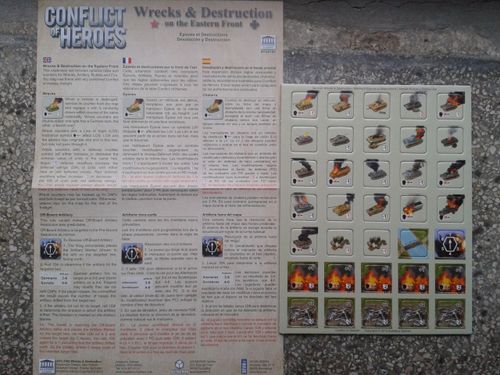
When a vehicle is destroyed, remove its counter from the map and replace it with a randomly drawn wreck counter of the same nationality. Wreck counters are double-sided: one side has a German tank; the other, a Soviet one.
Wreck counters with a Line of Sight (LOS) hindrance symbol affect LOS. LOS and fire attacks may originate and end in this hex, but may not pass through it.
Wreck counters with a defense modifier symbol will either increase or decrease the defense value of units in the same hex. Black +1 defense modifiers increase the defense ratings (DR) of units with either blue or red defense values. Red defense modifiers either increase +2 or decrease -1 the DR of units with red defense ratings.
Ex: The wreck counter shown above would lower the defense value of foot units only.
Wreck counters may be hooked up for 2APs and then towed as per normal rules. Otherwise, wrecks stay on the map for the rest of the firefight.
Off-Board Artillery
This rule variant makes Off-Board Artillery Resolution less predictable.
Off-Board Artillery is targeted in the Pre-Round Sequence as normal.
To Resolve Off-Board Artillery:
-
The firing commander places the Artillery Marker (shown to the left) on the targeted hex, facing north.
-
Roll 1D6 to determine if the artillery hit the targeted hex.
Hit on: Germans 3-6; Soviets 4-6.
Players may modify their die roll with CAPs. If the player misses, the unmodified die result equals the number of hexes the artillery drifted from the target hex.
- If the artillery did not hit its target, roll 1D6 to determine the direction in which the artillery drifted. The direction is marked on the Artillery Marker.
Ex: The Soviet is resolving his Off-Board Artillery strike and places the Artillery Marker on the target hex. He rolls 1D6 for a 2 and misses the target (by 2 hexes). He rolls 1D6 again for a 1, indicating that the artillery drifted north. So the artillery strikes 2 hexes north of the intended target hex.
Rubble
Rubble is created when a building is destroyed by artillery fire. Artillery attacks are resolved individually against each unit and building in a target hex. If a building is destroyed, units inside it still receive the building's DM against that artillery attack.
An artillery attack value (AV) greater than or equal to the building's defense rating (DR) destroys the building. Place a Rubble marker on that hex.
| Building | DR |
|---|---|
| Wood Building | 13 |
| Stone Building | 14 |
| Reinforced Bld (Bunker, etc.) | 15 |
Rubble does not block LOS. Buildings reduced to rubble do not block LOS.
Rubble increases a hex's movement cost by +2APs for all units. Wheeled vehicles are not allowed into rubble hexes, and tracked vehicles must check for immobilization.
All units in a rubble hex receive a +2 defense modifier.
Rubble remains on the map for the remainder of the game.
Fire
Building fires may be started by artillery and flamethrower attacks into a hex, or by infantry close combat (CC) attacks targeted against a building.
An AV greater than or equal to the building's DR +1 results in fire.
Note: It is harder for a building to catch fire than it is to create rubble.
Ex: Artillery fire hits a wooden building and scores a 14 AV. Instead of Rubble, a Fire marker is placed on the hex.
Ex: A German Pioneer unit attacks a Soviet unit in an adjacent wooden building hex with a flamethrower. The German rolls for effect against the Soviet unit and then against the building.
Ex: A rifle unit CC attacks an empty wooden building. The rifle's FP is 6 (2FP + 4CC modifier). It needs an 8 die roll (8+6FP=14) to catch the building on fire.
A building fire blocks LOS through the hex from all levels. LOS and fire attacks may originate and end in this hex, but may not pass through it.
Fire decreases the defense value of all units by -2. NO other terrain modifiers count in these hexes.
Fire increases a hex's movement cost by +1AP for all units.
Fire Damage: At the start of a new round, units in a fire hex must pass a fire damage check. During the 'Smoke' step of the Pre-Round Sequence, roll 2D6. A result of 8 or more results in a hit. A player may modify this roll with CAPs.
Ex: A rifle unit begins a new round in a fire hex. The fire damage check results in a 9, so the unit fails and pulls a hit counter.
Fire spreads: During the 'Target Off-Board Artillery' step of the Pre-Round Sequence, players must check if fires already on the map spread into adjacent building hexes.
If 2D6 + 6 is greater than or equal to an adjacent building's DR, the fire spreads. These rolls may not be modified with CAPs, since either player rolls for the results.
Note: Fires spread more easily than they are started.
Ex: Figure below: It is a new round and the players check if the fire in D07 spreads into the adjacent stone building hex D08. They roll a 9 for a total 15 Spread Value (2D6 + 6 fire spread modifier). This 15 Spread Value is greater than the stone building's 14DR and the fire spreads. The Rifles do not need to check for Fire Damage this round, since the fire just spread into their hex.