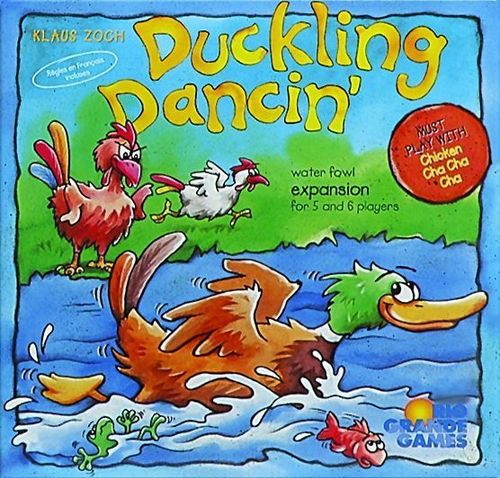
Chicken Cha Cha Cha: Duckling Dancin'
Chicken Cha Cha Cha: Duckling Dancin' Rulebook
Table of Contents
Table of Contents
Contents
- 2 ducks
- 2 tail feathers
- 6 piles (droppings) in 6 colours
- These rules
Game Idea
Anyone who knows Chicken Cha Cha Cha knows the game idea of Duckling Dancin': the young birds taking part (ducks and chickens) try to overtake one another and steal each other's feathers in the process.
New in Duckling Dancin' are 2 ducks and 6 coloured piles. It is better to step around them so as not to lose a feather. However, whoever gets overtaken may well drop another pile out of fright...
Setup
All tiles are laid out as in the base game, Chicken Cha Cha Cha.
Each player receives a chicken or a duck with any tail feather, which is inserted into the rump of the playing piece. The fowl are distributed over the path tiles so that the distance between all pieces is the same. (The only exception: if exactly five players are playing, the youngest player may place their animal one space closer to its "front animal" than the other players do.)
Before the game begins, each fowl drops a pile in its own colour behind it (see Figure 1).
Figure 1 (image only): Starting layout in a 6-player game.
Playing the Game
All movement and overtaking rules of Chicken Cha Cha Cha apply. To move forward, you must therefore always uncover a farmyard tile and try to find the picture that is also on the next path tile in front of your own fowl.
New in Duckling Dancin': The Coloured Piles
1. Jumping over a pile... or stepping in it
Piles lying on the path must be overtaken, just like a duck or a chicken: you look in the farmyard for the picture of the next free path tile (see the section "Overtaking" in the Chicken Cha Cha Cha rules).
If a fowl fails to jump over a pile, it steps right into it. That is, the player must place their playing piece on the path tile with the pile lying on it. The owner of the pile receives one tail feather from the fowl, if it has one. Afterwards, the owner of the pile removes their pile from the chicken muck (see section 2).
Figure 2 (image only): The blue chicken managed to jump over the yellow pile, but not the green pile, into which it therefore steps.
2. Removing a pile from the game and dropping it again
When a fowl, which may also be the owner's own, steps into a pile, the owner must take that pile out of the game and place it in front of themselves.
If their fowl is later overtaken, the owner brings the pile back into the game by placing it on any free path tile. If the pile is already lying on a path tile, it stays there.
The overtaking player then continues their turn.
Figure 3 (image only): The red duck overtakes the blue chicken and receives its tail feathers. If the overtaken chicken's pile is not already on a path tile, it drops that pile onto a free path tile out of fright.
3. Overtaking several piles and pieces
It can also happen that, in the same turn, several piles, fowl or even fowl and piles lying directly one after another must be overtaken in order to reach the next free path tile.
If this succeeds, all overtaken players who have their pile in front of them may immediately drop that pile again onto a free path tile. This happens one after another, beginning with the fowl that was overtaken first. The overtaking fowl pauses its turn until all overtaken animals have placed their piles.
If a young bird fails to overtake several piles and/or playing pieces, there are two possibilities:
Case 1: a pile lies in front of our red duck.
Figure 4 (image only): The duck is not able to find the fried egg, so it steps into the yellow pile. It must therefore give a tail feather to the yellow chicken. The owner of the yellow pile must take that pile out of the game and place it in front of themselves.
Figure 5 (image only): In the next turn the duck must jump over all occupied spaces to reach the next free path tile (arrow A). If the duck does not find the fried egg, however, it steps into the (yellow) pile lying in front of it (arrow B).
Case 2: a chicken stands in front of our duck.
Figure 6 (image only): If the duck finds the fried egg, it moves straight onto the path tile with the fried egg (arrow A). If the duck fails to overtake, it stays where it is, because a playing piece in front of it is one it cannot overtake.
End of the Game and Winner
With up to 4 players, the game ends as soon as one fowl has all the feathers in play in its rump.
In a 5- or 6-player game, the fowl that first collects 5 feathers wins.