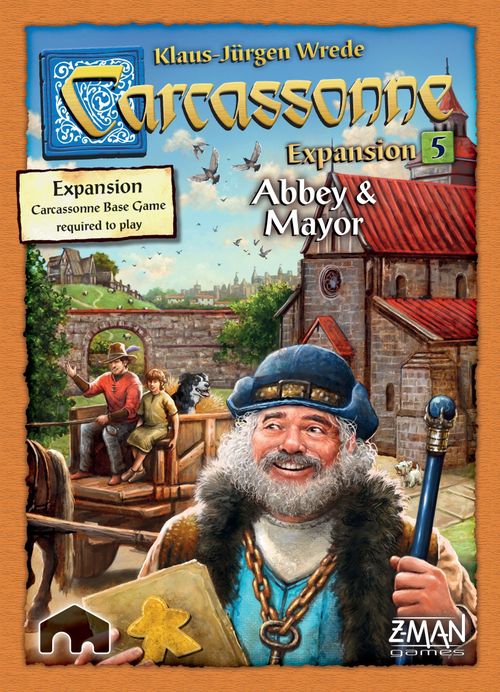
Carcassonne: Expansion 5 – Abbey & Mayor
Carcassonne: Expansion 5 – Abbey & Mayor Rulebook
Table of Contents
Table of Contents
Contents
- 12 Land tiles (marked with a symbol, to help you separate and sort your tiles)
- 6 Abbey tiles
- 6 Mayors
- 6 Wagons
- 6 Barns
Setup
Each player receives 1 Abbey tile. If you are playing with fewer than 6 players, return the remaining Abbey tiles to the box.
Shuffle the new Land tiles with those from the base game (and any other expansions you wish to use). Place them in multiple stacks, as usual.
Then give each player the following 3 figures in their color: 1 mayor, 1 wagon, and 1 barn. Each player adds these figures to their regular supply of meeples.
The New Land Tiles
The new Land tiles are played like those in the base game.
The rulebook illustrates a few of the new tiles:
- There are two separate cities on this tile. The city with the coat of arms ends after the bridge in the lower field. This is important for field scoring.
- There are two separate cities on this tile.
- The road on this tile is unbroken. The top part of the road separates two fields, the lower part does not. This is important for field scoring.
- This road ends in the field.
- The road on each of these tiles touches the city, creating 3 separate fields.
- The road does not end on this tile. Instead, it branches into 3 directions.
Abbey
1. Placing a tile
If you wish to place an abbey, do not draw a Land tile at the beginning of your turn. Instead of drawing and placing a Land tile, place your Abbey tile.
An abbey may only be placed in an empty space surrounded on its 4 orthogonally adjacent sides. In other words, the abbey may only be used to fill a hole. What is depicted on the 4 adjacent tiles (fields, roads, cities) does not matter; the abbey always fits.
If no such hole exists, you may not place your abbey.
Since 4 tiles are already adjacent to that empty space, you may place your Abbey tile there.
2. Placing a meeple
The abbey behaves like a monastery. You may choose to place a meeple as a monk onto your abbey.
3. Scoring a feature
The abbey completes the side of each tile directly adjacent to it. Once you have placed your abbey (and chosen whether or not to place a monk there), score any features completed by its placement.
The rules for scoring an abbey are identical to those for scoring a monastery.
The road with the blue meeple is complete. Blue scores 3 points.
Mayor
The source prints no step 1 for the Mayor, Barn and Wagon sections; the numbering below is transcribed as printed.
2. Placing a mayor
You may place your mayor instead of placing a meeple. A mayor may only be placed in a city containing no knights or mayors. All other rules that apply to meeples also apply to mayors.
3. Scoring a feature
The strength of your mayor is equal to the number of coats of arms in the city it occupies. If two or more players have meeples in the same city, it is scored as follows:
- Each normal meeple has 1 strength.
- Each large meeple has 2 strength.
- Each mayor has strength equal to the number of coats of arms in the city. If there are no coats of arms, the mayor has 0 strength.
When scoring a city, each player adds the strength of their meeples in the city. The player with the highest strength scores the points for that city. In case of a tie, all tied players score full points.
The value of a city is not affected by a mayor.
When a city is completed, mayors in that city are returned to their respective supplies.
Your mayor has 3 strength (3 coats of arms). The 2 blue meeples add up to 2 strength. You alone score 20 points.
If a city containing only mayors is completed, but with no coats of arms, each mayor has 0 strength and scores no points for the city.
Barn
2. Placing a barn
You may place a barn instead of placing a meeple. If you place a tile that creates a junction where 4 tiles connect to create an open field, you may place your barn directly on that junction. In other words, the corner of each tile forming this junction must only depict a field in order for a barn to be placed there.
You may place your barn on a field already occupied by farmers. You may not, however, place your barn on a field already occupied by another barn. Once placed, a barn remains in play until the end of the game.
The corner of each tile is a field: you may place a barn here.
The corners of both bottom tiles have city segments: you may not place a barn here.
3. Scoring a feature
Farmer scoring after barn placement
If there are farmers in the field where you place your barn, that field is scored immediately, just as it would be at the end of the game. Therefore, the player with the most farmers in that field scores 3 points per completed city in the field. It does not matter which player placed the barn that initiated this scoring.
Then, all farmers occupying that field are returned to their respective supplies.
You place a barn. Blue scores 6 points for the 2 completed cities in the same field and returns her farmer to her supply.
Farmer scoring by field connection
A field occupied by a barn may NOT be occupied by farmers. If you place a tile that connects a field occupied by one or more farmers to a field occupied by a barn, the connected field is scored during the scoring phase of that turn (after 2. Placing a meeple). The player with the most farmers in that field scores only 1 point per completed city.
Then, all farmers occupying that field are returned to their respective supplies.
The tile placed this turn connects both meeples to the barn's field. You and Blue each score 2 points for the 2 completed cities in that field and return the farmers to your supplies.
Barn scoring at game end
At the end of the game, you score 4 points per completed city in the field your barn occupies. If multiple barns occupy the same field, all concerned players score full points.
Wagon
2. Placing a wagon
You may place your wagon instead of placing a meeple. A wagon may be placed most places a meeple may normally be placed (road, city, monastery, abbey), but it may not be placed in a field.
3. Scoring a feature
When scoring a feature (road, city, monastery) a wagon occupies, the wagon is treated like a normal meeple.
After scoring, you may return the wagon to your supply, or you may move it to a directly adjacent unoccupied, incomplete feature (road, city, monastery, etc.). Adjacent, in this case, means that the feature is on the same tile or a tile orthogonally or diagonally adjacent to the tile the wagon is moving from. If there are no such features for your wagon to move to, it must be returned to your supply.
If several wagons are involved in a scoring phase, each concerned player chooses whether to return or move their wagon in clockwise order starting with the active player.
You score 6 points for the completed city and may move your wagon to the monastery above or the road below. You may not move your wagon to the completed road above or to the city (occupied by Blue) on the left.
You score 3 points for the road. Then you may move your wagon to the monastery on the right or the city below.
Rules for Using This Expansion with Other Expansions
Please refer to this page when you have questions regarding how this expansion interacts with other expansions. Until such time, you can safely ignore these clarifications and start playing.
Barn
- Exp. 2 — If you have the most farmers in a field where a barn is placed, you score 1 additional point per completed city (4 points total) if your pig is in that field. Furthermore, if you have the most farmers in a field that becomes connected to a field occupied by a barn, you score 1 additional point per completed city (2 points total) if your pig is in that field. You can place your pig on a tile that connects your farmer to the barn. After scoring your pig, return it to your supply.
- Exp. 3 — A barn may not be eaten by the dragon. You may not place the fairy by a barn. A barn [may] not be placed using a magic portal. (The verb "may" is missing from the printed text; it is supplied in brackets.)
- Exp. 4 — A barn may not be captured by a tower. You may not place your barn on a tower.
- Exp. 6 — If a barn placement triggers a field scoring, you may move meeples from the market in the city of Carcassonne to that field. Score that field as normal, and return all farmers in that field to their respective supplies. If your barn placement triggers a field scoring in which you score no points, you may place a meeple in the city of Carcassonne.
- The pigsty (The River II expansion) only affects field scoring for farmers. Barns do not score additional points from the pigsty.
- Exp. 8 — When scoring a field, whether for farmers or barns, castles are worth 1 more point.
Mayor and Wagon
- Exp. 3 — Both figures may be placed using the magic portal. They may only be placed in features in which they may normally be placed.
- Exp. 4 — Both figures may be captured by the tower. Both figures may not be placed on a tower.
- Exp. 6 — Both figures may be placed in the city of Carcassonne with the following exceptions:
- The mayor may only be placed in the castle quarter.
- The wagon may be placed anywhere but in the market.
- Exp. 8 — Both figures may occupy a castle. However, the mayor (now the lord of this castle) cannot score points for that castle, as that castle does not have any coats of arms.