Caesar XL: Gold Expansion Kit
Rulebook PDF: Victory Point Games · PDF
Caesar XL: Gold Expansion Kit Rulebook
Table of Contents
Table of Contents
[2.0] Game Equipment
New SPQR Cards
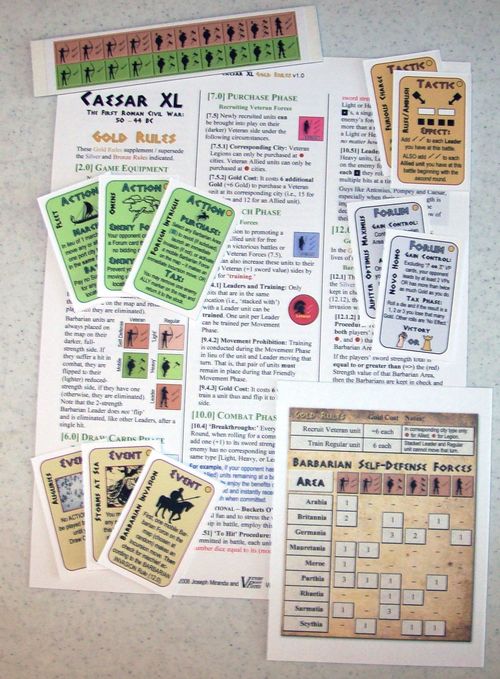
Several new SPQR cards are included in this Expansion Kit. These are simply shuffled into the deck when playing with these Gold Rules. They are marked with a gold circle in their top-right corner so that you can easily remove them when playing the Bronze or Silver versions of the game.
Barbarian Units
Twenty new, two-sided 1/2” square Barbarian counters are provided in the Gold version of Caesar XL. They come in two basic colors: brown (stronger, self-defense forces that are only used when a Barbarian Area is invaded and then removed after the battle) and green (weaker, mobile forces that are placed on the map and remain in play until they are eliminated).
Barbarian units are always placed on the map on their darker, full-strength side. If they suffer a hit in combat, they are flipped to their (lighter) reduced-strength side, if they have one (otherwise, they are eliminated). Note that the 2-strength Barbarian Leader does not ‘flip’ and is eliminated, like other Leaders, after a single hit.
[The printed sheet shows a chart of Barbarian counters in Veteran and Regular columns, with Light, Heavy and Leader rows, and brown (Self-Defense) and green (Mobile) counters. The chart is pictorial and is not reproduced as text.]
[6.0] Draw Cards Phase
Trading SPQR Cards
[6.2] A player may offer to trade any Action or Forum card he controls with the other player for any mutually agreeable terms. Only Action and Forum cards, plus Gold, may actually change hands – although promises can also be made, players are not obliged to keep them (that is a matter of trust).
[7.0] Purchase Phase
Recruiting Veteran Forces
[7.5] Newly recruited units can be brought into play on their (darker) Veteran side under the following circumstances.
[7.5.1] Corresponding City: Veteran Legions can only be purchased at Legion-symbol cities. Veteran Allied units can only be purchased at Allied-symbol cities.
[7.5.2] Gold Cost: It costs 6 additional Gold (+6 Gold) to purchase a Veteran unit at its corresponding city (i.e., 15 for a Legion and 12 for an Allied unit).
[9.0] March Phase
Training Forces
[9.4] In addition to promoting a Legion or Allied unit for free after certain victorious battles or recruiting Veteran Forces (7.5), players can also increase these units to their (darker) Veteran (+1 sword value) sides by paying for ‘training.’
[9.4.1] Leaders and Training: Only units that are in the same location (i.e., ‘stacked with’) with a Leader unit can be trained. One unit per Leader can be trained per Movement Phase.
[9.4.2] Movement Prohibition: Training is conducted during the Movement Phase in lieu of the unit and Leader moving that turn. That is, that pair of units must remain in place during that Friendly Movement Phase.
[9.4.3] Gold Cost: It costs 6 Gold to train a unit thus and flip it to its Veteran side.
[10.0] Combat Phase
[10.4] ‘Breakthroughs:’ Every Battle Round, when rolling for a committed unit, add one (+1) to its sword strength if the enemy has no corresponding units of that same type [Light, Heavy, or Leader] there.
For example, if your opponent has no Light (e.g., Allied) units remaining at a battle, all of your Light units enjoy the benefits of not being directly opposed and instantly receive +1 to their sword strength when committed.
[10.5] OPTIONAL – Buckets O’ Dice: For additional fun and to stress the value of leadership in battle, employ this rule:
[10.51] ‘To Hit’ Procedure: When committed in battle, each unit rolls a number dice equal to its (modified) sword strength. If, among its rolls, a Light or Heavy unit rolls one or more 1’s, a single ‘hit’ is inflicted on the enemy’s forces there. Important: No more than a single hit can be inflicted by a Light or Heavy unit’s throw of the dice no matter how many 1’s it throws!
[Printed as “a number dice” on the source sheet.]
[10.51] Leaders: Unlike Light and Heavy units, Leader units inflict one hit on the enemy forces at that battle for each 1 they roll. Thus, they can inflict multiple hits at a time.
[The source sheet prints this Leaders paragraph's number as [10.51], the same as the paragraph above it.]
Guys like Antonius, Pompey and Caesar, especially when their sword strength is improved by a Tactic card, can be decisive in battle with a lucky throw of their dice!
[12.0] Barbarian Areas
General Rule
In the Gold Rules, the Barbarians take on lives of their own.
Barbarian Invasion
[12.1] This rule is largely unchanged from the Silver Rules, but if the Barbarians aren’t kept in check by local Roman strength (12.12), they will now launch a physical invasion with their own units!
[12.1.2] Barbarian Invasion Procedure: Total the sword strength of both players’ units in Roman cities (brown-square, Legion-symbol, and Allied-symbol cities) that are adjacent to that Barbarian Area (green square).
If the players’ sword strength total is equal to or greater than (=>) the (red) Strength value of that Barbarian Area, then the Barbarians are kept in check and nothing happens.
If the players’ sword strength total is less than (<) the Strength value of that Area, an Invasion Force is created. To create an Invasion Force, take the green (mobile) Barbarian units in the stock and set aside any unit types not available from that Area as shown on the Barbarian Self-Defense Forces chart (e.g., Sarmatia has no Leaders). Then randomly pick from the stock among its available unit types a number equal to the Area’s Strength value and place them in that Area. If not enough units are available in the stock, take as many as are.
[12.1.3] Moving Barbarian Invasion Forces: The newly placed Barbarian Invasion Force then Makes an Incursion (i.e., moves one space). To determine which space it moves to, determine the Target Value for each connected Roman or Allied city by taking its Gold value and subtracting the number of Roman units (Legions, Allied units, and Leaders) there. Whichever has the highest value (it can be a negative number) is where the Barbarian Invasion Force moves. If there is a tie, roll a die to randomly determine between the tied locations.
For example, Not enough Roman sword strength is adjacent to Parthia when it activates, thus creating a Parthian Invasion Force on the map. The Invasion Force consists of 5 randomly selected mobile (green) units (Parthia’s Area Value) from among all three unit types (since the Parthian Self-Defense forces consists of all three unit types). One player randomly chooses from among the available mobile Barbarian units: 1x Light, 3x Heavy and 1x Leader, all of which are placed in Parthia and prepare to move.
Quo vadis (where are they going)? Of the three adjacent areas, Armenia has a Gold Value of 2 (it has no garrison); Pontus is worth 3, -1 for a Roman Ally unit there; and Antioch is worth 4, -1 for a Roman Legion unit present there. The area with the highest net Target Value is Antioch (with 4 – 1 = 3), and so the Parthian Invasion Force is immediately moved there and commences a battle with the poor beleaguered Legion stationed there (see below).
[12.1.4] Barbarians in Combat: If there are any Roman units in that city, combat immediately ensues. Barbarians cannot benefit in battle from any SPQR cards, or ever retreat or profit from looting (10.2). They can absolutely exploit the benefit of Breakthroughs (10.4) where applicable. When a Barbarian Invasion Force gains control of a Roman city, it is ‘looted’ and each player immediately rolls one die and loses that number of Gold (exactly as per the Bronze Rules, 12.12). If that city has an Ally marker in it, it is returned to the stock.
Barbarian Units in Battle Rounds
- ‘Light’ units fight in the first segment concurrently with Allied units
- ‘Heavy’ units fight in the second segment concurrently with Legions
- ‘Barbarian Leaders’ fight in the third segment with other Leaders.
Subduing Barbarian Areas
[12.2] Players may enter Barbarian Areas, as in the Silver Rules, but in the Gold Rules, the Barbarians defend their territory with physical brown units (as listed on the Barbarian Self-Defense Forces Chart) instead of notional units. These units are always returned to the stock after a battle.
Note that Taxing Barbarian Areas and Maintaining Control of Barbarian Areas remain unchanged from the Silver Rules.
Card Notes
From the sheet's Developer's Notes; the card's own text is printed on the card.
Jupiter Optimus Maximus (Forum card): If you appease Jupiter by expanding the Republic (i.e., subduing an important Barbarian Area), you will receive the benefit of a re-roll each Player Turn (i.e., up to twice per Game Turn).