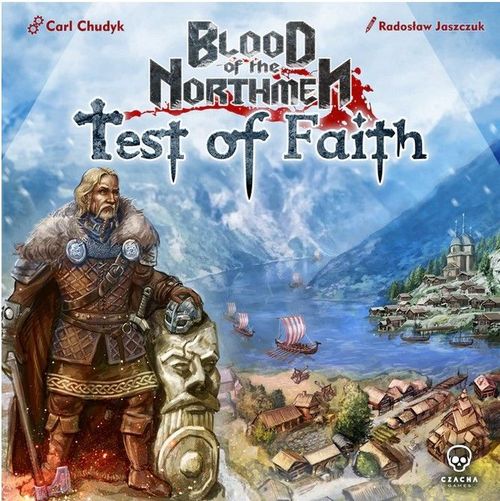
Blood of the Northmen: Test of Faith
Rulebook PDF: Czacha Games · PDF
Blood of the Northmen: Test of Faith Rulebook
Table of Contents
Table of Contents
Components
- 5 x Mead Town Tiles
- 5 x Silver Town Tiles
- 5 x Tusk Town Tiles
- 5 x Pelt Town Tiles
- 40 x Unique Terrain Tiles
- 5 x Special Ability Tiles
- 12 x Church Miniatures
- 20 x Longships Miniatures (5 for each Player)
- 20 x Catapults Miniatures (5 for each Player)
- 20 x Hersirs Miniatures (5 for each Player)
Goal
Bolster your forces with hersir, longship, and catapult units to take on the enemy in your efforts to form Bjarmia. Incite brigands against your foes. Found churches and control holy cities to spread your faith.
Map Tiles
Each Map Tile in Test of Faith is similar to the tiles in Blood of the Northmen with one additional type of side possible called a pass. A pass counts as a road side for movement in both directions if the side opposite is a road or an empty side, or if the pass leads off the map. A pass can be placed opposite a road, a mountain, an empty side, or another pass; a road, mountain, or empty side can likewise be placed opposite a pass.
The map tile diagram labels its sides as: forest side (top), forest side (upper left), pass (upper right), lake side (lower right), empty side (bottom), and empty side (lower left).
When a tile is placed, for each pass, before the other basic actions given by the tile, a player gains church actions. With each church action, a player may place a church, or draw a card; and he must do the same with each church action. A player placing a church must do so in a town in which the player has more units than any other player, including the brigands, and there is not yet a church. Stored mead actions may be used as church actions. A player drawing cards with church actions cannot draw cards with his other actions.
Churches
Conflict cannot occur in towns with churches, except when initiated by the neutral brigands.
At the end of each player's turn, he scores one Victory Point for each town with a church in which he has more units than each other player individually and more units than the brigands, but only if he did not engage in any conflicts that turn.
Conflict
In some conflicts a player may have more than one type of unit. When a player loses units he chooses which to return to his supply. A player must destroy all enemy units of all types in a tile during a conflict to gain two extra warbands upon victory; otherwise victory only provides one warband. In conflict a pass side on a discarded tile does not count as a mountain side.
Neutral Brigands
A player may spend forest actions to incite brigands, each two forest actions providing a tile discard for a brigand order, instead of taking other forest actions on his turn. Each tile is drawn, revealed, and discarded, and the number of the tile referenced for the actions of the brigands, just as in the Solo Game. When a choice is to be made involving the actions of the brigands, the player inciting the brigands makes that choice. If there is more than one order to be done, each order is resolved completely before revealing and discarding the next. At the conclusion of all brigand orders the inciting player continues with his turn spending his lake actions, road actions, and then mountain actions as usual.
Neutral brigands execute their listed orders treating hersirs, longships, and catapults (see below) as warbands. In a conflict initiated by brigands, hersirs, longships, and catapults are treated as warbands. In a conflict initiated by a player, a player's units retain their specific abilities.
It is possible for the brigands to win the game before any of the players. The brigands win by collecting six Victory Points, or if the draw deck is depleted through a discard executed by the listed order of the brigands. If either draw deck is depleted by a player, the game ends and a player winner is determined normally.
Neutral brigands may prevent the construction of churches and deny the counting of a town towards town actions in the same way other player's units do.
Hersirs
A player may spend road actions to place hersirs, each two road actions providing one hersir, instead of taking other road actions on his turn. A hersir is moved like and along with warbands in armies, with a maximum of three units total in any move. Like a warband, a hersir can be taken as a casualty in conflict and provides an additional tile.
In a conflict the winning player gains an additional Victory Point for each hersir he has that survives the battle, and gains one less Victory Point for each surviving enemy hersir belonging to any player.
Each hersir counts as an additional town of the type it occupies for town actions and for end of game victory conditions.
If all of a player's hersirs are built, a hersir on the board can be removed to build another on a newly placed tile.
Longships
A player may spend lake actions to place longships, each two lake actions providing one longship, instead of taking other lake actions on his turn. A longship is moved like and along with warbands in armies, with a maximum of three pieces total in any move. However a longship may only ever be moved across lake edges; longships cannot leave a lake once placed.
Each longship provides the player with an additional tile placement on his turn, provided that placement extends the lake the longship is on. A Stronghold may be placed on each tile, however a Stronghold cannot be placed on a side that would result in the lake not being extended contiguously. Any additional longship tile placements must be done before the player's main tile placement. Tiles may be drawn with the chance of them extending a lake, however if not placed as an extra tile the drawn tile is then considered the player's main tile to place for the turn.
Extra longship tiles do not provide actions when placed. Each extra longship tile placed provides the player with one Victory Point.
A player with a longship in a standard conflict automatically wins against a player with none (but not in a ranged conflict, see CATAPULTS). An opposing player (or players) without any longships does not discard tiles and loses all units. Tiles are not discarded at all for a conflict if only one player has a longship. If more than one player has a longship, each longship provides an additional tile and can be taken as a casualty in the conflict, like a warband.
If all of a player's longships are built, a longship on the board can be removed to build another on a newly placed tile.
Catapults
A player may spend mountain actions to place catapults, each two mountain actions providing one catapult, instead of taking other mountain actions on his turn. A catapult is moved like and along with warbands in armies, with a maximum of three pieces total in any move. Like a warband, a catapult can be taken as a casualty in conflict and provides an additional tile.
Each catapult a player has gives the player an extra mountain action that can only be used to initiate a conflict in the tile containing the catapult, regardless of how any other mountain actions are used in the turn. This action is available on the turn a catapult is placed. Such extra attacks may occur before and/or after attacks made using standard mountain actions granted either by a placed tile or by stored mead.
A player with at least one catapult in a tile may initiate a ranged conflict against an adjacent tile instead of a normal conflict, even across a side with an enemy Stronghold, but not across a mountain side on either tile. Both attacks granted by mountain actions and extra attacks granted by each individual catapult for itself may be changed to ranged conflicts in this way. In a ranged conflict only catapults provide tiles for each player, with no additional tile for initiating the conflict as the attacker. Warbands are not gained from winning ranged conflicts, though Victory Points still are. Ranged conflicts cannot be made against opposing forces in the same tile; these conflicts must be normal ones.
Prepared cards can be used in ranged conflicts even by players without catapults.
If all defenders are eliminated, if there is a Stronghold on the edge between the tiles it is either destroyed and removed from the board or captured by the attacker with a warband placed on top to signify change in ownership. A ranged conflict can be initiated against an empty tile just to destroy or capture a Stronghold in between, if one is present, and the result is a complete victory without tiles being discarded.
More than one catapult in a tile provides more than one additional conflict from that tile, with all units in the tile present for each whether it is a standard conflict or a ranged conflict.
Hersirs award additional Victory Points, or negate them for opponents, for ranged conflicts in the same way they do for normal conflicts.
A ranged conflict cannot occur from or against a tile with a church.
If all of a player's catapults are built, a catapult on the board can be removed to build another on a newly placed tile.
Novgorod
The Novgorod tile is a special tile with two pelt towns. The church action provided by the Novgorod tile is automatically used to place a church in Novgorod, even though the tile has no units yet. A Stronghold cannot be placed over the pass side when placing Novgorod.
Once Novgorod is in play, churches provide two points instead of one at the end of each turn, provided a player did not engage in conflict, and eight Victory Points are needed to achieve victory by score instead of six.
Solo Mode
In Test of Faith Solo Mode, the main deck is only 40 tiles, along with the 60-tile Test of Faith deck.
Before mountain actions, even if a player has none, each hersir, longship, and catapult that has not been placed this turn or moved this turn is returned to the supply.
During the brigand turn, hersirs, longships, and catapults lose their abilities and function as regular warbands.
Bribing Units
A player bribing away an opponent's units chooses which type to return to the supply for each silver action.
Unit Presence
In Test of Faith, the player with more units of all types than any other player, not just warbands, is the player who controls a town for purposes of church points. Similarly, if the game ends by deck depletion, a unit of any type in a town counts as presence in a town when checking for presence in most towns to determine the winner.
Team Mode
Two teams of two players may play a team game of Blood of the Northmen: Test of Faith. Teammates should sit across from each other to begin the game.
During the game, a player cannot move his units into or through tiles that have a unit belonging to his teammate. Each time a player places a tile with a town, he counts towns on the map controlled by his teammate as his when figuring the number of town actions he has.
A team wins the game immediately by collecting eight Victory Points between the two players in the team (or ten Victory Points once Novgorod is in play), or by one player forming Bjarmia individually as in a standard game. A teammate's units still block the player forming Bjarmia when tracing connection between the town types.
Special Ability Tiles
Conspirators
Inciting brigands costs you only one forest action per order instead of two.
In Solo Mode, start with a 50-card draw deck instead of a 40-card deck.
Nightwind
Each of your longships may be returned to the supply at the appropriate time and spent immediately as an action of any type in the same way as warbands placed in reserve from mead actions.
Oathbound
Upon moving an army through at least one pass, you may change one of the warbands in that army into a hersir.
Sectarians
Upon moving an army to end on a tile with a church, you may remove the church, except for the church at Novgorod.
Stonefists
You choose which units of your opponents are returned to the supply when you win a ranged conflict. At the end of your first turn after which you have at least three Victory Points, place a catapult on any tile.