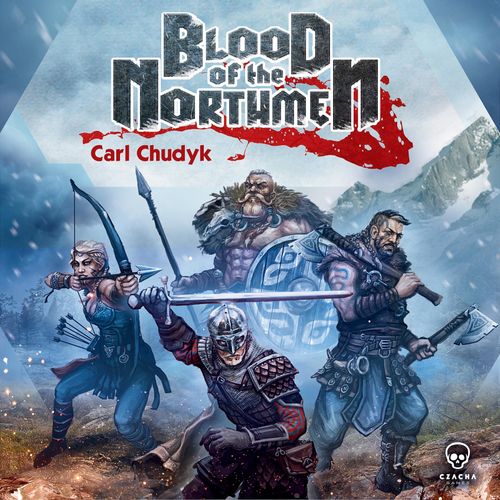
Blood of the Northmen
Blood of the Northmen Rulebook
Table of Contents
Table of Contents
Goal
Gather your warbands in young villages to forge a nation under your rule. Crush those who stand in your way. Explore a countryside map by placing new lands with forests, lakes, mountains and roads that connect outposts. Recruit, manoeuvre and attack with your forces according to the terrain types you add. Great rewards await, but only for those who are ready to fight for control of the villages.
Components
- 10 Mead Village tiles
- 10 Silver Village tiles
- 10 Furs Village tiles
- 10 Tusk Village tiles
- 80 unique terrain tiles
- 10 special ability tiles
- 5 player aid tiles
- 5 two-sided player boards
- 60 warband miniatures (12 for each of the 5 types)
- 12 fortress miniatures
- 1 active player marker
Translation note: the village tiles are "Городок Мёда", "Городок Серебра", "Городок Пушнины" and "Городок Бивней", rendered here as Mead, Silver, Furs and Tusk villages. The terrain count is printed as "8 0", read as 80; with 40 village tiles this gives the 120 map tiles used in setup.
Setup
- Choose your Jarl and take the corresponding player board.
- Take the matching set of 12 miniatures and place them on the left side of your player board in the marked circles. This is your settlement, and the starting point for all 12 of your warbands. The warband miniatures shown here are considered available to you.
- Take a player aid tile and add it to your player board.
- Randomly take a special ability tile and add it to your player board.
- Shuffle the map tiles to form draw piles (tile draws). Map tiles are all the village tiles and all the unique terrain tiles; there are 120 tiles in total. The draw piles must contain 60 random tiles for a 2-player game, 90 for a 3-player game, and all 120 for a game with more players. Shuffle the map tiles to form the draw piles face down, and place them next to the play area.
- Deal one tile from the pile to each player face up. The player who was dealt the tile with the most mountain sides will be the first player. If there is a tie, deal one more tile face up to each player involved in the tie until it is broken. Continue dealing tiles face down from the pile until the first player has three tiles, the player to their left has four, the next has five, and so on. If a player has already been dealt more tiles than this number face down, they keep them.
- The first player takes the active player marker and places it next to their player board.
- Keep the draw piles face down next to the play area.
- Place the fortress miniatures in a supply next to the draw piles.
Now you can begin the game.
Map Tiles
Each map tile in the game is a space that warband miniatures can occupy.
Map tiles are laid out together in a hexagonal arrangement throughout the game. Two adjacent tiles touch along a common edge. Each of the six sides of a tile is either a forest side, a lake side, a mountain side, a road side, or an empty side. In addition, some tiles also have a village in the middle of the space. Each tile can be placed next to six other tiles. Any number of warbands may occupy a tile.
Playing the Game
The game begins with the first player and continues clockwise around the play area. On their turn, a player:
- adds a tile to the map; then
- performs a forest action for each forest side on the placed tile; then
- performs a lake action for each lake side on the placed tile; then
- performs a road action for each road side on the placed tile; then
- performs a mountain action for each mountain side on the placed tile.
Adding a Tile to the Map
The first player chooses any tile from their hand and places it face up in the middle of the play area to start the map. The next two players, in turn order, must place a tile from their hand so that it touches exactly one previous tile along exactly one side of the new tile. Once there are three tiles on the map, for the rest of the game each player on their turn must place a tile from their hand so that it touches at least two previous tiles. All tiles added to the map are placed face up.
Adjacent sides must match. When a tile is placed next to another along a forest side, the placed tile must also have a forest side there. When a tile is placed next to another along a lake shore, the placed tile must also have a lake side there. When a tile is placed next to another along a road side, the placed tile must also have a road side there. When a tile is placed next to another along an empty side, the placed tile must also have an empty side there. Mountain sides are the exception: they may be placed next to any kind of side except a road side, and any kind of side except a road side may be placed next to a mountain side. If you are playing with the Citadel (which is recommended), you may place a tile with one forbidden combination of sides (see Citadel).
Example of map formation: in a 2-player game the first player starts the map with one tile. The second player wants to add a tile; the source shows three possible positions for it, each touching the first tile at a matching side. The source then shows a further example in which the tile must touch the middle tile and the map's mountain side must meet a forest side or lake side. Diagrams omitted from this transcription.
Drawing a Tile from the Pile
If on their turn a player has no tile in hand that they can legally place, or if they simply choose not to place a tile from their hand, they instead take a tile from the draw pile and reveal it face up. They may add this tile to the map. If they cannot or do not wish to do so, they discard it to a discard pile separate from the draw pile, take another tile into hand, and end their turn without performing any actions.
Performing Actions
After placing a tile, the current player counts the number of forest sides on the placed tile and then performs up to that many forest actions (see below). Alternatively, they may draw up to that many tiles from the draw pile, limited by the number of warband miniatures left in their settlement. The player then does the same for lake sides, road sides, and finally mountain sides, in that order. If a player decides to draw tiles at any point, that option is no longer available for later action types. For example, if a player places a tile with one forest side and two lake sides and chooses to draw a tile instead of their forest action, that player can no longer choose to draw tiles instead of their lake actions.
Forest Action
A player performing a forest action takes a warband miniature of their colour (type) from their settlement (on the player board) and places it on the tile they have just placed. If there are no available warbands left in their settlement, they may instead take one of any other tiles on the map or one of their victory points.
Lake Action
A player performing a lake action moves an army by taking up to three of their warbands that are on one map tile, and moving them to an adjacent tile across an empty side or a road shoulder. They cannot move an army across a side that has a mountain on any tile. They may move an army across a forest side by using two lake actions in a row, if they have them. A player may move an army across any number of consecutive lake shores in one action. In other words, an army may be moved in one lake action across a lake of any size formed on the map by more than one tile.
Example of a lake action: the source shows a large lake and a player with two warbands next to it. The player places a tile and performs a forest action, then one lake action on one lake side of the placed tile. The newly placed group cannot move because each boundary has a mountain side against the neighbouring tile. The player can move one or both groups as an army with one lake action; the army can move southeast along an empty side, or cross a lake shore to the southwest or south, or cross two lake shores within one lake to a tile two tiles away. Any of these moves costs one lake action. The army cannot advance northeast across the newly placed tile, because again a mountain side blocks the path. Diagram omitted.
Road Action
A player performing a road action moves an army by taking any number of their warbands that are on one map tile with a road, and moving them to an adjacent tile across a road.
If the target tile has no enemy warbands, they may continue moving the army onto subsequent tiles, always along roads, until they decide to stop or reach a tile with one or more enemy warbands.
They cannot choose to continue moving only some of the warbands they moved at first; they must either continue moving all of them or stop. Likewise, they cannot add any of their own warbands they might encounter along the way.
A player may move an army off a road across the map edge. If they do so, they follow a route clockwise or counter-clockwise along the map edge until they reach another road-edge side of a tile, possibly many tiles away from the edge. They move their army to the first such distant tile and end the road action.
Example of a road action: the source shows a player with a warband in a Furs village along a road. The player places the highlighted tile and performs a forest action, then a lake action to take a tile, and finally one road action on one road side of the placed tile. The player can move either of their warbands because both are on road tiles. The player may move the warband already on the map onto the Furs village one tile south across a road. If they do, it must stop there, because the tile holds an enemy warband. If the tile held no enemy warband, it could keep moving along the road. Alternatively it may leave the map across the road to the northeast, and go around the map clockwise or counter-clockwise until it reaches the next road side (shown in the source), and stop on that tile.
Mountain Action
A player performing a mountain action starts a battle by choosing a tile on the map that contains at least one of their warbands and at least one enemy warband. All warbands on the chosen tile now take part in the battle.
First, the active player takes one tile for each of their warbands taking part in the battle, plus one tile for starting the battle. Then, moving clockwise from the active player, each player who has at least one warband taking part in the battle reveals a number of tiles equal to the number of their warbands taking part. Tiles may be revealed from the player's hand or taken from the draw pile and revealed.
When a player reveals tiles, they reveal them one at a time, and may decide after each tile where the next tile will be taken from. Each player totals the number of mountain sides on all of their revealed tiles; this sum is their battle strength. The player with the greatest battle strength wins the battle. After the battle ends, all revealed tiles are discarded.
Example of a mountain-action battle: suppose a map tile somewhere has two yellow warbands, one red warband and one blue warband. A player uses a mountain action from a placed tile elsewhere on the map to start a battle. Blue has the right to reveal two tiles, one for their warband and one for starting the battle. Blue takes both from the draw pile; together they have two mountain sides, so blue's battle strength is two. Yellow has two warbands in the battle, so yellow reveals two tiles from the draw pile. The first has one mountain side and the second has none, for a total battle strength of one. Red has one warband in the battle, so red reveals only one tile; instead of drawing, red discards and reveals a strong tile from its hand that shows two mountains, for battle strength two.
Battle outcome in that example: blue and red have the highest battle strength with two. Yellow has battle strength one and loses the difference, losing one of its two warbands. Blue and red each lose one warband and each score one victory point for the tie, and one yellow warband remains on the tile.
Battle Resolution
After every player's battle strength has been determined, each player who does not have the greatest battle strength loses a number of warbands equal to the difference between their battle strength and the greatest strength in the battle. They remove their lost warbands from the tile where the battle took place and return them to their settlement (on the player board). If they do not have enough warbands to lose, they simply lose all their warbands on the tile. If there are several players each with the greatest battle strength, each tied player loses one warband, and the other players lose warbands equal to the difference in battle strength, as normal. If there is one player with the greatest battle strength, they may add one warband to the tile; if that player is the only one with warbands left on the tile, they may add two instead. Finally, the player or players with the greatest battle strength each score one victory point. Each winner marks the point by taking a warband miniature from their settlement (on their player board) and placing it by the campfire on their player board. If there are none in their settlement, they may mark the victory point by removing one of their warband miniatures from the tile on the map.
A player who performs more than one mountain action to take part in battles may take part in the next battles on different tiles, or on the same tile, as long as warbands of more than one colour, including their own, remain there. They do not need to decide where the next battle is until the first one is resolved.
After the mountain actions, the player ends their turn by passing the active player marker to the player on their left, and that player begins their turn.
Special Ability Tiles
Each player has one special ability tile, chosen at random during setup. Each ability is as follows:
- Corsairs: On each of your turns, get one free additional lake action, but only through a lake.
- Marauders: In a battle in which exactly one of your warbands takes part, your final battle strength is increased by 1. Note: you do not reveal an extra tile; you add 1 to the total number of mountain sides on all your revealed tiles.
- Sails: When you place a village tile, you may discard from your hand another village tile of any type. If you do, you are considered to be in the discarded village, for the purpose of getting village actions of the same type as the placed village.
- Picaroon: During road actions, your citadels count as road sides, and the armies of warbands opposing you do not stop the movement of your larger army.
- Warriors: When you place a tile with exactly one forest side, get one free additional forest action.
- Norman: On each of your turns you get one free road action, but only on a road marked on the map.
- Bandits: In battle, take and reveal two additional tiles for each of your citadels on one side of the tile.
- Vikings: After each turn in which your warbands are present in more than one village of the same type, score one additional victory point.
Translation note: the source uses "крепость" (fortress) and "цитадель" (citadel) for the same piece in several places, most clearly in the Goods and Citadels sections. Both are rendered as printed in context. The Sails and Picaroon wording is rendered literally.
Winning the Game
If a player scores their sixth victory point, their military skill is sung of in ancient legends, and they win. If several players score their sixth victory point in the same battle, the game ends in a draw between them.
If at the end of a turn a player has at least one warband of their colour in at least one village of each type (furs, mead, silver and tusk), and can trace a path through the wilderness at any distance between each such village, without crossing a mountain side, through the map or through a tile containing only warbands that are not their colour, they have founded the nation of Bjarmia and won.
If the draw piles are exhausted, the player taking their turn finishes their actions. No further draws are possible, and any ties in the remaining battles are treated as having no mountains.
At the end of a turn, the player with at least one warband of their colour in the most villages is the winner. They are the most influential of the leaders. In a tie, the player who has scored the most victory points wins. They are the most powerful of the leaders. If there is still a tie, the player with the most warbands of their colour on the map becomes the winner. If players are still tied, the game ends in a draw between them. The leaders issue a charter of peace.
Source wording note: the sentence on exhausted draw piles and ties ("любые ничьи в оставшихся боях рассматриваются как не имеющие гор") and the end-of-turn tiebreaks are transcribed as printed in the source translation.
Example of Winning by Founding Bjarmia
At the end of the three-player game shown in the source, Purple places a tile with three lake sides and a road side in the lower right. After all their actions, Purple has warbands in a tusk village, a furs village, a mead village and a silver village on the map, connected in a continuous way. Purple founds the nation of Bjarmia and wins the game.
Advanced Rules
Once players are familiar with the base game of Blood of the Northmen, two additional modules are available for advanced play: Goods and Citadels. Each can be added to the game separately, or they can be combined for the richest experience.
Goods
When a player adds a village tile to the map, before their main actions they receive a number of actions matching the village type. For each village (of any type) on the map where only their warbands are present, they receive one action. In addition, for each village of the same type as the newly placed one, where only their warbands are present, they receive an additional action.
As with the basic actions, the player may choose to perform all, some or none of their actions in the villages that are eligible.
For example, if a player places a furs village, and before their main actions they are present in only one furs village and two silver villages on the map, they may perform four actions in the furs village (three villages plus one additional for the furs village).
Furs Village
A player performing furs actions returns their accumulated points, and then scores one victory point for each furs action. They mark each point by taking a warband miniature from their settlement (on the player board) or, if there are none in their settlement, they may remove one of their warband miniatures from a tile on the map, or take one of their warband miniatures from their reserve (see Mead). In any case, a player may not add a point to their score with a furs action that exceeds the number of warbands they have on the map.
For example, if a player has two warbands on the map and one point, and has three furs actions, they can only score one more point with furs actions, since they give up their original point and score two, but cannot score a third. Also, the second victory point cannot be taken as a warband miniature from the map, since then they would have two points and only one warband on the map.
Translation note: the furs-action wording "возвращает свои набранные очки" is rendered as printed and is not clear in the source; the example that follows is transcribed as printed.
Mead Village
A player performing mead actions places one of their warband miniatures in reserve in front of them, taking a warband miniature from their settlement (on the player board) or, if there are none in their settlement, they may remove one of their warband miniatures from a tile on the map, or take a warband miniature from those by the campfire. Warbands in the player's reserve may be spent later in this turn or any subsequent turn, together or separately, as additional forest, lake, road or mountain actions at the appropriate time during their turn. They may be spent in this way even if the player is not entitled to any actions of that type because of their placed tile. All action types used in a turn must still be used for the same purpose.
Additional mountain actions may be declared after seeing the results of previous battles. Reserved warband miniatures used as basic actions are removed from your reserve and placed in your settlement (on your player board).
Silver Village
A player performing silver actions chooses a tile on the map on which they and at least one other player have a warband. The player may discard a tile from their hand; if they do, they remove from that tile one miniature of each other colour. Removed warbands return to the settlements of their owners (on their player boards). Removed warbands are removed without a battle or scoring of victory points.
For example, if Purple performs silver actions where they have a warband, and there are two orange warbands and one yellow warband there, one silver action removes one orange warband and one yellow warband. A second silver action, if performed on the same tile, removes the second orange warband.
Tusk Village
A player performing tusk actions may place a tile from their hand face down in front of them. The tile is kept together with any previously prepared tiles from earlier turns. Prepared tiles may be used in battles in future turns, as described below.
Prepared for Battle
Whenever a player's warbands take part in a battle, whether a battle started by the player on their turn or by another player on another turn, before the player draws and reveals tiles to determine battle strength, the player may choose to reveal any or all of their prepared tiles, adding the number of mountains on those tiles to their battle strength; the tiles are discarded after the battle. Prepared tiles are chosen before and in addition to the battle tiles the player would normally take. All unused prepared tiles held by the player are kept face down for future battles. The number of prepared tiles a player has is public knowledge.
Example from the source: in a three-player game, Purple attacks Orange in a silver village. Purple is entitled to two tiles, one for their warband and one for the attack. Orange is entitled to two tiles for their warbands. Purple also has two prepared tiles from earlier tusk actions. Purple may use one or both of their prepared tiles for their mountains, before taking and revealing their two basic tiles.
Citadels
When a player adds a tile to the map, before their village and main actions they may place one citadel from the supply on the map, on the common side of the added tile and an adjacent tile. When doing so, they take a warband from their settlement and place it in the citadel to mark their ownership. If no available warbands remain in their settlement, they may instead take one from any other location on the map, or from their victory points, or from their reserve, or from one of their previously placed citadels, also returning that citadel to the supply. If no citadels remain in the supply, they may similarly return one of their previously placed citadels to the supply in order to place a new citadel.
When adding a tile to the map, matching one side with another existing tile may be incorrect, but then the player must place a citadel on that side. A citadel over an incorrectly matched side is permanent; it cannot be removed later to place other warbands or another citadel. The player does not get the normal basic action from the side of their tile on which they placed a citadel.
Lake and Road Actions Through Citadels
A player treats a side on the map with their own citadel as an empty side, passable when moving their warbands with lake actions. A player treats a side on the map with an opponent's citadel as a mountain, which is impassable.
For example, on the map shown in the source, the orange player places a tile with a mead village as shown in the diagram. They decide not to place a citadel this turn. With the three lake actions given by the tile, they may also move their orange warband from a furs village three times, the third time through their previously placed citadel in the middle of the map. With one road action, they may then continue their movement from the edge of the map, going around it and coming back, stopping in a tusk village.
Furs Actions and Citadels
Playing also with the Goods module, a player treats each citadel on the map that they own as a warband for the purpose of determining their maximum victory point limit when performing furs actions, and they perform six furs actions. For example, if they have three warbands on the map and two citadels, they gain five points.
Bjarmia and Citadels
A player may connect through their citadels when tracing between different village types when forming Bjarmia, as if they were empty sides. A player may not trace through opposing citadels, just as they cannot trace through mountains.
For example, on the map shown in the source, both Purple and Orange have warbands present in a tusk village, a silver village, a furs village and a mead village. Orange can form Bjarmia and win the game if it is their turn. Purple cannot because of the orange citadel in the middle of the map. In the case shown on the right, mountains block any other movement between populated villages, except movement through sides holding a citadel. Orange may trace through their own citadel, but Purple may not trace through the opponent's citadel.
Solo Play
A solo player may play against the bandits roaming the local countryside. Shuffle the cards and form a draw deck of 60 cards, then the player takes three cards.
The player begins with twelve warband miniatures in their supply. Against them there are twelve bandit miniatures in a separate set, using warband miniatures of another colour.
The player must win the game before the deck runs out, either by scoring six victory point tokens, or by founding Bjarmia, connecting one village of each of the four types over land without interruption by mountains or by any space containing only bandits. If the deck runs out or the bandits score six victory points, the bandits win and the player loses. The bandits cannot win by founding Bjarmia.
On their turn the player plays normally, using goods and fortresses as they choose. After each turn the player turns the top card of the draw deck over to the discard deck, noting the card number from 001 to 120. They then look up the bandit action for that card in the table below and perform it. Note that if there are no bandit miniatures on the map, any card numbered above 030 must be redirected to the action for 030 or below, as shown in the brackets. The bracketed actions are the ones that place more bandits on the map.
All actions performed by bandits are directed by the player. When a choice must be made, the player makes it. For example, if three bandits must be added to a village tile and there is more than one village tile on the map, the player decides which village the bandits go to. If an action cannot be performed, it is not performed. For example, if a card calls for bandits to be placed on a village tile and there are no village tiles on the map, no bandits are added.
Bandit miniatures added to the map come first from the supply, and then must come from another location on the map. They are never removed from the bandits' victory points. Bandit victory points for battle wins, scored according to card instructions, are always scored; they cannot be declined.
Whenever bandits must perform a lake or road action, it must be performed by moving as many bandit miniatures as possible (up to three for a lake action) from one selected tile to another tile that already contains bandit or warband miniatures. If no such move exists, the action is not performed. Then, if two lake and/or road actions are available, and two moves can be made to transfer bandit miniatures to another tile containing miniatures, they must be performed. If a bandit army of four or more is divided, a subsequent move cannot undo the previous move.
If the instruction says that a bribe must happen, bandits do not need to pay any cards from hand; they have no hand. A bribe of a warband can only occur on a tile containing a bandit.
If the instruction says that a card must be prepared for a future battle, the card is taken from the draw deck and kept face down next to the bandit miniatures. Whenever a battle occurs, all prepared bandit cards are used automatically.
Translation note: the source uses "подкупают" for the bandit bribe action, rendered here as "bribe"; the source's "взятка" wording is rendered the same way. Card numbers in brackets are the redirect values used when no bandits are on the map.
Bandit Action Table
Cards 001-030 are the direct bandit actions. Cards 031-120 with a number in brackets are the redirect values used when no bandits are on the map.
Cards 001-030
- 001 — Add 2 bandits to a tile without warbands or bandits. Lake action moves bandits.
- 002 — Add 3 bandits to a village tile. Lake action moves bandits.
- 003 — Add 1 bandit to each lake tile. Lake action moves bandits.
- 004 — Add 4 bandits to a tile. Lake action moves bandits.
- 005 — Add 2 bandits to a mountain tile. Road action moves bandits.
- 006 — Add 3 bandits to a village tile. Road action moves bandits.
- 007 — Add 1 bandit to each road tile. Road action moves bandits.
- 008 — Add 4 bandits to a tile. Road action moves bandits.
- 009 — Add 2 bandits to a tile with a warband. Then attack with bandits.
- 010 — Add 3 bandits to a village tile. Then attack with bandits.
- 011 — Add 1 bandit to each tile with a warband. Then attack with bandits against the smallest possible warband army.
- 012 — Add 4 bandits to a tile. Then attack with the largest possible bandit army.
- 013 — Add 3 bandits to the tile just placed by the player. Then bandits score 2 points.
Cards 031-060
- 031 (001) — Lake action moves bandits twice. Road action moves bandits.
- 032 (002) — Lake action moves bandits. Road action moves bandits.
- 033 (003) — Lake action moves bandits. Road action moves bandits. Then attack with bandits.
- 034 (004) — Lake action moves bandits. Road action moves bandits. Then draw and discard to play another card.
- 035 (005) — Lake action moves bandits twice. Then attack with bandits.
- 036 (006) — Lake action moves bandits. Then attack with bandits twice.
- 037 (007) — Lake action moves bandits. Then attack with bandits against the smallest possible warband army.
- 038 (008) — Lake action moves bandits. Then attack with bandits using the largest possible bandit army.
- 039 (009) — Lake action moves bandits twice. Then bandits score 1 point.
- 040 (010) — Lake action moves bandits. Then bandits score 2 points.
- 041 (011) — Lake action moves bandits. Then bandits score a point for each bandit army.
- 042 (012) — Lake action moves bandits. Then draw and discard to play another card.
Cards 061-090
- 061 (001) — Bandits prepare 1 card. Then attack with bandits.
- 062 (002) — Attack with bandits. Then bandits prepare 2 cards.
- 063 (003) — Attack with bandits twice. Then bandits prepare 1 card.
- 064 (004) — Attack with bandits. If the bandits win, bandits prepare 4 cards.
- 065 (005) — Bandits score 2 points. Then attack with bandits.
- 066 (006) — Bandits score 1 point. Then attack with bandits twice.
- 067 (007) — Attack with bandits twice. Bandits score 1 additional point for each battle that the bandits win.
- 068 (008) — Attack with bandits. If the bandits win, the bandits win the game.
- 069 (009) — Bandits bribe 2 warbands. Then attack with bandits.
- 070 (010) — Bandits bribe 1 warband. Then attack with bandits twice.
- 071 (011) — Attack with bandits. Then bandits bribe 3 warbands.
- 072 (012) — Attack with bandits twice. Then bandits bribe 2 warbands.
- 073 (013) — Attack with bandits three times. Then discard 5 cards from the deck.
Cards 091-120
- 091 (001) — Road action moves bandits three times. Then discard 5 cards from the deck.
- 092 (002) — Road action moves bandits once for each bandit army. Then discard 5 cards from the deck.
- 093 (003) — Road action moves bandits once for each village tile. Then discard 5 cards from the deck.
- 094 (004) — Road action moves bandits once for each warband. Then discard 5 cards from the deck.
- 095 (005) — Road action moves one bandit four times. Do not undo the previous move. Then discard 5 cards from the deck.
- 096 (006) — Road action moves bandits twice. After each move, if a bandit moved onto a tile with a warband, attack there with bandits. Then discard 5 cards from the deck.
- 097 (007) — Bandits score 2 points. Then bandits bribe 1 warband.
- 098 (008) — Bandits score 1 point. Then bandits bribe 2 warbands.
- 099 (009) — Bandits bribe 2 warbands. Then bandits score a point for each warband bribed.
- 100 (010) — Bandits bribe a warband on each village tile. For each such tile without a warband, bandits score a point.
- 101 (011) — Bandits score 2 points. Then bandits prepare 1 card.
- 102 (012) — Bandits score 1 point. Then bandits prepare 2 cards.