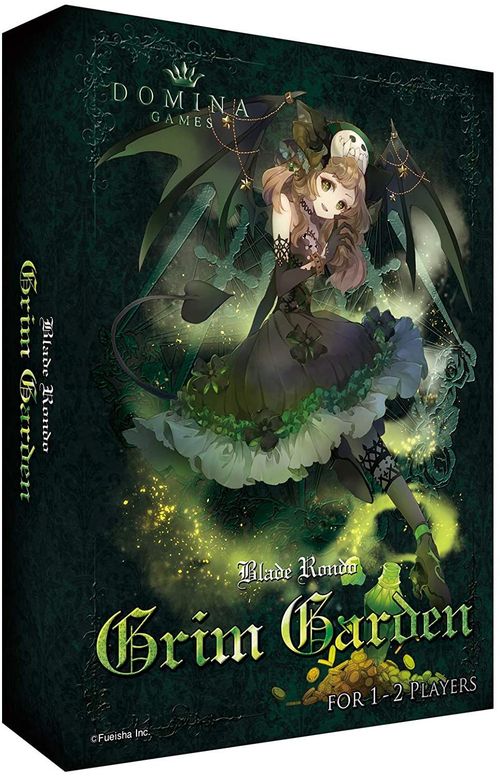
Blade Rondo: Grim Garden
Blade Rondo: Grim Garden Rulebook
Table of Contents
Table of Contents
Contents
- Manual x1
- Cards x65
- Parameter board x2
- Parameter dice x6
- Life stone x2
Object of the Game
This game is a card game for 1 to 2 players. Using the 7 "swords" you chose yourself as your hand, you fight, and you win by reducing the enemy's Life to 0. The rules are first explained for 2 players; when playing solo, please also read from here in order.
Setup
1. Each player prepares their own area as shown in the diagram.
- Parameter dice: Place each die with its 0 face up inside the circle of its corresponding color. Note: The die above ATTACK is Attack Power; the die below VOLTAGE is Voltage; the die above DEFENCE is Defence Power.
- Life stone: Place it on the 15 space.
- Parameter board: Place the boards so that both players can see them easily, joining the top edge of the opponent's board to your own.
- Breathing Art cards: Place one "加熟法" and one "加護法" face up in front of yourself.
If you are playing for the first time, please first read "First Battle" on p.17.
2. Shuffle the 40 Sword cards face down and deal 15 to each player. The remaining 10 cards are not used; set them aside unrevealed.
3. Each player chooses 7 cards from their dealt 15 to be their hand. The remaining 8 are not used; set them aside unrevealed.
4. Decide who goes first and second as fate guides. The second player receives the "鼓動法" card, places it in front of themselves, and also sets their Attack Power to 1. When the above preparations are done, the battle begins.
If you want to fight with swords of your choice... If each player owns a copy of this game, each player can fight using 7 cards they prepared beforehand as their hand. You may include up to 2 cards of the same name in your hand. In this case, steps 2 and 3 above are skipped.
Flow of the Game
Until one player wins, the first player and the second player alternate taking turns in the following flow.
1. Start of Turn Processing
- Increase your Voltage by 1. Voltage does not go to 10 or more; if it is already 9, you
and lose 1 Life. - You may exchange any number of Gold Coin icons in your Set Area with the same number or fewer of Gold Coin icons in your hand. (Only once per turn.)
- Resolve the start-of-turn effects of cards granted to you.
- Resolve the start-of-turn effects of your Retainers (配下).
2. Action
- Use any number of cards, within the range where the total cost does not exceed your Voltage.
To use a card: Choose one Breathing Art card in front of you or one Sword card in your hand and put it into play. If the card has "Response (Z)" it is put out face down; if not, it is put out face up. At this time, you consume the cost written at the top left of the card (1 cost, or in the case of "加護法" a cost decided by yourself) and it counts as having been used. Consuming cost does not reduce the Voltage itself. After that, if the card was put out face up, resolve its effect. The place where used cards are put is called the Play Area.
3. End of Turn Processing
- For each of your face-up cards placed in the Play Area, do the following:
- Cards with the Limited icon (L): Discard to the discard pile.
- Sword cards without: Return to your hand.
- Breathing Art cards without: Return in front of yourself.
- If the opponent has a face-down card in the Play Area, they return it to their hand.
When a parameter or Life changes: Change the top face of the parameter die, or the position of the Life stone, to that value. The upper limit of each parameter is 9, and the upper limit of Life is 15. However, Attack Power and Defence Power may temporarily exceed the upper limit through the effect of a Sword card. In this case it is not necessary to change the top face of the parameter die.
The Play Field
(Diagram labels, own side:)
- Set Area: the place where Retainers and granted cards are placed.
- The place where you keep your own Breathing Art cards.
- Play Area: the place where used cards are placed.
Reading the Cards
Breathing Art cards and Sword cards are displayed as follows.
- Card name
- Cost: The cost necessary to use this card.
- Limited icon: A card bearing this icon becomes a discard when used, at end of turn. (Only if it is in the Play Area at end of turn.)
- Symbol
- Text: The effect when this card is used.
- Flavor: A summary of the story and legend. It is not used in the game.
Note: At the bottom of the card, other things such as the card number and the name of the character depicted in the illustration are written, but they have nothing to do with game play.
(Card backs: Breathing Art card back; Sword card back.)
Types of Cards
This game uses Breathing Art cards and Sword cards to fight. There are no conditions imposed on using cards based on these classifications.
- Breathing Art (呼吸法) — an art for strengthening yourself: Cards that raise your own parameters; they are placed in front of you. Each player always has "加熟法" and "加護法", and "鼓動法" is obtained by the second player.
- Sword — Physical (物理) — the basic form of attack: Cards with the "Physical Attack" effect, whose power changes with your Attack Power.
- Sword — Magic (魔法) — a sure-kill attack that ignores defence: Cards with the "Magic Attack (X)" effect, which deal damage while ignoring the opponent's Defence Power.
- Sword — Support (補助) — support effects that make battle advantageous: Cards that support with Life recovery and parameter increases, with the "Summon (Y)" effect that calls Retainers.
- Sword — Cloth Stone / Preparation (布石) — preparation against the enemy's attack: Cards with the "Response (Z)" effect, which can be used in reaction to the opponent's actions.
- Sword — Special (特殊) — unconventional special actions: Cards that have multiple different effects.
Keyword Abilities
Some effects within cards are abbreviated and shown as keywords.
Physical Attack Deals the opponent damage equal to your (or your Retainer's) Attack Power minus the opponent's Defence Power.
Magic Attack (X) Deals the opponent X damage.
Summon (Y) Even if this card has a Limited icon, it is not discarded at end of turn; after use it becomes a Retainer with the parameters and text written below, and is placed in your Set Area.
- If it has an Attack Power, when this Retainer Y performs a Physical Attack, that value is referenced.
- If it has a Defence Power, when you (or the opponent's Retainer) receive a Physical Attack, you may reference that value in place of your own Defence Power.
Response (Z) When you use a card with "Response (Z)", place it in the Play Area face down so the opponent cannot see its face. This card is returned to your hand at end of your turn and is not discarded. During the opponent's turn, if an action bearing the Z symbol is performed, you may turn it face up. Then resolve that effect. If multiple cards that simultaneously satisfy the condition are used with "Response (Z)", turn them face up and resolve them in any order you like. A card whose effect has been resolved is discarded at the end of the opponent's turn. A card that was not resolved by the end of the opponent's turn and remains face down is returned to your hand.
Add (追加) Resolve this effect only if you dealt 1 or more damage to the opponent through the effect of this card.
Forge (錬成) When you use this card, you may resolve this effect before paying the cost. (Note: it is optional, so you need not resolve it.)
Compensation (代償) When you use this card, resolve this effect at the same time as paying the cost. (Note: it is mandatory, so you must resolve it.)
Gold Coin (金貨) icon If there is a card bearing this icon in your Set Area, at the start of your turn you may exchange any number of Gold Coin icons in your Set Area with the same number or fewer of Gold Coin icons in your hand. Placing a card in the Set Area by this is not treated as an action, and you cannot perform a Response to it.
Glossary
You (あなた) The player who used that card, or the player to whom that card has been granted.
Retainer (配下) A card placed in the Set Area by the effect of Summon (Y).
Action (行動) The general term for effects bearing the symbols written on cards and in card text.
Attack (攻撃) The general term for actions, among all actions, with the Physical or Magic symbol.
Example: "ヘルリサイタル" is an action and an attack. (The card text reads: "At the start of your turn, do the following. [symbol] ヘルリサイタル: Magic Attack (1). Compensation: You take 1 damage.")
Negate (無効化する) To cancel that card, or the effects of an action other than its "Compensation". The cost of a negated card is not returned, and if it is a card with a Limited icon it is discarded at end of turn.
Ignore (無視する) To treat the target's parameter value as 0, or to nullify the target's effect.
Deal (Receive) Damage (ダメージを与える(受ける)) To reduce the target player's Life. It is distinct from "losing Life".
Respond (レスポンスする) During the opponent's turn, when a card bearing the Z symbol (or an action bearing the Z symbol, such as one held by a Retainer) is used, to turn face up the "Response (Z)" card you placed face down in the Play Area and resolve its effect before the opponent's card.
Grant (付与する) To place this card in the target player's Set Area. While it is placed, the target player receives the effect of the text written below. A granted card is not discarded at end of turn even if it has a Limited icon.
Revive (復活する) When the target player's Life becomes 0, to change their Life to a stated value instead of that player being defeated.
Do the following (may do) (以下を行う(行っても良い)) Perform the action written below. If there is no cost written, it can be performed for 0 cost.
Example: "Add: Immediately after this attack, you may do the following. [symbol] ダズル: Magic Attack (3)" — To perform "ダズル" of "魔導剣", 1 cost is required.
Detailed Rules (Ver 1.01)
This page lists detailed rules of the game extracted from the detailed rules. You do not need to read it first; refer to it as needed when something arises that you do not understand while playing. The detailed rules may be updated as needed. Please check the full text of the latest detailed rules and Q&A for individual cards on the official site.
1. Hand Hand refers only to the Sword cards you hold in your hand. Breathing Art cards and cards placed in the Play Area are not regarded as hand.
2. Parameters If an effect changes a parameter for a period such as "until end of turn" or "while this card is in play", the value of the parameter die does not change. In this effect, the upper limit of each parameter, 9, may be temporarily exceeded.
3. Damage 3.1 Even though an effect that deals damage was used, if damage is not dealt to the opponent for a reason other than negation, such as reduction by Defence Power, it is regarded as dealing 0 damage. 3.2 Losing Life is not the same as damage. You cannot use the effect of "燐光" in response to losing Life due to "Burst" or "Poison".
4. Response 4.1 When resolving the effects of cards with "Response (Z)" placed face down, turn them face up one at a time, resolve that effect, and then decide on the effect of another card with "Response (Z)". 4.2 The effects of cards with "Response (Z)" can only be resolved during the opponent's turn. 4.3 Unless otherwise written, you cannot interrupt an action with a card that does not have "Response (Z)" and resolve it first. 4.4 You cannot place a card without "Response (Z)" face down in the Play Area. (Except for the Outlaw (アウトロー) during solo play.)
5. Use of Cards 5.1 A player can use cards by putting a Breathing Art card or a Sword card from their hand into the Play Area. However, depending on a card's effect, the player may execute processing as if they had used a card. 5.2 When an "Attack" is performed, process in the following order.
- If there is "Forge", you may resolve its effect.
- Pay the cost. If there is "Compensation", resolve its effect at the same time.
- If this attack is negated by a continuing effect, do not perform the subsequent processing. (e.g. "迷い道のトパーズ")
- If the non-turn player has a face-down "Response", they may turn it face up and resolve its effect. (At this point, effects of "after the attack ends" and "damage adjustment" are not resolved.)
- Resolve effects that take place before the attack. (e.g. "フィナーリア")
- Determine the turn player's Attack Power. (e.g. "陽光導くカンタータ")
- Determine the non-turn player's Defence Power. (e.g. "月光のルチル")
- Calculate the base damage. (Physical Attack, Magic Attack (X))
- Apply the turn player's damage adjustment. (e.g. "クロウリーシラン")
- Apply the non-turn player's damage adjustment. (e.g. "事象透過のアメジスト")
- The turn player uses "燐光".
- The non-turn player uses "燐光".
- The non-turn player reduces Life by the amount of damage determined up to this point.
- Resolve the "Add" effect.
- Resolve the effects of "after the attack ends" and "after the action ends". (e.g. "封厄のアゲート")
- Resolve the effects of "immediately after this attack". (e.g. "舞踏剣")
6. Granted Effects 6.1 It is possible to be granted multiple effects of the same name. 6.2 If a granted or summoned card is not placed in its normal place, its effect is not resolved, and its type and number of cards cannot be referenced. 6.3 Even if a granted effect is negated, its values and text can still be referenced. Example: All Retainer effects were negated by "聖域のフローライト". Even in this example, you can discard them using "絢爛剣".
7. Retainers The word "opponent" refers to the player, not to a Retainer. Example: 1. Player A's "牛人" uses "牛豪腕". 2. Player B responds with "霧紡ぎのパール". In this example, if Player A pays 1 cost, "牛豪腕" will no longer be negated.
8. Gold Coin Returning a card with a Gold Coin in your Set Area to your hand at the start of your turn, and placing another card with a Gold Coin from your hand in the Set Area, is not regarded as using a card, and you cannot resolve the effect of a "Response" to it.
Swords of the Witch (Solo Play)
"It has been a long time. I was worried about you." When you step into the mansion, the master comes down the stairs. Veronica, the legendary witch who has overcome death many times through secret arts. The only surviving Idea. She is certainly complicit in the Roses' scheme to dominate humans. "For the disobedient who defy the master, we must offer a gift." From Veronica's shadow cast on the stairs, several deformed figures appear. Drive away the Ideas that block you and rush up to Veronica!
Solo Play Setup
1. Shuffle the cards marked "LEVEL 1", "LEVEL 2" and "LEVEL 3" on their faces separately, face down, to make three "Idea decks".
2. Pull the 8 cards of the Cloth Stone (布石) type out of the 40 Sword cards. Of the pulled-out cards, take one of each of the 4 types to be "護符", and set the remaining 4 aside.
3. Shuffle the remaining 32 Sword cards face down to make the "Sword deck".
4. Draw 10 from the "Sword deck". Choose 4 of them to be your hand. The remaining 6 are removed from the game.
5. Of the total 5 battles, for the first 2 battles draw 1 card from the "LEVEL 1" Idea deck, for the next 2 battles from the "LEVEL 2" Idea deck, and for the last battle from the "LEVEL 3" Idea deck. Prepare the Idea's parameter board according to the initial parameters of the drawn card. However, since Ideas have no Voltage, do not place a Voltage die.
6. Begin the battle. When you win, obtain the reward corresponding to the following, then perform step 5 above again and start the next battle. If you win 5 battles in a row you clear the game, but if you are defeated even once it is game over.
- "LEVEL 1": Draw 3 cards from the "Sword deck". Obtain 1 of them, or the defeated Idea.
- "LEVEL 2": Draw 4 cards from the "Sword deck". Obtain 2 of them, or the defeated Idea.
Reading the Idea Cards
The Idea cards that become your opponent in solo play are displayed as follows.
- Level
- Startup Turn: The turn in which the Idea begins to take actions.
- Card name
- Initial parameters: The initial values of the Idea's Attack Power and Defence Power.
- Flavor: The Idea's lines. It is not used in the game.
- Text: Text in silver frames is the Idea's actions. Text in gold frames is the effect you obtain if you choose this Idea as your reward upon victory. The Idea of the final "LEVEL 3" has no gold frame text. Text in black frames is processed under the following conditions.
Continuing effect (常在効果): An effect that is permanently in effect during the battle.
Note: At the bottom of the card, other things such as the card number and the name of the character depicted in the illustration are written, but they have nothing to do with game play.
(Idea card backs: LEVEL 1, LEVEL 2, LEVEL 3.)
Solo Play Rules
As a rule, you go first and take turns alternately with your opponent's Idea. However, the Idea does not act until its startup turn. For the turn flow, refer to "Flow of the Game" on P4.
Rules that apply to Ideas
- The Idea does not use "鼓動法".
- The Idea does not act until its startup turn. (For example, "ルーニャ" begins to act when your 3rd turn ends. Normally, when your Voltage reaches the same value as or more than the Idea's startup turn, the Idea acts from the next turn; if you use "満ち溢れるキャロル" or "渦動", a gap arises.)
- Each turn, the Idea performs all of the actions written at the top left in order. When it has performed all of its actions, the Idea's turn ends. (For example, "フェルシー" performs "エグゾースト", "紋章剣", "ブレイズ" in that order each turn.)
- The Idea's actions have no cost, but if there is a "Compensation", it receives that effect.
- If the Idea performed an action with a Limited icon, thereafter that action is not performed.
- When the same action is repeated, the text is abbreviated. In this case, it performs that action the number of times written for the action name.
- Each time you defeat one Idea, your Attack Power, Defence Power and Voltage return to 0, your Life returns to 15, and the Sword cards you discarded also return to your hand.
- The continuing effect of "プローディア" is not resolved when exchanging a Gold Coin in your Set Area with one in your hand.
(Example Ideas pictured: "Rising Idea: defeat it and obtain a new power", "ネーデ: performs the same action 3 times", "Defeat the Level 3 Idea to win.")
Rules that apply to you Some effects of the Sword cards and Amulets you use are changed as follows.
-
"骨響きの錐": Physical Attack. Add: If the Idea's Life is 5 or less, choose the first action the Idea can perform. During the next Idea's turn, that action is not performed.
-
"ディスペルワイス" [Limited]: Magic Attack (4). Forge: Pay X cost. Add: If the Idea's level is 1 or less, or if you have forged and the Idea's level is 1+X or less, choose one of the Idea's actions. During the next Idea's turn, that action is not performed.
-
"聖域のフローライト" [Limited]: Response (Physical, Magic symbols). If the current turn's value is the Idea's level + 2 or more, negate all attacks until end of turn.
-
If you obtained a defeated Idea as a reward, the effect of the "イデアの残光" can be used. Effects that arise during battle because of it are treated as your own actions.
-
Sword cards you did not choose as a reward are removed from the game. If, as a result of obtaining a reward, your hand exceeds 7 cards, choose cards and remove them from the game until it is 7.
-
You can use an "Amulet" against the Idea's actions.
Amulet (護符): The 4 Cloth Stones pulled out at the start of the game: "迷い道のトパーズ", "聖域のフローライト", "断絶のラピスラズリ", and "因果検閲のサファイア". These cards are treated as 0 cost, and unlike "Cloth Stones", they do not need to be set face down beforehand. However, after use they are removed from the game and cannot be used again.
First Battle
Maria and Sonya, who are completely incompatible, aim to try to annihilate each other in mock battles. First, why not borrow their favorite swords and fight?
1. Player A receives Maria's 10 cards and Player B receives Sonya's 10 cards.
Maria's cards: No.42 絢爛剣; No.44 魔導剣; No.45 骨響きの錐; No.48 クロウリーシラン; No.52 駆り立てるマーチ; No.54 残響するノクターン; No.55 振り撒くラプソディー; No.56 存在穿つスクリーム; No.57 迷い道のトパーズ; No.60 因果検閲のサファイア.
Sonya's cards: No.41 微税剣; No.43 紋章剣; No.46 重撃剣; No.47 ルミノブーケット; No.49 ディスペルワイス; No.50 パイロガーランド; No.51 満ち溢れるキャロル; No.53 嘆き立てるファルセット; No.58 聖域のフローライト; No.59 断絶のラピスラズリ.
2. Each player shuffles their 10 cards and randomly chooses 7 as their hand. The remaining 3 are set aside unrevealed.
3. Perform steps 1 and 4 of the Setup (P3) and begin the battle.
4. When the outcome is decided, next choose 7 cards from the 10 cards received in step 1 yourself and try fighting.
Mixed Play
If you own "Blade Rondo", you can also play it mixed with this game.
1. Make two decks, each made up of one each of all 40 types of Sword cards from "Blade Rondo" and "Blade Rondo: Grim Garden".
2. Each player receives one 40-card deck, chooses 5 Sword cards from it that they do not want the opponent to use and removes them, and hands the remaining 35 cards to the opponent.
3. Reveal the 5 removed cards simultaneously, then choose 7 cards from the 35 handed over by the opponent to be your hand. After that, perform steps 1 and 4 of the Setup (P3) and begin the battle.