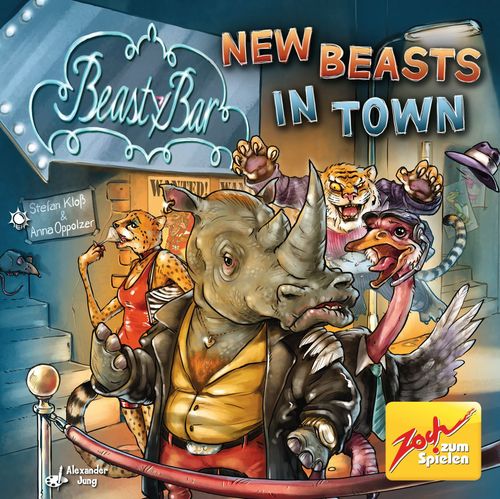
Beasty Bar: New Beasts in Town
Beasty Bar: New Beasts in Town Rulebook
Table of Contents
Table of Contents
- Goal of the Game
- Components
- Set-up
- Course of the Game
- Ending and Winning the Game
- Symbols
- The Animal Cards / Animal Actions
- 12: The rhino … mutates from a lanky youth into Rambo
- 11: The bear … shows its power paws with claws
- 10: The tiger … leaps and eats
- 9: The cheetah … makes a whole meal out of a half-pint
- 8: The llama … can be a real "spitfire"
- 7: The porcupine … pokes strong aggressors away
- 6: The ostrich … always runs (un-)evenly
- 5: The penguin … always has a few strong friends on hand
- 4: The dog … hounds the others in line
- 3: The peacock … spreads its plucky plumes in front of the higher-ups
Goal of the Game
Your animals desperately want to get into the club. This means, they have to bear with pushy rivals at "Heaven's Gate", the entrance to the Beasty Bar. Whenever the line reaches five animals, the first two in line get in – and the last one in line is sent packing. Whoever gets the most animals into the bar is likely to win.
If you already know "Beasty Bar", please note the following changes:
- If you send several animals to the THAT'S IT card on your turn, you choose the order to stack them there.
- The vulture is an exception to the rule that all animals that land on the THAT'S IT card have to stay there until the end of the game.
- Once you are familiar with all the species, you can combine cards from Beasty Bar and New Beasts in Town. From the 24 cards of his color, each player selects one animal of each number (1 to 12) to form his play deck for this game. After the first game, real party animals immediately play another in which each player plays with the 12 animals he didn't play with earlier.
Components
- 48 animal cards (12 animals in each of the 4 card colors)
- 2 Cards Heaven's Gate / Bounced (Front / Back)
- 1 Beasty Bar card
- 1 THAT'S IT card
- 2 Reference sheets
Set-up
- Each player shuffles the 12 animals in his card color and draws 4. He puts the 8 remaining animals – without looking at them – in front of him as a face-down deck.
- Place the two Heaven's Gate/Bounced cards in the middle of the table – one as Heaven's Gate and the other as the Bounced card. Leave enough room for five animal cards between them. This space is called the Jostling area.
- Put the Beasty Bar card near Heaven's Gate and the THAT'S IT card near the Bounced card.
- Before you start, read the explanations of the animal actions (pages 15 + / Reference sheets)!
Course of the Game
The player with the wildest laughter begins. Then play proceeds in turn, in clockwise order. On your turn, you perform the following five actions in this order:
- Play a card
- Carry out the card's animal action
- Carry out "recurring" animal actions
- Five-animal check: Open Heaven's Gate and bounce
- Draw a card
1. Play a card
Add one animal from your hand face up to the end of the waiting line in the Jostling area (exception: vulture). If the Jostling area is empty, the animal played opens a (new) waiting line in front of Heaven's Gate.
The Jostling area: This is where all laid-out animals – put face up next to one another – form a "waiting line". Each newly played animal first has to go to the end of the line. Once all animal actions have been carried out, there can't be more than 5 animals in the Jostling area. Whenever a space opens up in the Jostling area, the animals behind step forward to fill it (without changing their order).
Example 1: You place your llama into the Jostling area. It has to go to the end of the line.
2. Carry out the card's animal action
Now carry out the action of the animal you just played, if possible.
Example 2: You use the llama you have played to spit at the porcupine in front of it; the porcupine is grossed out and bolts to the end of the line.
3. Carry out "recurring" animal actions
Two species show this symbol (recurring animal action). The animal actions of the tiger and of the llama must be carried out "recurringly", again and again in every player's subsequent turn, if possible. You begin with the animal closest to Heaven's Gate and end with the animal that is closest to the Bounced card.
Example 3: On each player's turn, the tiger jumps onto the animal two steps ahead of him, provided this animal is weaker than the tiger. Here, the tiger jumps over the bear and eats the peacock. The llama doesn't spit again as it was played this turn and has already spit at the porcupine.
If you send several animals to the THAT'S IT card on your turn, you choose the order to stack them there.
4. Five-animal check: Open Heaven's Gate and bounce
After carrying out all recurring animal actions, you now check whether the waiting line consists of 5 animals. If there are fewer than 5 animals in line, nothing happens. Play continues with action 5: "Draw a card".
If the waiting line consists of 5 animals, Heaven's Gate opens and the bounce takes place as well:
- The two animals that are closest to Heaven's Gate manage to get into the bar: Put them face down on the Beasty Bar card! They stay there until the end of the game.
- The last animal in the waiting line is bounced: Put it face up on the THAT'S IT card. It stays there until the end of the game. Bad luck – the party takes place without this animal!
- The animals remaining in the Jostling area are (in unchanged order) shoved toward Heaven's Gate.
Example 4: After all actions have been carried out, there are five animals in the Jostling area. Heaven's Gate opens for the bear and the bat, lets them into the bar. The porcupine – being the last of the waiting animals – is bounced and is put on the THAT'S IT card.
5. Draw a card
At the end of your turn, draw the top card of your deck. If your deck is empty, skip this step.
Ending and Winning the Game
The game ends as soon as all players have played all their animal cards. The player who scored the most points with his animals in the Beasty Bar wins. There can be more than one winner.
2 Points:
- 11 Bear
- 4 Dog
- 3 Peacock
- 2 Vulture
3 Points:
- 12 Rhino
- 10 Tiger
- 6 Ostrich
- 5 Penguin
4 Points:
- 9 Cheetah
- 8 Llama
- 7 Porcupine
- 1 Bat
Symbols
Use the symbols on the animal cards as additional reminders of the animal actions.
- Recurring animal action: Activates in every turn of every player.
- Permanent animal action: Continuously active.
- Big Bruiser: Strong and dangerous.
- Little Bully: Not strong, but still dangerous.
- Doppelganger: Makes use of another animal.
- Trampler: Pushes forcefully forward.
- Shield: Blocks and protects.
The Animal Cards / Animal Actions
The card value shows the animal's strength.
12: The rhino … mutates from a lanky youth into Rambo
The rhino rams the strongest animal in the Jostling area onto the THAT'S IT card and takes its place. It can even do this to another rhino.
If there are more than one strongest animal, the rhino's owner chooses which one to ram.
Example 5: The ostrich is the strongest animal in the Jostling area. The rhino rams it onto the THAT'S IT card and takes the ostrich's place.
11: The bear … shows its power paws with claws
The bear drags all animals of the lowest and of the second lowest strength out of the line, provided they are weaker than the bear (< 11). They go to the back of the line, behind the bear, with their order unchanged.
Example 6: The peacock and the two dogs leave their places in the waiting line and go to the end of the line.
10: The tiger … leaps and eats
A tiger jumps onto the animals two steps ahead of it and eats it, provided it is weaker than the tiger (< 10), and takes its place. In doing so, the tiger can jump over a stronger animal.
The tiger carries out its action "recurringly" – on every subsequent turn of each player. Every time, it jumps only once.
Example 7: The tiger jumps over the rhino and eats the peacock.
Example 8: The animal two steps ahead is a bear. The bear is stronger than the tiger; the tiger stays where it is.
9: The cheetah … makes a whole meal out of a half-pint
The cheetah eats the weakest animal in the line and takes its place. The eaten animal goes to the THAT'S IT card. If there are more than one weakest animal, the cheetah's owner chooses which one to eat.
Example 9: The cheetah eats one of the two penguins.
8: The llama … can be a real "spitfire"
The llama spits at the animal directly in front of it – unless its strength is higher than 7. The spit-at animal is grossed out and bolts to the end of the line.
The llama carries out its action "recurringly" – on every subsequent turn of each player.
7: The porcupine … pokes strong aggressors away
If the porcupine would be sent to the THAT'S IT card by a Big Bruiser, such as the rhino, the tiger, or the cheetah, it defends itself with its quills and stays where it is. Instead, the Big Bruiser lands on the THAT'S IT card.
This is not a "recurring" action, but rather a permanent one that applies continuously.
Example 10: The tiger "recurringly" eats the animal two steps in front, if this animal is weaker than the tiger itself. Here, the tiger jumps onto the porcupine but the tiger is the one that ends up on the THAT'S IT card. The porcupine stays put.
6: The ostrich … always runs (un-)evenly
The ostrich runs past either all even-strength animals or all odd-strength ones (active player's choice). If it runs past evens, it stops right behind the first odd animal it reaches, and vice versa.
Example 11: The ostrich passes the cheetah and the porcupine. Both are "odd". The ostrich ends his run behind the "even" dog.
5: The penguin … always has a few strong friends on hand
The penguin imitates another type of animal in your hand. When you play the penguin, reveal an animal from your hand (it stays in your hand). The penguin carries out that animal's action. Throughout the animal action, the penguin also takes on the card value of the chosen species. But before the "recurring" animal actions are carried out (on the same turn), the penguin is a penguin with strength 5 again.
Example 12: The penguin acts as a tiger, eats the cheetah and takes its position.
4: The dog … hounds the others in line
The dog sorts all animals in the line by strength. Put the weakest animal next to Heaven's Gate and the others behind in increasing strength. Animals of the same card value don't pass each other.
See also example 15.
Example 13: The green dog establishes order. Now, the weakest animal (the bat) is by Heaven's Gate. (It won't last long there – see the bat's rules below.) The dog that was in the line already is ahead of the one just played. The bear, the strongest, is at the back.
3: The peacock … spreads its plucky plumes in front of the higher-ups
The peacock positions itself in front of the strongest animal in the line. If there are more than one strongest animal, the peacock's owner decides which one to stand in front of.
Example 14: The peacock goes in front of the strongest animal in the line, the bear.
2: The vulture … has good connections to the otherworld
The vulture doesn't join the line. Instead it starts beside the THAT'S IT card. It adds the top card of the THAT'S IT pile to the back of the line and carries out that card's animal action (making any decisions for it). At the very end of the turn, put the vulture onto the THAT'S IT pile.
Example 15: The yellow vulture adds the blue dog from the THAT'S IT pile back into the Jostling area. The dog re-arranges the animals from the weakest to the strongest. The bat gets into first position, where it burns up. Now, the tiger can jump (it had been prevented by the rhino before). The tiger takes the dog's place and sends the dog back to the THAT'S IT card. Finally, at the end of the turn, the vulture goes to the THAT'S IT card.
Double vulture: If a vulture takes another vulture off the THAT'S IT card, both vultures immediately enter the bar together.
1: The bat … bites its way through the dark and burns up in the light
The bat zooms at any one animal in the line, sends it to the THAT'S IT card and takes its place.
If the bat ever gets into first position (directly at Heaven's Gate), it burns up immediately: THAT'S IT for the bat (see examples 13, 15, 16 and 17).
Example 16: The bat takes the tiger's place and sends it to the THAT'S IT card. If the bat had taken the dog's place, it would have burned up immediately afterwards.
Example 17: One player uses his blue vulture to take a green penguin off the THAT'S IT card, and carries out the penguin's action: he shows a bat from his hand and carries out the bat's action with the penguin. He uses the penguin (in its role as a bat) to lunge at the dog, and replaces it (1). But since the penguin is still acting as a bat and is then in first position, it burns up and lands on the THAT'S IT card (2). Finally, the blue vulture is put on the THAT'S IT card (3).