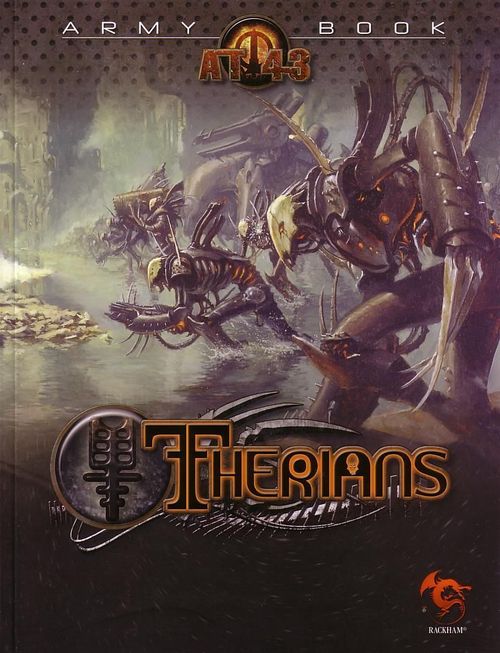
AT-43 Army Book: Therians
AT-43 Army Book: Therians Rulebook
Table of Contents
Table of Contents
Operational Organization
Platoon Pattern
- Unit of soldiers (★★) !
- Unit of soldiers (★★)
- Unit of soldiers (★★ / ★★★) or support unit (★★)
- Unit of soldiers (★★★) or combat strider unit (★) or vehicle unit (★)
- Combat strider unit (★★ / ★★★) or vehicle unit (★★ / ★★★)
! : Priority slot. Should be picked first.
Building a Company
The briefing for each mission indicates the number of A.P. available to each company, the share for assault units and reinforcement units, as well as potential special rules. Once all the players have this information they can start building their company.
If the number of A.P. is not given players can agree on one as long as they respect the directives of the briefing.
Once the company has been built, the player splits his units into assault units and reinforcement units.
- Assault units are available from the beginning of the battle.
- Reinforcement units join the battle later on in the game, once the player has taken secondary objectives described in the briefing.
The highest ranking officer in game becomes the Commander (see Tactical phase, AT-43: The Rulebook) of the company.
Reinforcement Officers
An officer in a reinforcement unit cannot be designated as the Commander. However, he can become Commander once his unit becomes a reserve unit.
Reserve Units
Controlling secondary objectives allows players to "change" reinforcement units, waiting far from the battlefield, into reserve units ready to jump into action at any moment.
During the control phase each side counts the reinforcement points (RP) earned. Once this is done, the players, beginning with the loser of the Authority test, can call reinforcement units by spending RP. Each RP spent allows the player to change 1 A.P. of reinforcement units into 1 A.P. of reserve units.
The card of the reserve unit is placed in the activation sequence. The player can choose to leave it in reserve when its card is revealed.
At the beginning of the game the player can choose to leave in reserve as many units as he wishes to.
Playing Reserves
Activation
During the tactical phase the players include in their activation sequence all the units considered "in game", meaning both units in reserve and the units already on the battlefield.
When the card of a reserve unit is played the unit it represents can be activated normally and deployed, or else it can be kept in reserve (no LP need to be spent).
When a reserve unit is deployed, the player controlling it brings it in through one of the tactical positions (see AT-43: The Rulebook p.86) under his control.
Deployment
- A unit that enters the game through an access zone can act immediately. Its first action will be a movement measured from the edge of the battlefield.
- A unit that enters the battlefield using a drop point must be placed within a 10 cm radius around the drop point. If there is not enough room for the entire unit the drop is not possible. To come into play this way a unit must be activated normally. However, it can neither act nor be issued combat drills for the current round. It will be able to act normally during the following rounds.
Therian Overseers
Therian overseers are masters of the machine. They are the Therian officers. The EMI grid gives them access to leadership routines and allows them to improve the effectiveness of their unit. They are organized into five ranks. Apart from a handful of atypical characters, overseers only have access to leadership routines applicable to the unit they command: armored fighting vehicle routines if they are aboard type .armored_fighting_vehicle machines, infantry routines if they lead a type .troops unit.
- Rank 0: Khaos
- Rank 1: Alpha
- Rank 2: Delta
- Rank 3: Omicron
- Rank 4: Sigma
- Rank 5: Omega
Therian Overseers
| Rank | Authority | Leadership | Numbers bonus |
|---|---|---|---|
| Alpha | 2 | 2 | 0 |
| Delta | 2 | 3 | 1 |
| Omicron | 3 | 4 | 2 |
| Sigma | 5 | 6 | 2 |
| Omega | 6 | 8 | 2 |
The Units
In this section the Therian units are reviewed. Each unit is described under its designation. Then a few paragraphs present its story, its tactical deployment and the technical information needed to play the unit.
The composition of a unit gives its potential number of fighters, from standard to maximum, as well as the number of special fighters and officer ranks available.
The "Cost of a unit" table gives its value (in A.P.) depending on the number of fighters, its equipment options and its potential officer.
Composition of a Unit
- Type: Gives the unit's type. This information is used to follow the platoon pattern.
- Numbers: Indicates the minimum and maximum number of fighters in the unit. The maximum number can be exceeded using an officer's numbers bonus.
- Standard equipment: This equipment is included in the unit's cost. All the unit's fighters, apart from special weapon bearers and heroes are equipped this way.
- Special weapons: The special weapons the unit may use. All the special weapon bearers of a same unit must carry the same weapon.
- Optional equipment: The list of options available to the unit. Each option increases the cost of the unit as indicated in the table. The effects of the equipment are described later.
- Specialists: Details the various specialists the unit can include. Each specialist replaces a standard fighter for free. The number of specialists allowed per unit is indicated in the "Cost of a unit" table.
- Officer: The ranks allowed for the unit's officer, if there is one. An officer replaces a standard fighter and his cost is added to that of the unit.
Cost of a Unit Table
- Standard and maximum number: For each kind of unit a table gives the value in A.P. of its standard and maximum number of fighters. This table also details the number of special weapon bearers and specialists related to the number of fighters. In order to have more than one special weapon bearer the unit must be at its maximum number of fighters. And in order to be considered to be at its maximum number of fighters, a unit must include the number of special weapon bearers indicated.
Most of the time a unit costs the same number of A.P. no matter the weapon chosen. When this is not the case the extra cost is indicated according to the special weapon chosen.
- Extra fighter: This value indicates the cost in A.P. of each fighter added to the chosen number of fighters. This value is used to add fighters to the standard number of fighters (without exceeding the maximum number of fighters), or to exceed the maximum number of fighters (when there is an officer in the unit). The officer's numbers bonus indicates the number of fighters the unit can include beyond its normal maximum number of fighters.
The Overseers' Routines
Therian overseers use routines, sophisticated combat programs that allow them to increase the skills of the units placed under their command. These routines are an overseer privilege; these programs utilize nanomachine technology and the higher scientific knowledge of the Therians.
Cyphers
Playing the Cyphers
The player can choose any platoon pattern to build his company, but he can only use one at a time. Only Cypher platoon patterns, including those published for the Operation Damocles campaign (see Cry Havoc 14), benefit from the advantage and disadvantage below.
- Cypher advantage: Every overseer has access to all the infantry and armored fighting vehicle routines no matter his category.
- Cypher disadvantage: The player may not wager LP before the Authority test.
Platoon pattern:
- Armored fighting vehicle unit (★ / ★★ / ★★★) !
- Armored fighting vehicle unit (★★ / ★★★)
- Unit of soldiers (★ / ★★ / ★★★)
- Infantry unit (★★)
- Infantry unit (★★)
! Priority slot
Warriors
Playing the Warriors
The player can choose any platoon pattern to build his company, but he can only use one at a time. Only Warrior platoon patterns, including those published for the Operation Damocles campaign (see Cry Havoc 14), benefit from the advantage and disadvantage below.
- Warrior advantage: Each unit can change a standard fighter into an overseer alpha for free.
- Warrior disadvantage: A unit of fighters equipped with mêlée weapons must always engage an opposing unit if the movement mode chosen allows it to.
Platoon pattern:
- Infantry unit (★★) !
- Infantry unit (★★)
- Infantry unit (★ / ★★ / ★★★)
- Armored fighting vehicle unit (★)
- Armored fighting vehicle unit (★★ / ★★★)
! Priority slot
Web Striders
Playing the Web Striders
The player can choose any platoon pattern to build his company, but he can only use one at a time. Only Web Strider platoon patterns, including those published for the Operation Damocles campaign (see Cry Havoc 14), benefit from the advantage and disadvantage below.
- Web Strider advantage: Each routine costs 1 LP less than usual. A routine will always cost at least 1 LP.
- Web Strider disadvantage: The fighters of this army lose their "Nerves of steel" ability. Consider them to have Morale 8.
Platoon pattern:
- Infantry unit (★★★) !
- Infantry unit (★ / ★★ / ★★★)
- Infantry unit (★ / ★★ / ★★★)
- Armored fighting vehicle unit (★)
- Armored fighting vehicle unit (★★ / ★★★)
! Priority slot
Overseer Profiles
Alpha Atis-Astarte
Atis-Astarte is an overseer alpha who transferred her mind into a grim golem body. Her profile and rules are as printed.
Unit formation: Atis-Astarte must be the officer of a grim golem unit. Contrary to usual officers, she does not replace a fighter but she is added to the unit. Her cost is added to that of the unit.
Atis-Astarte is an overseer alpha and has the same characteristics and routines as a standard overseer alpha.
Recruiting a unit: Atis-Astarte: + 55 A.P.
Optical camo module: This equipment gives the ability "Stealth" to Atis-Astarte. Any shot targeting her from beyond range 1 is an automatic failure. This ability also works against locked shots.
Routines: Atis-Astarte has access to the following routine in addition to those she has access to as an overseer:
- Combat teleportation (3 LP): This routine allows Atis-Astarte to move in contact with any enemy unit she can see. Once the miniature representing Atis-Astarte has been moved, all the fighters of her unit may be placed in contact with the enemy unit. They must respect the rules for cohesion (see AT-43: the Rulebook, p. 47). Any miniatures that cannot be placed properly are eliminated. This routine replaces the movement of Atis-Astarte's unit.
Profile: Atis-Astarte (printed page 25)
Characteristics: 18 | - | 6 | 5
Officer row (three values, as printed): - | 2 | 2
- Mêlée weapon: Reaper blades (1): 6 | 1/0 | - | 7/1
- Mêlée weapon: Reaper blades (2): 6 | 1/0 | - | 7/1
Sigma Urash
Unit formation: Urash must be the officer of a unit of storm golems. Contrary to usual officers, he does not replace a fighter but he is added to the unit. His cost is added to that of the unit. Nimit-Urash constitutes a unit of his own.
In both cases, he is an overseer sigma and has the same characteristics and routines as a Therian overseer sigma, except for LP: Urash and Nimit-Urash have one extra Leadership point.
Recruiting a unit: Urash: + 100 A.P. Nimit-Urash: 450 A.P.
Medium nucleus cannon: Nimit-Urash gets the "Sniper" ability:
- This ability can only be used if the fighter doesn't move at all during his activation;
- Cover and fighters caught in the zone of fire are ignored;
- This ability cannot be used in "Overwatch!";
- The player chooses the target of each impact among the visible fighters of the targeted unit. If the target is an armored fighting vehicle, the player chooses the location of each impact.
Heroic pilot: When Nimit-Urash is destroyed, the miniature representing Urash on foot is deployed where his machine stood. He constitutes a new unit but can join a storm golem unit (see AT-43: The Rulebook, p.77).
Routines:
- Fusion (4 LP): Urash on foot can use this routine. He chooses two combat striders of the unit. They are immediately destroyed and replaced by a single brand new combat strider of the next highest type. The new strider is not an overseer. It is deployed where one of the two previous striders stood before they were eliminated and forms a new unit. Its card is placed in the activation sequence for the next round. The player must have the miniature and enough room to place it on the battlefield.
- Transfer (1 LP): Nimit-Urash can use this routine. One of his company's soldiers is replaced by any other soldier already eliminated. The unit's composition rules must be respected (see AT-43: Rulebook, p. 80).
Omega Tiamat
Unit formation: Tiamat is an armored fighting vehicle. Tiamat constitutes a unit of her own.
Recruiting a unit: Tiamat: 445 A.P.
Routines: Tiamat has access to the following routine in addition to those she has access to as an overseer:
- Body hacking (1 LP): Each time Tiamat is destroyed, the player can remove the unit of the closest overseer from the game. The overseer's miniature is replaced by Tiamat's miniature. Tiamat is a unit of her own.
Infantry
Therian infantry is the best and toughest in the universe, built around robust and powerful attack systems. Summoned whenever an overseer feels the need for them, this infantry is supremely flexible: the only limit is the commander's ability to foresee what he really needs.
Troops Frames
The EMI grid lists three types of frames: 2.1 and 2.2 frames are the base onto which classic light infantry models are built. The difference between these two frames is their age: the 2.1 frame (medusa) is older and tougher than the 2.2 version (golem), which is designed to be quicker.
Type 3 frames (goliath) are the latest achievement of Therian research. Stronger and smarter, they can use heavy armament. Their only drawback is their particularly high consumption of nanoresources.
Weapons
Most Therian weapons work according to one of two main principles:
- Nanoweapons shoot a smart nanomunition that seeks its target, pierces its armor and expands inside it causing maximum damage;
- Sonic weapons generate a sound wave that grinds and shatters everything standing in its way.
Other weapons such as the flamer, reaper blades and nanostorms work with different principles.
- Electrolash: Medusas' cables are electrified and woven from smart material that transforms them into electrified whips. This weapon uses close combat rules.
- Flamer: Sends a mixture of nanomachines that sticks to anything it touches and reacts exothermically. This weapon uses indirect fire rules.
- Nanoblaster: Fires a salvo of nanomunitions. Despite its short range, the high number of munitions fired makes it highly improbable for the shot to miss its target. This weapon uses direct fire rules.
- Nanostorm: A hand-held weapon meant to be thrown by a golem (the other frames lack the appendages necessary to use them). It explodes when it hits the ground and releases a self-contained cloud of nanomachines composed exclusively of penetration agents. This weapon uses indirect fire rules.
- Nucleus gun: Uses the same technology as the nucleus rifle; the munitions are smarter and rarely miss, have penetration agents that pierce the hardest material, and are larger so they cause more damage when they reconfigure. This weapon uses direct fire rules.
- Nucleus rifle: Generates an extremely accurate smart nanomunition with powerful penetration agents, which pierces the target's armor and reconfigures itself inside. This weapon uses direct fire rules.
- Reaper blades: Long blades fixed to a gauntlet, vibrating at an ultrasonic frequency to tear through conventional armor. This weapon uses close combat rules.
- Sonic gun: Smashes anything it encounters; what withstands it is shaken by vibrations that damage the softer and more mobile parts. This weapon uses direct fire rules.
Infantry Overseer Routines
Using an overseer's routine requires the expenditure of leadership points (LP) from the leadership points pool (see AT-43: The Rulebook p.54). These routines are used by the overseers in charge of infantry units. When a routine affects a movement or a test it can be declared before or after the movement or the test. Otherwise it is declared during the activation of the overseer's unit. Routines that are not instantaneous remain in effect until the unit's following activation.
Routines only affect the overseer's unit. However, if the company's Commander is in an infantry unit he may execute routines on any of the company's infantry units.
An overseer can use each routine once per activation phase.
- Transfer (1 LP): One of the unit's soldiers is replaced by any other soldier already eliminated. The unit's composition rules must be respected (see AT-43: The Rulebook, p80).
- Dash (2 LP): If the unit performs a rush movement it can cover up to 30 cm.
- Hyper nanonucleus (2 LP): The unit can reroll all its failed Damage tests once.
Assault Golems
Technical description: The assault golems are autonomous combat systems based on a type 2.2 frame. An assault golem is assembled from several giga-units of nanomachines and benefits from advanced combat programming. It can be given detailed instructions concerning ranged weapons and ranged combat. Its standard equipment is composed of a nanomunition weapon (nucleus rifle) and a set of reaper blades.
The assault golem is provided with an efficient and autonomous operating system which allows it to manage 97% of all tactical situations without any assistance.
Tactics: Assault golems are a first strike force designed to hold ground while wiping out the enemy's lighter defenses. Equipped with an accurate and powerful weapon, they eliminate resistance from long range while advancing on the objectives. Assault golems are an excellent escort for overseers on foot: their resilience to damage is even better when reinforced by the overseer's routines.
Composition of a unit
- Type: 2.
- Numbers: 6 to 9.
- Standard equipment: Nucleus rifle and reaper blades.
- Optional equipment: Nanostorms, relay.
- Special weapons: Flamer or nucleus gun.
- Officer: Rank 1 to 5.
Equipment
- Flamer: This weapon has the "Projection" ability:
- When a unit contains several of these weapons, each of them can pick a different target;
- Cover is ignored;
- No shooting test is necessary, so there are no successes. (Therefore, shots cannot be combined to increase the area of effect.);
- The Accuracy of the weapon shows the weapon's maximum range in cm, as measured from the special weapon bearer. The template is centered on a fighter. All miniatures located even partially under the area of effect suffer a damage test.
- Nanostorms: Fighters equipped with nanostorms can shoot with this indirect fire weapon. This equipment represents enough nanostorms for the whole game. A unit using this equipment cannot use any of its other ranged weapons during the current activation.
- Relay: This equipment can only be given to a unit leader. Activating a unit with a relay doesn't cost any LP. This equipment is lost when the unit's leader is eliminated.
Officers: Overseer alpha: + 10 A.P.
Cost of an assault golem unit
| Equipment | Standard number (1) | Maximum number (2) | Extra fighter |
|---|---|---|---|
| Standard | 275 A.P. | 425 A.P. | + 45 A.P. |
| Nanostorms | 305 A.P. | 470 A.P. | + 50 A.P. |
| Relay | 280 A.P. | 430 A.P. | + 45 A.P. |
| Relay + nanostorms | 310 A.P. | 475 A.P. | + 50 A.P. |
| Flamer * | + 25 A.P. | + 25 A.P. |
(1) 6 assault golems including: 1 special weapon + 0 to 1 officer (2) 9 assault golems including: 3 special weapons + 0 to 1 officer * Extra cost to equip all of the unit's special weapon bearers.
Correction note: an earlier pass of this entry had the cost rows mis-grouped (with invented "unit cost" rows). The table above is re-read from the printed "Cost of an assault golem unit" table (page 33 of the book) and matches it.
Profile: Assault golem
Characteristics: 18 | - | 6 | 5
- Standard range weapon: Nucleus rifle: 6 | 1/0 | - | 6/1
- Special range weapon: Flamer (projection, indirect fire): (25) | 1/0 | 4 | 9/1
- Special range weapon: Nucleus gun: 8 | 1/1 | - | 14/1
- Mêlée weapon: Reaper blades: 6 | 1/0 | - | 7/1
- Optional weapon: Nanostorms (indirect fire): 0 | 1/0 | 1 | 5/1
Grim Golems
Technical description: The grim golem model is based on a type 2.2 frame and was designed to execute advanced combat routines. Dedicated exclusively to close combat, its computing power is used by its optical camo module instead of the typical ranged combat files, which are useless to it. Swift and discreet, the grim golem is equipped either with a pair of reaper blades or with a flamer, a combination that makes it a fearsome killer in close quarter combat. It uses its speed and stealth to advance under enemy fire. Once on its victims, it charges and annihilates its targets before vanishing again.
Tactics: Grim golems are assassins and hunters. Their low cost allows the Therian commander to deploy a lot of them on the frontline. Complex strategy has no place here: grim golems are meant to run straight up to the enemy. Unless they are caught in a zone of fire, their optical camo module protects them from enemy fire better than any kind of armor. Another strategy consists in using them for surgical strikes: deployed away from other troops, they advance quickly on their objectives.
Composition of a unit
- Type: 2.
- Numbers: 6 to 9.
- Standard equipment: Reaper blades (x 2) and optical camo module.
- Optional equipment: Relay.
- Special weapons: Flamer.
- Officer: Rank 1 to 5.
Equipment
- Flamer: "Projection" ability, as for the assault golem flamer (each special weapon bearer may pick its own target; cover is ignored; no shooting test is needed; the Accuracy shows the maximum range in cm measured from the special weapon bearer; the template is centered on a fighter and every miniature located even partially under it suffers a damage test).
- Optical camo module: Gives the unit the "Stealth" ability. Any shot targeting the unit from beyond range 1 is an automatic failure. This ability also works against locked shots.
- Relay: Same as for assault golems (leader only; no LP cost to activate; lost when the leader is eliminated).
Officers: Overseer alpha: + 10 A.P.; Overseer delta: + 15 A.P.; Overseer omicron: + 25 A.P.; Overseer sigma: + 50 A.P.; Overseer omega: + 65 A.P.
Cost of a grim golem unit
| Equipment | Standard number (1) | Maximum number (2) | Extra fighter |
|---|---|---|---|
| Standard | 250 A.P. | 450 A.P. | + 35 A.P. |
| Relay | 255 A.P. | 455 A.P. | + 35 A.P. |
(1) 6 grim golems including: 1 special weapon + 0 to 1 officer (2) 9 grim golems including: 3 special weapons + 0 to 1 officer
Profile: Grim golem
Characteristics: 18 | - | 6 | 5
- Special range weapon: Flamer (projection, indirect fire): (25) | 1/0 | 4 | 9/1
- Mêlée weapon: Reaper blades (1): 6 | 1/0 | - | 7/1
- Mêlée weapon: Reaper blades (2): 6 | 1/0 | - | 7/1
Storm Golems
Technical description: The storm golem is a type 2.2 attack system. It is supplied with either a sonic gun or a flamer as special weapon, or with a set of reaper blades and a nanoblaster. Although the nanoblaster is a short range weapon, the exceptional accuracy of the storm golem and the nanomunition's ability to follow the movement of its target make it remarkably efficient at medium range. The sonic gun, based on the double vibration effect, disembowels and shatters its targets with great ease; while the flamer proves lethal in close quarter combat.
Tactics: The storm golem is the ultimate soldier. Deployed in small units, as close as possible to the enemy, the storm golems will move into contact to score a quick and bloody victory. Storm golems are excellent at hunting down elite units: low in numbers and rarely equipped for close combat, they are an easy target to prey on. Storm golems are just as efficient at counter attacking, especially against defensive positions or fortifications: in close combat or at short range, defensive positions are useless. Even when the enemy avoids contact, the storm golems will drown him in a hailstorm of nanomunitions.
Composition of a unit
- Type: 2.
- Numbers: 6 to 9.
- Standard equipment: Nanoblaster and reaper blades.
- Optional equipment: Nanostorms, relay.
- Special weapons: Flamer or sonic gun.
- Officer: Rank 1 to 5.
Equipment
- Flamer: This weapon has the "Projection" ability:
- When a unit contains several of these weapons, each of them can pick a different target;
- Cover is ignored;
- No shooting test is necessary, so there are no successes. (Therefore, shots cannot be combined to increase the area of effect.);
- The Accuracy of the weapon shows the weapon's maximum range in cm, as measured from the special weapon bearer. The template is centered on a fighter. All miniatures located even partially under the area of effect suffer a damage test.
- Nanostorms: Fighters equipped with nanostorms can shoot with this indirect fire weapon. This equipment represents enough nanostorms for the whole game. A unit using this equipment cannot use any of its other ranged weapons during the current activation.
- Relay: This equipment can only be given to a unit leader. Activating a unit with a relay doesn't cost any LP. This equipment is lost when the unit's leader is eliminated.
Officers: Overseer alpha: + 10 A.P.; Overseer delta: + 15 A.P.; Overseer omicron: + 25 A.P.; Overseer sigma: + 50 A.P.; Overseer omega: + 65 A.P.
Cost of a storm golem unit
| Equipment | Standard number (1) | Maximum number (2) | Extra fighter |
|---|---|---|---|
| Standard | 250 A.P. | 400 A.P. | + 40 A.P. |
| Nanostorms | 280 A.P. | 445 A.P. | + 45 A.P. |
| Relay | 255 A.P. | 405 A.P. | + 40 A.P. |
| Relay + nanostorms | 285 A.P. | 450 A.P. | + 45 A.P. |
| Flamer * | + 25 A.P. | + 25 A.P. |
(1) 6 storm golems including: 1 special weapon + 0 to 1 officer (2) 9 storm golems including: 3 special weapons + 0 to 1 officer * Extra cost to equip all of the unit's special weapon bearers.
Profile: Storm golem
Characteristics: 18 | - | 6 | 5
- Standard range weapon: Nanoblaster: 3 | 1/1 | - | 5/1
- Special range weapon: Flamer (projection, indirect fire): (25) | 1/0 | 4 | 9/1
- Special range weapon: Sonic gun: 5 | 3/0 | - | 8/1
- Melee weapon: Reaper blades: 6 | 1/0 | - | 7/1
- Optional weapon: Nanostorms (indirect fire): 0 | 1/0 | 1 | 5/1
Assault Medusas
Technical description: The assault medusas are autonomous combat systems based on a type 2.1 frame. They are meant to favor endurance and elegance. Slower than the golems, the assault medusas are ancient attack systems that were designed in the habitat of Thera. Engineered in the traditional way, combining ergonomics and resistance, their carefully programmed ranged combat procedures make them great fire support units. Because of their movement mode, they are most reliable when used as shooting platforms. The usual equipment of assault medusas is either light nanomunition weaponry (nucleus rifle), or heavy nanomunition weaponry (nucleus gun).
Tactics: Assault medusas are perfect to hold objectives. However, their toughness makes them universal troops, perfectly suited for all kinds of possible missions. Assault medusas can endure enemy fire and return it with lethal accuracy, which makes them terrifying frontline units. A great classic of Therian attack systems, the assault medusa will never go out of fashion!
Composition of a unit
- Type: 2.
- Numbers: 4 to 7.
- Standard equipment: Electrolash and nucleus rifle.
- Optional equipment: Relay.
- Special weapon: Nucleus gun.
- Officer: None.
Equipment
- Relay: This equipment can only be given to a unit leader. Activating a unit with a relay doesn't cost any LP. This equipment is lost when the unit's leader is eliminated.
Cost of an assault medusa unit
| Equipment | Standard number (1) | Maximum number (2) | Extra fighter |
|---|---|---|---|
| Standard | 225 A.P. | 425 A.P. | + 55 A.P. |
| Relay | 230 A.P. | 430 A.P. | + 55 A.P. |
(1) 4 assault medusas including: 1 special weapon (2) 7 assault medusas including: 3 special weapons
Profile: Assault medusa
Characteristics: 10 | - | 8 | 6
- Standard range weapon: Nucleus rifle: 7 | 1/0 | - | 6/1
- Special range weapon: Nucleus gun: 9 | 1/1 | - | 14/1
- Melee weapon: Electrolash: 7 | 2/0 | - | 4/1
Assault Goliaths
Technical description: Assault goliaths are autonomous combat systems based on a type 3.1 frame and designed for all forms of combat. This versatility results in unrivalled performance. Their revolutionary tactical interface allows them an exceptional increase in autonomy: assault goliaths do not need an overseer. Assault goliaths are a breakthrough in the field of super attack systems and are now the benchmark in terms of troops machines. No battle can be planned without at least one unit of these outstanding attack systems.
Tactics: Assault goliaths form very versatile units designed to cause an outrageous amount of damage. These units are rapid troops that count on their speed and firepower to suppress the enemy before he has time to retaliate. Their sonic gun is used to get rid of the opponent's infantry as soon as possible. On the other hand, the nucleus gun forces the enemy combat striders to keep a low profile.
Composition of a unit
- Type: 3.
- Numbers: 3.
- Standard equipment: Nucleus gun and sonic gun.
- Optional equipment: Relay.
- Officer: None.
Equipment
- Relay: This equipment can only be given to a unit leader. Activating a unit with a relay doesn't cost any LP. This equipment is lost when the unit's leader is eliminated.
Cost of an assault goliath unit
| Equipment | Standard number (1) |
|---|---|
| Standard | 375 A.P. |
| Relay | 380 A.P. |
(1) 3 assault goliaths
Profile: Assault goliath
Characteristics: 18 | - | 10 | 5
- Range weapon: Nucleus gun: 8 | 1/1 | - | 14/1
- Range weapon: Sonic gun: 5 | 3/0 | - | 8/1
Bane Goliaths
Technical description: Bane goliaths are autonomous combat systems based on type 3.1 frames. Their long range anti-tank firepower has been maximized at the expense of their anti-infantry abilities. Bane goliaths are the result of the goliath specialization process. By mounting them with very heavy weaponry, meant for the destruction of larger opposition, they concentrate enough firepower to fell even the heaviest golgoths. With their twin nucleus guns, a unit of bane goliaths can vaporize an assault golgoth in one well aimed salvo. Even support golgoths are not safe around them.
Tactics: As is often the case with goliaths, the use of bane goliaths is remarkably straight forward. Deployed at the back of the battlefield, they need only to move to acquire a line of sight. The goliaths limited size protects them from locked shot fire and the efficient range of their weapons render conventional armament useless. So they can use their range to pound enemy positions, which generally never takes long considering the firepower deployed.
Composition of a unit
- Type: 3.
- Numbers: 3.
- Standard equipment: Nucleus gun x 2.
- Optional equipment: Relay.
- Officer: None.
Equipment
- Relay: This equipment can only be given to a unit leader. Activating a unit with a relay doesn't cost any LP. This equipment is lost when the unit's leader is eliminated.
Cost of a bane goliath unit
| Equipment | Standard number (1) |
|---|---|
| Standard | 375 A.P. |
| Relay | 380 A.P. |
(1) 3 bane goliaths
Profile: Bane goliath
Characteristics: 18 | - | 10 | 5
- Range weapon: Nucleus gun (1): 8 | 1/1 | - | 14/1
- Range weapon: Nucleus gun (2): 8 | 1/1 | - | 14/1
Armored Fighting Vehicles
Therian armored fighting vehicles are called golgoths and they constitute the scientific and artistic achievement of the intellectual overseer elite. Powerful, comfortable and maneuverable, they allow the Therians to experience a wide range of sensations while participating in the war effort of their people. The overseers form a strong affinitive bond with their golgoth. From their point of view, it is not merely a combat strider but, in fact, an extension of their own body.
Frames
Each golgoth frame is considered a unique work of art by most Therians. However, in a move to standardize procedures and gain strategic efficiency, all frames have standard weapon mounting points and are organized in three classes: recon, assault and support. Since Therian technology was used to create human striders, the people of Ava reproduced the same classification.
Therian armored fighting vehicle frames are very different from human ones: no controls or screens encumber the pilot's vital space. The latter is nestled in a soft biological envelope filled with cyber-neural connection liquid. Each thought is turned into an order activating a mechanism and each impulse brings the pilot closer to victory!
Mounted Weapons
- Heavy flamer: Sends a large quantity of nanomachines that, once they touch something, combine to form the most efficient exothermic reaction catalyst possible. It can set fire to steel or glass as if it was paper. This weapon uses indirect fire rules.
- Heavy particle accelerator: Propelled at such speed that even time and space are altered, the most elementary particle becomes a missile capable of knocking over mountains. This weapon uses direct fire rules.
- Light grim scythes: Ever-sharp vibro-blades capable of slicing through the toughest materials. This weapon uses close combat rules.
- Light virus cannon: Launches a salvo of nanomachines that slip in under the target's armor. They then run along the power systems of the infected machine to generate powerful electrical interference as well as devastating short-circuits. Useless against lighter targets, which do not have significant enough electrical circuits to home in on (such as infantry), the light virus cannon is the scourge of armored fighting vehicles, whose protection is ignored when shot at. In fact this weapon is so dangerous that it was classified in the same category as bane goliaths. This weapon uses direct fire rules.
- Nucleus cannon: The ultimate evolution of nucleus weapons. The ammunition it generates is so smart that it almost never misses its target; they are even capable of choosing where they hit; and they are assisted by penetration agents that render most armor pointless. This weapon uses direct fire rules.
- Sonic cannon: Produces an even more powerful and destructive soundwave than other sonic weapons. It turns armored fighting vehicles into wrecks and soldiers into puddles with the same ease. This weapon uses direct fire rules.
Armored Fighting Vehicle Overseer Routines
Using an overseer's routine requires the expenditure of leadership points (LP) from the leadership points pool (see AT-43: The Rulebook p.54). These routines are used by the overseers in charge of armored fighting vehicle units. When a routine affects a movement or a test it is declared at the time of the movement or the test. Otherwise it is declared during the activation of the overseer's unit. The routines that are not instantaneous remain in effect until the unit's following activation.
The routines only affect the overseer's unit. However, if the company's Commander is in an armored fighting vehicle unit he may execute routines on any of the company's armored fighting vehicle units.
An overseer can use each routine once per activation phase.
- Repair (1 LP): An armored fighting vehicle regains 1 SP. The armored fighting vehicle and the location repaired are chosen by the player.
- Dash (2 LP): If the unit performs a rush movement it can cover up to 50 cm.
- Hyper nanonucleus (2 LP): The unit can re-roll all its failed Damage tests once.
- Creation (4 LP): A type 1 combat strider appears on the battlefield in contact with the overseer. It constitutes a new unit. Its card is placed in the activation sequence for the next round. The player must have the miniature and enough room to place it on the battlefield.
- Fusion (4 LP): The overseer chooses two combat striders of the unit. They are immediately destroyed and replaced by a single brand new combat strider of the next highest type. The new strider is not an overseer. It is deployed where one of the two previous striders stood before being eliminated and forms a new unit. Its card is placed in the activation sequence for the next round. The player must have the miniature and enough room to place it on the battlefield.
Succubus Golgoth
Technical description: The Succubuses are semi autonomous combat systems based on a light recon type frame. Their armament is designed to deal with any category of enemy: an anti-infantry weapon (light sonic cannon) and an anti-tank weapon (light virus cannon). Very efficient and quite inexpensive in nanoresources, the Succubuses are widely successful with overseers. A single Succubus is capable of carrying out deadly ambushes. A pack of Succubuses is a real nightmare: no opponent, from an infantry company to a class 3 armored fighting vehicle, will withstand them very long.
Tactics: The Succubus is a quick and flexible armored fighting vehicle whose modest strategic value compensates for its frailty. Its light sonic cannon is the scourge of infantry and the bane of light armored fighting vehicles; its light virus cannon is used to harass heavier armored fighting vehicles. Its speed allows it to get within optimum range of the enemy and then escape before any serious retaliation. But beware of weapons capable of damaging it seriously in one shot, such as rocket launchers.
Composition of a unit
- Type: 1.
- Numbers: 1 to 3.
- Standard equipment: Light sonic cannon and light virus cannon.
- Officer: Rank 1.
Officers: Overseer alpha: + 15 A.P.
Equipment
- Light virus cannon: This weapon has the "Jammer" ability:
- It can only target armored fighting vehicles;
- Damage tests are resolved differently: The minimum result needed on the die is always the same. This result is shown instead of the Penetration of the weapon.
- Relay: This equipment can only be given to a unit leader. Activating a unit with a relay doesn't cost any LP. This equipment is lost when the unit's leader is eliminated.
Cost of a Succubus golgoth unit
| Equipment | Standard number (1) | Maximum number (2) | Extra fighter |
|---|---|---|---|
| Standard | 225 A.P. | 675 A.P. | + 225 A.P. |
| Relay | 230 A.P. | 680 A.P. | + 225 A.P. |
(1) 1 Succubus golgoth including: 0 to 1 officer (2) 3 Succubus golgoths including: 0 to 1 officer
Profile: Succubus golgoth
Characteristics: 30 | - | 12 | 6
Structure points: Frame 3, Propulsion 2
- Range weapon: Light sonic cannon: 6 | 3/0 | - | 8/1 | SP 1
- Range weapon: Light virus cannon (jammer): 5 | 1/0 | - | 2+/1 | SP 1
Hekat Golgoth
Technical description: This experimental frame, born from the mind of a particularly inventive overseer, is very easy to assemble and produce. The Hekat is a light combat system based on an ancient design, whose function is long forgotten. Terribly efficient in contact (it can even threaten the mighty support golgoths), it moves at lightning speed and can carry out simple handling tasks, such as moving low walls. Paradoxically, this golgoth, intended for close combat, is the dreaded enemy of any armored fighting vehicle! At first the concept was met with the extremely fierce opposition of the most traditionalist overseers, until it proved its efficiency on the battlefield.
Tactics: Hekat units make the most out of the mobility of recon golgoths. They dash to the frontline in order to destroy their prey as quickly as possible. Defenseless at range, they become extremely dangerous in contact, causing even the heaviest armored fighting vehicle unit to flee. In units of three, Hekats become the mechanical equivalent of sharks, capable of tearing to bits even medium armored fighting vehicle units. Their numbers also allow incoming impacts to be shared among the members of the unit and gives the Hekats a better chance of reaching the enemy.
Composition of a unit
- Type: 1.
- Numbers: 1 to 3.
- Standard equipment: Light grim scythe x 2.
- Officer: Rank 1. (The printed page reads "Rang : 1." for this line; read here as Rank 1.)
Officers: Overseer alpha: + 15 A.P.
Equipment
- Light grim scythe: A Hekat equipped with this weapon gains the "Hoist" ability. When a Hekat is in contact with a low wall, the low wall can be redeployed anywhere in contact with the Hekat. This action replaces its close combat attacks.
- Relay: This equipment can only be given to a unit leader. Activating a unit with a relay doesn't cost any LP. This equipment is lost when the unit's leader is eliminated.
Cost of a Hekat golgoth unit
| Equipment | Standard number (1) | Maximum number (2) | Extra fighter |
|---|---|---|---|
| Standard | 200 A.P. | 600 A.P. | + 200 A.P. |
| Relay | 205 A.P. | 605 A.P. | + 200 A.P. |
(1) 1 Hekat golgoth including: 0 to 1 officer (2) 3 Hekat golgoths including: 0 to 1 officer
Profile: Hekat golgoth
Characteristics: 30 | - | 12 | 6
Structure points: Frame 3, Propulsion 2
- Mêlée weapon: Light grim scythe (1): 8 | 2/0 | - | 13/1 | SP 1
- Mêlée weapon: Light grim scythe (2): 8 | 2/0 | - | 13/1 | SP 1
Wraith Golgoth
Technical description: The Wraith assault golgoth is a semi-autonomous combat system based on a medium assault frame. It combines solidity and multiple core system patterns to guarantee maximum survival span. Designed to be an extremely mobile command unit, the assault golgoth was designed to become above all else the overseers' favorite vehicle on the battlefield. The dreaded medium sonic cannon is ideal against soldiers and the medium nucleus cannon works marvels against armored vehicles. This variety of equipment is the Wraith's best asset. It guarantees the overseer will never experience any boredom during a battle.
Tactics: The Wraith is ideally configured for novice overseers. Its versatility means it will always have the proper weapon at hand while its remarkable resilience allows it to endure the deadliest shots while taking minimum damage. Designed to be a frontline machine, it is particularly comfortable in medium and short range combat. At such distances it benefits from its optimum fire power. However, it is far from useless at longer range, thanks to its medium nucleus cannon.
Composition of a unit
- Type: 2.
- Numbers: 1.
- Standard equipment: Medium nucleus cannon and medium sonic cannon.
- Officer: Rank 1.
Officers: Overseer alpha: + 15 A.P.
Equipment
- Relay: This equipment can only be given to a unit leader. Activating a unit with a relay doesn't cost any LP. This equipment is lost when the unit's leader is eliminated.
- Medium nucleus cannon: A fighter equipped with this weapon gains the "Sniper" ability:
- This ability can only be used if the fighter doesn't move at all during his activation;
- Cover and fighters caught in the zone of fire are ignored;
- This ability cannot be used in "Overwatch!";
- The player chooses the target of each impact among the visible fighters of the targeted unit. If the target is an armored fighting vehicle, the player chooses the location of each impact.
Cost of a Wraith golgoth unit
| Equipment | Standard number (1) |
|---|---|
| Standard | 350 A.P. |
| Relay | 355 A.P. |
(1) 1 Wraith golgoth including: 0 to 1 officer
Profile: Wraith golgoth
Characteristics: 25 | - | 14 | 6
Structure points: Frame 4, Propulsion 2
- Range weapon: Medium nucleus cannon (sniper): 9 | 1/1 | - | 15/1 | PS 2
- Range weapon: Medium sonic cannon: 6 | 4/0 | - | 9/1 | PS 2
Poltergeist Golgoth
Technical description: The Poltergeist is a semi-autonomous combat system based on a medium assault type frame. Designed for leadership roles, it offers great anti-personnel performance, without being totally at a loss against armored fighting vehicles. The Poltergeist uses significant quantities of nanoresources to offer its user highly concentrated firepower. This type of assault golgoth is capable of vaporizing an infantry unit in one salvo and it represents a serious threat to recon golgoths, whose weapons and propulsion it can easily destroy. This makes it an excellent infantry hunter, the best in its category, and a real threat to armored fighting vehicles. The Poltergeist is an attractive alternative to the Wraith golgoth. It proves highly efficient in combat against infantry, without losing its threat to other types of units.
Tactics: The Poltergeist is meant to strike from medium range. It is perfectly suited for hunting soldiers, thanks to its weapons that combine both high rate of attack and penetration into terrifyingly dense salvos. With its tremendous endurance, it approaches its targets, laughing in the face of enemy fire, including infantry held anti-tank weapons. If the assault golgoth ever comes across such weapons, the sonic wall from both medium sonic cannons is generally enough to make sure the infantry is no longer a threat to anyone.
Composition of a unit
- Type: 2.
- Numbers: 1.
- Standard equipment: Medium sonic cannon x 2.
- Officer: Rank 1.
Officers: Overseer alpha: + 15 A.P.
Equipment
- Relay: This equipment can only be given to a unit leader. Activating a unit with a relay doesn't cost any LP. This equipment is lost when the unit's leader is eliminated.
Cost of a Poltergeist golgoth unit
| Equipment | Standard number (1) |
|---|---|
| Standard | 375 A.P. |
| Relay | 380 A.P. |
(1) 1 Poltergeist golgoth including: 0 to 1 officer
Profile: Poltergeist golgoth
Characteristics: 25 | - | 14 | 6
Structure points: Frame 4, Propulsion 2
- Range weapon: Medium sonic cannon (1): 6 | 4/0 | - | 9/1 | SP 2
- Range weapon: Medium sonic cannon (2): 6 | 4/0 | - | 9/1 | SP 2
Incubus Golgoth
Technical description: The Incubus is a semi-autonomous combat system based on a medium assault type frame. Designed to protect the overseer and to be his leadership platform, it offers optimum anti-tank performance. The Incubus is sharper than a surgeon's knife. It is a sword designed to sever exactly what it wants, to leave the opponent unarmed, ready for the sacrifice. With the multiple core system copies that made assault golgoths so tough and popular, it can easily withstand enemy fire. And when it retaliates, it is always with a bull's eye. The absolute reliability of this combat system has made it the overseers' favorite weapon. The Incubus is meant for esthetes of war who paint their blood-soaked epics with light, sure-handed touches.
Tactics: The Incubus is the best tank hunter in its class. Its efficiency is at its maximum when it targets enemy striders and vehicles. Using the accuracy of the nucleus cannon, it can destroy the most annoying enemy systems. When the mission requires the destruction of armored fighting vehicles, the Incubus can target their propulsion systems. If it needs to protect the units accompanying it, it will make it a priority to destroy the opponent's armored fighting vehicle armament systems and his special weapon bearers. Once all opposing armored fighting vehicles are neutralized, the Incubus can destroy the enemy chain of command by picking out officers, one after the other. Aboard an Incubus, war becomes a work of art.
Composition of a unit
- Type: 2.
- Numbers: 1.
- Standard equipment: Medium nucleus cannon x 2.
- Officer: Rank 1.
Officers: Overseer alpha: + 15 A.P.
Equipment
- Relay: This equipment can only be given to a unit leader. Activating a unit with a relay doesn't cost any LP. This equipment is lost when the unit's leader is eliminated.
- Medium nucleus cannon: A fighter equipped with this weapon gains the "Sniper" ability:
- This ability can only be used if the fighter doesn't move at all during his activation;
- Cover and fighters caught in the zone of fire are ignored;
- This ability cannot be used in "Overwatch!";
- The player chooses the target of each impact among the visible fighters of the targeted unit. If the target is an armored fighting vehicle, the player chooses the location of each impact.
Cost of an Incubus golgoth unit
| Equipment | Standard number (1) |
|---|---|
| Standard | 350 A.P. |
| Relay | 355 A.P. |
(1) 1 Incubus golgoth including: 0 to 1 officer
Profile: Incubus golgoth
Characteristics: 25 | - | 14 | 6
Structure points: Frame 4, Propulsion 2
- Range weapon: Medium nucleus cannon (1) (sniper): 9 | 1/1 | - | 15/1 | SP 2
- Range weapon: Medium nucleus cannon (2) (sniper): 9 | 1/1 | - | 15/1 | SP 2
Baal Golgoth
Technical description: The "Baal" support golgoth is a combat system designed to provide the most firepower and best protection possible to an overseer. Furthermore, it offers improved access to the EMI grid. The Baal is the quintessence of combat platforms and mobile support: its weapons are directly powered by the E section component of the EMI grid and its heart is a mobile nanogenerator. This allows the Baal to use a tremendously powerful range of armament: the spectacle of a Baal golgoth firing with all its weapons is an unforgettable, and almost mystical, experience. With its advanced nanoresource administrator, the support golgoth can assemble, repair, fuse, activate and accelerate combat systems, increasing its destructive capability exponentially!
Tactics: The Baal is a versatile unit, meant to offer maximum protection to an experienced overseer while providing the means to get the most out of his experience. A Baal has its place anywhere on a battlefield, on the frontline or in support; alone or protected by lines of lighter attack systems. It performs three functions in a company. Firstly, the Baal greatly simplifies the administration of nanoresources thanks to its integrated nanogenerator. Secondly, it optimizes the activity of the troops that can then use the unspent nanoresources for their own needs. Finally, it neutralizes the most important threats on the battlefield with its mind-blowing firepower.
Composition of a unit
- Type: 3.
- Numbers: 1.
- Standard equipment: Heavy flamer, heavy particle accelerator.
- Officer: Rank 3.
Officers: Overseer omicron: + 40 A.P.
Equipment
- Relay: This equipment can only be given to a unit leader. Activating a unit with a relay doesn't cost any LP. This equipment is lost when the unit's leader is eliminated.
- Heavy flamer: This weapon has the "Projection" ability:
- When a unit contains several of these weapons, each of them can pick a different target;
- Cover is ignored;
- No shooting test is necessary, so there are no successes. (Therefore, shots cannot be combined to increase the area of effect.);
- The Accuracy of the weapon shows the weapon's maximum range in cm, as measured from the special weapon bearer. The template is centered on a fighter. All miniatures located even partially under the area of effect suffer a damage test.
- Advanced nanoresource administrator: Armored fighting vehicle routines executed by an overseer aboard a Baal cost one LP fewer than usual (to a minimum of zero LP).
Cost of a Baal golgoth unit
| Equipment | Standard number (1) |
|---|---|
| Standard | 675 A.P. |
| Relay | 680 A.P. |
(1) 1 Baal golgoth including: 0 to 1 officer
Profile: Baal golgoth
Characteristics: 20 | - | 16 | 6
Structure points: Frame 5, Propulsion 4
- Range weapon: Heavy flamer (projection, indirect fire): (25) | 1/0 | 7 | 9/1 | SP 3
- Range weapon: Heavy particle accelerator: 8 | 3/0 | - | 18/2 | SP 3
Appendixes
The Troops
The printed troops summary (book pages 58-59) reprints the stat block of every unit transcribed above, one block per unit (assault golem, storm golem, grim golem, assault medusa, assault goliath, bane goliath, and the golgoths). The figures are the same as in the unit sections, so they are not repeated here.
Therian Arsenal
Equipment
- Flamer: This weapon has the "Projection" ability:
- When a unit contains several of these weapons, each of them can pick a different target;
- Cover is ignored;
- No shooting test is necessary, so there are no successes. (Therefore, shots cannot be combined to increase the area of effect.);
- The Accuracy of the weapon shows the weapon's maximum range in cm, as measured from the special weapon bearer. The template is centered on a fighter. All miniatures located even partially under the area of effect suffer a damage test.
- Heavy flamer: This weapon has the "Projection" ability:
- When a unit contains several of these weapons, each of them can pick a different target;
- Cover is ignored;
- No shooting test is necessary, so there are no successes. (Therefore, shots cannot be combined to increase the area of effect.);
- The Accuracy of the weapon shows the weapon's maximum range in cm, as measured from the special weapon bearer. The template is centered on a fighter. All miniatures located even partially under the area of effect suffer a damage test.
- Light grim scythe: A Hekat equipped with this weapon gains the "Hoist" ability. When the fighter is in contact with a low wall, the low wall can be redeployed anywhere in contact with the fighter. This action replaces its close combat attacks.
- Light virus cannon: This weapon has the "Jammer" ability:
- It can only target armored fighting vehicles;
- Damage tests are resolved differently: The minimum result needed on the die is always the same. This result is shown instead of the Penetration of the weapon.
- Medium nucleus cannon: A fighter equipped with this weapon gains the "Sniper" ability:
- This ability can only be used if the fighter doesn't move at all during his activation;
- Cover and fighters caught in the zone of fire are ignored;
- This ability cannot be used in "Overwatch!";
- The player chooses the target of each impact among the visible fighters of the targeted unit. If the target is an armored fighting vehicle, the player chooses the location of each impact.
- Optical camo module: This equipment gives the unit the "Stealth" ability. Any shot targeting the unit from beyond range 1 is an automatic failure. This ability also works against locked shots.
- Nanostorms: Fighters equipped with nanostorms can shoot with this indirect fire weapon. This equipment represents enough nanostorms for the whole game. A unit using this equipment cannot use any of its other ranged weapons during the current activation.
- Relay: This equipment can only be given to a unit leader. Activating a unit with a relay doesn't cost any LP. This equipment is lost when the unit's leader is eliminated.
Overseer routines
Using an overseer's routine requires the expenditure of leadership points (LP) from the leadership points pool (see AT-43: The Rulebook p.54). When a routine affects a movement or a test it is declared at the time of the movement or the test. Otherwise it is declared during the activation of the overseer's unit. Routines that are not instantaneous remain in effect until the unit's following activation.
Routines only affect the overseer's unit. However, if he is the company's Commander, he may execute routines on any of the company's units as long as it is the same type as his.
An overseer can use each routine once per activation phase.
Infantry
- Transfer (1 LP): One of the unit's soldiers is replaced by any other soldier already eliminated. The unit's composition rules must be respected.
- Dash (2 LP): If the unit performs a rush movement it can cover up to 30 cm.
- Hyper nanonucleus (2 LP): The unit can reroll all its failed Damage tests once.
- Reconstruction (3 LP): One of the unit's fighters comes back into the game.
Armored fighting vehicles
- Repair (1 LP): An armored fighting vehicle regains 1 SP. The armored fighting vehicle and the location repaired are chosen by the player.
- Dash (2 LP): If the unit performs a rush movement it can cover up to 50 cm.
- Hyper nanonucleus (2 LP): The unit can re-roll all its failed Damage tests once.
- Creation (4 LP): A type 1 combat strider appears on the battlefield in contact with the overseer. It constitutes a new unit. Its card is placed in the activation sequence for the next round. The player must have the miniature and enough room to place it on the battlefield.
- Fusion (4 LP): The overseer chooses two combat striders of the unit. They are immediately destroyed and replaced by a single brand new combat strider of the next highest type. The new strider is not an overseer. It is deployed where one of the two previous striders stood before they were eliminated and forms a new unit. Its card is placed in the activation sequence for the next round. The player must have the miniature and enough room to place it on the battlefield.
Gaming Aids
Players take turns during a game of AT-43. The player whose turn it is to play is called the active player. The other players are the passive players. Once the active player has finished acting, he hands the lead to the next player who becomes the active player as he becomes a passive player.
Universal Table of Resolution
The universal table of resolution is used to determine the success or failure of actions carried out by the fighters of AT-43. To resolve an action you need to determine its action value (generally a characteristic) and its difficulty. The descriptions of the various actions show the numbers to use.
You then do the calculation "action value – difficulty". The result determines the column to read in the universal table of resolution. This column indicates the minimum result required on a die for the action to succeed.
| Action value – difficulty | Minimum result on a die |
|---|---|
| …/-6 | Automatic failure. The action is a failure. No need to roll the die. |
| -5/-4 | 6 (the red splatter face) |
| -3/-2 | 5 or more |
| -1/0/+1 | 4 or more |
| +2/+3 | 3 or more |
| +4/+5 | 2 or more |
| +6/… | Automatic success. The action is a success. No need to roll the die. |
Transcriber note: the printed table shows the die faces as pictograms. The -3/-2 to +4/+5 columns show a die face with 5, 4, 3 and 2 pips, each followed by "+"; the -5/-4 column is a red-marked face, read as 6 following the same table in the AT-43 Una army book. The "…/-6" and "+6/…" icons are the automatic failure and automatic success icons from the legend.
Line of Sight
Obstacles can prevent a unit from seeing certain opponents. A fighter has a line of sight on an element when he can see it.
When two dimensional terrain is used (a gaming poster for instance), the line of sight is determined by tracing imaginary lines connecting the edges of the fighter's base to those of the targeted element.
- If at least one line can be traced without encountering any obstacle, the target is visible.
- If all the lines encounter an obstacle, the target is not visible and cannot be targeted.
When three dimensional terrain is used (a container, a low wall, etc.), adopt the point of view of the acting fighter by placing yourself at the miniature's level to determine if he can or cannot see his target. If he can see it, even partially, he has a line of sight; the action is resolved as if the target was visible.
Important! Soldiers are an exception to this rule: they never block the line of sight.
If the case is debatable, refer to the Size indicated on the reference card. A miniature whose Size is less than or equal to the obstacle's is completely hidden behind it; if its Size is higher by at least one point, it is visible.
Playing a Game
A game lasts a certain number of game rounds. This number can be defined by the mission or by the players themselves. A game round is divided into three phases. Each phase is detailed in separate chapters hereafter.
- Tactical phase (see AT-43: The Rulebook p.54): The players determine in which order they will play their units and decide which player will play first.
- Activation phase (see AT-43: The Rulebook p.56): The players activate their units in turn. The fighters move on the battlefield, shoot at their enemies and engage them in close combat.
- Control phase (see AT-43: The Rulebook p.72): The players check the objectives that are to be achieved. Holding strategic points allows the player to call in reinforcements!
Damage Inflicted on Armored Fighting Vehicles
An armored fighting vehicle is composed of several distinct parts:
- The frame: The general structure of the machine;
- The propulsion systems: Anything that allows the armored fighting vehicle to move;
- The weapons: The number of weapons varies from one armored fighting vehicle to the next. Each weapon is considered to be an independent part.
Each part is given a certain number of Structure points (SP) to represent its durability. When a damage test against an armored fighting vehicle is successful, the part that is hit must be determined. A die is rolled and its result is read on the Location table.
Location table
| Result | Damaged part |
|---|---|
| 1 or 2 | Propulsion |
| 3, 4 or 5 | Frame |
| 6 | A weapon chosen by the active player |
Transcriber note: the printed location table shows the results as die-face pictograms (two pips for propulsion, three to five pips for frame, the red-marked face for a weapon). The numeric ranges are read from those pictograms.
The indicated part loses a number of SP equal to the Damage value of the weapon used. When the location indicates a part of the machine that has already been destroyed the damage is then transferred to the frame. When the damage inflicted is higher than the number of SP of the part hit the Damage excess points go to the frame.
0 SP: Destruction. When a part of a machine falls to 0 SP it is destroyed. The consequences vary depending on the part's function.
- Weapon: The weapon destroyed cannot be used until the end of the game.
- Propulsion: The armored fighting vehicle is immobilized (see Immobilized armored fighting vehicles).
- Frame: The armored fighting vehicle is destroyed and counted as a loss. The miniature is removed.
Immobilized armored fighting vehicles. An armored fighting vehicle whose propulsion has been destroyed cannot move anymore. If it was part of a unit, the player has the following choice upon each of the unit's activations:
- He maintains the unit's cohesion and keeps the other members in contact (2.5 cm) with the immobilized armored fighting vehicle.
- The pilot ejects himself from his armored fighting vehicle and leaves the battlefield. The armored fighting vehicle is considered destroyed and its miniature is removed. If the pilot is a hero his miniature is placed on the game table where the armored fighting vehicle stood.
The printed Company sheet (a blank form for recording units, A.P., ranks, weapons and equipment) at the back of the book is not rules content and is not transcribed.