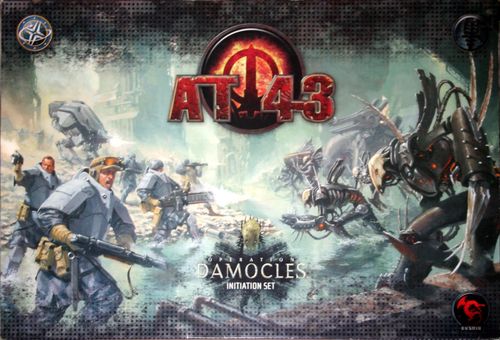
AT-43 Initiation Set: Operation Damocles
AT-43 Initiation Set: Operation Damocles Rulebook
Table of Contents
Table of Contents
43 Years After the Trauma
The universe is ablaze, and new wars erupt everywhere. The United Nations of Ava have launched their elite forces, the White Stars, into battle. If the U.N.A. prevail, the iron rule of success will apply without concession on Ava.
The merciless Therians, for their part, seek to eradicate humanity, to eliminate these parasites who contest their dominion. If they triumph, they will be able to recycle every solar system, reduce every star to its simplest components in order to reassemble them into one gigantic intelligent machine.
Mankind's victorious revolt showed that it was possible to oppose the Therians' overreaching project. Ava now carries the war into the heart of the Therian worlds. Other species follow this example and prepare to confront this enemy that destroys entire civilizations with indifference. Humans have recently discovered one of the colossal and mysterious Therian factory-planets.
Each side has therefore mobilized its forces to conquer it.
Against all expectations, the Therians react slowly, lose ground, and suffer heavy losses. However, their army of machines is assembling inexorably, and the hour of their revenge could sound sooner than men expect.
For the first time, a Therian factory-world is being invaded.
Humans have sent reconnaissance missions to discover what dark project was brewing at the heart of this wandering world. They are trying at all costs to stop this mass of metal and technology heading for Ava. But how can one thwart the plans of a species that uses planets as spaceships, a species capable of destroying entire solar systems?
The White Stars have an answer: Operation Damocles. Escorted by the most advanced combat walkers, the invincible steel troopers land and drive deep into the metal entrails of the planet. They have only one urge: to meet the "morphos" enemy in order to make it pay as dearly as possible for the harm it has done to Ava. The troops are waiting only for the report of the first reconnaissance missions to determine where the landing will take place...
The Therians seem lost in their dreams of power. No one has ever successfully opposed their plans. And yet, the boldness of men seems to know no limits. They explore ever further. Something must be done.
The EMI grid, the inexhaustible Therian network for distributing energy, matter, and information, is beginning to produce attack systems, to assemble ever more powerful war machines.
Will men manage to launch their offensive? Will the Therians react quickly enough?
AT-43 depicts these exceptional battles, with galactic stakes. This Initiation booklet is the first guide to it; it gives the most courageous, the most daring, the keys to thousands of battles to come.
For the moment, only White Stars forces have landed; only the lightest elements, the reconnaissance forces, have taken position. Facing them, the Therians have created a few simple, hastily assembled attack systems. For now they react more out of play than necessity.
Total war approaches, and countless battalions are massing. Soon, entire legions will clash and armies will fight for the galaxy, thanks to the Advanced Rules of AT-43 (to be released in 2007).
The first move of this conflict will determine the future of many worlds. When the threat is known, when these sophisticated weapons are mastered, entire armies will be able to intervene, led by a commander capable of leading them to victory.
You!
Welcome to AT-43
This game lets you face off against a friend in thrilling futuristic battles. Direct your fighters on the battlefield and command formidable armies of flesh and steel in fast-paced, exhilarating games.
AT-43 is played with miniatures representing your fighters. Using the tape measure, you can move them across the playing surface. Dice are used to determine whether their actions succeed.
Operation Damocles
This Initiation Set is designed to familiarize you with the rules of AT-43. In the following pages, you will find the rules you need to know before playing Mission 1. In each mission, new rules are introduced to progressively teach you everything you need to know to win resounding victories.
Initiation Set: Operation Damocles contains everything you need to play your first games of AT-43:
- This Initiation booklet, in five languages: It contains the basic rules as well as detailed missions. You will discover the rules in their entirety as you progress through the missions.
- 19 miniatures, each representing one fighter:
- 1 Fire Toad combat walker of the White Stars, equipped with two light laser cannons;
- 9 White Stars elite infantry, the steel troopers:
- 5 infantry with laser rifles and combat knives,
- 2 infantry leaders with laser rifles and combat knives,
- 2 infantry with missile launchers.
- 1 Wraith golgoth combat walker of the Therians, equipped with a medium sonic cannon and a medium nucleus cannon;
- 8 Therian elite infantry, the storm golems:
- 4 infantry with nanoblasters and reaper blades,
- 2 infantry leaders with nanoblasters and reaper blades,
- 2 infantry with sonic guns.
- 9 cards:
- 7 AT-43 game cards presenting the miniatures and their abilities;
- 2 Universal Resolution Table reminder cards.
- 10 scenery elements:
- 1 illustrated play surface. It is used in the Initiation Set missions, but you may play without it. NB: Only the illustrations bordered with a white line count as obstacles (to movement, to fire, etc.) in the game;
Reading a Card
Each fighter's card carries the following characteristics.
- Manpower Bonus: This value is not used in the Initiation Set.
- Affiliation: Affiliation shows whether the fighter is a White Star or a Therian.
- Movement: Movement shows the distance in centimeters the fighter can cover during a move.
- Morale: This value is not used in the Initiation Set.
- Protection: Protection shows the toughness of a fighter's armor or plating. The higher this value, the harder the fighter is to wound.
- Combat: Combat shows how skilled the fighter is in hand-to-hand fighting. The higher this value, the better the fighter fights in melee.
- Structure Points (SP): Every part of a combat walker (chassis, propulsion, and weapons) has a certain number of Structure Points. The more SP a part has, the tougher it is. This value is not used in the Initiation Set.
- Weapons: The various ranged and melee weapons the fighter can use are listed here.
- Authority: Authority shows an officer's ability to maintain discipline among their troops.
- Command Points (CP): These points show an officer's tactical talent.
- Designation: Designation shows the corps to which the fighter belongs.
- Category: Fighters are classed into two Categories. Infantry are fighters who move on foot. Combat walkers are war machines.
The Rules of the Game
Cards
In AT-43, cards show fighters' characteristics, as well as the information needed to resolve their actions; they let you identify fighters and their weapons.
Units
A unit is a group of one or more fighters of the same Designation. Once battle is joined, it is impossible to separate the fighters of the same unit.
When a unit is made up of several fighters, one of them must be chosen to be its leader. Throughout the game, this leader's position is used to determine the overall position of their unit.
A unit must always stay grouped. This is called a unit's cohesion. This means that once a unit's actions are resolved, the following two conditions must be met:
- All members of the unit must be within 10 cm of the leader;
- Each fighter of the unit must be within 2.5 cm of another member of the unit at most.
When a unit's leader is eliminated, another member of that unit becomes the new leader. To do this, choose the fighter (from the same unit) closest to the former leader and replace their miniature with the leader's.
Dice
Most actions, such as shots or combats, are simulated by dice rolls. A die showing a result equal to or higher than the required number is a success; a die showing a lower result is a failure.
For example, for the shooting test of a unit made up of four infantry each equipped with a single-shot weapon, a player rolls four dice. Each of these dice represents one of the projectiles fired. Each result is used to determine whether a projectile hits its target.
The red dragon face counts as a result of 6+.
Missions
Initiation Set: Operation Damocles lets you get familiar with AT-43 through missions that introduce the rules of the game progressively.
A mission begins with a story explaining why the two sides are fighting. Then, the available fighters, the particularities, and the objectives of the mission are described for each player. The first player to fulfill their objectives has won.
Each mission introduces new rules. Once these rules elements have been absorbed, the game can begin. The new rules from a mission apply to all missions that follow it.
A mission lasts about 30 minutes.
The Game Turn
A game of AT-43 is divided into several game turns. To determine who starts, each player rolls a die. This die roll is called an Authority test. It must be made at the start of every game turn.
The player who gets the better result chooses who activates their first unit. In the case of a tie, reroll until one of the two players wins.
The players then take turns making their units act, one at a time. This is called activating their units. When all units have been activated, a new turn begins.
When two players face off, the first designates one of their units. They then resolve all of that unit's actions (movement, shooting, combat, etc.). Their opponent then does the same, and it is again the first player's turn, who chooses a new unit. This alternates until all units have been activated.
In some missions, no Authority test is required on the first turn. The mission description then indicates which side automatically wins this test.
Who Sees Whom?
The fighters presented in Initiation Set: Operation Damocles see in every direction. However, obstacles (a combat walker, a closed door, etc.) may prevent them from seeing certain opponents (see below).
A fighter is said to have a line of sight to an element when they can see that element. To determine this, imaginary lines are drawn connecting the edges of their base to those of the targeted element:
- If one of these lines does not meet any obstacle, the target is visible.
- If both of these lines meet an obstacle, compare the Size of that obstacle with that of the shooter or the target.
To do this, simply adopt the shooter's point of view, placing yourself at their level, to determine whether or not they can see their target.
Infantry, however, are an exception to this rule: they never block lines of sight.
Measuring Distances
In AT-43, distances are measured using the tape measure supplied in the box. This tape measure is graduated on two scales:
- Range is used to determine the difficulty of shooting tests;
- The centimeter graduation is used to measure all other distances.
Distances must be measured from the edge of one element to the edge of another. This may be the edge of a miniature's base or the edge of a scenery element.
When measuring the distance between a unit made up of several fighters and another point, always measure from the leader's base. Measurements from unit to unit are therefore made from leader to leader.
Warning! It is forbidden to measure a distance before declaring an action. You must first announce the action, then measure.
Movement
A fighter can move in two ways. They can make a fast move, which lets them move a greater distance, or a combat move, which lets them move and shoot. The maximum distance that can be covered depends on the fighter and the type of movement chosen.
Choose your movement, fast or combat, before measuring distances! A move may take place in any direction.
Fighters and scenery elements are obstacles that must be gone around. Not even a combat walker can pass through concrete walls. However, infantry do not hinder the movement of other fighters on their own side... On the other hand, fighters on the opposing side cannot "pass through" them.
Throughout a fighter's move, their base must be able to pass between obstacles. To go around obstacles, it's very simple: run the tape measure around the obstacles when you measure your fighter's move.
Moves cannot end on an obstacle.
Engagement
Two enemy infantry fighters within 2.5 cm or less of each other are engaged. A combat walker is never considered engaged. If a fighter is engaged, their entire unit is as well. An engaged unit cannot make a fast move. It can make a combat move, but the distance it can cover is then halved.
Shooting
A unit may shoot before or after a combat move. The following conditions must be met:
- Only fighters who have a line of sight to at least one member of the targeted unit may shoot;
- No member of an engaged unit may shoot. An engaged unit may nevertheless make a combat move to disengage and shoot afterward;
- All members of the unit must shoot at the same time and target the same unit. Only fighters equipped with special weapons may target a different unit. They must nevertheless shoot at the same time as the rest of their unit.
Number of shots per activation: Any fighter may fire once with each of their ranged weapons during their activation. It is possible to shoot both before and after a move, using a different weapon each time. A unit may target a different target with each shot. If several fighters, each equipped with several weapons, form a unit, they must all target the same targets.
Rules Summary
This section brings together the rules introduced over the course of the previous missions. Added to those presented before the first mission, they form the basis of the AT-43 game.
Activation Sequence
At each turn, before the Authority test, the activation sequence is set up. To do this, the cards representing the fighters are gathered and placed left to right, face down, in the order in which you wish to activate the units. Once both players have set up this activation sequence, the game turn begins. The first player reveals their first card (the one furthest to their left). They immediately play the unit it represents. Their opponent then does the same, and so on, back to the first player, until all cards have been revealed and the corresponding units activated.
This may sometimes lead one of the two players to reveal a card without activating a unit, if that unit has been eliminated. It may also lead a player to reveal a card, activate a unit, and then go again if their opponent has no more cards to reveal.
Movements
At each of its activations, a unit may make a single move:
- Either a combat move: move (per its Movement value) cm. Shooting possible;
- Or a fast move: move (Movement +6 cm for infantry, Movement +10 cm for a combat walker). Shooting not possible.
Engagement
Two enemy infantry fighters within 2.5 cm or less of each other are engaged. A combat walker is never considered engaged. If a fighter is engaged, their entire unit is as well. An engaged unit cannot make a fast move. It can make a combat move, but the distance it can cover is then halved.
Shots
A unit may shoot before or after a combat move. The following conditions must be met:
- Only fighters with a line of sight to at least one member of the targeted unit may shoot;
- No member of an engaged unit may shoot. An engaged unit may nevertheless make a combat move to disengage and then shoot;
- All members of the unit must shoot at the same time and aim at the same unit. Only fighters equipped with special weapons may target a different unit. They must nevertheless shoot at the same time as the rest of their unit.
Number of shots per activation: Any fighter may fire once with each of their ranged weapons during their activation. It is possible to shoot both before and after a move, using a different weapon each time. A unit may target a different target with each shot. If several fighters, each equipped with several weapons, form a unit, they must all target the same targets.
The Game Turn
- Activation Sequence: Each player places, face down, the reference cards of their units. The order in which these cards are arranged (left to right) is the order in which these units will be played.
- Authority Test: Each player rolls a die. Some missions give bonuses to this roll. The player who gets the better result decides who plays first.
- Activation of Units: The first player turns over their leftmost card. They then declare the actions of the unit thus revealed. Finally they resolve these actions (measuring distances, movement, measuring range, shooting, combat, etc.). Then the second player turns over their leftmost card, declares the actions of their unit, and resolves them. It then returns to the first player, and so on for as long as there are face-down cards remaining.
Shooting Tests
The player who controls a shooter rolls a number of dice equal to their weapon's Rate of Fire. For each fighter, a table indicates the minimum result needed to hit, depending on the distance to the target. This table appears on the back of this booklet.
For each die showing a number equal to or greater than the required minimum result, the player scores a hit on the target.
Fire Zone
When a unit shoots at another unit, a fire zone is determined. Regardless of the number of shooters and their position, the fire zone is determined relative to the fighters at the ends of the units. This is true even in the case of a fighter equipped with a special weapon (such as a sonic gun, for example).
Hits must be distributed between the targeted unit and the fighters caught in the fire zone. They are distributed at a rate of one per fighter in the fire zone, starting with those closest to the shooters. Once every fighter in the fire zone has received one hit, all remaining hits are assigned to the unit originally targeted.
Fighters found in the fire zone of a shot are ignored if their Size is smaller than that of the shooters or of the shot's targets.
Damage Tests
Each hit causes a damage test. For this test, the player who just fired rolls as many dice as they scored hits. The result needed to pierce the target's Protection is shown in the shooter's table. This table appears on the back of this booklet.
Each successful damage test causes a number of Damage points equal to the Damage value of the weapon used. A single point of Damage is enough to eliminate an infantry fighter. It takes 4 to destroy a Fire Toad and 5 to annihilate a Wraith golgoth.
Cover
When a unit suffers hits, the cover zone is determined the same way as the fire zone, using the ends of the obstacle as the "edge" of a notional unit. The zone beyond the obstacle is called the blind angle. A fighter with at least half of their base in the blind angle is in cover. If at least half the members of a unit are in cover, the whole unit is. Otherwise, the entire unit is in the open.
However, if the leader of the shooting unit is within 10 cm of the nearest edge of the obstacle to the targeted unit, then the latter benefits from no cover.
A unit in cover benefits from a saving test: for each hit scored against this unit, roll a die. On a result of 5+, the hit is cancelled. Damage tests are then carried out for any remaining hits.
Removing Casualties
Casualties are removed starting with those closest to the shooters' leader. If this is the leader, their miniature is placed back into the unit, in place of the closest fighter.
Special Weapons
A fighter equipped with a special weapon must shoot at the same time as the rest of their unit. They may nevertheless target a different unit. A special-weapon carrier is not replaced by a leader if the leader is killed; another fighter must be chosen instead, if possible. When the only fighter remaining in the unit is a special-weapon carrier, they become the leader and keep their special weapon.
Locked Fire
Locked-fire shots hit their target on a fixed result, whatever the distance to it. Locked-fire weapons may only be used against armored vehicles and scenery elements that can be destroyed. Since the target is locked, any fighters as well as any cover present in the fire zone are ignored.
Melee
Fighters may attack after moving, but they cannot move after attacking. The following conditions must be met:
- Only fighters in contact with an opponent may attack;
- Only fighters equipped with a melee weapon may attack. Special-weapon carriers are not equipped with melee weapons.
At each of their activations, each fighter may attack once with each of their melee weapons.
Multiple Combats
If a unit is in contact with several enemy units at once, combats are resolved unit by unit. If a fighter is in contact with opponents belonging to different units, the player who controls them must choose which unit they attack.
Attack Tests
The player who controls the attacker rolls a number of dice equal to their weapon's Rate of Fire. For each fighter, a table indicates the minimum result needed to hit, depending on the opponent. This table appears on the back of this booklet.
For each die showing a number equal to or greater than the required minimum result, the player scores a hit on the target.
Damage Tests
Each hit causes a damage test. For each hit, the player who just attacked rolls a die. The result needed to pierce the target's Protection is shown in the attacker's table. This table appears on the back of this booklet.
Each successful damage test causes a number of Damage points equal to the Damage value of the weapon used. A single point of Damage is enough to eliminate an infantry fighter. It takes 4 to destroy a Fire Toad and 5 to annihilate a Wraith golgoth.
Removing Casualties
The attacking player freely chooses which casualties to remove from among the fighters in contact with the attackers.
New Rules
Characteristics
Universal Resolution Table: This table works on a simple principle: for each action, an action value and a difficulty are determined. To resolve an action, calculate the difference action value − difficulty. Then consult the table below. Read the corresponding column to find the minimum result needed on a die to succeed at the action.
- Shooting test: The action value is the Accuracy shown on the card for the weapon used. The difficulty of the test is the range separating the leader of the shooting unit from the leader of the targeted unit. For locked-fire weapons, the result needed remains the same regardless of the distance between the shooter and their target. This result is shown on the card in place of Accuracy.
- Attack test: The attacker's action value is the Accuracy shown on the card for the weapon used. The difficulty of the test is the defender's Combat value.
- Damage test: The action value is the Penetration of the weapon used. The difficulty is the target's Protection.
Command
An army is commanded by an officer. As long as this officer is alive, their Authority value is added to the result of each turn's Authority test.
-
Command Point Reserve: At the start of each turn, before the Authority test, each player calculates their Command Point (CP) reserve. This reserve equals the CP value of the officer commanding the army plus the number of units in that army. Only units still in play, or preparing to enter play during the current turn, count.
CP are kept until the end of the turn, even if the officer is eliminated. However, unused points are lost at the end of the turn.
-
Using Command Points:
- Improving an Authority test (X CP): The final result is increased by the number of CP spent (2 CP maximum for an overseer alpha or a sergeant).
- Activating a unit with no officer (1 CP): If a player cannot or does not want to spend this point, the unit does nothing, but it is nevertheless considered to have already been activated this turn. If it is a unit that has not yet entered play, it stays out of play. A player may thus delay the arrival of their units. It is also possible, at the moment of their activation, not to bring into play a unit that has an officer.
- A player may use one, and only one, of the following options each time it is their turn to play:
- Activation deferral (2 CP): The player passes their turn. A player cannot pass their turn twice in a row.
- Repositioning the first card (1 CP): The player repositions their first card wherever they wish in their sequence. The next card must then be played.
You may now replay Operation Damocles with all the rules of AT-43. May the best player win!
Universal Resolution Table (Reference)
The following weapon-vs-target hit and damage tables appear on the back cover of the booklet, keyed to the fighters and weapons included in Initiation Set: Operation Damocles. Column headers are the action-value-minus-difficulty result (0 through 9); rows give the minimum die result needed against each target type (Workbot, Storm golem, Wraith golgoth, Steel trooper, Fire Toad), for To-Hit and, beneath it, To-Damage.
- Steel trooper / Laser rifle — To-Hit and To-Damage vs. Workbot, Storm golem, Wraith golgoth, Steel trooper, Fire Toad.
- Steel trooper / Combat knife — To-Hit and To-Damage vs. the same target list.
- Steel trooper / Missile launcher — To-Hit and To-Damage vs. the same target list.
- Fire Toad / 2 light laser cannons — To-Hit and To-Damage vs. the same target list.
- Storm golem / Nano blaster — To-Hit and To-Damage vs. the same target list.
- Storm golem / Reaper blades — To-Hit and To-Damage vs. the same target list.
- Storm golem / Sonic gun — To-Hit and To-Damage vs. the same target list.
- Wraith golgoth / Medium sonic cannon (MSC) & Medium nucleus cannon (MNC) — To-Hit and To-Damage vs. the same target list, tracked separately for the MSC and MNC weapon systems.
The extracted source text for these tables consists only of column markers and target-row labels without the numeric die-result values reliably aligned to them (a layout artifact of the two-column booklet), so the exact numbers are not reproduced here; players should consult the physical reference card included in the box, which reproduces the same table.