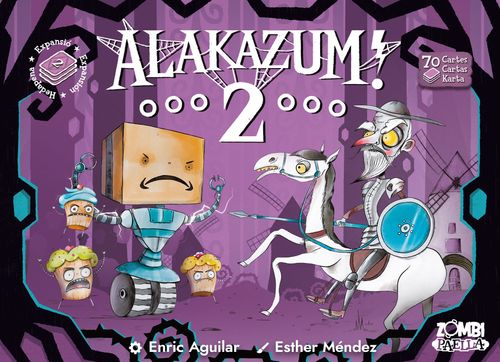
Alakazum! 2
Official rulebook: Zombi Paella
Alakazum! 2 Rulebook
Table of Contents
Table of Contents
Objective of the Game
The objective of the game is the same as in the original game: accumulate 8 or more points of the same culture to conjure the Alakazum spell and so defeat one of the American traditions.
But beware! The new final enemy, Armazon, is invincible: if anyone faces it, their Alakazum will always fail. Armazon is revealed if anyone faces it, as with any other final enemy.
Components of the Expansion
- 6 cards with the final back
- 3 cards with the initial back (Don Quixote and Scepters)
- 51 forest cards
- 2 Miserable Witch's Cauldron cards
- 8 challenge cards
- 4 rulebooks (in 4 languages)
You can recognise the expansion's cards because they are marked with a symbol in the upper right corner.
Setup
Set up the game as explained in the basic game, with the following changes:
-
Return the final enemy cards of the basic game to the box. In their place, use the ones from this expansion, which include them again and add Armazon, the new final enemy. This way, all the backs of the final enemies are exactly identical.
-
Set aside the 8 challenge cards for now (they are only used in challenge mode; see New Game Mode: Challenges for Experts).
-
Shuffle the new cards in with those of the basic game and set up the game as usual; but now you have 12 initial cards. From these, take the 6 hand cards and form the market deck. Lay out the remaining 6, which are characters, face up in a row.
-
Place 1 Miserable Witch's Cauldron card beside the market deck (in the centre of the table) and return the other to the box. If you are 5 players, place both Miserable Witch's Cauldron cards in the centre of the table.
Initial hand: in the unlikely event that, when dealing the initial hand, a player receives 3 hand cards with the hand symbol, 3 hand cards are dealt again to that player.
The setup diagram in the booklet is labelled "3-player game".
Sequence of Play and Turn Phases
In Alakazum! 2, the sequence of play and the turn phases explained on the magic scroll stay exactly the same as in the original game, so you only need to learn how the new cards work.
Detailed Card Explanations
Miserable Witch's Cauldron
This card is never added to the forest deck or the market deck. It stays in the centre of the table until a single player is the one with the fewest characters, that is, every other player has more characters than they do. At that moment, that player takes this card and places it beside their characters. As long as they remain the only player with the fewest characters, they keep the card. The cauldron gives its holder +1 combat point and +1 on all their dice rolls, and also grants the traits very magical, thrifty and natural (as shown by the icons on the card).
At the exact moment the holder stops being the only player with the fewest characters, they return the cauldron to the centre of the table, or hand it to the new player who meets that condition.
In 5-player games, a second cauldron is added. In this case, as soon as 3 rivals have more characters than a player, that player takes one of the Miserable Witch's Cauldron cards. In this mode, 2 players (the two with the fewest characters) may hold a cauldron at the same time.
Character Cards
Castilian Characters
The new Castilian culture cards work the same as all the other cultures. Gather 8 or more points of Castilian culture to try to win the game.
Juana, the Great Castilian Witch
Some say that Juana, the great Castilian witch, is mad, and others that she is a very powerful leader. The truth is that she is unpredictable: at levels B and C, this character has culture points that vary between 1 and 6. At the moment of conjuring the Alakazum, first the player rolls the die to find out how many Castilian culture points Juana has. Only if the total Castilian culture points are 8 or more may the player go ahead and conjure the Alakazum. The player must not reveal any final enemy if they do not reach 8 points in total! If they cannot conjure the Alakazum, they also do not lose any character.
Other Characters
In addition to Castilian culture, this expansion includes one new character from each existing culture and one character who goes her own way: Almudena, the great Madrid witch. Almudena belongs to a new culture, the Madrid culture, is the only character of this culture and, in addition, does not level up with any food. In exchange, she has a very special trait: the centralist (see New Traits, page 6).
New Traits
Some characters have additional icons that indicate their trait. This expansion includes the following new traits:
-
Chaotic: if you have a chaotic character, before starting the explore-the-forest phase and before applying the thrifty trait, you may either shuffle the market deck, or shuffle the forest deck. If you have two chaotic characters you may shuffle both decks if you wish.
-
Complementary: a complementary character gains one additional point of its culture if you have its other complementary character in your team. For example, the player who has Don Quixote and Sancho Panza gains 1 additional Castilian culture point. However, two Don Quixotes do not complement each other, nor do two Sancho Panzas.
-
Natural: during the explore-the-forest phase, you may draw 1 additional card for each natural symbol in your team. Note that, as in any forest exploration, if a character or a trap appears, you must stop drawing cards and then you cannot keep drawing cards in that phase.
-
Enchanting: when this character wins a combat, it always hypnotises the rival character without needing to roll the die, unless the rival character is on a broomstick or is the only character of a player (remember that a player NEVER can be left without characters). The rest of the combat works normally.
-
Centralist: the centralist character adds 1 point to its culture points for each other character you have in your team, regardless of what culture or level those characters are.
Example of centralist: a player has a Dolçainer, a Penitente, a Castanyera, the Three Kings and Almudena at level C. She has 4 Madrid culture points and, as Almudena is centralist, she gains 1 additional Madrid point for each of the other four character cards. In total she has 8 culture points and could conjure the Alakazum!
Trap Cards
There are 2 new traps marked with a symbol that indicates they can affect any player in the game, regardless of the player who came across the trap in the explore-the-forest phase. After resolving the traps, they are removed from the game.
-
Saint Valentine's Present: the player with the most characters must give one of their characters of their choice (at the level it is at) to any other player. If there is a tie between two players who have the most characters, the one affected is, among those tied, the player who obtained the trap or the next one in turn order. If all players have the same number of characters, this trap affects no one.
-
Fast Food Festival: no player may have more than 4 characters in their team. Each player decides which characters to send to the graveyard until they have 4 characters in their team. Players with 4 or fewer characters are not affected by this trap.
Hand Cards
Capes
During the action to give items to your characters, place this card under a character, leaving one of the cape's two icons uncovered. The character acquires the trait or bonus that is left uncovered for the rest of the game, and the other is ignored. However, this character can still go to the graveyard or to a rival's team. If that happens, the cape returns to its owner's hand and can be used again with another character on another turn. A broomstick and a cape, or two capes, cannot be given to the same character. There are three types of capes:
- Thrifty / very magical (trait icons): the character with the cape becomes thrifty or very magical, and keeps its other traits it may already have (even if they are repeated!).
- Natural / +2 hypnosis resistance (tree and eye icons): the character with the cape becomes natural or gains 2 more points of resistance to hypnosis, and keeps its other traits it may already have.
- +2 combat / +1 culture (sword and star icons): the character with the cape gains two additional combat points or one additional point of that character's culture (even if the character is multicoloured!).
Example: the Tragaldabas becomes "thrifty" thanks to a cape. Place the cape so that its bonus is always visible at any level of the character.
Scepters
This item works as a dice potion, a combat potion or a magic hat. Choose which of the 3 functions you want to give your scepter at that moment. The scepter goes to the market deck once used. If used as a potion, it is used in combats against forest characters or other players; whereas, if used as magic energy, it is used in phase 2, cast magic. Scepters cannot be stolen with the theft potion, since that only steals dice and combat potions.
Recovery Potion
Like the other potions, this card is used in a combat, either against a forest character or another player's character. Use it when a combat ends to recover all the potions and scepters you used in that combat, regardless of whether you won or lost it. A potion that was stolen from you with a theft potion cannot be recovered. The recovery potion, like the voodoo doll and the traps, is removed from the game once used and never goes to the market deck.
Example: Esther attacks with Sancho Panza against Enric's Sant Jordi. She uses 2 potions of +1 and then, after winning and rolling the die to hypnotise, one of +5. When the combat ends, she uses the recovery potion and recovers the 3 potions mentioned, but the recovery potion is removed from the game.
Crystal Ball
This card is always used with the action to go to the market. When using it, say a number from 1 to 6 out loud, then roll the die. If the die shows a number equal to or higher than the number you said, draw from the market as many cards as the number you said when using the card. If the die number is lower than the number you predicted, you get nothing. The cards you draw from the market are of your choice, not from the top of the deck, and the crystal ball used ends up on the top of the market deck.
Example: in the go-to-the-market phase, Enric uses a crystal ball and says "3". He rolls the die and gets a 4. As it is a number equal to or higher than what he said, Enric draws 3 cards from the market deck, any cards. In later turns, Ren uses another crystal ball and says "4", but when he rolls the die he only gets a 2. As his prediction has not come true, he draws no cards.
Cupcake
During the action to give items to your characters, use this invasive food card and indicate which of your characters you want to give a cupcake to. The chosen character goes to the graveyard automatically. In exchange, draw 3, 4 or 5 cards from the market deck of your choice, not from the top of the deck, depending on the level of the character that went to the graveyard (A: 3 cards, B: 4 cards, or C: 5 cards). Afterwards, place the used cupcake card on the top of the market deck.
Example of cupcake: Izaskun uses a cupcake to kill her level B Don Quixote. So she sends Don Quixote to the graveyard, draws 4 cards from the market of her choice and places the used cupcake on the top of the market deck.
REMEMBER! When you use the crystal ball or the cupcake, the cards you recover from the market deck are OF YOUR CHOICE! When you choose cards from the market, you may not change the order of the cards left in the deck.
New Game Mode: Challenges for Experts
Before starting the game, players who wish to may draw a challenge card at random without showing it to the other players, and keep it hidden, face down, for the whole game. This will complicate the game a little. All players may wish to play with challenges, or the more advanced players may take a challenge card while the others play a normal game without a challenge.
Challenge cards impose an additional condition for winning the game. At the moment of conjuring the Alakazum, the player with a challenge card must reveal it to show the other players that they have met the challenge and then proceed with the Alakazum. If the Alakazum fails, the challenge is revealed (face up on the table) and known to all, but the player must continue to meet the challenge in order to conjure the Alakazum.
If conjuring the Alakazum with Juana, the great Castilian witch, first roll the die to find out how many culture points Juana has and then, if you meet the challenge, reveal it.
Note: the booklet does not print the wording of the 8 individual challenge conditions; they appear only on the challenge card faces, which are not reproduced in the booklet text. Only the rules for using challenge cards and the clarifications below are transcribed here.
Clarifications on Challenges
- "Great witches": refers to the characters Vicentica, Montserrat, Maruxa, Kattalin, Rocío, Juana and Almudena.
- "3 different cultures in the team": refers to the characters. Count the Madrid culture as a culture.
- "Have and conjure": "have" means it is in your team of characters; "conjure" means using it to conjure an Alakazum.