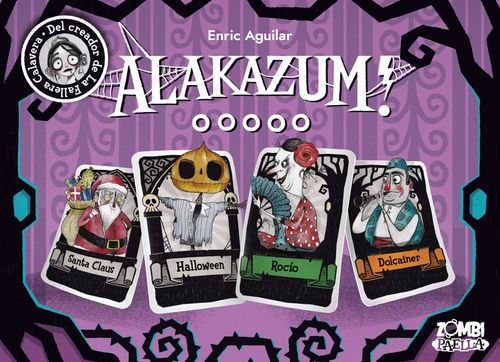
Alakazum!: Witches and Traditions
Alakazum!: Witches and Traditions Rulebook
Table of Contents
Table of Contents
- Objective of the Game
- Components
- Iconography
- Character Cards
- Hand Cards
- Trap Cards and Final Enemy Cards
- Setup
- Sequence of Play
- Turn Phases
- Fighting and Hypnotising Characters
- Detailed Explanation of the Cards
- Magic Scroll: Spells
- Rule for 2 Players
- Rules for 5 Players
- Final Clarifications and Tips
- Final Enemies (culture points)
Objective of the Game
Accumulate 8 or more culture points of the same culture -- Valencian (VAL), Catalan (CAT), Galician (GAL), Basque (EUS) or Andalusian (AND) -- to conjure the powerful Alakazum spell. Only in this way will you defeat one of the final enemies of the North American traditions and win the game.
Components
- 5 cards with the final card back
- 9 cards with the initial card back
- 90 forest cards
- 10 magic scrolls (in 4 languages)
- 4 rulebooks (in 4 languages)
- 1 die
Iconography
- Culture points (a different colour for each culture)
- Multicolour culture points (belong to any of the 5 cultures)
- Character (a different colour for each culture)
- Multicolour character (belongs to any of the 5 cultures)
- Character level (A, B and C)
- Hand card
- Trap card
- Combat points
- Hypnosis resistance
- Magic energy
- Die
- Sociable character trait
- Thrifty character trait
- Very magical character trait
- Steal
Character Cards
Each character card shows:
- Combat points
- Culture points of each culture
- Hypnosis resistance points
- Character levels (A, B, C)
- Name
- Culture
- Character card symbol
- Thematic phrase (visit alakazum.com to learn more about the meaning of the phrase)
Hand Cards
Each hand card shows:
- Number of cards you take back from the market
- Effect
- Hand card symbol
Trap Cards and Final Enemy Cards
Trap cards show an effect and the trap card symbol. Final enemy cards show a name and culture points.
Setup
-
Give each player a magic scroll.
-
Identify the 5 final cards and the 9 initial cards by their backs and set them aside.
-
Take the 5 final cards, shuffle them and place them face down in a row. Do not look at which is which. For games of 3 or 4 players, remove the Saint Valentine card from the game. In games of 2 or 5 players, include Saint Valentine.
-
From the initial cards take the 4 hand cards and form a face-up pile: this will be the market pile.
-
The 5 remaining initial cards are character cards: Senyor Pirotècnic, Tió de Nadal, Moura, Olentzero and Penitente. Take them and display them in a row, face up.
-
The rest of the cards form the forest deck. Shuffle the forest deck and deal 3 cards face down to each player. Players who received any card that is not a hand card exchange those cards for new random cards. Repeat until they only have 3 hand cards. During the game you can only hold hand cards in your hand (that is, cards with the hand symbol at the bottom)! Cards that came out in the deal and are not hand cards return to the deck. Shuffle the deck well afterwards.
-
The player who exchanged the most cards will be the starting player. In case of a tie, the one who last touched a broom starts.
-
The starting player chooses 1 of the 5 available characters and places it on the table in front of them. (All the characters you have in this area form your team of characters.) After that, the player to the left also chooses a character. Continue like this until every player has chosen a character. Any that are not chosen go to the forest graveyard, a space where you display in a row the characters you have defeated but not hypnotised.
-
Now the turns begin, clockwise.
Even if you start with an initial character of a specific culture, you can win the game with another culture. Be flexible!
Sequence of Play
Starting with the starting player, each player carries out their whole turn following the turn phases. Then they pass the turn to the player on their left.
Turn Phases
During their turn, a player must follow these phases in this order:
1. Explore the Forest! (Mandatory)
This phase is mandatory and is carried out at the start of the turn. Take as many cards from the forest deck as you currently have characters in your team. In this phase you must draw the cards one at a time, and you stop drawing immediately if a trap card or a character card appears. In that case you must face the character or suffer the effects of the trap, and after that you cannot continue drawing cards in this phase (see combat against a forest character, p. 8, and trap cards, p. 11).
Example. Uxía has 3 characters and therefore must draw 3 cards. She draws the 1st card: it is a hand card and she keeps it. She draws the 2nd, but a character appears: she will have to fight it and cannot draw any more cards.
2. Do an Action! (Optional)
After exploring the forest, you may do only one of these 4 actions, although it is not mandatory:
a. Go to the market: discard 1 hand card in exchange for cards from the market pile. Show a hand card. Take from the top of the market pile as many cards as the value of cards you take back from the market indicated on it. Then, put the card you showed from your hand on top of the market pile. (See the market pile and going to the market, p. 12.)
b. Give objects to your characters: use 1 single food card or broom card. (See foods, p. 15, and brooms, p. 16.)
c. Fight and hypnotise: pit one of your characters against a character of another player and try to hypnotise it to add it to your team. In this action you may use as many potions as you wish. When you add characters to your team, you place them on the table in front of you (see combat against another player's character, p. 9, and potions, p. 13).
d. Do magic: cast 1 single spell of the 7 available. Spend as much magic energy as the spell requires. The spells are listed on your magic scroll (see magic hats and magic energy, p. 15).
3. Conjure an Alakazum! (Optional)
In this final phase you perform the great Alakazum spell that lets you defeat one of the traditions of the United States and win the game. This phase is also optional, but it has a requirement: you need at least 8 culture points of one same culture (VAL, CAT, GAL, EUS or AND). When you conjure an Alakazum, uncover a final enemy card of your choice. If in total you have more culture points of the same colour as the final enemy, you have won the game! To win the game you will need between 8 and 14 culture points, depending on the final enemy that appears. You only need to defeat one final enemy to win. If the final enemy has equal or more culture points than your team, send one of the characters that took part in the confrontation to the graveyard. In addition, the final enemy card that defeated you stays uncovered and no other player can choose it. That is, when the next Alakazum is conjured, one enemy fewer will take part. And so on until someone exceeds with their culture points those of a final enemy.
Fighting and Hypnotising Characters
Combat is used to raise the level of your characters (see character cards, p. 10) and to try to hypnotise new characters. Hypnotising characters means adding them to your team so that you can use them afterwards. There are two types of combat:
- Against a forest character (explore the forest phase).
- Against a character of another player (fight and hypnotise action).
Combat Against a Forest Character
At the moment a character appears in the explore the forest phase, stop drawing cards and place that character in view of everyone. You must defeat the character that has just appeared with one of the characters you have hypnotised. At this moment you may use potions.
Choose one of your characters to fight. Does your character have more combat points than the forest character?
YES: Your character GOES UP A LEVEL and you roll the die. Does the die exceed the hypnosis resistance points of the forest character?
- YES: The character that appeared in the forest becomes part of your hypnotised characters, at level A. You will be able to use it in the next combat!
- NO: The forest character goes to the graveyard, at level A.
NO: Drama! The forest character returns to the forest deck and your character goes to the graveyard at level A, except if it is your only character or it is on top of a broom. Now shuffle the forest deck well.
Combat Against a Character of Another Player
If you perform the fight and hypnotise action, say which rival character you want to face: this will be the defending character and the player who has it, the defending player. Both players may use potions in this combat. You cannot attack a player who has only one character in their team, since a player can NEVER be left without characters.
Choose one of your characters to attack: this will be the attacking character and the player who has it, the attacking player. Does the attacking character exceed the combat points of the defending character?
YES: The ATTACKER GOES UP A LEVEL. Then the attacking player rolls the die. Does the die exceed the hypnosis resistance points of the defender?
- YES: The attacking player hypnotises the defender. The hypnotised character keeps its level.
- NO: The defender stays with the defending player (but the attacker will have gone up a level).
NO: Twist of fate! The DEFENDER GOES UP A LEVEL. Then the defending player rolls the die. Does the die exceed the hypnosis resistance points of the attacker?
- YES: The defending player hypnotises the attacker. The hypnotised character keeps its level.
- NO: The attacker stays with the attacking player (but the defender will have gone up a level anyway).
VERY IMPORTANT! After winning a combat and before rolling the die to hypnotise... your character goes up a level!
Detailed Explanation of the Cards
Character Cards
There are characters of 5 cultures, each represented by a colour. There are even multicolour characters, which contribute culture points to any culture. Character cards can never be in the hand; they are always on the table in two ways:
- Hypnotised: placed in a horizontal line where each player puts the characters they control. This is your team of characters.
- In the forest graveyard: where the forest characters that have been defeated but not hypnotised are displayed.
There is no limit to the number of characters that may be hypnotised or in the graveyard, but a player can never be left without any hypnotised character. If a player would have to lose their last character, in that case they do not lose it.
Character Levels
A character has 3 levels (A, B and C). A character always starts at the lowest level, A. When a character takes part in a combat and defeats the other character, it goes up a level. Turn the card to mark that it has gone up a level. A character does not go up beyond level C and never goes down, except when it goes to the graveyard, where it returns to level A.
Character Traits
Only some characters have additional icons, which represent their character trait:
- Sociable: a sociable character can add its combat points to those of any character you control, whether attacking or defending. If you win the combat, the sociable character that added its points does not go up a level, only the main character. Two sociable characters cannot be added at the same time.
- Thrifty: at the start of the turn (don't forget!), before the explore the forest phase, draw as many cards from the top of the market pile as you have thrifty characters.
- Very magical: contributes 1 permanent magic energy that you can use every turn to cast spells. Two or more very magical characters can add their magic energy together.
Trap Cards
If a trap card appears when you are drawing in the explore the forest phase, stop drawing and face its effects immediately. Afterwards, the trap disappears from the game (return it to the box).
You can skip the explanation of each trap and read it when one appears during the game.
- Black Friday's Discount: didn't you want discounts? 50%! Give half of your hand cards to the other players, distributing them as you wish. If you have an odd number of cards, give half minus one. This trap does not affect you if you have 1 or no hand cards.
- Halloween's Trick or Treat: trick or treat? You may choose: either give 50% of your hand cards to the other players or send one of your characters to the graveyard. This trap does not affect you if you only have 1 character and you have 1 or no hand cards.
- Santa Claus' Present: Santa Claus brings you a present... an explosive one! Roll the die and, if you roll less than a 3, send a character of your choice to the graveyard. If you roll a 3 or more, pass the die to the player you want. That player rolls the die again. Continue like this until someone's present explodes and they send one of their characters to the graveyard. This trap does not affect someone who has only 1 character, but someone can still pass them the die.
Hand Cards
Hand cards, unlike characters and traps, are held in the hand and are not shown to the other players. In general, these cards always go on top of the market pile once they have been used. Therefore they never disappear from the game and can always be recovered.
The Market Pile and Going to the Market
The market pile fills up with the hand cards (hats, foods...) that are used. In addition, if a card does not especially interest you but you need new cards, in phase 2 of the turn you can go to the market.
To perform the go to the market action, the player shows one of the cards in their hand. Then they draw as many cards from the market pile as indicated by the label on the card shown. The player draws the cards one at a time just as they are placed in the market pile. A player can always look at the cards in the market pile, but cannot change their order. After drawing the corresponding number of cards, the player places on top of the market pile the card they showed from their hand.
Example of going to the market. If you show a potion with the symbol 2 you must draw the 2 cards that are highest in the market pile, regardless of their value, and leave this potion on top in exchange.
Potions
There are combat potions, die potions and steal potions. All potion cards are used during combats. After playing a potion, that card is discarded onto the market pile.
Combat Potions and Die Potions
These potions are used in a combat (against a forest character or against another player). They instantly modify the combat points (combat potions) and the die rolls (die potions). The effects of potions are not permanent and only apply to the active combat. You may use as many potions as you wish in a combat. If a card has 2 potions available, you must choose which one you want to use.
In forest combats, the player decides whether to play combat potions or not at the start of the combat and, after rolling the die, chooses whether or not to use die potions to hypnotise the character.
Example. Jordi wants to hypnotise a Castanyera that has 1 hypnosis resistance point. He rolls the die and gets a 1, that is, insufficient. But he uses a +1 potion and now his roll is 2.
In combats between players, the attacking and defending players decide whether they play potion cards or not and in what order to determine their combat points. When both players declare that they do not want to play any more potions, the combat is resolved.
Then the player who has the option to hypnotise the rival character rolls the die and may use die potion cards to improve the result of the die. Attention: die potion cards only add to the die roll; they are only useful for the player who is trying to hypnotise the rival character.
Example. Ana wants to use her level B Penitente (1 combat point) to attack Pep's level A Dolçainer (1 combat point). Since both have 1 combat point, Ana would be losing. Ana plays a double potion card that lets her add +1 or +1. She plays it as +1 combat, so her Penitente now has 2. Pep plays the same card on his Dolçainer, which equals their combat points (2). Ana tries again to win the combat with another +1 to have 3, but Pep plays a +2 potion that leaves his Dolçainer with 4. Ana declares that she plays no more potions. Pep neither, so the combat is won by Pep's Dolçainer. The Dolçainer goes up to level B and Pep rolls the die to try to hypnotise Ana's Penitente; he gets a 1: he fails! Pep spends the last potion (+1 die) he has left in his hand to turn the die result into a 2 and so manages to hypnotise Ana's Penitente.
Steal Potion
This potion is only used in combats against characters of another player. When you use the steal potion, automatically take the last combat or die potion your rival used in the combat and add it to your hand. Not only will you cancel their potion, but you will be able to use that same potion in that or another combat! A steal potion cannot be stolen.
Magic Hats and Magic Energy
Magic hats serve to pay for the spells you can perform during the do magic action. There are magic hats with value 1, 2 and 3 magic energy. You will find a list of the available spells on the magic scroll that each player has. You may cast 1 spell of your choice, provided you pay the cost of that particular magic.
Example. If you cast clairvoyance, which costs 2 magic energy, discard (send to the market pile) a hat card of value 2 or 2 hat cards of value 1.
Each character with the very magical trait in a player's team gives them 1 magic energy when they perform the do magic action. You can combine magic hat cards with the very magical trait of the characters in the player's team.
Example. If you cast clairvoyance, which costs 2 magic energy, and you have 1 very magical character in your team, you only need to use one hat card with value 1 from your hand.
Foods
During the give objects to your characters action you can use foods (when foods are used they also go to the market pile). Foods are specific to each culture and only affect characters of that same culture, represented by the corresponding colour. They are grouped two by two and when you use them you must choose which of the two foods you want to use. The food will affect all the characters of the same culture that you have hypnotised (all the Galicians or all the Catalans, for example, but not Galicians and Catalans at the same time). The result will be that all your characters of that culture will rise to level C, whatever level they are at that moment.
Multicolour characters do not go up a level with any food.
Brooms
During the give objects to your characters action, place this card under a character and leave it there for the rest of the game. The character will no longer leave this player for the rest of the game, neither through combats nor through magic, not even after a failed Alakazum.
Culture Objects and Amulets
Culture objects (the barretina, the botafumeiro, etc.) also belong to a specific culture and add 2 culture points to your characters of that culture during phase 3 (conjure an Alakazum).
In the conjure an Alakazum phase, before uncovering the final enemy card, reveal these objects to the other players to indicate that you have additional culture points. These cards are used from your hand and are not spent or lost. If your Alakazum succeeds you will have won the game, but if you do not manage it, these cards remain in your hand for the following turns.
There are also multicolour amulets, which can contribute 1 culture point to any of the cultures and work the same as culture objects.
Example. Izaskun has 5 culture points with Catalan characters and in her hand she has a barretina (2 culture points) and a multicolour amulet (1 culture point). She already adds up 8 of the same culture, so she can conjure an Alakazum. Izaskun chooses one of the face-down final cards, turns it over and Halloween appears, which has 9 culture points: she fails. She sends one of her Catalan characters to the forest graveyard and keeps the barretina (2) and the multicolour amulet (1) in her hand. She will be able to use them again in the future.
Voodoo Dolls
The voodoo doll is never used on your own turn and serves to cancel an Alakazum or an action of another player (go to the market, give objects to your characters, fight and hypnotise, or do magic). At the moment a player announces one of those plays, use the voodoo doll to cancel it! A voodoo doll does not cancel another voodoo doll. If you cancel an Alakazum, the affected player does not lose their culture objects or multicolour amulets.
This card can never go to the market pile. When it is used, it returns to the box (just like trap cards).
Magic Scroll: Spells
The 7 spells listed on each player's magic scroll (cost in magic energy first):
- 0 Unlucky Witch (Bruja desgraciada): if all players have more characters than you, keep the 2 cards of your choice from the market pile.
- 1 Training (Entrenamiento): raise one of your characters one level.
- 2 Clairvoyance (Videncia): look at 1 of the final cards, without showing it to anyone, and put it back in its place.
- 3 Forest Magic (Magia del bosque): take the first 6 cards of the forest deck, keep 1 of your choice and arrange the other 5 as you wish on top of the deck. If you choose a character, you must fight it.
- 3 Levitation (Levitación): exchange 1 of your characters for another one on the table that is not at level C, whether from another player or from the graveyard.
- 4 Revive (Revivir): recover 1 character from the graveyard and place it at level A in your area of hypnotised characters.
- 4 Déjà Vu: after conjuring Déjà Vu, perform 2 consecutive actions (from phase 2) this turn.
The scroll also summarises the turn: 1. Explore the forest! (mandatory, as many cards as characters); 2. Do an action! (optional): a. Go to the market, b. Give objects to your characters, c. Fight and hypnotise, d. Do magic; 3. Conjure an Alakazum! (optional, if you have 8 culture points or more).
Rule for 2 Players
Add a fifth final enemy: Saint Valentine. Saint Valentine has 9 culture points in 2-player games.
Rules for 5 Players
Add a fifth final enemy: Saint Valentine. Saint Valentine has 7 culture points in 5-player games. In addition, there is a special rule for the Unlucky Witch spell. In games with 5 players, a player may use the Unlucky Witch spell if 3 or 4 players have more characters than they do.
Example. Iker, Empar, Jordi, Sabela and Antonio. Iker and Jordi have 3 characters, while Empar, Sabela and Antonio only have 1. At that moment, none of them can use the Unlucky Witch spell. Later, Sabela acquires her second character and this allows Empar and Antonio to now perform this spell, since there are 3 players with more characters than they have.
Final Clarifications and Tips
- You cannot use another Déjà Vu in one of the 2 actions that Déjà Vu allows you.
- If you cast the Déjà Vu spell, very magical characters keep their magic energy intact during the 2 following actions and can be used again.
- When you use a voodoo doll to prevent an Alakazum, do it before the rival uncovers a final enemy card. The player who declares they want to conjure an Alakazum should leave a reasonable time so that rivals have time to declare whether they want to use a voodoo doll.
- The combat points of characters are usually a number, but sometimes they are a die. That is, you must roll the die to know how many points they have in that particular combat.
- In a combat against another player, you may use many potions at once or use them gradually depending on the potions the opponent uses.
- In case of a tie in combat points, the forest character or defender always wins, never the attacker.
- You can pay for spells with more than the magic costs, but... you will not get change back!
- Players who want no trouble should always keep hats and potions in hand!
Final Enemies (culture points)
- Black Friday: 7
- Fast Food: 8
- Halloween: 9
- Santa Claus: 13
- Saint Valentine: 9 (2 players) / 7 (5 players)