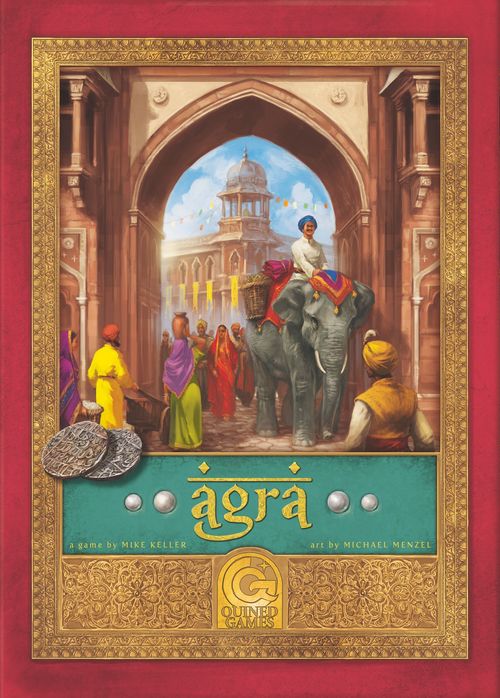
Agra
Agra Rulebook
Table of Contents
Table of Contents
1.0 Game Components
- 1 Game board
- 1 Imperial board (requires assembly)
- 24 Notables
- 69 Rupees (28x1, 15x2, 10x5, 10x10, 6x20)
- 3 Price tokens
- 3 Order Limit markers
- 3 Guild Order markers
- 1 Merchant
- 1 Builder
- 1 Boat
- 1 Meditation marker
- 1 Starting Player marker
- 1 6-sided die
- 12 Under Construction tiles
- 12 Building Bonus tiles
- 14 Favour tiles
- For each of the 4 players:
- 1 Player board
- 1 Cloth Bag
- 8 Cover tiles
- 10 Workers
- 22 Player markers
- 4 Farmers
- 3 Influence markers
- 1 Meditation tracker
2.0 Game Setup
2.1 Game Board
- Place the 3 Price tokens on the designated "Trader" spaces, with the lesser number of flags on each one placed face-up.
- Place the 12 Building Bonus tiles face-up on their designated spaces.
- Place the 12 Under Construction tiles on all appropriate Buildings of 2nd, 3rd, and 4th Level.
- Place the Merchant on the board: to determine where, roll the die. Move the Merchant down the line of Buildings by one space for each pip shown on the die, starting with the quarry (the topmost left Building, showing Sandstone). Reroll if the result is 5 or 6. The Merchant only moves over already-built Buildings, so it will stay on one of the four Buildings in the leftmost (first) column. Next, roll the die for the Builder. Move him from the first Under Construction tile (the second Building in the upper-left of the game board) down the line of Buildings by one space for each pip shown on the die. If the Builder reaches the lowest Building of a column, he moves to the topmost Building of the next column.
- Place the Rupees next to the board.
- Place the Notables along the river: randomly choose 5 Notables of Level I and distribute them in the appropriate spaces of the river (Notables' Levels are indicated on the backs of their cards). Continue this process until you've placed 14 Notables on the board (4 of Level II, 3 of Level III, and 2 of Level IV). Please note that all three Guilds shown on the Notables (the symbols on the Notables' upper-right corners) should be represented more or less equally, meaning a distribution of 5/5/4. If this is not the case, exchange Notables starting with Level I Notables until the Guild symbols are distributed as described in the preceding sentence. Put the remaining cards back into the box. They won't be needed during the game.
- Place the Order Limit markers on the spaces indicated between the Piers. Place the Boat by the first Pier.
- Put the Meditation marker on the "Deliver a Good" action space in the Meditation Circle.
- Randomly determine the starting player. That player takes the Starting Player marker and begins the game.
2.2 Player Board
Each player receives:
- 1 Player board.
- 8 Cover tiles. Place one on each marked square on the left side of your Player board.
- 1 Meditation tracker. Place it on the first meditation symbol.
- 2 Rupees.
Each player also receives, in his or her player color:
- 4 Farmers. Place one of these on the centre square of each column and row on your Player board.
- 10 Workers. Form a supply of these next to your Player board.
- 22 Player markers. Form a supply of these on the central field of your Player board.
- One cloth bag. You will keep your Rupees hidden in this throughout the game. You may count your Rupees at any time.
2.3 Imperial Board
- Place the Imperial board next to the main Game board.
- Each player places an Influence marker on the starting position of each of the 3 Influence tracks.
- Roll the die once for each Guild Order column and place a Guild Order marker on the matching number (from 1-6, counting from the top down). These markers determine which three Orders are available at the beginning of the game.
- Shuffle the Favour tiles and form a face-down draw pile. Draw 3 of these and place them, face-up, next to the Imperial board.
Example: You rolled 3, 5, & 1. Place one Order token on the appropriate space of each Order column.
See "IV. Changes to the Game for 2 and 3 Players" (in the Appendix) for the differences in play and setup for a game with 2 and 3 players.
4.0 Game Overview
The game will last for a variable number of rounds, beginning with the Starting Player and going clockwise. Each player in order will take a turn that consists of three phases: Meditation, Action, and Order. At any time during his turn, a player may also perform any number of Secondary Actions. Play continues in this fashion until the end of the game is triggered, at which point the current round is completed and one final full round will be played. This is followed by final scoring; the player with the most Rupees at the end of the game is declared the winner.
4.1 Player Turn
4.1.1 Meditation Phase
The active player may generate Meditation Points (MP) by laying his Workers down. The MP earned will allow him to perform actions currently available on the Meditation Circle.
4.1.2 Action Phase
The player then performs his main action by placing a Worker from his supply on either a Building or a Main Character. These actions allow players to produce and process goods, trade them with Notables, fulfill Guild Orders, or deliver goods to the Palace. Players may also build Buildings or expand their Farms.
4.1.3 Order Phase
The player may then earn Rupees by fulfilling Guild Orders or delivering Goods to the Palace.
4.2 Secondary Actions
At any time during his turn, the active player may perform Secondary Actions by spending Favour or Luxury Goods.
4.3 Game End
The end of the game is triggered when any of the following events occur:
- A Notable's Contract of Level IV is completed, OR
- A player's Influence marker reaches the top step of an Influence track, OR
- A Guild Order column is filled with 6 Player markers.
Note: For a detailed explanation of the different phases and actions see "6.0 Gameplay". The final scoring is explained in chapter "8.0 Final Scoring".
5.0 Explanation of Important Elements
5.1 Action Spaces (Main Characters and Buildings)
The board consists of three sections where you can place your Workers. The upper part shows the four Main Characters that will allow you to perform the 4 main actions of the game: Building, Shipping, Exchanging Goods, and Farming.
- Architect (Build)
- Sailor (Ship)
- Trader (Exchange Goods)
- Botanist (Farm)
The middle section of the board shows 16 Buildings.
The first 4 are called Production Buildings and will allow you to produce the four Basic Goods of the game (see "5.2.1 Goods Value and Price Tokens"). These are available at the beginning of the game for you to place a Worker on.
The next 12 Buildings are called Processing Buildings. You will process the Basic Goods into Advanced Goods (Cement, Bricks, Planks, Paper, Curry, Dye, Oil, Cloth), and certain Advanced Goods may be converted into Luxury Goods (Statues, Books, Paintings, Clothes). These begin the game unbuilt; once built they will become available as spaces on which to place your Workers. HOWEVER, you will be able to process and exchange Goods on those Building spaces even if their Buildings have not yet been built.
The lower part of the board shows the Yamuna River, which will carry Notables to the city for Akbar's birthday.
5.2 Goods
Goods are the very heart of this game; they are used for practically every action. You will use Buildings to produce, process, and store Goods. Every Player marker next to a Building represents one owned Good of the type indicated by that Building. Each Building can store an infinite amount of Goods, even if it hasn't yet been built!
Building Materials / Basic, Processed, and Luxury Goods:
| Basic Good | Processed Good | Luxury Good | Value chain |
|---|---|---|---|
| Sandstone (value 1) | Cement (value 2) | Statues (value 3) | Sandstone → Cement → Statues |
| Wood (value 1) | Planks (value 2) | Books (value 3) | Wood → Planks → Books |
| Turmeric (value 1) | Curry (value 2) | Paintings (value 3) | Turmeric → Curry → Paintings |
| Cotton (value 1) | Oil (value 2) / Bricks (value 2) / Dye (value 2) / Paper (value 2) / Cloth (value 2) | Clothes (value 3) | Cotton → Oil/Cloth → Clothes |
(Sandstone and Wood are also processed into Bricks and Paper respectively along alternate arrows; the exact processing network is shown on the game board. Sandstone, Cement, Wood, and Planks are the 4 Building Materials.)
5.2.1 Goods Value and Price Tokens
The number of Flags next to a Goods icon shows its value. Goods values are very important, as many actions are influenced by current Goods values. Thanks to the "Trader" action, you will be able to change and manipulate these Goods values by placing or swapping Price tokens on the board.
Example: Curry has a Goods value of 2.
5.2.2 Basic Goods
During the game you will produce and store the 4 Basic Goods: Sandstone, Wood, Turmeric, and Cotton.
5.2.3 Producing Basic Goods
Your Player Board's production tracks determine how many Goods of any given type you will produce when taking a Production Building action. Count the number of open, uncovered farm spaces between a Basic Goods symbol and its two adjacent Farmers. The number of spaces indicates the quantity of Goods produced (minimum 0, maximum 8).
Note: You can modify the amount of Goods produced during the game by removing Cover tiles and by moving Farmers. For more details see "6.1 Meditation Phase" and "Botanist" (6.2.2.1).
Example: the Teal player performs the Quarry action. There are two free spaces between the sandstone symbol and his Farmers, so he produces 2 Sandstone.
5.2.4 Processing Goods
Through certain main and Secondary Actions, you can process one, two, or three Goods from one kind into another in the direction of the arrows on the board. Processed Goods generally have higher values. When you process one or more Goods through a main action, every other player may process exactly ONE Good of the same kind along the same path. The active player earns 1 Favour for each other player processing a good in this way.
Example: You can process Sandstone either to Cement or Bricks.
5.3 Building Buildings
5.3.1 Building Materials
Sandstone, Cement, Wood, and Planks are considered the 4 Building Materials. You will need them in order to build Processing Buildings (including the Processing Buildings for Cement and Planks!). Each Building Material has a specific "Building value", shown by a wooden frame with a number 1 or 2.
Example: Cement has a Building value of 2.
5.3.2 Building Costs
You will also find the same wooden frame on each Under Construction tile. These tiles symbolise Buildings not yet built at the start of the game. If you want to build a Building, you will need to pay its Building costs (see "Architect" on page 13 for more information).
5.4 Getting a Contract from a Notable
At the beginning of the game, 14 Notables are displayed along the River. During your action phase, you may use the "Sailor" action to deliver Ordered Goods and fulfill Notables' Contracts. If all Ordered Goods are delivered, a Notable's Contract is fulfilled. The Contract goes to whichever player delivered the greatest number of Goods. In the case of a tie, the player who delivered the topmost Good(s) takes the Contract. That player turns the Notable over to its Contract side and may, from now on, use that Notable's special ability.
See also "7.0 Notables" and "Appendix I: The Notables and their Contracts".
5.5 Favour
Favour is a special element in the game that allows you to perform Secondary Actions. There are multiple ways to gain Favour, which you may spend on your turn.
You receive Favour:
- When one of your standing Workers gets 'kicked out' (1 Favour, or 2 once you reach the fourth step of the Meditation Track).
- When you visit the Merchant (2 Favour).
- When you reach specific spaces on the Guild Influence Tracks (1 or 2 Favour).
- Through certain Building Bonus tiles.
- Through certain Notables, or if you have markers on a Notable whose Contract has gone to another player (after the Order is fulfilled).
- When other players follow your processing action (1 per player processing a Good).
- Through certain events along the River.
Favour is symbolised by your Player markers; these are stored in the upper section of your Player board (Favour section). When you receive Favour, place the correct amount of Player markers on the Favour section. Each marker symbolises one Favour. Note: you always receive Favour from the "game", not from other players. You begin the game with three Favour actions, but you will be able to add Favour tiles to your Player board as you make progress along the Imperial board.
5.6 Guilds and Imperial Board
The Artisans' Guild, the Merchants' Guild, and the Scholars' Guild are another important element of the game. All the Notables in the game belong to one of these three Guilds. During the game, you will try to raise your Influence with these Guilds. Higher standing with a Guild brings greater rewards when completing that Guild's Orders.
You can see this on the Imperial board: the central section shows the rewards gained from completing Orders; the higher you are up the steps, the greater your rewards.
The lower section shows the Orders currently available to fulfill for each of the three Guilds. The Guild Order markers are placed at random in the beginning of the game and will move whenever a player fulfills a Guild's Order.
6.0 Gameplay
Chapter 4 described the basic structure of a turn; now we'll look in detail at every phase and action.
6.1 Meditation Phase (optional)
You may lay down any number of your Workers standing on the board in order to generate Meditation Points (MPs). Afterwards, you may spend your MPs for Meditation actions.
Note: You may not "store" MPs for your next turn. Any unused MPs are wasted.
6.1.1 Generating Meditation Points
Your Meditation track will indicate how many MP you can generate. For the first Worker laid down, you will receive MP as indicated by your Meditation tracker. The next Worker you lay down will generate MP as indicated by the preceding space, and so on. No matter how many Workers you lay down, a Worker will always generate a minimum of 1 MP.
Example: The Magenta player has his Meditation tracker on the 3rd space. He lays down 3 Workers. Now he may spend up to 5 MPs (2+2+1).
6.1.2 Meditation Actions
You may now spend MPs for Meditation actions. The central Meditation circle shows these actions; the Meditation marker will block one of the outer action spaces from use. You may perform the available actions as many times as you wish and in whichever order you please, as long as you have MPs to spend. The "Move a Farmer" action can never be blocked; it is always available. Here are the actions in detail:
- Trade a Good: You may exchange one Good for another of the same Goods value. The cost in MP is the same as the value of the Good. Note: You may only change Goods of the same value. You may not convert goods into cheaper or more expensive ones! Example: The Teal player spends 2 MPs to exchange a Curry into a Paper.
- Deliver a Good: Pay 3 MPs to deliver one Good to one Notable. For more info see "7.0 Notables" and "Appendix I: The Notables and their Contracts".
- Process a Good: Process one Good into another along a single arrow by spending MPs equal to the value of the Good you process to. Example: Spend 2 MPs to process Cotton to Oil, as the value of Oil is 2.
- Remove a Cover tile: Spend 2 MPs to remove a Cover tile from your Farm; place it next to your Player board.
- Move a Farmer: Spend 1 MP to move any of your Farmers one space. Note: This action is always available. See "Botanist" (6.2.2.1).
6.1.3 Move Meditation Marker
At the end of the phase, move the Meditation marker to the last Meditation action space you used. The exception is the central action, "Move a Farmer": that space can never be covered. If "Move a Farmer" was your last Meditation action, instead cover the space for the action you took immediately before moving your Farmer. This action is now blocked for all players until the marker is moved again.
6.2 Action Phase (mandatory)
Now you must perform one action by placing a Worker from your marker supply onto any Main Character, built Building, or the Under Construction tile currently containing the Builder.
Note: In the beginning of the game, the first 4 Buildings (which produce the Basic Goods) are already built.
6.2.1 Place Your Worker on an Action Space
6.2.1.1 If the action space is unoccupied
If you place your Worker on an unoccupied action space, perform the action of that space.
6.2.1.2 If the action space is occupied by a Worker
If the Character or Building is occupied by another player's laid-down Worker, return that Worker to its owner ("kick it out") and perform your action.
If the Character or Building contains another player's standing Worker, return that Worker to its owner. That player receives 1 Favour (or 2 if he is on the 4th step of the Meditation track) "from the game," as compensation. Then, perform your action.
If the Character or Building already contains any of your own Workers, you may use this action space again. Simply pay 2 Rupees to the general supply and perform the action: this is called the "PEON" effect. If your Worker is laid-down, stand him upright. If your Worker was already upright, you do NOT earn Favour for this. If you can't or don't want to pay the 2 Rupees, you must instead perform another action.
6.2.1.3 If the action space is occupied by the Merchant
If the Building contains the Merchant, you will receive 2 Favour AFTER performing your action.
After receiving Favour, roll the die and move the Merchant a number of steps matching the die result down any built Buildings, always moving from top to bottom and then left to right. If the Merchant moves past the last Building (the Tailor), he continues on back to the Stone Quarry.
Place 1 Rupee from the supply onto each built Building the Merchant passes through. Whenever a player places a Worker on a Building with at least 1 Rupee on it, that player receives all Rupees on that Building.
6.2.1.4 If the action space is occupied by the Builder
If the Building contains the Builder, perform the following two steps:
- Build the Building at no Building Material cost (Note: you won't get any Building bonus for this!) AND
- Process Goods (see 6.2.2.3).
Then, roll the die. Move the Builder one step down any Under Construction tile for each pip shown on the die. Remember that the Builder moves like the Merchant: always from top to bottom and then left to right. If the Builder must move past the Tailor, he continues back at the top-leftmost Under Construction tile.
Once every Building has been built, remove the Builder from the game.
What if I can't place a Worker, because all of my Workers are already on the board?
In this rare case, you must use the Peon. Attention: you may not build a Building during this action, as it requires 2 Workers (see "Architect" below). If you only have 1 Rupee, pay it. If you don't have any Rupees, you do not have to pay for this action.
6.2.2 Perform an Action
There are 3 locations where you may place your Workers: the Main Characters (at the top of the board), the Production Buildings, and the Processing Buildings. The Characters allow you to take specific actions, and the Buildings allow you to produce and process Goods that you will need to take other actions in the game, and for the Imperial board. Let's look at all of them in greater detail:
6.2.2.1 The Main Characters' Actions
Architect
With this action you may either:
- Move one of your Influence markers up one space, OR
- Build a Building of your choice. This is a three-step process:
- Build a Building. Build a Building of your choice by paying Building Materials matching the costs shown on that Building's Under Construction tile. If you pay your Building costs with at least 2 sorts of Building Materials, you get a bonus of +1 to the sum of all Building values. Remove the Under Construction tile from that Building.
- Receive and Use the Building Bonus. After that, choose one of the available Bonus tiles from the corresponding Level (2, 3, or 4 as symbolised by the number of arches). Use the bonus depicted on the tile (see "Appendix II"), and place it face-down in front of you.
- Place a Worker on the new Building. Then, place one of your Workers from your supply onto this Building. You may now process (see 6.2.2.3) up to three Goods associated with that Building.
Note: You may build the Building where the Builder is located. This action is paid for as usual; it is not free. The Builder then moves as usual.
Example: The Yellow player wants to build the Paper factory, which has a Building cost of 4. For this, he places one of his Workers on the "Architect" and removes 1 Wood (Building Material value 1) and 1 Cement (Building Material value 2). Since he used 2 sorts of Building Materials, he gets the bonus of +1 Building Material value and builds the Paper factory. He removes the Under Construction tile. He then takes one of the available Building Bonus tiles. In this case, he receives 3 Rupees and a Favour. He places one of his Workers on the Paper factory to process 3 Wood into 3 Paper. The Teal and Orange players happen to also have Wood. The Orange player decides to process a Good as well, and the Yellow player receives one Favour for this.
Sailor
With this action you may deliver Goods to:
- The Imperial board to fulfill exactly one Guild Order AND/OR
- As many available Notables as you want.
The 1st Good you deliver is free. To deliver more goods, you may return one of your Goods from a Building back to your supply. The value of this Good determines how many supplemental Goods you may deliver this turn. So, depending on its value, you can deliver 1-5 Goods. At the end of this action, receive 1 Rupee for each delivery that you have paid for but not used (because you "overpaid" the Sailor).
Example: The Magenta player pays a Painting (value of 3) and can deliver 4 Goods (1 free delivery + 3 deliveries for the Painting). He decides to deliver only 2 Goods and receives 2 Rupees for the remaining deliveries.
Fulfill a Guild Order: Choose any Order marked with a Guild Order marker and deliver all required Goods at once. Note: you may only do this if you return one Good (as exactly two deliveries are needed to fulfill a Guild Order). Then continue as explained in "6.3.2 Fulfilling an Order".
Example: The Teal player wants to fulfill the available Order of the Scholars' Guild Order column. He pays a Curry to the Sailor (value of 2) and removes 1 Wood and 1 Painting from the Buildings. Because he has a delivery left over, he receives 1 Rupee. Then, for fulfilling the Order, he receives Rupees, places 1 of his own markers on the just-fulfilled Order, and moves the Guild Order marker down 1 step.
Deliver Goods to Notables: (Please refer to "7.0 Notables" for a detailed explanation of this action). Move your Goods to as many available Notables as you wish and are able. For each delivered Good, you will receive 1-5 Rupees. For each Notable to whom you deliver at least one Good, you may move your corresponding Influence marker up one space on the Imperial board. If a Notable's Contract is fulfilled, it will be evaluated immediately.
Example: The Yellow player wants to deliver 1 Curry and 1 Wood to 2 different Notables. He removes a Cotton marker (value of 1, so with his free delivery that makes 2 deliveries) and moves one marker from the Curry Building and one from the Woodcutter to the Notables. He receives 2 Rupees for this. Additionally, he moves his Influence markers up 1 step each on the Scholars' and Artisans' Guilds.
Double Delivery: When using the "Sailor" main action (and only when using this action), you may deliver one of the Ordered Goods on a Notable twice. Place your first marker on the Ordered Good and take your reward as usual. Then, place a second marker next to the first. This will only earn 1 Rupee, but it will count in determining which player wins the Notable tile.
Example: The Teal player wants the Mahout, where another player has already delivered a Good to the top spot. Teal uses 2 of his deliveries to deliver 2 Wood to the Mahout. The Mahout has now received all Ordered Goods. Examining the Mahout's card, Teal has delivered the greatest number of goods and so takes the Contract. Teal now goes up one (and only one) step in the Merchant Guild.
Trader
The Trader allows you to Exchange up to 3 of your Goods for ANY other Goods you desire. The value of the new Goods must be one less than the total value of Goods traded in.
Example: The Orange player wants to exchange his 2 Cement (value of 2 each) and 1 Turmeric (value of 1), which in total have a value of 5, for the following Goods worth a total Goods value of 4: 1 Curry (Goods value of 2) and 2 Cotton (Goods value of 1 each).
Before or after the exchange action, you may place, move, or flip one of the three Price tokens. These tokens can raise or lower the value of any Good by 1.
While you can choose which side of the Price token to use, you are NEVER allowed to stack them, or to raise/lower the value of a Good by more than 1 from its original value. You can use this to your advantage to earn more Goods in the exchange.
Price tokens stay where they are until a player decides to move one by using the Trader, or when a specific River event occurs.
Example: The Teal player wants to exchange Goods. He places the Price token with 2 Flags on Wood. Wood now has value 2 instead of 1. He removes 2 Wood (total value: 4 - 1 = 3) and now chooses to place one Player marker on any Good of value 3.
Botanist
With this action you may perform any 2 different actions (in any order) from these 3 options:
- Increase Meditation: Remove Goods to advance your Meditation tracker one step up the Meditation track. The costs to advance are illustrated between the current position and the next space. (Note: If your Meditation tracker is at least on space 4 (value "3") or higher, you will now gain 2 Favour instead of 1 whenever one of your upright Workers is 'kicked out').
- Remove a Cover tile: Remove a Cover tile from your Player board and place it next to your board.
- Move Farmers: You may either move up to 2 of your Farmers 1 space each, OR move 1 of your Farmers 2 spaces.
Note: Farmers may NEVER move on or through Goods symbols or Cover tiles.
6.2.2.2 The Production Buildings and their Actions
In the 4 Production Buildings (Quarry, Woodcutter, Turmeric farm, Cotton farm) you can produce the four Basic Goods, which will be stored in their respective Buildings afterwards (see "5.2.3 Producing Basic Goods").
Note: Each Building can contain an unlimited number of Player markers. When producing, you are not required to place as many Goods as produced. You may place fewer markers in order to save them for something else. If you should need more markers, you may always return your markers from Buildings and/or Favour markers from your player board.
Example: The Orange player performs the Woodcutter action and has 4 empty spaces next to the Wood symbol. He receives 4 Wood, so he takes 4 Player markers from his marker supply and places them by the Woodcutter Building.
6.2.2.3 The Processing Buildings and their Actions
These Buildings allow you to convert your own Goods into different, more-advanced ones. To do so, move your Goods along an arrow from one Building to another in which you have placed a Worker. You may process 1 to 3 Goods in this way. The other players may, as mentioned before, process ONE Good along the same arrow. You will earn 1 Favour for each other player that processes a Good in this manner.
Example: The Teal player has 4 Cotton and sets his Worker in the Cloth Building. Now he wants to process a total of 3 Cotton into Cloth. So he takes 3 Cotton and moves them along the arrow into the Cloth Building, where they turn into Cloth. The Magenta player gladly follows, and moves 1 of his Cotton markers to the Cloth Building, which gives the Teal player 1 Favour.
Secondary Actions
There are three types of Secondary Actions that you may perform on your turn. These are the "Oil and Curry", "Favour", and "Luxury Goods" actions. You may perform these at any time during your turn, but they do not count towards playing your mandatory action.
1. Oil and Curry actions
In your turn, you may pay either 1 Oil OR 1 Curry to place 1 of your Workers upright, or you may spend both 1 Oil AND 1 Curry to place 3 Workers upright.
Hint: this is most useful at the beginning of the Meditation Phase.
2. Favour actions
Your Player Board contains spaces for Favour actions. You may perform each Favour action once at any time during your turn. You may even perform Favour actions in the middle of performing other actions. Do note that some Favour actions require you to spend all pictured Favour markers, while others require you to possess more Favour markers than you must spend. When you perform a Favour action, place 1 of your player markers on that Action's space to remind yourself that you have used it this turn. At the end of your turn, return all of your markers placed on Favour actions to your supply.
Every player starts the game with 3 available Favour actions:
- Pay 2 Favour to receive 1 Sandstone, Wood, Turmeric, or Cotton.
- Pay 3 Favour to process 1 Good.
- Own 4 Favour, and pay 3 in order to move an Influence marker up 1 step on a Guild Influence Track of your choice.
Later in the game, when your Influence markers climb the steps of the Guild Influence Tracks, you will be able to gain additional Favour actions. Once you reach the 3rd / 6th steps of any Guild Influence Track you may either receive 1/2 Favour markers, or you may choose to take one of the three available Favour action tiles (if you take a tile, remember to replace it with one from the draw pile). You may have up to three additional Favour action tiles on your board. If you receive a fourth Favour tile, you may choose which tile to discard. Shuffle the discarded tile back into the draw pile.
3. Luxury Goods actions
Each of the 4 Luxury Goods allows you to perform a special action. You may spend only ONE of each of these Goods during your turn. To indicate this, move the Good to the appropriate Banner. At the end of your turn, return these markers to your supply.
- Statue: After the action phase and before the Order Phase, perform an additional main action.
- Painting: Move your Influence markers up 1 step on 2 different Guild Influence Tracks of your choice.
- Book: Stand 3 of your laid-down Workers upright and receive 1 Favour.
- Clothes: Receive Rupees in the amount of the current Goods value of Clothes.
6.3 Order Phase (optional)
Now you may deliver Goods to either:
- serve the Emperor Akbar, OR
- fulfill exactly 1 Order on any one Guild Order Track.
6.3.1 Serving Emperor Akbar
Deliver exactly one Good to Emperor Akbar. Please note that you may only deliver goods that the Emperor has not yet been served. Take one of your Player markers from the appropriate Building and place it in the bowl matching the Good's symbol on the top of the Imperial board. At the end of the game, you will receive Rupees according to how many goods you have delivered to the Emperor (see "8.0 Final Scoring").
6.3.2 Fulfilling an Order
Orders are separated by Guild, which are identified by symbols on each column. Each Order consists of 2 Goods, and the number of available Orders is determined by the Order Limit markers; each column can only hold as many Player markers as determined by this Limit.
You can only deliver an Order marked by a Guild Order marker. To fulfill an Order you must have advanced along the appropriate Guild Influence Track; your Influence pawn must have moved up at least one step.
To fulfill an Order, you must possess all required goods. Return the appropriate markers from their Buildings back to your supply. (NOTE: If you use the Sailor to fulfill an Order, you must make both deliveries at once).
Place one of your Player markers on the fulfilled Order and move the Guild Order marker down to the next free space. If the Guild Order marker was at the bottom of the line, start again from the top. Then, check the position of your Influence marker:
- If your marker is the highest up (or is tied for this position) on this Guild's Influence track, you receive Rupees as noted to the left of the track.
- In any other case, receive the indicated amount of Rupees, minus one (i.e., "x-1"). Then, move your Influence marker up one step on the appropriate Guild's track.
If all of a Guild's Orders are fulfilled, place the Order token underneath that column. This triggers the end of the game (see "8.0 Final Scoring").
Example: The Orange player wants to fulfill the current Merchants' Guild Order. He cannot fulfill the Artisans' Order because he has not yet moved up one step on that Guild's track, and he cannot fulfill the Scholars' Order because that track has reached the current Order Limit of 3. The player removes one of each of his Oil and Dye markers from the game board, placing one of them on the spot occupied by the Guild Order marker. The Guild Order marker is now moved one step down, indicating a new Order of 1 Wood and 1 Statue. The player receives 2 Rupees (3-1, because Orange is not in the lead on this track), and then moves his Influence marker up one step.
7.0 Notables
At the beginning of the game, the Notables are placed along the River. These Notables require certain goods, offering advantageous Contracts in return. On top of that they will also reward you with Rupees every time you deliver Goods to them, and they will also increase your influence among the different Guilds. To deliver Ordered Goods, you can use the "Sailor" action, or the "Deliver a Good" Meditation action.
At the start of the game, you may only deliver Goods to Notables up to the position of the Boat. Once 2 Level-I Notables' Contracts have been fulfilled, the Boat moves to the next pier on the river, allowing for deliveries to Level-II Notables. This process goes on until the Boat reaches the last pier. When this happens, it triggers the end of the game (see "8.0 Final Scoring").
7.1 The River
The Boat moves down the River from Pier to Pier as Notables leave the river. Between two Piers, the board shows the number of Notables that need to have their Contracts fulfilled in order to move the Boat one Pier further down the river. Whenever the Boat moves to a new Pier, it will trigger an event. Between certain Piers, new Order Limit markers will be taken from the River and placed on the Imperial board.
- 1st Pier: the Boat's starting point. Once 2 level-I Notable's Contracts have been fulfilled, the Boat moves to the 2nd Pier.
- 2nd Pier: the Building with the Builder on it is built; remove that Building's Under Construction tile and move the Builder with the die, as usual. Once 1 level-II Notable's Contract has been fulfilled, the Boat moves to the 3rd Pier.
- 3rd Pier: the Merchant moves (by rolling the die, as previously described). Every player receives 1 Favour per Cotton they own (to a maximum of 3). The Order limit marker with the number "4" is placed on the Imperial board. Once exactly 2 level-II Notables' Contracts have been fulfilled, the Boat moves to the 4th Pier.
- 4th Pier: all Price tokens are removed from the board and go back to the Trader. Every player receives 1 Favour. The Order limit marker with the "5" is placed on the Imperial board. Once 1 level-III Notable's Contract has been fulfilled, the Boat moves to the 5th Pier.
- 5th Pier: every player receives a Good of value 1 / 2 / 3 depending on the amount of Cotton they own (0 / 1 / 2+). The Order Limit marker with the number "6" is placed on the Imperial board. Once 1 level-IV Notable's Contract has been fulfilled, the Boat moves to the 6th Pier.
- 6th Pier: selling Clothes with the Luxury Good action yields +1 Rupee. The end of the game is triggered (see "8.0 Final Scoring").
Note: The movement of the Boat happens immediately after the indicated number of Notables' Contracts are fulfilled. All effects connected to that movement happen BEFORE a player continues with his turn (the game comes to a temporary halt).
7.2 Delivery and Reward
If you deliver a Good to a Notable, take the respective Player marker from the Building and place it on the ordered Good shown on the Notable. Then you immediately receive Rupees equal to the total number of Player markers on that Notable.
You may then deliver another Good, take your Rupee(s), and so on. The Rupees will be paid separately after each delivery other than Double Delivery. This means that if you fully deliver to a Notable with 2 Goods, you receive 3 Rupees (1+2); if you fully deliver a Notable with 3 Goods, you receive 6 Rupees (1+2+3)!
Example: on his turn, the Yellow player delivers 1 Oil to the Cook, and receives 1 Rupee. Then it's the Teal player's turn: he delivers 1 Wood and receives 2 Rupees. If the Yellow player had delivered both goods, he would have received 3 Rupees instead (1+2, for a total of 3).
7.3 Special Rule: Double Delivery
When you perform the "Sailor" action, you may deliver one of the Ordered Goods twice (this is NOT allowed with the Meditation action, "Deliver a Good"). Place your first marker on the Ordered Good and take your reward as usual. Then, place your second marker next to the first. For this extra marker you only receive ONE Rupee, but it counts in the evaluation to determine which player wins the Notable's Contract.
Example: the Teal player wants the Mosaic Maker, but the Magenta player has already delivered a good to that Notable's top spot. Teal uses a Double Delivery with the Sailor to deliver 2 Cement to this Notable; he receives 2 Rupees for the first Cement delivered, but just ONE for the second (see "Double Delivery"). The Mosaic Maker's Contract is fulfilled and Teal receives the Notable, flipping it to its Contract side. Teal may now immediately take one of the available Favour tiles, or he may select any tile from the draw pile, shuffling the pile afterwards. Teal may now use the Mosaic Maker's ability to receive 1/2 Favour/turn, at a cost of 1/3 MPs.
7.4 Fulfilling and Evaluating
If all Ordered Goods on a Notable are delivered (2 or 3 different kinds, depending on the Notable), this Notable's Contract is considered fulfilled and is immediately evaluated. Play pauses, and the following happens: the player who delivered the most Goods on that Notable takes the card, flips it to its Contract side, and puts it next to his Player board. He can use its special ability immediately. If there is a tie, the player who delivered the topmost Good(s) gets the Notable. He takes also his Player markers from the tile back to his marker supply.
All other players with markers on the Notable take their markers back, placing them as Favour on their player boards. They don't receive the Contract, but are instead compensated with Favour.
7.5 Raise Influence
Once you have completed every delivery you wish to make, you may raise your Influence in the Imperial board: for each Notable whom you supplied with at least 1 Good this turn, you may move your Influence marker up one step on the corresponding Influence Track.
Note: Once any of your Influence markers reaches a space with Favour bonuses, you immediately receive one of the three available Favour tiles OR the indicated amount of Favour.
Example: the Yellow player performs the Sailor action and delivers 1 Brick to the Mullah (receiving 1 Rupee) and 1 Plank to the Jagirdar (receiving 3 Rupees, because the Magenta Player had performed a Double Delivery there earlier). The Jagirdar's Contract is fulfilled and then evaluated: since the Magenta player has more markers on this card, the Contract goes to the Magenta player. Because this is the first Level II Contract fulfilled, the Boat advances from the 2nd pier to the 3rd one. This immediately triggers an event: the Merchant moves (by rolling the die). Every player receives 1 Favour per Cotton they own (to a maximum of 3). Because the Yellow player delivered to both the Mullah (of the Scholars' Guild) and the Jagirdar (of the Merchants' Guild), he goes up one step on the Influence track of both Guilds. Having reached the 3rd step of the Merchants' Guild Influence Track, he may now choose his reward: he may take either 1 Favour, or he may select a new Favour tile. He does the latter and adds the Favour tile to his Player board.
7.6 Abilities of the Notables
When you receive a Notable, you may use its special abilities. There are lasting effects and immediate effects; some of the most common benefits you receive from the Notables' Contracts include:
- Rupees: these are received when certain conditions are met, or at the end of the game.
- Generous deliveries: every time you deliver a Good (to a Notable, or somewhere on the Imperial board), you receive one or two extra Rupees from the supply.
- Once per turn: you can use these effects just once during your turn. Tip: rotate a Notable 90° when you use his or her ability to remind yourself that you have already used it this turn.
- Once per game: these effects are executed once, immediately after receiving the Notable.
For a more detailed explanation of these effects, see "Appendix I: The Notables and their Contracts".
8.0 Final Scoring (Game End)
The end of the game is triggered whenever:
- A Level IV Notable's Contract is fulfilled, OR
- A player's Influence marker reaches the topmost step of an Influence track, OR
- A Guild Order column is filled with 6 Player markers.
Once one of these three conditions is met, finish the current round. Everyone plays ONE more turn after this. Players then count their Rupees, starting with what they have collected throughout the course of the game and then receiving additional Rupees for the following:
- For every Notable marked with the 'Game End' symbol, the players receive Rupees according to the Contract (see "Appendix I: The Notables and their Contracts").
- Each of the three Influence tracks will now be scored: the player on the topmost step of each Influence track receives 2 Rupees for each of their Player markers in the corresponding Order column. All players in second position on the Influence tracks receive 1 Rupee per marker. In the event that players are tied for the topmost position on a track, they each receive 1 Rupee per marker; players in second place receive nothing.
- Each player whose Meditation tracker reached the last space of the Meditation track receives 5 Rupees.
- Each player receives 1 Rupee for each of their own removed Cover tiles.
- Every player gets 1/3/5/+3 Rupees for delivering 1/2/3/+1 goods to the Emperor Akbar.
Players now total their Rupees. The player with the greatest total amount of Rupees is the winner of the game.
In case of a tie, the tied players count the values of their remaining Goods and Favour (every Favour counts as a Good of value 1). The player with the highest Goods value wins. If there is still a tie after this, the victory is shared.
Example of a final scoring:
- The Orange player owns 36 Rupees in coins.
- He receives Rupees from his 2 "Game End" Notables: 4 Rupees from the Subadar (he fulfilled 4 Orders); 4 Rupees from the Grand Imam: he has 2 Contracts from Scholars (including the Grand Imam himself) & fulfilled 2 Scholars' Orders.
- From the Guild Influence tracks he receives: 4 Rupees for the Traders' Guild (he's 1st on the track and completed 2 Orders); 2 Rupees for the Scholars' Guild (he's 2nd on the track and completed 2 Orders).
- He removed 5 Cover tiles (+5 Rupees).
- He delivered 5 goods to Emperor Akbar (+11 Rupees (5+3+3)).
So the final score is: 36 + 4 + 4 + 4 + 2 + 5 + 11 = 66 Rupees.
Appendix
I. The Notables and their Contracts
Note: every time it is mentioned that you get a bonus when you "deliver" a Good, it refers to delivering a Good to a Notable, an Order, Akbar, or the French Trader.
Level I
- Portuguese Trader — Contact between Western Europe and the Mughal Empire began at the very beginning of the 17th century. The Portuguese, English, French, and Dutch were the ones to trade with the Mughals. During the "Sailor" action you may spend more than 1 Good to boost the amount of Goods you can deliver, but to a maximum total Goods value of 4 (for example: you could spend 2 Wood and 2 Turmeric to deliver 5 Goods: 1 free Good + 4 "paid" ones). You receive 1 Rupee each time you deliver a Cloth.
- Sufi — Islamic Mystic figure, practitioner of Sufism. Immediately move the Meditation tracker once on the Meditation track for free. You receive 1 Rupee each time you deliver Curry.
- Takshaka — Traditional Stonemason. Every time you build a Building (without using the Builder), you get +1 Building value and receive 1 Rupee.
- Mahout — Elephants were an essential part of Indian culture. They were used for trade, transport, and even military purposes. A Mahout is an elephant rider, trainer, or keeper. Each time you produce Sandstone or Wood, you produce 1 additional Good of the same kind.
- Khatib — In Islam, a khatib is a person who delivers the sermon (literally "narration"), during Friday and Eid prayers. Each time you produce Cotton or Turmeric, you produce 1 additional Good of the same kind.
- French Trader — Contact between Western Europe and the Mughal Empire began at the very beginning of the 17th century. The Portuguese, English, French, and Dutch were the ones to trade with the Mughals (Note: historically, the French only began trading with the Mughals after Akbar's death in 1605). Once during your turn, you may place 1 Good of value 1, 2, or 3 on this card. Once the French Trader holds three Player markers, you immediately receive 5 Rupees and place the markers back into your supply. Don't forget that you may receive one or more extra Rupees if you deliver Goods to the French Trader in combination with some other Notables (for instance, receiving +1 Rupee per Cloth with the Portuguese Trader).
- Dyer — Distinctive features of Indian textiles include a consistent use of decorative motifs as well as the use of madder dye, which provides a vibrant red hue. Every time you produce Goods, you can exchange 2 of these Goods for 1 Good of the same colour with a value of 2. You receive 1 Rupee each time you deliver Dye.
- Cook — Mughlai cuisine consists of dishes developed at the centers of the Mughal Empire. This cuisine is strongly influenced by those of Central Asia, the region from whence the Turco-Mongol Mughals originated. Mughlai cuisine has in turn strongly influenced the regional cuisines of modern India, Pakistan, and Bangladesh. On this card you may store up to 2 of your standing, 'kicked-out' Workers (not laid-down Workers). In the Meditation phase, you may take one or both of these Workers back to your Worker supply to generate MPs (as if you had laid them down). You receive 1 Rupee each time you deliver Oil.
Level II
- Muezzin — The muezzin is a chosen person at the mosque who leads the call (adhan) to Friday service and the five daily prayers. Every time you generate at least 1 MP in the Meditation phase, you receive one extra MP.
- Jagirdar — A Jagir was a sort of feudal land grant. In return for use of the land, the vassal (jagirdar) had to make certain contributions, either in the form of tax payments or military service. If another player performs the "Sailor" action, you may also deliver 1 good to a Notable. If you do this, the active player receives 1 Favour; you deliver your Good after the active player finishes his delivery, OR if you perform the "Sailor" action, you can deliver an extra good at no cost.
- Caliph — A person considered a religious successor to the prophet Muhammad, and a leader of the entire Muslim community. Once per turn, you can spend 1 Cotton to stand a laid-down Worker upright.
- Calligrapher — Islamic calligraphy is the artistic practice of handwriting and calligraphy, based upon the alphabet in the lands sharing a common Islamic cultural heritage. It includes Arabic, Ottoman, and Persian calligraphy. It is known in Arabic as khatt Islami, meaning Islamic line, design, or construction. For using the Peon, you need to pay just 1 Rupee (instead of 2). You receive 1 Rupee each time you deliver Paper.
- Mullah — The term is sometimes applied to a Muslim man or woman educated in Islamic theology and sacred law. Once during your turn when performing a Favour action, you may pay one fewer Favour than required; you must still have the requisite amount of Favour. You may never use this effect to reduce the Favour you have to spend to zero. You receive 1 Rupee each time you deliver a Brick.
- English Trader — Contact between Western Europe and the Mughal Empire began at the very beginning of the 17th century. The Portuguese, English, French, and Dutch were the ones to trade with the Mughals. Once per turn, you can exchange one good for another of the same value.
- Mosaic Maker — Mosaics and inlaid decorations were widely used in Mughal Buildings. In the time of Akbar, the mosaics were made from small tesserae which were combined in Persian geometrical patterns. Immediately take one Favour tile of your choice from the draw pile or the three face-up tiles. Shuffle the pile afterwards to form a new draw pile. Once per turn, you can spend 1 / 3 MP to receive 1 / 2 Favour.
Level III
- Mujtahida — A mujtahid is an individual who is qualified to exercise ijtihad (legal reasoning) in the evaluation of Islamic law. The female equivalent is a mujtahida. In general, mujtahids must have an extensive knowledge of Arabic, the Qur'an, the Sunnah, and legal theory (Usul al-fiqh). Immediately build the Building closest to the upper-left corner at no cost, following the normal Building rules (see "Architect"). You receive 2 Rupees each time you deliver a Statue.
- Dutch Trader — Contact between Western Europe and the Mughal Empire began at the very beginning of the 17th century. The Portuguese, English, French, and Dutch were the ones to trade with the Mughals. During final scoring, you receive 1 Rupee for having fulfilled at least one Order from a single Guild. If you fulfilled Orders from 2 Guilds, instead receive 3 Rupees. If you fulfilled Orders from all 3 Guilds, instead receive 6 Rupees. You receive 2 Rupees each time you deliver Clothes.
- Painter — The Mughals developed a particular style of painting, generally confined to miniatures either as book illustrations or as single works to be kept in albums. This style came out of Persian miniature painting, with Indian Hindu, Jain, and Buddhist influences. Immediately stand up to 3 laid-down Workers upright and move 1 step up on any Guild Influence track. You receive 2 Rupees each time you deliver a Painting.
- Subadar — 'Subadar' was a title designating the governor of a Subah (province) during the Mughal era. These figures were also known as 'Sahib i Subah', or 'Nazim'. The word 'subadar' is of Persian origin. During final scoring, you receive 1 Rupee for each Guild Order you fulfilled. You receive 2 Rupees each time you deliver a Book.
- Sadr us-Sudur — The Sadr us-Sudur was the emperor's chief religious advisor, and was in charge of disbursing grants for religious, educational and charitable purposes. As the empire's chief justice, his judicial authority was second only to that of the emperor. Immediately deliver a Good to Akbar on an available space with the same value as the delivered Good (for example: you could place a Paper marker on the Curry Offer space). During final scoring, you receive 1 Rupee for each of your markers delivered to Akbar.
Level IV
- Grand Mufti — The Grand Mufti is the highest official of religious law in a Sunni or Ibadi Muslim country. Immediately receive 3 Favour. During final scoring, you receive 3 Rupees for every set of all 3 Guild symbols you have/occupy (on Orders and/or Notables).
- / 23. / 24. Grand Imam / Court Artist / Dewan — The Grand Imam is a prestigious Sunni religious title. The Court Artist refers to the many artists Akbar lured to his court from all over Persia and Central Asia as inspired by his father, Humayun, who believed that artists "were the delight of all the world". The Dewan served as the chief revenue officer of a province. Immediately receive 3 Favour. During final scoring, you receive 1 Rupee for each Notable and Order you have/occupy with the appropriate Guild symbol (including the Grand Imam, Court Artist, or Dewan themselves).
II. The Building Bonus Tiles
Level 2
- Move up one step on the Artisans' Guild Influence track. Receive 3 Rupees.
- Remove one Cover tile and place it next to your Player board. Receive 2 Rupees.
- Move up one step on the Merchants' Guild Influence track. Receive 3 Rupees.
- Receive one Favour. Receive 3 Rupees.
Level 3
- Move up one step on the Artisans' Guild Influence track. Receive 4 Rupees.
- Receive one Favour. Receive 4 Rupees.
- Move up one step on the Scholars' Guild Influence track. Receive 4 Rupees.
- Receive 5 Rupees.
Level 4
- Move up one step on the Scholars' Guild Influence track. Receive 5 Rupees.
- Receive one Favour. Receive 5 Rupees.
- Move up one step on the Merchants' Guild Influence track. Receive 5 Rupees.
- Receive 6 Rupees.
III. The Favour Tiles
- Spend 2 Favour and stand up one of your laid-down Workers on the game board.
- Spend 2 Favour to process 1 additional Good. This Favour action has to be combined with another Processing action (Meditation action, Favour action, Processing Buildings; and also when processing alongside another player).
- Own 2, spend 1 Favour to get +1 MP (used only in the Meditation Phase).
- Own 3, spend 2 Favour to sell 1 Good for its value in Rupees.
- Own 3, spend 2 Favour to remove one Cover tile; place this tile next to your Player board.
- Own 4, spend 2 Favour to deliver 1 Good to an available Notable.
- Own 4, spend 2 Favour to deliver a good to Emperor Akbar or fulfill one Order from any Guild.
- Own 2, spend 1 Favour to move your Farmers 2x (either 1 Farmer 2x or 2 Farmers 1x).
- Own 3, spend 2 Favour to move any Price token (as though you were taking the Trader action).
- Spend 2 Favour to exchange 1 Good for another Good of the same value.
- Own 4, spend 3 Favour to receive 1 Good of value 2.
- Spend 4 Favour to advance one step with your Meditation tracker for free.
- Own 3, spend 2 Favour to process 1 Good of value 1 to a Good of value 2.
- Spend 3 Favour to use the Peon for free (used only in the Action Phase).
IV. Changes to the Game for 2 and 3 Players
- Place 1 fewer Notable per Level on each section of the River. You will only place 10 Notables; their guild distribution should be 4/3/3.
- For games with 2/3 players, place 4/2 random neutral markers (use components from an inactive player color) on the Emperor Akbar section of the Imperial board:
- For 2 players, roll the die twice for each of the left and the right sides and cover the Goods indicated by the die roll(s). If one of the rolled Goods is already covered, do not reroll: it is possible that fewer than 4 Goods will be covered.
- For 3 players, roll the die twice: for the 1st rolled number, cover one of the 6 Goods on the left. For the 2nd rolled number, cover one of the other 6 Goods on the right.
- For games with 2/3 players, place 6/3 neutral markers on the Guild Order columns of the Imperial board:
- For 2 players, roll the die twice for each Guild Order column and cover the corresponding Orders. If any rolled number is already covered, roll again as often as necessary until another Order can be covered.
- For 3 players, roll the die once for each Guild Order column. After the 1st roll, cover the respective Order of the 1st Guild Order column. After the 2nd roll, cover an Order of the 2nd Guild Order Column, and so on.
Summary
Game Turn:
-
Meditation Phase (optional)
- Generate Meditation Points (MPs): For the first Worker laid down, receive MPs as indicated by your Meditation tracker. The next Worker you lay down will generate MP as indicated by the preceding space, and so on. A Worker will always generate a minimum of 1 MP.
- Meditation actions: Use all generated MPs for available actions.
- Move the Meditation marker to the last Meditation action used ("Move a Farmer" never gets blocked).
-
Action Phase (mandatory)
Place one of your Workers from the supply onto an action space: the Main Characters (at the top of the board), the Production Buildings, or the Processing Buildings.
- If the action space is occupied by a Worker:
- If it's another player's laid-down Worker, just 'kick him out' and give it back to its owner. Then perform the action of the space.
- If it's another player's standing Worker, 'kick him out' and give it back to its owner; that player gets 1 Favour (or 2, if that player has reached the 4th step of his Meditation track). Then perform the action of that space.
- If it's your own Worker, you MUST pay 2 Rupees to perform the action. Place the already-present Worker upright; you do not collect favour for this. Then perform the action of that space.
- If the action space is occupied by the Merchant: Gain 2 Favour AFTER performing the action. After that, roll the die and move the Merchant. Place 1 Rupee on each built Building he passes through.
- If the action space is occupied by the Builder: Build the Building at no material cost (no Building bonus). Process Goods. After that, roll the die and move the Builder (over unbuilt Buildings).
- If the action space is occupied by a Worker:
-
Order Phase (optional)
- Serve Emperor Akbar: Deliver 1 Good to Akbar, OR
- Fulfill an Order: Deliver 2 Goods to fulfill a single marked Order at one of the three Guilds. Check your position on that Guild's Influence track. If you are:
- 1st on the track: Receive Rupees.
- Not 1st: Receive Rupees -1 AND advance 1 Step.
On your turn you may also perform three kinds of Secondary actions:
- Oil and Curry actions: pay Oil and/or Curry to stand up laid-down Workers.
- Favour actions: spend Favour in order to gain bonuses.
- Luxury Goods actions: spend Luxury Goods to perform special actions.
How to Obtain Rupees:
- Deliver to Notables: receive 1 Rupee per marker on the Notable per delivery (on a Double Delivery, the 2nd Good always pays 1 Rupee).
- Fulfill Orders: by using the "Sailor" action or during the Order Phase.
- Build a Building: receive 2-6 Rupees from Building bonus tiles.
- Perform Sailor action: for every unused delivery, receive 1 Rupee.
- Place a Worker on a Building with 1 or more Rupees on it: take all Rupees on that Building.
- Perform the "Clothes" Luxury Good action: receive Rupees in the amount of the Clothes' Goods value.
- Use certain Notables' special abilities to get Rupees.
- In the final scoring you receive extra Rupees for several things: your deliveries to Akbar, your position on the Guild Influence tracks, certain Notables' Contracts, removed Cover tiles, and for reaching the final space of the Meditation track.
How to Receive Favour:
- If one of your standing Workers is 'kicked out' of a space (1 Favour, or 2 if you've reached the 4th step of the Meditation Track).
- When you visit the Merchant (2 Favour).
- When you go up on one of the Guild Tracks and reach specific spaces (1 or 2 Favour).
- Through certain Building Bonus tiles.
- Through special abilities of certain Notables, or if you are a runner-up in fulfilling a Notable's Contract (after the Contract is fulfilled).
- When other players follow your processing action (1 per player that processes a Good).
- Through performing the "Book" Luxury Good action.
- Through certain events along the river.
Easily Forgotten Rules:
- Move the Meditation marker after performing at least one of the 4 outer Meditation actions.
- Receive Rupees after EVERY Delivery to Notables.
- If you use the "Architect", you may choose to build a Building OR you may move up 1 step on one of the three Guild tracks.
- To stand laid-down Workers upright: use the "Oil and Curry" action, or perform the "Book" Luxury Good action.
- You can use Favour and/or effects from Notables at any time during your turn (even in the middle of an action).
- Place 1 Rupee on each built Building the Merchant passes through.
- Placing a Worker on a Building containing the Builder allows that Building be built (and used).
- Move the Boat and trigger the River event IMMEDIATELY after the requisite amount of Notables' Orders have been fulfilled.
- At the end of your turn, return all of your markers on Favour actions and Luxury Goods (actions) Banners to your supply and turn used Notables upright.