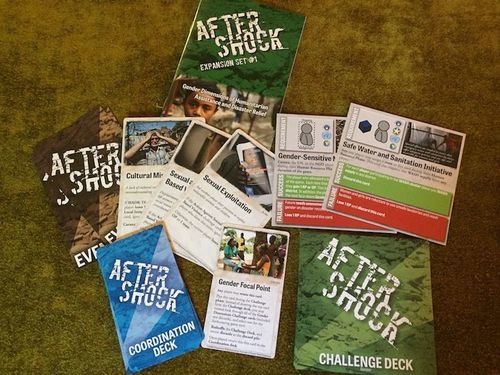
AFTERSHOCK: Expansion #1 – Gender Dimensions of Humanitarian Assistance and Disaster Relief Rulebook
Table of Contents
Table of Contents
- Components
- Event, Coordination, and Challenge Cards
- Challenge Phase
- Using Expansion Sets with AFTERSHOCK
- Note for Instructors
- Coordination Card
- Event Cards
- Challenge Cards
- Gender-Sensitive Needs Assessment
- Action Against Sexual and Gender-Based Violence (SGBV)
- Protection
- Community Education Initiative
- Reproductive Health Initiative
- Partnering With Community Organizations
- Informal Mediators
- Local Insight and Sociocultural Awareness
- Gender-Sensitive Aid Distribution
- Safe Water and Sanitation Initiative
- Community Food Kitchen Initiative
- Non-Food Items
- Card Comments
Components
This expansion set includes the following items:
- 1 Coordination card*
- 3 Event cards*
- 12 Challenge cards
*Additional blank cards have been added for customization.
Event, Coordination, and Challenge Cards
Remove the Preparedness card from the Coordination deck. It is no longer used. Add the new Coordination card included in this expansion (Gender Focal Point) in its place.
Remove the Protection card from the Event deck and set it aside. It now enters play via a Challenge card. Also remove the Now Longer News and Landslides cards.
(The source prints "Now Longer News" here; the base game event is the No Longer News card, transcribed as printed.)
Add the three new Event cards included with this expansion to the existing deck.
Shuffle the Challenge deck and place the cards face-down near the Calendar display.
Challenge Phase
This expansion introduces a Challenge Phase at the end of each game turn. This takes place immediately after the NGO player has completed their player turn, and before the turn track is advanced.
Each Challenge card lists a series of requirements to be met during the forthcoming game turn. These conditions might involve:
- assigning a team to the card (by placing the team on top of the Challenge card during a player's Human Resource Phase). The card will indicate on the right side of the Requirements box which players are eligible to place such a team.
- allocating a relief supply to the card (by moving it from a local warehouse to the Challenge card during a player's Relief Phase). The card will indicate the type (color) of relief supply required. If a grey cube is shown a supply of any type may be used.
During each Challenge Phase, players collectively undertake the following two steps:
First, check to see if the requirements of the current face-up Challenge card have been met. (Skip this step on Days 1-2, since no card will yet be face up.)
- If the requirements have been met, follow the instructions listed under SUCCESS. In some cases the player who assigned the team to the card will be permitted to retain the card and use any capabilities listed on it for the remainder of the game. Otherwise, set the card aside in a discard pile.
- If the listed conditions are not met, follow the instructions listed under FAILURE. Set the card aside in a discard pile.
- Any team that was assigned to the card is returned to the owning player, and may be reassigned to a new task during their next human resource phase. (The only exceptions to this are the Protection and Gender-Sensitive Needs Assessment cards, both of which require that a team remain assigned to them for the duration of the game.) Any supplies assigned to the card are returned to the container.
Second, the players together draw the top face-down Challenge card and place it face-up beside the deck. This will be the challenge they face during the next game turn.
Example
During the Challenge Phase at the end of Days 1-2 the players draw the top face-down card from the Challenge deck and place it face-up. The card in this case is Community Food Kitchen Initiative.
Next game turn Carana allocates a food supply to the card during their Relief Phase. Later, the NGO player assigns a team to the card during their Human Resources Phase.
During the Challenge Phase at the end of Days 3-4, the players check the Challenge card. In this case, the card requires one team and one food supply. Since those requirements have been met, the SUCCESS effects of the card are applied. The players then draws a single new Challenge card for Days 5-7.
Using Expansion Sets with AFTERSHOCK
Gender Dimensions of Humanitarian Assistance/Disaster Relief is the first expansion set for AFTERSHOCK. It is possible to customize this expansion using the blank cards provided.
This expansion is also designed so that it can be combined in whole or part with other future expansions. If you use components from more than one expansion set, the players or game facilitator should decide which Event, Coordination, and Challenge cards will be added to the game:
- You may mix together any number of Challenge cards from different sets. Note that the Gender Focal Point coordination card only allows a player to pick a gender card from the Challenge deck, not a card from any of the other expansions (the type of card is noted on the reverse side).
- We recommend that you remove an Event card for each new one added. The Event cards that are removed should not be of the sort that requires a district to be resolved (E-9 to E-29, E-33).
Because of the additional phase introduced by the expansion set, 15 minutes should be added to overall game play time when using the timed game.
Note for Instructors
The expansion sets for AFTERSHOCK are designed to highlight particular sets of issues without excessively complicating or lengthening game play. They are also designed to force players to think about priorities, trade-offs, and opportunity costs. It may not always be the case, for example, that meeting a gender challenge should be a player's top priority, especially when they face many other urgent demands on their time and resources. On the other hand, if players systematically fail to address the gender dimensions of humanitarian assistance their overall score will certainly suffer as the game progresses.
You may also find that, during a hectic game, players "forget" about the current gender challenge as they concentrate on other things. This should be seen as a teachable moment as to how gender issues may get lost in both the routine and turmoil of humanitarian operations. Moreover, players are sure to realize their mistake when the next challenge phase arrives and they face a penalty for their failure to address important gender-related needs!
Coordination Card
Gender Focal Point (CO-101)
Any player may retain this card.
Play this card during the Challenge phase. Instead of drawing the top card from the Challenge deck, you may instead look through all of the Gender Dimensions Challenge cards (included any discards), and select one for the forthcoming game turn.
Reshuffle the Challenge Deck, and return discards to the discard pile.
Once played return this card to the Coordination deck.
Event Cards
Sexual Exploitation (E-101)
Aid workers abuse their position to exploit vulnerable women and children.
If the Action Against Sexual and Gender-Based Violence challenge card is held by the player who drew this event, ignore this card.
Otherwise, the current player loses either 2 OP or 1 team.
Sexual and Gender-Based Violence (E-102)
Displacements and weakened rule of law have left women vulnerable. The psychological and social tensions generated by the disaster have also contributed to domestic abuse.
If the Action Against Sexual and Gender-Based Violence challenge card is held by any player, ignore this event.
Otherwise, lose 1 RP.
Cultural Mishap (E-103)
A lack of cultural sensitivity results in a misunderstanding or dispute.
If HADR-TF, UN, or NGOs, the current player loses 1 OP. If the player holds the Local Insight and Sociocultural Awareness card, ignore this event.
Carana is not affected.
Challenge Cards
Gender-Sensitive Needs Assessment
Carana, the UN, or the NGO player may assign a team to this card during their Human Resource Phase. It will remain there for the duration of the game.
- SUCCESS: The player who allocated a team retains this card for the duration of the game. Each time that player undertakes a needs assessment they gain 1 RP or OP. This bonus may only be counted once per district. In addition, the player may look ahead at any time to view the next face-down Gender Challenge card.
- FAILURE: Future needs assessments fail to adequately address the impact of gender on disaster recovery. Lose 1 RP and discard this card.
Action Against Sexual and Gender-Based Violence (SGBV)
Carana, the UN, or NGOs may assign a team to this card during their Human Resource Phase. This card also requires one supply from any type from any player. If any player already has the Protection card, no supplies are needed.
(Printed wording on the card is "one supply from any type from any player"; transcribed as printed. The card's requirement icon is a grey cube, meaning a supply of any type.)
- SUCCESS: The player who allocated a team retains this card for the duration of the game. A variety of measures, SGBV awareness campaigns, psychological counseling, increased security, and engagement with community and religious leaders, help to reduce the problem. Gain 1 RP. This card also reduces the effect of certain event cards.
- FAILURE: The problem continues to worsen. Lose 1 RP, and discard this card.
Protection
Carana, the UN, or NGOs may assign a team to this card during their Human Resource Phase. It will remain there for the duration of the game.
- SUCCESS: The player who allocated a team retains this card for the duration of the game, with a team assigned to it. That player gains 1 RP and 1 OP at the end of the game.
- FAILURE: The disaster-affected population suffers from family separation, abuse and exploitation, mental trauma, and an erosion of their rights. Lose 2 RP, and discard this card.
Community Education Initiative
Carana, the UN, or NGOs may assign a team to this card during their Human Resource Phase. This card also requires one shelter supply from any player.
- SUCCESS: Education continues despite the disaster, and parents receive some relief from childcare duties. Gain 1 RP.
- FAILURE: In addition to losing homes and loved ones, children lose education too. Lose 1 RP and discard this card.
Reproductive Health Initiative
Carana, the UN, or the NGO player may assign a team to this card during their Human Resource Phase. This card also requires one medical supply from any player, allocated during the Relief Phase.
- SUCCESS: The player who allocated a team retains this card for the duration of the game. Each time the player implements medical infrastructure they gain 1 RP or OP. This bonus may only be counted once per district.
- FAILURE: Future investments in the health sector fail to adequately address the needs of women, sexually transmitted disease, and maternal health care. Lose 1 RP and discard this card.
Partnering With Community Organizations
Any one player may assign a team to this card during the Human Resource Phase. This card also requires one supply of any type from any player, allocated during the Relief Phase.
- SUCCESS: The player who allocated a team retains this card for the duration of the game. For each team that player has assigned to logistics they may move any one of their supplies from any warehouse (including the frontier) to any district, regardless of whether they have a team assigned to relief there.
- FAILURE: Relief efforts work at cross-purposes with local self-help. Remove one supply from each of any two districts and discard this card.
Informal Mediators
Any one player may assign a team to this card during their Human Resource Phase.
- SUCCESS: Remove any two Social Tensions cards, then discard this card.
- FAILURE: Discard this card.
Local Insight and Sociocultural Awareness
HADR-TF, the UN, or NGO player may assign a team to this card during their Human Resource Phase.
- SUCCESS: The player who allocated a team retains this card for the duration of the game. That player draws one extra Coordination Card each turn (although still only plays one as usual).
- FAILURE: Cultural and other misunderstandings spark local antagonism. Carana loses 1 OP. Discard this card.
Gender-Sensitive Aid Distribution
Any one player may assign a team to this card during their Human Resource Phase.
- SUCCESS: The player who allocated a team retains this card for the duration of the game. That player is unaffected by the Looting, Corruption and Highest Bidders event cards.
- FAILURE: When aid is distributed with inadequate attention to local social dynamics it is less effective. Lose 1 RP and discard this card.
Safe Water and Sanitation Initiative
Any one player may assign a team to this card during their Human Resource Phase. This card also requires one WASH supply from any player.
- SUCCESS: For each player participating in the WASH cluster place one WASH supply in any district. Discard this card.
- FAILURE: Women and girls are reluctant to use unsafe lavatories and wash facilities. Lose 1 RP and discard this card.
Community Food Kitchen Initiative
Any one player may assign a team to this card during their Human Resources Phase. This card also requires one food supply from any player.
- SUCCESS: For each player participating in the Food & Nutrition cluster place one food supply in any district. Discard this card.
- FAILURE: Remove one food supply from each of District 2 and 3. If insufficient available, lose 1 RP. Discard this card.
Non-Food Items
Any player may assign a team to this card during their Human Resources Phase. This card also requires one Shelter supply from any player.
- SUCCESS: For each player participating in the Shelter cluster place one shelter supply in any district. Discard this card.
- FAILURE: Remove one shelter supply from each of any two districts. If insufficient available, lose 1 RP. Discard this card.
Card Comments
These are the designers' comments printed beside each card in the source's card list. The photo credits in that list are not transcribed.
- CH-101: Humanitarian crises often affect men, boys, women, and girls in different way. Female survivors may be especially vulnerable. Cultural norms may assign primary family care responsibility to women. Employment opportunities may vary too. For all of these reasons it is essential that needs assessments include a gender perspective.
- CH-102: Maternal and infant health may be at particular risk in the aftermath of disaster. Moreover, support for family planning helps families manage their futures more effectively.
- CH-103: In some contexts, women may be less directly involved in conflict and thus able to promote solutions.
- CH-104: Failure to appreciate the complexities of local norms and culture, including those surrounding gender issues, can put operations at risk of mishap.
- CH-105: Local actors are the most important resource in any humanitarian disaster. Women's groups may be among those in the forefront of local response.
- CH-106: In order to reduce problems of diversion, theft, or violence and to increase the likelihood that aid reaches families, it may be useful to target women for aid distribution.
- CH-107: Sanitation facilities are essential to good health, but if poorly planned can put women and girls at risk.
- CH-108: Community food initiatives, often led by women, can be an important component of local self-help in a disaster. Outside actors can act to support these.
- CH-109: Individuals and families need more than a tent or roof for shelter: bedding, clothes, and safe heating/cooking facilities are also important.
- CH-110: With humanitarian crisis comes psychological stress, the fracturing of families, weakened rule of law, and the potential for greater sexual and gender-based violence.
- CH-111: Protection is usually one of the clusters in the humanitarian cluster system. Here it has been depicted in a Challenge card to highlight its importance.
- CH-112: The destruction of schools in a disaster not only hampers education and opportunities for healthy childhood development, but also places additional burdens on already overwhelmed parents.
- CO-101: A gender focal point can help to highlight the gender-related needs of women and girls (or men and boys).
- E-101: Peace, stabilization, and aid operations have sometimes been marred by inappropriate behavior by personnel who exploit the vulnerabilities of disaster-affected women and girls. Training and sustained organizational attention to this issue are essential.
- E-102: With humanitarian crisis comes psychological stress, the fracturing of families, weakened rule of law, and the potential for greater sexual and gender-based violence.
- E-103: It hardly makes you or your organization more effective in the field if the local population thinks you are insensitive jerks.