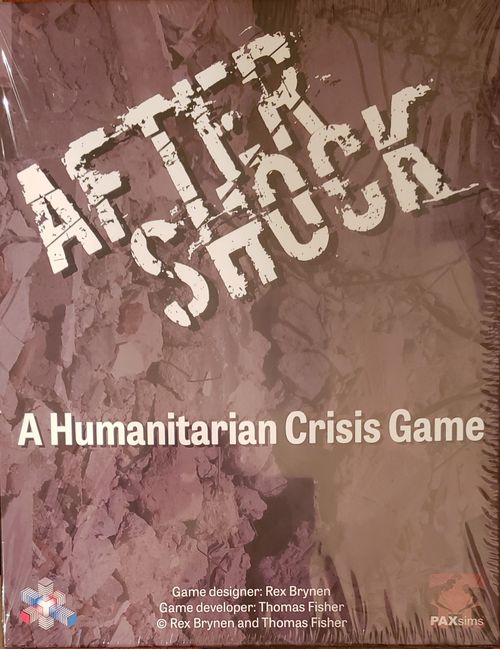
AFTERSHOCK: A Humanitarian Crisis Game
AFTERSHOCK: A Humanitarian Crisis Game Rulebook
Table of Contents
Table of Contents
1.0 About the Game
AFTERSHOCK: A Humanitarian Crisis Game explores the interagency cooperation needed to address a complex humanitarian crisis. Although designed for four players, it can be played with fewer (even solitaire) or more (with players grouped into four teams).
The game is set in the fictional country of Carana, but is loosely modeled on disasters such as the 2004 Indian Ocean tsunami and the 2010 Haiti earthquake:
Carana has suffered years of sometimes violent turmoil, and has only recently taken the first tentative steps to national reconciliation and reconstruction. Poverty is widespread, government capacity is weak, and political tensions remain high. Nongovernmental organizations and United Nations specialized agencies are active in the country, including a moderately-sized UN civilian police (CIVPOL) contingent.
At dawn today, a powerful earthquake struck Carana's capital city of Galasi, causing widespread destruction of homes and infrastructure. Tens of thousands of people are in need of urgent aid and medical attention. At the request of the Government of Carana, military forces from several friendly countries, operating as the multinational Humanitarian Assistance and Disaster Relief Task Force, or HADR-TF, are en route to assist, as are additional contingents of UN (United Nations) and NGO (non-governmental organization) personnel, together with much-needed relief supplies.
The game lasts for seven game turns. This represents approximately three months of humanitarian operations, including both the initial emergency stage and a later period of early recovery. More lives tend to hang in the balance during the emergency stage. Because Carana is a fragile, conflict-affected country, relief and reconstruction efforts may also involve issues of social unrest and political instability, especially once the initial shock of the crisis has worn off.
The primary objective of all players is to address the urgent humanitarian needs of the local population. This is measured during the game by relief points (RP), which are gained by addressing the needs of at-risk populations and lost by failing to meet those needs. There is one common RP score for all players.
Players also need to maintain public and political support for their organizations, whether to govern (Carana), sustain the relief mission (HADR-TF), or secure financial support (UN and NGOs). These are tracked separately for each player using operations points (OP). At times these can also be spent as a form of organizational capital to secure additional resources or personnel.
2.0 Game Components
The game consists of the following sets of components:
Player handouts. Handouts are supplied for Carana, HADR-TF, the United Nations, and the NGOs. These summarize the rules specific to each, as well as providing an overview of game components and the turn sequence.
Supplies. Players will move these to the various districts of Galasi to meet urgent humanitarian needs. All supplies not yet in play should be placed in an opaque container.
- 24 medical supplies (red cubes)
- 30 WASH (water and sanitation) supplies (blue cubes)
- 30 food supplies (green cubes)
- 30 shelter supplies (white cubes)
Infrastructure. These act as permanent, ongoing supplies in an area. In the case of logistics infrastructure, they instead help to increase transportation capacity. Optional stickers have been provided in the game box that can be applied to better identify the infrastructure tokens.
- 6 medical infrastructure (red disks)
- 6 WASH infrastructure (blue disks)
- 6 food infrastructure (green disks)
- 6 shelter infrastructure (white disks)
- 7 logistics infrastructure (black disks)
Assistance teams. These are used to deliver supplies, establish infrastructure, conduct rescue or security operations, assess local needs, interact with the media, and coordinate with other players through cluster meetings.
- 7 Carana assistance teams (purple figures)
- 7 United Nations assistance teams (blue figures)
- 7 NGO assistance teams (white figures)
- 7 HADR-TF assistance teams (green figures)
The number of supply, infrastructure, and assistance teams provided is an absolute limit; if players run out, no more are available. Two black pawns are also supplied with which to mark the current game turn and the total number of RP.
Blank cards. 6 blank event cards, 4 blank coordination cards, and 9 blank at-risk cards are provided as spares to allow customization of the game or to replace lost items. These should normally be set aside when playing.
Districts. There is one display for each of the five affected districts of Galasi. The district display is used to indicate whether assistance teams in that area are delivering supplies, establishing infrastructure, engaged in rescue or security operations, or assessing local needs. Supplies and infrastructure are placed on the display when they have been delivered. At-risk cards are also placed on the display, with the top card face-up to indicate current needs.
Event Cards. The 48 (large) event cards are used to determine the sequence of humanitarian and political developments in Carana during relief and recovery operations.
Coordination Cards. The 16 (medium) coordination cards are used to represent both the positive effects and frustrations of aid coordination through participation in Cluster meetings.
Transportation Nodes. Separate displays depict Galasi port, Galasi international airport, and Carana's frontier with neighboring countries. Warehouses for the players are located at each of these. In the case of the port and airport there is a capacity track where players indicate the total number of items that have arrived each turn, using the black logistics infrastructure markers. This track also indicates the maximum number of items that can arrive in each location per game turn. The port and airport are sometimes referred to as "local" warehouses, to distinguish them from the more distant frontier.
At-Risk Cards. The 36 (small) at-risk cards are used to indicate humanitarian needs in each district of Galasi.
Cluster Coordination. This display is used to indicate participation in coordination (cluster) meetings. There are five clusters: health/medical, water and sanitation (WASH), nutrition/food security, shelter, and logistics, each marked by a colored circle. When a team is placed in the appropriate box it is said to be participating in that cluster. In addition, there is a separate box for media outreach.
Monitoring and Evaluation. This display is used to track the current number of relief points (RP) and operations points (OP) the players have. RP represent the success of the humanitarian operation in saving lives, and are scored collectively. OP represent the degree of public and political support a player has within key constituencies, and are scored separately for each player.
Calendar. This is used to track the current game turn.
Other Components. The media card represents the current focus of the international media. An optional yellow clip stand is provided for the media card so that it can be stood upright. Social unrest cards are used to indicate where lawlessness or popular dissatisfaction with relief operations is growing. Needs assessment cards are used to indicate those districts where a needs assessment has been undertaken.
3.0 Setting Up the Game
Remove all blank cards from all decks. These are spares, and are not used.
Place the five district, three transportation node, cluster coordination, monitoring and evaluation and calendar displays on a suitable playing surface so they are clearly visible to all participants.
Shuffle the event cards and place the deck face-down.
Shuffle the coordination cards and place the deck face-down.
Separate the nine at-risk cards marked emergency and set these aside. Shuffle the remainder, and then place them face-down as follows on each of the district maps:
- District 1 (commercial and administrative district): 4
- District 2 (low income district): 7
- District 3 (slum district): 6
- District 4 (middle income district): 6
- District 5 (semi-rural district): 4
Having done this, shuffle the nine emergency cards and place one face-down on top of the pile of at-risk cards in District 5, and two face-down on top of the pile in each remaining district.
Turn the top at-risk card face up in each district. This indicates the current size of the at-risk population in that district, as well as their immediate need for medical care, water and sanitation (WASH), food, shelter, and rescue.
Place the media card in District 1.
Place one team (figure) for each player at zero on the monitoring and evaluation display to indicate that player's current number of operations points (OP). Place one black pawn on the same display on zero to indicate the current number of relief points (RP).
Place a black pawn on the calendar to mark the current game turn (Day 1).
Place one logistics infrastructure marker (black disk) at each of the port and airport. This is also used to mark the capacity track on these transportation nodes.
Place all of the supplies in an opaque container. Randomly select the following number of supplies for each of the following players, and place them in their warehouse at the port:
- UN: 3 supplies
- Carana: 4 supplies
- NGOs: 5 supplies
The HADR-TF player does not start with any stockpiled supplies.
Carana, the UN, and the NGO players each place their two initial assistance teams. These should be placed in the appropriate box of a district or cluster meeting. The HADR-TF player does not start with assistance teams on the ground.
The rulebook's example game set-up (printed page 4) is a diagram showing teams placed by players before the start of the game, in any eligible location, and the at-risk cards randomly drawn before the start of the game.
4.0 Playing the Game
Carana is the first player to act each game turn, followed by HADR-TF, the UN, and finally the NGOs. There are thus four player turns to each game turn.
In their turn, the current player completes each of the following six phases in sequence. For convenience these phases are summarized on the player hand-outs and are also indicated on the calendar.
- Coordination Phase. The current player shuffles the coordination cards (see section 4.1) face down, and draws one for each cluster in which they are currently participating. They then play one, and only one, of these by following the instructions on the card. Unless otherwise noted, return all cards to the deck.
- Event Phase. The current player draws the top face-down event card, and immediately applies the effects of the card. This event may require that the player resolve an at-risk card in one or more districts (section 4.2).
- Human Resources Phase. The current player may reallocate those assistance teams (section 4.3) currently in play to tasks in districts (section 4.5) or to attending cluster meetings (section 4.6) or media outreach.
- Relief Operations Phase. The current player undertakes emergency relief (section 4.7) by moving supplies (section 4.4) to districts (section 4.5). If attending a cluster meeting with another player (section 4.6), they may also transfer supplies of that type between their warehouses at the same location (port, airport, or frontier).
- Special Operations Phase. The current player may undertake security operations, logistics operations, needs assessments, or media outreach (section 4.8). Players may also deal with any outbreaks of cholera or measles at this time.
- Supply Phase. The current player receives new assistance teams and supplies (section 4.9). This functions somewhat differently for the Carana player than the others. Players may be able to exchange some of these supplies for infrastructure. OP may be spent to purchase additional supplies or teams.
When one player has undertaken all six phases, the next player does so. When all players have finished their turn, advance the counter on the calendar, reset the capacity tracks at the port and airport, and the next game turn begins.
4.1 Coordination Cards
During the Coordination Phase, the current player shuffles the coordination cards face down, and draws one for each cluster in which they are currently participating. They then play one, and only one, of these by following the instructions on the card.
Cards that are marked "retain this card" may instead be retained by the player and played at another time. Otherwise, all cards are placed back in the deck and reshuffled before the next player's turn.
When this or any other card refers to a "new" supply or infrastructure, this should be drawn from those that are not yet in play, rather than those at the port, airport, frontier, or in a district.
The Preparedness card, when played, allows a player to draw an event card during the event phase as usual but to postpone the effect of that card until the very end of their turn.
If a player is not participating in any clusters they do not draw a coordination card. Media outreach is not a cluster, and having a team assigned there does not count as participating in a cluster.
4.2 Event and At-Risk Cards
Event cards fall into two broad types: those that cause an at-risk card to be resolved in one or more districts (shown in the rulebook's illustration, left), and those that have other effects (shown on the right). In the case of the first card above, the player would resolve the at-risk card in District 1 as outlined below. In the case of the latter, the player would follow the self-explanatory instructions on the card. When a card calls for an effect to be implemented in a district with the "most at-risk" population, consult the face-up at-risk cards and see which has the highest number of people listed on it.
If an event card calls for an at-risk card to be resolved, this takes place immediately. Look at the face-up (emergency or early recovery) card in the appropriate district to determine what supplies are necessary for the needs of the population to be met.
In the case of the sample card (AR-2) pictured in the rulebook, for the population to have their needs met there must be at least 2 medical supplies (red cubes), 1 WASH supply (blue cube), 1 food supply (green cube) in the district, plus one team assigned to rescue there.
The event card itself may state additional effects that occur if needs are not met. In all cases, remove the supplies that are listed on the card on the at-risk card to the extent possible, then flip up the next at-risk card. If no more at-risk cards are available for this district then there are no further needs there.
Example (see the rulebook's example diagram): The event card (E-9) causes the at-risk card (AR-2) to be resolved in District 1. The district currently contains 1 medical, 1 WASH, and 3 food supplies. The at-risk card, however, states that 2 medical, 1 WASH, and 1 food supplies are required, plus one team must be assigned to rescue. The players are thus short 1 medical and 1 rescue, and lose 3 RP. In addition, the media are present in the district, so each player with a team in District 1 also loses 1 OP. The supplies used to meet local needs are then removed, leaving only 2 food supplies still in place.
- If the needs of this population are met, add the indicated number of RP to the RP track. If the media card is in the district, each player present there also gains 1 OP.
- If the district is just one supply or team short of what is required, there is no change to RP or OP.
- If the district is two or more short of what is required, subtract the indicated number of RP from the RP track. If the media card is in the district, each player present there also loses 1 OP.
While most of the needs of the population will usually be met by supplies that have been previously transported to that district, needs may also be met by local infrastructure (section 4.4), which act as a permanent form of supply. During the emergency stage some cards may require rescue, meaning that one or more teams must already be assigned to the rescue box in the district. Unlike supplies, infrastructure and teams assigned to rescue are not removed when the card is resolved.
Some special at-risk cards (Malnutrition, Squatters, Violence) have immediate effects. If these are drawn, follow the instructions on the card, remove it, and then flip another at-risk card.
Other special at-risk cards (Cholera, Fire, Measles) may have ongoing effects. If these are drawn, follow the instructions on the card. If certain conditions exist, the card is ignored and removed. Otherwise it is placed face-up in the district to indicate ongoing effects, and a new at-risk card is drawn.
Example: Having just resolved an at-risk card in District 1, the player draws a new at-risk card. This proves to be a possible Cholera outbreak (AR-32). If there were sufficient WASH supplies or infrastructure the card would be ignored and removed. However, District 1 lacks these and the disease takes hold. Place the card face-up beside the current at-risk deck, and turn the next at-risk card face-up. All at-risk cards in this district will now require 2 additional medical supplies to reflect the effects of the epidemic.
It is possible for several of these special at-risk cards to be active in a district at once. Once active, Cholera and Measles may be removed only by a special operation (section 4.8).
If the event card says media move to next district in the bottom right corner, this is carried out once the event card (and any associated at-risk cards) has been resolved for the player's turn. Move the media card into the next highest numbered district. If it is in District 5, move it back to District 1. The No Longer News event card may cause the media to be removed for the rest of the game.
Once an event card has been resolved, it is placed in the discard pile. The exception to this is the Lucky Break card, which may be held until it is used to cancel a future event.
4.3 Human Resources
Throughout the game, all assistance teams must be assigned to either one of the functional boxes (relief/rescue/infrastructure/security/assessment) in a district (section 4.5), or to one of the five cluster meetings (section 4.6), or to media outreach (section 4.8). In general, a box may hold any number of teams. However, no player may conduct media outreach operations if that box contains more than two teams.
During the Human Resources Phase, players may move each of their teams from any box in any district to any other box in any district, or to and from the boxes on the Cluster Coordination display.
Additional teams may be received during the Supply Phase (section 4.9).
The HADR-TF player may, if they wish, remove one team from Galasi during the Human Resource Phase, thereby gaining 1 OP. This is in addition to the teams they are required to withdraw in Weeks 5-7 and Weeks 8-12. Note that the HADR-TF will lose OP if they still have more than one team in Galasi at the end of the game (section 5.0).
The team markers on the Monitoring and Evaluation display are only used for scoring purposes, and may not be reassigned.
4.4 Supplies and Infrastructure
Medical, WASH, food, and shelter supplies are represented by red, blue, green, and white cubes respectively. These are generally received during the Supply Phase (section 4.9), and moved during the Relief Operations and Special Operations Phases (section 4.7 and 4.8). They are removed when an at-risk card is resolved (section 4.2). They may also be removed or placed by event cards.
Medical, WASH, food, and shelter infrastructure (red, blue, green, and white disks) can be placed in districts to act as a permanent form of supply, representing such things as permanent clinics, new piped water supplies, reopened local markets, and sturdier shelters. Each infrastructure marker of this sort in a district counts as one supply of the appropriate type, but, unlike supplies, is not removed when an at-risk card is resolved.
To place medical, WASH, food, or shelter infrastructure in a district, the player must have a team assigned to infrastructure in that district. The infrastructure is then moved from a local warehouse to the district by an infrastructure operation during the Special Operations Phase (section 4.8). Infrastructure may not be placed in a district where the current at-risk card indicates the area is still in the EMERGENCY stage of the crisis.
Logistics infrastructure (black disk) may be placed at the port or airport to reduce transportation bottlenecks (section 4.9). This represents repairs to damaged runways or buildings, additional air traffic control teams and equipment, warehouse construction or repairs, and the provision of equipment for off-loading ships or aircraft. To place logistics infrastructure at the airport or port, it must be in a local warehouse, and a team must be attached to the logistics cluster. It is then moved to the port or airport from the player's warehouse at the same location by a logistics operation during the Special Operations Phase. Note that Carana may only upgrade the port infrastructure (where it has a warehouse) and not the airport (where it does not have a warehouse).
On a practical note, players may find it useful to place supplies beside the current At-Risk card when the indicated needs are not yet met, and on top of the card when they are. This makes it easy to quickly see which districts still need additional supplies, and which do not.
It is possible to place more supplies in a district than will be required by the current at-risk card. This sort of pre-positioning can be helpful in preparing for future needs, but it comes with some risk too, since once supplies are placed in a district they cannot later be transferred elsewhere (except by the action of event cards).
4.5 Districts
There are five districts to Galasi, each with slightly different characteristics. Each district display sheet contains the following information and boxes:
- Relief. Teams are placed here if they are allocated to the emergency provision of health, WASH, food, or shelter supplies in the district.
- Rescue. A team assigned here fulfills the "rescue" requirements of some at-risk cards.
- Infrastructure. A team is placed here if it wishes to establish infrastructure in the district (sections 4.4, 4.8).
- Security. Teams are placed here if they wish to engage in security operations. There is a limit to which teams may be assigned to this task (section 4.8).
- Assessment. A team is placed here if it wishes to undertake a needs assessment in the district (section 4.8).
Any supplies that have been transported to a district will be placed in the main section of the district display sheet, as will any infrastructure established in that district. Supplies and infrastructure may not be moved between districts, except by the effects of an event card.
If there is widespread discontent with relief operations, one or more social unrest cards may be placed in a district. These have no immediate game effects, but may trigger certain event or at-risk cards.
If a needs assessment has been conducted in a district (section 4.8), a needs assessment card will indicate this.
4.6 Cluster Meetings
Assistance teams are assigned to cluster meetings by placing them in the appropriate colored circle of the cluster coordination display. By doing so, players gain positive effects through the draw of coordination cards.
In addition, the current player may, during the Relief Operations Phase (section 4.7), exchange the appropriate type of supplies with other players attending the same cluster meeting by simply moving those supplies from one section of a warehouse to another in the same location (port, airport, or frontier). Doing so requires the permission of the player holding the supplies; you can't take them without authorization! Infrastructure may not be transferred in this way.
While the media outreach box is located on the cluster coordination display, a team there does not count as being involved in a cluster meeting.
4.7 Relief Operations Phase
During the Relief Operations Phase, players may move supplies from their local warehouses at the port or airport to the various districts. To move supplies, the current player must normally have an assistance team in the relief box of the receiving district. Carana, however, may always move one supply to each district during the Relief Operations Phase even if it does not have a team assigned to relief there, reflecting the initiative of a local network of public employees and volunteers.
Once placed in a district, items may not subsequently be moved from that district to another location.
The current player may also move items between their warehouse and the warehouse of another player in the same location during the relief operations phase, provided they have permission and both players are attending a cluster meeting of the appropriate type (section 4.6).
Example: The UN and NGOs both have teams in the health cluster meeting. During their Relief Operations Phase the UN transfers two medical supplies at the airport from the NGO warehouse to their own warehouse in the same location. They then send these, together with the WASH supplies they already had in their warehouse, to District 3 (where they have a team assigned to emergency relief).
Note that Carana may only transfer supplies in this way at the port, as this is the only location where it has a warehouse.
4.8 Special Operations Phase
During the Special Operations Phase, players may undertake infrastructure operations, logistics operations, needs assessment, media outreach, and security operations. It is also during this phase that the Cholera Response and Vaccination coordination cards may be played.
Infrastructure Operation. For each team the current player has assigned to infrastructure in a district, it may transfer one infrastructure from its warehouse at the port or airport into that district. Infrastructure operations in districts may only be conducted if the current at-risk card shows it to be in Early Recovery.
Logistics Operations. For each team the current player has assigned to the logistics cluster, a player may conduct a logistics operation. This consists of one of two possible actions:
-
Place one additional logistics infrastructure at the port or airport, provided the infrastructure is already present in the player's warehouse there. Stack the disk upon the existing infrastructure marker on the capacity track to indicate this.
Example: HADR-TF has a logistics infrastructure in its airport warehouse, and a team assigned to the logistics cluster. It may therefore execute a logistics operation to place this additional logistics infrastructure at the airport proper by placing it on top of the existing infrastructure marker on the capacity track, thereby increasing the number of items that may be flown into the airport each game turn.
-
OR: The current player may move any number of supplies between their various warehouses, including at the frontier. Since these supplies are moving by road and not air or sea, this movement does not count towards capacity limits at the airport or port. Supplies may not be transferred between players through a logistics operation.
Media Outreach. If the current player has any teams assigned to the media outreach box, and there are no more than two teams in the box in total, that player may conduct a single media outreach operation. This either adds 1 OP to the player's current total, or subtracts 1 OP from another player. The latter represents the rare (but not unknown) instance when one organization publicly criticizes another for inadequate aid efforts.
Note that no one may conduct media outreach if the media box contains three or more teams, and that no player may conduct more than a single media outreach operation per turn regardless of how many teams they have assigned there.
Needs Assessment. If the current player is Carana, UN, or NGO and has both an assistance team assigned to needs assessment in a district and at least one team in a cluster meeting, they may conduct a needs assessment operation. Place a needs assessment card in the district to indicate this. All players may henceforth examine the face-down at-risk cards in a district with a needs assessment card at any time. Once the needs assessment card is placed the team need not remain assigned to that task, and may be reassigned elsewhere during a subsequent human resources phase. The HADR-TF may not conduct needs assessment.
Example: The NGO player has a team assigned to needs assessment in District 3, and at least one team assigned to a cluster. They may therefore place a needs assessment card in District 2, enabling all players to examine the face-down at-risk cards there for the remainder of the game.
Security Operations. If the current player has one or more assistance teams assigned to security in a district, they may launch a security operation in an attempt to improve local law and order. If HADR-TF or the UN initiates a security operation they must pay 1 OP, after all, pushing back crowds of desperate or angry survivors is hardly good publicity. There is no cost if Carana conducts the operation, however.
When a security operation is undertaken, remove one social unrest marker for each team the player has assigned to security in that district. NGO teams may not be assigned to security operations. The UN player may assign only one team to security at any one time. There is no limit to the number of Carana and HADR-TF teams that may be assigned to security operations. Security operations are assumed to include not only policing, but also efforts at political mediation and social reconciliation too.
Cholera Response and Vaccination. A player with these cards may play them during the Special Operations Phase to remove a face-up cholera or measles in a district. Do not remove any supplies.
4.9 Supply Phase
The Supply Phase works differently for the Carana player, compared to the HADR-TF, UN, and NGO players. Note that the number of supplies, infrastructure, and teams is limited at all times by the number of available markers of that type.
Carana. The host country is assumed to be in a state of disarray because of the devastation caused by the earthquake. The government is also assumed to use local resources in relief operations, rather than importing these from outside the country.
During the Supply Phase, the Carana player randomly draws the number of supplies indicated for that turn on the Carana briefing sheet from the supply container. If three supplies of the same color are drawn these may be exchanged for one infrastructure of the same type. If three supplies of different colors are drawn they may be exchanged for one logistics infrastructure. The Carana player then places these items in the port warehouse. Since these items are locally acquired and do not arrive by sea, they are NOT counted towards the maximum number of items that may be imported to the port each turn.
The Carana player also receives any new team indicated for that turn on their briefing sheet. This is placed into a district or cluster.
Example: The Carana player receives three supplies this turn, taken blindly from an opaque container. A medical, WASH, and nutrition supply are drawn. Since these three are of a different type, they could be replaced with a logistics infrastructure. In any case, they are placed at Carana's port warehouse. Unlike other players, this does not count towards the port's current maximum capacity.
Other players. The HADR-TF, UN, or NGO player receives the number of supplies indicated on the briefing sheet. They may choose which type of supplies these are. Players may immediately exchange some of their new supplies for infrastructure, as also indicated on their briefing sheet:
- HADR-TF: Any two new supplies may be exchanged for one logistics infrastructure.
- UN: Any three new supplies may be exchanged for a health, WASH, food, shelter, or logistics infrastructure.
- NGOs: Any three new supplies may be exchanged for a health, WASH, food, or shelter infrastructure.
These supplies must be delivered to Carana, either by air to Galasi airport, by sea to Galasi port, or to the frontier. However, there is a cumulative limit to the total amount of items (supplies and/or infrastructure) that the HADR-TF, UN, and NGO players may deliver to the port and airport each game turn, depending on the number of logistics infrastructure (black disks) currently in place. This limit is indicated on the display.
This cumulative total of items arriving during a game turn is tracked using the logistics infrastructure marker on the capacity track. The port and airport start the game with only one logistics marker each. Placing additional logistics infrastructure will increase transportation capacity.
Any supplies that cannot be delivered to the port or airport because of transportation bottlenecks are placed in the warehouse at the frontier instead. It will require a subsequent logistics operation to move them to the port or airport.
Example: Both the port and airport have not yet been upgraded, and only have their original one logistics marker each. HADR-TF brings in 5 supplies in their turn. The first arrives by sea at the heavily-damaged port, and so the logistics marker is advanced along the track one space to indicate this, reaching its current limit (1). HADR-TF flies the next 4 supplies into the airport, and marks off four spaces. The UN player, during their turn, has 3 supplies to transport. Because of the earlier HADR-TF flights, however, only 1 of these can arrive at the airport before it reaches its current capacity of 5. The other 2 supplies must therefore arrive at the frontier. Finally, in their turn, the NGO player has 4 supplies to transport to the disaster zone. With the port and airport now at full capacity, all of these must be placed at the frontier. It will take a logistics operation next turn to move supplies from the frontier overland to the port or airport, a much slower process.
During the Supply Phase the HADR-TF, UN, or NGO player also receives (or removes) any new team as indicated for that turn on their briefing sheet.
Mobilizing Additional Resources. During the Supply Phase, any player may spend OP to mobilize additional supplies or personnel. Two additional supplies may be purchased at the cost of 1 OP, or one additional team may be purchased at the cost of 2 OP. A player may only make one purchase per game turn, and such purchases may not take a player below zero OP. In this case, Carana may choose which type of supply it receives. Supplies and teams received in this way are treated as others received during the Supply Phase, and may be exchanged for infrastructure under the normal rules for doing so.
Example: Carana has 3 OP in the Supply Phase. They may spend one OP to purchase two additional supplies, or spend two OP to gain one additional team. They may not do both.
5.0 Winning the Game
If at any time the RP track reaches -30, all players immediately lose. If it reaches +30, all players immediately win. In either case, the game ends.
Otherwise, at the end of the final game turn (Weeks 8-12), make end-of-game adjustments to the monitoring and evaluation display in the following order:
- For each district where the requirements of the current (emergency or early recovery) at-risk card are met, or all of the (emergency or early recovery) at-risk cards have been resolved, add one RP.
- For each district where the requirements of the current (emergency or early recovery) at-risk card are not met, subtract one RP.
- For each Cholera, Measles, or Fire card active in a district, subtract one RP.
- If the current RP total is positive, add one OP to all players for every 5 RP scored.
- NGO: For each player with a higher OP than the NGO player, the latter loses one OP. For each player with a lower OP than the NGO player, the latter gains one OP.
- Carana: Subtract 1 OP for each social unrest marker in play. For each district with one or more infrastructure and where the needs of the current at-risk card are met (or there are no more emergency/early recovery cards remaining), gain 1 OP.
- HADR-TF: If more than one HADR-TF team is still deployed to the disaster, lose 1 OP for each team still in play beyond the first.
- UN: For each district with no infrastructure or where the needs of the current at-risk card are not met, lose 1 OP. For each district with one or more infrastructure and where the needs of the current at-risk card are met (or there are no more emergency/early recovery cards remaining), gain 1 OP.
Finally, determine the losers:
- If the RP track is below zero, all players lose. There have been too many preventable deaths; your humanitarian efforts have been a failure.
- If a player's OP track is below zero, that particular player loses. The negative publicity your organization has received has damaged its ability to deal with future challenges.
...and any winners:
- If the RP track is at zero, the single player with the highest positive number of OP wins. Humanitarian efforts were generally unimpressive, but one organization is seen as having done well.
- If the RP track is at zero or higher but the Carana OP track is below zero, the single player with the highest positive number of OP wins. While humanitarian efforts may have been successful, the local government has been seriously weakened. This will limit its ability to respond to future emergencies, and increases the risk of political instability.
- If the RP track is above zero and the Carana OP track is at zero or above, all players who have positive OP win. Good job!
It is possible for all players to win or lose.
6.0 Game Variants
6.1 Timed Game
The timed version of the game is strongly recommended: it adds considerably to the sense of urgency during play, and also helps to assure a game is completed within two hours.
Players immediately receive the following bonuses for completing the first three game turns (Days 1-7) of the game as follows:
- Within 40 minutes: +3 RP
- Within 50 minutes: +2 RP
- Within 60 minutes: +1 RP
The game ends after 2 hours of play, and players immediately gain 1 RP and 1 OP if all 12 weeks have been completed by this time.
6.2 Team Game
The Humanitarian Crisis game works best with two-player teams playing the role of each actor. This expands the number of participants who can be engaged in a single session from four to eight, and contributes to a richer discussion of strategy and coordination.
Larger teams can also be used, although this may slow game play.
6.3 Three-Player Version
Carana, UN, and the NGOs are used. In this case:
- Each player starts with one OP and one additional supply. Carana also starts with one additional team.
- The port starts with two logistics infrastructure.
- Each player receives one additional supply in each Supply Phase.
- The two "Trying Times" cards are removed from the event deck.
The rulebook's 6.3 RP track diagram marks "Instant Victory!" at the top (+30) and "Instant Loss!" at the bottom (-30).
6.4 Two-Player Version
One player plays both Carana and the UN, while the other plays both HADR-TF and the NGOs. All of the regular rules are used. A player can only win if BOTH of their actors have positive OP at the end of the game.
6.5 Solitaire Version
One player plays all four roles. The player wins if the game ends with an RP of 2 or higher, and all actors with a positive OP.
7.0 Design Notes
No game can capture all aspects of a complex process, and humanitarian assistance is no exception. A key design choice from the outset, therefore, was what elements needed to be most emphasized, and how those might best be represented.
First, the game needed to highlight humanitarian assistance as a cooperative endeavor, but one in which different actors have slightly different perspectives and priorities. This was done by measuring assistance efforts both collectively (relief points/RP) and individually (operations points/OP). Addressing humanitarian needs is a central priority for everyone, and if RPs are negative at the end of the game everyone loses. However, humanitarian actors also need public, political, financial, and organizational support to function, and failure to maintain this can result in losing for that reason too.
The game also needed to highlight that different humanitarian actors have different strengths and weaknesses. This is difficult to do, because each of the four actors identified in AFTERSHOCK are, in the real world, themselves comprised of many different elements with different skills and capabilities. However, for game purposes the rules give the local government primary responsibility for security, and some comparative advantage in local distribution; depict foreign militaries as having strong logistics and security capabilities but with limited staying power and little capacity to promote sustainable development; and depict UN agencies and NGOs as having comparative strength in relief and development.
The various actors also have slightly different organizational interests. Carana would like to see both short-term humanitarian needs and longer-term reconstruction addressed. However, it cannot afford to see the disaster increase social unrest and political instability. The UN agencies are largely focused on relief and development goals. NGOs must raise funds from donors to survive, and thus need be seen to be doing comparatively well. Finally, the HADR Task Force is concerned with its exit strategy; while of great help in the early part of the disaster, it has no interest in a prolonged commitment of military resources.
The combination of differing goals and capabilities, in turn, sets the stage for the coordination challenges in the game. This has been treated in two complimentary ways. First, players need to play cooperatively and coordinate their actions to win, both in terms of allocating their human resources and in deciding what kinds of assistance to deliver: where, when, and how. However, coordination is also an activity into which they can invest game resources directly, by assigning teams to the various coordination clusters. Doing so delivers benefits, but these are not wholly predictable, and the process can even be a bit frustrating. Indeed, the game forces players to even cooperate in coordinating, since some activities may require that multiple parties prioritize the same sectors at the same time. Yet coordination involves opportunity costs too, since resources invested in coordination are not available for other tasks.
The sudden and unpredictable operation of the event and at-risk cards is rather different, of course, than the constant loss of human life in a humanitarian crisis. The mechanism was adopted because it generates some of the sense of chaos and limited information of a major disaster. It also reflects the extent to which humanitarian actors are struggling to deal with an array of challenges beyond their immediate control.
AFTERSHOCK, like real humanitarian operations, rewards risk assessment and contingency planning. It also requires players to make difficult decisions about priorities and triage: given limited resources, do they focus on those who are most easily saved, or those most in need? The first few turns of the game are likely to be overwhelming, with the players lacking sufficient resources to meet needs.
The importance of event cards also means that every game is likely to be quite different, and some will be more difficult than others. In this sense, the game isn't "fair" and in some cases players may be faced with an almost impossible sequence of events. However, real humanitarian crises aren't "fair" either. All that any organization can do is to try to do its best.
There is a considerable amount of politics represented in the game. Actors need to maintain public and political support, generated both by their performance in the field and through media outreach. Carana itself is politically fragile, and a failure to address basic needs can be dangerous, especially in the latter part of the game after the initial shock of the disaster has worn off. It was important not to overemphasize the element of social unrest and insecurity, however, since it is often rather less than pundits anticipate (in Haiti in 2010, for example). Still, some risk is there. If this is mishandled the government of Carana, and, by extension, the other players too, could find themselves in serious trouble.
The media is a significant presence in humanitarian emergencies, important to the various actors yet beyond their control. In AFTERSHOCK it moves across the city, highlighting some areas while ignoring others, and either boosting or damaging the standing of players. Later it may leave altogether as the broader public loses interest, or as other news stories command greater attention. Players can try to shape public perception of their actions through media outreach. However, there is a limit to how many can do this at any one time: too many competing statements and press conferences simply adds to the confusion.
Players will notice that the game does not include a detailed map. Instead, the design is intended to prioritize processes and thematic sectors over geographic space. Geography is far from absent, however. As players will soon find out, transportation and logistics play an absolutely key role in providing relief in Carana.
The design also uses a fictional case and country. This allows a broader range of issues to be explored than in any one single real-world case, and reduces some of the pressure to depict historical events with a high degree of fidelity. It also allows players to get past their knowledge of (and horror at) a specific case like the Haiti earthquake to focus on the broader processes at work in humanitarian crisis response.
7.1 Game Strategy
While players might initially focus on getting vital supplies to hungry, thirsty, and injured survivors, it will soon become apparent that logistics are key. If resources cannot be brought into affected areas they are almost useless. Carana and the HADR-TF have a comparative advantage in opening up transportation routes, and should do so early.
Coordination through the cluster system is important, especially since it allows players to transfer resources amongst themselves. Without this sort of cooperation there will be duplication of effort on the ground. It is also impossible to deal with challenges like cholera without coordination. Needs assessment can be very useful to let the players know what is coming up.
Earning operations points matters, but so too does using them. While they may be necessary to "win" the game, players should also remember that they can be "spent" to acquire additional resources.
Carana is often both the weakest, most over-stretched actor and the most important one: it has a network for local delivery of supplies, it is primarily responsible for security, and if it does poorly all players suffer.
Social unrest is usually not a major problem unless players perform poorly in the later weeks of the crisis. However, if problems do arise they should not be left to fester.
Finally, be mindful that local needs will shift between the emergency and early recovery stages. Medical care and WASH tend to be the priority in the first few days, while food and shelter become more important as time moves on. Other than logistics, other infrastructure activities are reserved for the early recovery stage when needs are less acute.
8.0 AFTERSHOCK in the Classroom
AFTERSHOCK has been playtested with university students, those undergoing humanitarian training and certification, police and military personnel, and early- and mid-career development professionals.
The game works best for instructional purposes when played using a facilitator to assist. When played this way, there is no need for players to read or know the rules in advance. Instead, a quick 15-minute orientation is almost always enough, with most game procedures explained by the facilitator as the game progresses. By the end of the first turn the major elements of play are usually well understood, and more advanced procedures (such as the various special operations) can be introduced during subsequent turns. It is helpful to list the sequence of game turn phases with a whiteboard, data projector, or similar display so that the players and facilitator can refer to them easily.
Since it is possible (although very rare) for early event cards to make the game impossible to win, an instructor may wish to prescreen some of the initial cards in the deck. Shuffle the event cards and draw the first eight or so. Remove any especially challenging cards and place these lower into the deck before replacing the others back on top.
We have found the best results when the game is played in teams of two, for a total of eight players.
In our view, the timed game gives the best game experience by recreating some of the urgency of real-world humanitarian relief operations. The timed game reduces any delays due to "analysis paralysis"; that is, when a player might otherwise ponder for too long over what action to take. It also guarantees that all game play is completed within two hours. Facilitators should constantly remind players of the (simulated) lives at stake, and need the need to act both quickly and effectively.
Throughout the game, the facilitator should relate in-game actions and effects to real world experience. Issues of prioritization, coordination, and logistics are especially central to AFTERSHOCK, and are easily highlighted as the game progresses. The various event cards expose players to many of the challenges of humanitarian assistance and disaster response, and provide many "teachable moments". The Comments section (9.0) below summarizes a number of these.
If played as a stand-alone activity, some additional time should be devoted to debriefing the players by highlighting key lessons. Students can be encouraged to offer an after-action assessment of their individual and collective performance, and how this might have been improved. The game is most likely to be lost when players are too slow in their response, fail to prioritize the districts with greatest need, do not coordinate their actions well, ignore their comparative advantages, devote inadequate attention to opening up key logistics routes, and disregard the central role of the host country. When debriefing, note how AFTERSHOCK may differ from real-life operations too. After all, the game cannot depict everything, and some processes have necessarily been simplified or abstracted for gameplay purposes.
If AFTERSHOCK is embedded in a larger course and curriculum, it can be played at various points. Early in a course students may not yet have knowledge to employ in-game, but will soon identify key issues that can be later discussed in class. The game also works well to build camaraderie in new groups. At the mid-point or end of a course, students should be expected to apply lessons they have received from lectures and readings to addressing the urgent needs of earthquake-afflicted Carana.
9.0 Comments
The rulebook's "Comments and Credits" section. Its photo credits, acknowledgments, and designer and copyright lines are omitted. The card commentary is reproduced in the order printed; the printed table pairs each comment with its card numbers in a separate column, which the transcription does not reproduce.
- In the immediate aftermath of an earthquake the most urgent need is for water and medical attention to injured survivors. Some will also need rescue, although, for the international community, a focus on humanitarian relief is likely to pay bigger dividends. In Haiti in 2010, scores of foreign Search and Rescue (SAR) teams pulled fewer than two hundred persons from the rubble, while local Haitians rescued thousands.
- Unless addressed promptly, dissatisfaction and desperation can spiral into violence. Poor organization of relief efforts (for example, at distribution points) can increase the risk substantially.
- As the days pass, hopes of rescue dim and the need for food and secure shelter grows. Inadequate attention to WASH can increase the risk of cholera and other diseases. As the country enters the early recovery period, some infrastructure repairs can begin. Global standards for humanitarian response are provided by the SPHERE Project: http://www.sphereproject.org
- The risks of malnutrition are especially high in developing countries where food security was already problematic, or where some degree of malnutrition already existed among the poor. For more on food security issues see http://www.wfp.org
- Temporary makeshift shelters, coupled with the use of fires and portable stoves for heating and cooking, can pose a very significant fire risk, especially among displaced persons.
- Cholera and other water-borne diseases can be extremely dangerous in the aftermath of a disaster, given crowding, poor sanitation facilities, and low water quality. For more information see http://www.who.int/topics/cholera/en/
- Crowding and ill health leaves populations (and especially children) vulnerable to infectious diseases. Measles spreads particularly quickly in such conditions, especially in areas with uneven vaccination coverage before the crisis. For more information see http://www.who.int/topics/measles/en/
- Displaced and dispossessed populations will find their own shelter solutions, often by squatting on private or unused land. This can generate political and social tensions.