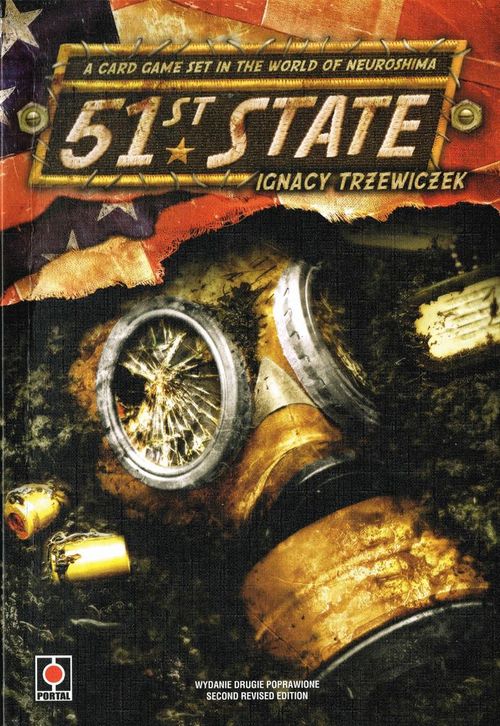
51st State
51st State Rulebook
Table of Contents
Table of Contents
- Components
- Object of the Game
- General Description of Play
- Game Setup
- The Turn Sequence (Five Phases Each Turn)
- Game End
- Cards
- Actions
- Range
- Action: Conquest
- Action: Establish Cooperation
- Action: Incorporation
- Action: Redevelopment
- Action: Play a New Leader or Change the Current Leader
- Action: Discard 2 Cards and Draw One Card from the Draw Deck
- Action: Send a Worker to Work at a Location
- Action: Send Workers to Work at a Location a Second Time
- Action: Send a Worker to an Opponent's Location
- Action: Send Two Workers for Resources
- Card Icons
- The Four Factions
Components
- 4 Base cards
- 16 faction markers (4 per faction)
- 72 Location cards
- 26 Contact cards
- 8 Leader cards
- 16 Worker tokens
- 39 Resource tokens (Scrap, Fuel, Weapons, Building Material and Universal)
- 47 Victory Point tokens
- 11 Contact tokens (Conquest, Cooperation, Incorporation and Universal)
- 2 Redevelopment tokens
- 1 first player token
Also included: the Victory Point Track.
Object of the Game
Each player commands one of the four available factions and enters the fight for influence in order to dominate the competition. The goal of the game is to reach the height of power by accumulating the most Victory Points. The winner will proudly unfurl his banner as the leader of the new country.
General Description of Play
Each turn players obtain new cards including newly discovered locations and leaders willing to take command.
Locations cards can be put into play in three different ways. A player may choose to Conquer a location in order to obtain Spoils - a one-time benefit represented by the red part of a card. One might also choose Cooperation, which yields a regular (yet smaller) benefit every turn - it is represented by the blue part of a card. The third way is Incorporation, which allows a player to make permanent use of a Location's inherent resources and special abilities - these are represented by the grey part of a card (in the middle). A player can also obtain such permanent resources and abilities by Building a Location on the ruins of a another Location of a similar type.
Players develop their factions' power by executing plans of their leaders, expanding their territories, and performing actions, which are all reflected in Victory Points. If any player ever reaches or exceeds 30 Victory Points, then the game ends at the end of the turn. At that point it will be known which faction has outrun the others in the race for domination over the ravaged States.
Game Setup
Choose Factions
Each player randomly chooses a Faction and takes its corresponding Base card and three Contact cards.
Sample starting faction cards: one Base card and 3 Permanent Contact cards.
Set aside all the unused Base cards and their corresponding Contact cards and return them to the box - they will not be used in this game.
Next, each player takes 4 faction markers corresponding to his faction, puts one of them on the "0" space on the Victory Point Track, and places the remaining ones near his Base card (they will be used later in the game).
Prepare Decks
Shuffle all the remaining cards together (Locations, Leaders, and Contacts), deal four cards to each player and place the remaining cards in a facedown stack in the centre of the play area.
The youngest player goes first (beginning with phase 1: Lookout) and other players follow in clockwise order. At the end of each turn, the first player token is passed to the player on the left.
Note: If players run out of tokens at any point during the game, they should use substitutes instead.
Component Layout During Play
Common play area:
- The Discard pile (common to all players).
- The Lookout area (5 cards revealed during phase 1).
- The Draw deck (cards placed face down).
- Token pool (all the unplayed or spent tokens).
Play area of a single player. Each player builds his faction structure here:
- 3 permanent Contact cards.
- The Leader Card.
- The Base card, together with resources obtained during a turn.
- Faction markers.
- The Player's hand: all the unplayed cards in that player's possession.
- Location cards bearing the Production pattern.
- Location cards bearing the Trait pattern.
- Location cards bearing the Action pattern.
(The card patterns are explained in detail in the "Cards" section of the rulebook.)
The Turn Sequence (Five Phases Each Turn)
Play proceeds over a series of turns. Each turn is divided into five phases which take place in the following order:
- Lookout
- Production
- Actions
- VP count
- Clean-up
Phase 1: Lookout
During this phase, players draw new cards into their hands (usually a total of two faceup cards and one facedown card per player).
At the beginning of this phase, reveal 5 cards from the draw deck and place them face up in the centre of the play area.
Example: 5 face up cards revealed during the Lookout phase.
Players are now ready to select cards - this step is carried out according to the number of players:
2-player game:
Beginning with the first player and proceeding clockwise, each player takes one of the face up cards into his hand:
- Player A selects 1 out of 5 cards;
- Player B selects 1 out of 4 cards;
- Player A selects 1 out of 3 cards;
- Player B selects 1 out of 2 cards;
The last (unselected) card is placed on the discard pile.
At the end of the Lookout Phase, each player draws one card from the draw deck.
3-player game:
Beginning with the first player and proceeding clockwise, each player takes one of the face up cards into his hand:
- Player A selects 1 out of 5 cards;
- Player B selects 1 out of 4 cards (add one card from the draw deck);
- Player C selects 1 out of 4 cards
Afterwards:
- Player A selects 1 out of 3 cards (add one card from the draw deck);
- Player B selects 1 out of 3 cards
- Player C selects 1 out of 2 cards;
The last (unselected) card is placed on the discard pile.
At the end of the Lookout Phase, each player draws one card from the draw deck.
4-player game:
Beginning with the first player and proceeding clockwise, each player takes one of the face up cards into his hand:
- Player A selects 1 out of 5 cards;
- Player B selects 1 out of 4 cards (add one card from the draw deck);
- Player C selects 1 out of 4 cards (add one card from the draw deck);
- Player D selects 1 out of 4 cards
Afterwards:
- Player A selects 1 out of 3 cards (add one card from the draw deck);
- Player B selects 1 out of 3 cards (add one card from the draw deck);
- Player C selects 1 out of 3 cards;
- Player D selects 1 out of 2 cards;
The last (unselected) card is placed on the discard pile.
At the end of the Lookout Phase, each player draws one card from the draw deck.
Note: Players should keep the cards in their hands secret.
Note: If the draw deck runs out before the end of the game, then the discard pile should be shuffled and formed into a new draw deck.
Note: if players run out of the revealed cards for any reason, they should draw further cards from the draw deck instead.
10 cards in hand:
A player cannot have more than 10 cards in his hand at any time during the Lookout Phase. This limit does not apply to any of the remaining phases. If a player ever reaches the 10-card limit and is instructed to draw further cards, then the cards should be drawn normally, and immediately discarded (instead of being added to the player's hand).
Phase 2: Production
There are 4 ways a player can acquire resources for the current turn:
- Each Base produces one particular Resource and 3 workers (according to the Resource icon on the Base card).
- Each Agreement obtained during the course of the game produces resources according to the Resource icons present on the blue part of the card.
- Spoils acquired during the course of the game can be exchanged for resources - a player can discard any number of Spoils and receive resources according to the Resource icons present on the red part(s) of the discarded card(s).
- Each Location bearing production icons produces resources according to the Resource icons presented on the middle part of the card.
Refer to the "Cards" and "Icons" sections of the rulebook for a detailed description of all the icons and card types (Locations, Agreements, and Spoils).
Beginning with the first player and proceeding clockwise, each player takes the produced Resources, Workers, Contact tokens, and Victory Points he is entitled to. Appropriate tokens should be taken from the Token pool and placed on each player's Base card respectively.
Resource tokens: Scrap, Fuel, Weapons, Building material, Universal.
Other assets: a Worker; Contact tokens (Conquest, Cooperation, Incorporation, Universal).
Victory Point tokens.
Resources are used to perform particular actions. Weapons are generally used for Conquest, Fuel for establishing Cooperation, Scrap for Incorporating locations and Building Material for Redeveloping Locations.
Other assets include Workers (which are used to perform Location-specific Actions), additional cards added to a player's hand, and Contact tokens (which, depending on their type, facilitate Conquest, establishing Cooperation, or Incorporating Locations). Furthermore, resources can be used to perform Location-specific Actions.
Note: Players take resource tokens in clockwise order beginning with the first player - this allows all the players to figure out the potential moves of their opponents.
Note: The universal resource can substitute any one of the four basic resources. The Universal Resource Token is simply used as an aid, so that a player can save time during the production phase and later decide to use it as a substitute for any of the four basic resources.
Note: Remember that players can score Victory Points during this phase (thanks to certain Spoils or Agreements).
Phase 3: Actions
During the Action Phase, players acquire and play new Locations, Leaders, Agreements and Spoils, as well as perform Location-specific Actions.
Beginning with the first player and proceeding clockwise, each player performs one of his available actions. A player can execute one action or pass (e.g. when he doesn't want or cannot perform any more actions). Having passed once during a turn, a given player can no longer perform any further actions (his action turn is simply skipped).
The order in which a player performs his actions (e.g. Redeveloping Locations, discarding cards, or sending workers) is NOT restricted in any way.
After each player has performed one action, then the next action turn begins. This cycle continues until all players have passed, in which case play proceeds to phase 4.
Players have the following actions at their disposal:
- Conquer a Location
- Establish Cooperation
- Incorporate a Location
- Redevelop a Location
- Play a new Leader / exchange the current Leader
- Discard 2 cards and draw one card from the draw deck
- Send a Worker to work at a Location
- Send a Worker to an opponent's Location
- Send two Workers to work at a Location a second time
- Send two Workers for Resources
- Perform the Leader's special Action (applies only to the "Baby Swift" Leader card)
Refer to the "Actions" section of the rulebook for a detailed description of particular Actions.
Scoring Victory Points
Victory Points can be scored in several different ways (a detailed description of each can be found further in the rulebook, together with particular card and action types).
- EACH LOCATION IN PLAY is worth 1 VP (no VP tokens awarded)
- EACH LEADER IN PLAY is worth 1 VP (no VP tokens awarded)
- EACH REDEVELOPED LOCATION / EXCHANGED LEADER is worth 2 VPs (1 VP as it was a Location / Leader plus 1 VP for the Redevelopment / Exchange the Leader Action). The player places a VP token with a value of 2 onto his Base. If the redeveloped Location / exchanged Leader had any VPs placed on them, those VPs are also put onto the Base card.
- SOME LOCATIONS score VPs. Such VP tokens should be placed on the corresponding Location card(s).
- SOME SPOILS and AGREEMENTS score VPs. Such VP tokens should be placed on the Base card.
VP tokens are used to mark scored VPs. Players don't use VP tokens to mark the basic VP value of Locations and Leaders, as they are all worth 1 VP each.
VP tokens present on cards (except for the Base card) cannot be exchanged, because BOTH their value AND their number are equally important (most cards lose the ability to score further VPs once they have accumulated 3 VP tokens). You can, however, exchange VP tokens that have been placed on your Base card.
Phase 4: Count Victory Points
During Phase 4, each player totals his current number of Victory Points. Victory Points are NOT accumulated from turn to turn, but counted on the basis of the total sum of Location and Leader cards in play (1 VP for each) and any VP tokens present on a player's cards (Base, Location, and Leader). Mark the current VP level on the VP track. Refer to the scoring example for a detailed description of scoring.
Phase 5: Clean-up
At the end of each turn, players discard all their unused Resource, Worker, Contact, and Redevelopment tokens. Faction tokens are returned to their owners.
Exception: Cards bearing the "keep" icon (e.g. "Old Factory", "Basement", and Leader cards) allow a player to keep a number of Resource tokens between turns.
Furthermore, all tokens that have been placed on cards to pay for Actions are discarded as well.
Game End
If any player reaches 30 or more VPs during Phase 4, then the current turn becomes the last. The game is over at the end of the turn and the player with the highest sum of VPs is declared the winner. If two or more players are tied for the highest number of VPs, then the one with more cards in his hand is the winner. If there is still a tie, then the player with the higher number of unused Resources and Workers wins the game. If the players are still tied for victory, then there is no winner and the game ends in a draw.
Cards
Note: Some rules on the cards may modify the general rules of play.
There are four card types in the game: Base cards, Contact cards, Location cards, and Leader cards.
Base Cards
Each of the four factions has its own Base card: The Mutants Union Base card, The Merchants' Guild Base card, New York Base card, and The Appalachians Federation Base card.
Base cards are used for production, as well as for attaching Agreements and Spoils cards accumulated during play.
Up to three Agreements and/or Spoils cards can be kept tucked under a player's Base card at any time.
Example: a Base card with two Spoils and one Agreement attached to it.
Contact Cards
There are 12 Permanent Contact cards in the game (each faction has its own three), as well as 14 one-time Contact cards.
Contact cards are used to perform Conquest, Cooperation, and Incorporation Actions (depending on their colour). Refer to the "Actions" section of the rulebook for their detailed description.
Contact card types: Conquest, Cooperation, Incorporation.
Contact Cards contain two important pieces of information, that is their Range (necessary for putting Locations into play) and a Price that has to be paid in order to use the card. If a given card does not have a specified Price, then it is played for free.
Anatomy of a Contact card: Resource cost, Range. The Range types are: Conquest Range, Cooperation Range, Incorporation Range, and Universal Range.
Each player starts the game with 3 Permanent Contact Cards assigned to his faction. Each of them can be used only once per turn. A player places the appropriate resource token on a Permanent Contact Card to mark that it has been already used. This card will be available for further use again in the following turn.
Apart from the Permanent Contact Cards, there are also one-time Contact Cards which can be found in the draw deck. These Contact Cards are immediately discarded after their effects are resolved.
Location Cards
Location cards represent various buildings, characters, machines, etc.
Anatomy of a Location card: Card name, Card type, Distance, Worker symbols, Spoils (the red part), Card ability (the grey middle part), Agreement (the blue part).
- Spoils - this part of a card is important if the card is played as Spoils.
- Agreement - this part of a card is important if the card is played as an Agreement.
- Card Ability - (e.g. Production, Location-specific Action or other ability) - this part of a card is important if the card is played as a Location (as a result of Incorporation or Redevelopment).
- Distance - the Range value required to play this card as Spoils, Location, or Agreement.
- Card Type - icons which are used in a variety of situations (including Redevelopment and certain Actions).
- Worker / Factory icons - These icons determine how a card can be used in the Production and Action phases.
Spoils, Agreements, and Locations
There are four ways of putting Location cards into play. The results of each are as follows:
- ACTION: CONQUEST → SPOILS
- ACTION: COOPERATION → AGREEMENT
- ACTION: INCORPORATION → LOCATION
- ACTION: REDEVELOPMENT → LOCATION
SPOILS yield resources, cards, or VPs which are specified on the red part of a card. Discard a Spoils card from play during the Production phase in order to obtain the benefit. A player can discard any number of Spoils cards during the Production Phase.
AGREEMENTS allow a player to automatically receive all the cards, resources, or VPs specified on the blue part of a card. These are received every turn during the Production phase.
LOCATIONS grant the Resources and Actions specified in the middle part of a card (according to the rules therein). A player can receive the Resources during the Production Phase and perform the action during the Action Phase (having sent a Worker). Some cards also grant players other abilities (you can find a detailed description of each card ability at the end of this rulebook).
Worker and Factory Icon Patterns
Worker and Factory symbols appear in four distinct patterns. Each of them has a different meaning: ACTION (closed), OPEN PRODUCTION, CLOSED PRODUCTION, TRAIT (closed).
- ACTION (a Worker icon at the bottom and a crossed out Worker icon at the top). Using this action requires spending one Worker token (a player places one of his Worker tokens on the card in order to mark the Action as used).
- OPEN PRODUCTION (a Factory icon at the bottom and a Worker icon at the top). Besides producing free Resources for its owner (each turn during the Production Phase), such locations also allow other players to spend their Worker tokens in order to perform these cards' Production abilities. Refer to the "Actions" section of this rulebook for a detailed description.
- CLOSED PRODUCTION (a Factory icon at the bottom and a crossed out Worker icon at the top). These cards function the same way as the open production cards (meaning that they produce free resources each turn), however, closed production cards do not allow other players to make use of them in any way.
- TRAIT (a crossed out Factory icon at the bottom and a crossed out Worker icon at the top). These cards do not produce any resources, but possess a permanent trait instead.
The "Three Slot Rule"
Many Location cards allow players to score Victory Points or to tuck additional Spoils and Agreements underneath. There is, however, a limit: a single card cannot generate more than 3 VP tokens or have more than 3 cards attached to it (i.e. Spoils or Agreements).
This means, for example, that VP-producing cards cease to produce Victory Points once they have produced three VP tokens of any value.
Examples: 3 Victory Point tokens placed on the "Manufacture" card. 3 Spoils / Agreements attached to the "Office Block" card (Note the Card Trait which allows a player to do so).
Leader Cards
PLAYING A LEADER does not cost a player anything (the Distance value on such cards equals zero). A player may have only one leader in play at any given time.
CHANGING THE LEADER gives the player performing this action 1 VP. In order to play a new Leader Card, a player must spend one "Weapons" Resource token and remove the current Leader. The current Leader Card is discarded and replaced with the new one. Remember to keep all the VPs scored with the Leader Card being discarded - place the VP tokens on your Base card.
RESOURCES. The resources specified on a Leader card are placed on it as soon as the Leader comes into play. Such Resource tokens can be kept on the card between subsequent turns until their owner decides to spend them, or exchanges the Leader card. When a Leader is discarded, all his resource tokens are put on the Base card.
VICTORY POINTS. Each Leader in play is worth 1 VP. Every Leader can also score additional Victory Points provided that the requirements specified on his card have been met (e.g. playing a card of a given type, gaining Spoils, establishing Cooperation, or executing a Redevelopment Action). A Victory Point is awarded for meeting the requirements only after the Leader has been played. In other words, meeting the requirements prior to playing the leader yields no effect.
The "Baby Swift" card differs from all the other Leader cards in the game. It doesn't score VPs upon meeting any requirements, but does so when a player performs the Action described on the "Baby Swift" card.
Each Leader can accumulate up to 5 VP tokens during the game.
Location and Leader Card Placement
Follow this example when playing Location and Leader cards into your play area:
- Leader cards are played to the left of the Base card.
- Location cards following both Open and Closed Production patterns are played into the top row.
- Location cards following the Trait pattern are played into the middle row.
- Location cards following the Action pattern are played into the bottom row.
Victory Point Scoring Example
After the first turn, a player has one Location card in play and one VP token with a value of one placed on it.
The player scores a total of 2 VPs. The player moves his faction marker onto the 2nd space on the Victory Point Track.
After the second turn, the player has one new Location card in play and one new VP token on his previously played card. He has also gained a VP token with a value of 1 on the newly played card. The player now has two Locations in play: one having two VP tokens with a value of 1 point each, and the other having one VP token with a value of 1.
The player scores a total of 5 VPs (2 VPs for the two Locations in play, another 2 VPs for the VP tokens present on the first card, and yet another 1 VP for the VP token present on the second card). The player moves his faction marker onto the 5th space on the Victory Point Track.
Actions
Following is a detailed description of Actions available to players during the Action Phase each turn.
Range
Range icons: Conquest, Cooperation, Incorporation.
In order to perform a Conquest, Cooperation, or Incorporation Action, a player has to match or exceed the Distance value of the card he intends to play. In order to achieve that, the player can spend Contact cards and Contact tokens of appropriate value and colour. The values of individual Contact cards and Contact tokens of the same colour are added together. Players cannot, however, divide the value of a single Contact card or Contact token among several actions. The total Range value of the Contact cards and tokens played must be equal to or greater than the Distance value specified on the card the player intends to play.
Action: Conquest
The Conquest action allows a player to put one Location card into play as Spoils. The player has to play Contact cards (and/or Contact tokens) with a total Conquest Range value equal to or higher than the Distance value specified on the Location card he intends to play.
Example: A player uses the "Mutants" Contact card and one Conquest Contact token in order to put the "Assembly plant" card into play as Spoils. The Range values of the played Contact card and the Contact token are added to give a total of 3 (which fulfills the Range requirement, as the Distance value on the "Assembly plant" equals 3).
Tuck the Location card under the Base card so that only the red part of the card is visible. As a result, the card is now treated as Spoils.
Please note that certain Location cards (e.g. "Office block", "City hall", "Hideout", or "Old Slaughterhouse") allow players to tuck Spoils under them in the same way as Base cards do.
Please note that a player is allowed to discard any of his Spoils at any time during the game (in order to make room for other Agreement or Spoils cards, for example).
Action: Establish Cooperation
The Cooperation Action allows a player to put one Location card into play as an Agreement. The player has to play Contact cards (and/or Contact tokens) with a total Cooperation Range value equal to or higher than the Distance value specified on the Location card he intends to play.
Example: A player uses the "Junk Train" Contact card in order to put the "Storehouse" card into play as an Agreement. The Range value of the played Contact card is 2 (which fulfills the Range requirement, as the Distance value on the "Storehouse" equals 2).
Tuck the card under the base card so that only the blue part of the card is visible. As a result, the card is now treated as an Agreement.
Please note that certain Location cards (e.g. "Office Block" or "City Hall") allow players to tuck Agreements under them in the same way as Base cards do.
Please note that a player is allowed to discard any of his Agreements at any time during the game (in order to make room for other Agreement or Spoils cards, for example).
Action: Incorporation
The Incorporation Action allows a player to put one Location card into play as a Location. The player has to play Contact cards (and/or Contact tokens) with a total Incorporation Range value equal to or higher than the Distance value specified on the Location card he intends to play.
Place the Location card to the right of the Base card. As a result, the card becomes a player's Location and its red and blue parts are henceforth ignored.
If the newly incorporated Location bears a Production pattern, then it is brought into play with its corresponding Resource token(s) on top of it.
A Location in play is worth 1 VP.
Action: Redevelopment
The Redevelopment Action allows a player to put one Location card into play as a Location ignoring the Distance value of the card. The player pays 1 Building Material Resource token and discards one of his Locations already in play. The player can now place one new Location card as a substitute to the Location that has just been discarded. However, both these cards have to share at least one Card Type icon for this action to be possible.
Example: A player wishes to play the "Scrapyard" card via the Redevelopment Action. He pays one Building Material Resource token and discards his previously played "Heavy Gear" card (these cards share a Card Type icon) and plays "Scrapyard" in its place. Doing so allows the player to ignore the required Distance. (Fulfilling the Card Type requirement: both cards have at least one Card Type icon in common.)
The player places his new Location card following the normal rules for placing Locations. The card has now become the player's Location and its red and blue parts are henceforth ignored. If the discarded card had any Resource tokens on it, they should be placed on the player's Base card.
Remember that the Victory Points that have been scored with the former card are not lost, but should be moved to the player's Base card instead. Furthermore, the player gets 1 VP each time he performs the Redevelopment Action.
If the new Location bears a Production pattern, then it is brought into play with its corresponding Resource tokens.
A player may perform one Redevelopment action each turn by paying 1 Building material Resource. Having performed it once during a turn, the player has to pay one Redevelopment token for each subsequent Redevelopment Action he performs the same turn (Redevelopment tokens can be obtained via such cards as "Bulldozer", "Excavator", or "Mr President"). Redeveloping a Location using the Redevelopment token does not cost the player any Resources. It may be done any number of times per turn, provided that the player can pay the required cost in Redevelopment tokens.
Action: Play a New Leader or Change the Current Leader
A player can put a Leader into play for free if the player does not have any Leader currently in play. A player can also substitute his current Leader in play for a new one by paying one "Weapons" Resource token and discarding the current Leader.
Remember that the Victory Points that were scored with the former card are not lost, but should be moved to the player's Base card instead. Furthermore, a player gains 1 VP each time he changes his Leader.
Action: Discard 2 Cards and Draw One Card from the Draw Deck
A player may choose to discard two cards from his hand and draw a new card from the draw deck.
Action: Send a Worker to Work at a Location
A player can use his Workers in order to perform Location-specific Actions on the cards in the bottom row of his play area. The player places 1 Worker token on the card he intends to use. The action is resolved immediately.
Important note: Some cards (e.g. "Barracks" and "Thieves' Caravan") require two Workers instead of one.
A Location card bearing the Action pattern requires a Worker to resolve its Action effect.
Action: Send Workers to Work at a Location a Second Time
If a player wishes to perform a given Location-specific Action a second time during a turn, he must send 2 Workers there instead of just one (3 in case of "Barracks" and "Thieves' Caravan"). A Location cannot be activated more than twice a turn.
Action: Send a Worker to an Opponent's Location
A player can send his Worker to an opponent's Location bearing the Open Production Pattern in order to make use of the card's Production ability. As a result, the player who performs this action obtains the Resources produced by the Location card (even though it is not the Production Phase).
A player can send only 3 workers to an opponent's Locations. Each time he does so, he puts his faction token on such a Location. Furthermore, a player cannot use an opponent's single Location more than once a turn.
A player can send his Workers to an opponent's Location bearing the Open Production pattern. (A Location card bearing the Closed Production pattern cannot be used.)
When a Worker is sent to an opponent's Location, the player's Faction token is placed on the opponent's card and a Worker token is given to the opponent. This worker can be used by that opponent until the end of the current phase.
A single Location card belonging to a player may be used by multiple opponents (in other words, every opponent can send his workers to that Location).
Workers cannot be sent to Locations belonging to a player who has already passed.
Action: Send Two Workers for Resources
A player may discard 2 Worker tokens in order to obtain any one of the four basic Resources available in the game (Scrap, Fuel, Weapons, or Building Materials).
Card Icons
Assets
Each Asset icon represents one token of its category.
Resources:
- Scrap
- Weapons
- Fuel
- Building Material
- Universal Resource
Workers:
- a Worker
Contacts:
- 1 / 2 / 3 Incorporation Range. These Range values allow a player to Incorporate a Location bearing the 1 / 2 / 3 Distance value or to increase his Incorporation Range by 1 / 2 / 3.
- 1 / 2 / 3 Cooperation Range. These Range values allow a player to Establish Cooperation with a Location bearing the 1 / 2 / 3 Distance value or to increase his Cooperation Range by 1 / 2 / 3.
- 1 / 2 / 3 Conquest Range. These Range values allow a player to Conquer a Location bearing the 1 / 2 / 3 Distance value or to increase his Conquest Range by 1 / 2 / 3.
- 1 / 3 Universal Range. These Range values allow a player to Incorporate, Establish Contact with, or Conquer a Location bearing the 1 / 2 / 3 Distance value or to increase these actions' Range by 1 / 3.
Victory Points
- one VP token with a value of 1
- one VP token with a value of 2
Cards
- One-time only. Resources bearing this icon are received only once, at the moment of playing the card.
- Keep. Resource tokens are not discarded from cards bearing this icon during Phase 5 (they can be accumulated between turns).
- Any card from a player's hand
- The top card of the draw deck
- Spoils
- Agreement
- Spoils or Agreement
- Card type
Note: In order to build a new Location on another Location (the Redevelopment Action), both cards in question must have at least one common Card Type Icon.
Note: Cards bearing the "Universal Resource" Type icon do not refer to all the four basic Resources, but specifically to the cards bearing the Universal Resource Card Type Icon.
Summary of Location and Leader Icons
- Production card - these cards produce Resources during the Production Phase. After Incorporating or building this card (via the Redevelopment Action) place it to the right of the Base Card.
- Requires a Worker - a player has to spend a Worker token in order to make use of this card.
- Closed Location. The opposing players cannot send their Workers to activate this card's ability.
- Location bearing a Trait. Location Traits are always active regardless of timing and do not require any workers for Activation.
- Location Distance. Whenever a player wishes to perform a Conquest, Establish Cooperation, or Incorporate a Location, the player is required to match or exceed the 1 / 2 / 3 Conquest, Cooperation, or Incorporation Range.
- Leader's Distance. A Leader can be put into play without playing any Contact cards or Contact tokens.
Location Traits
- A space for three additional Agreements or Spoils. Note: The owner of this card can fill these three slots with any combination of Spoils and Agreements (e.g. 1 Agreement and 2 Spoils).
- Discard X in order to gain Y. Examples: Discard one "Fuel" Resource token in order to gain a Contact Token with a Cooperation Range value of 3. Discard one of your Agreements in play in order to receive 2 VPs.
- Each card of this type in your play area gives X. Note: This is true both for the cards that were played beforehand and afterwards. Note: In terms of Victory Points there is a maximum limit of 3 Victory Point tokens (according to the "Three slot rule"). Examples: Each "Scrap" type card in your play area yields one "Scrap" Resource token. Each "Fuel" type card in your play area yields one VP token.
- After fulfilling requirement X, receive Y (this icon is restricted to Leader Abilities).
- Resource Depot. Up to 3 resource tokens can be stored at a single Resource Depot. Placing and removing Resource Tokens from a Resource Depot does not involve any extra cost. Resources placed at a Resource Depot cannot be stolen.
- Resource Combo. A space for three specific Resources. The Resource tokens placed on this card remain there until the combo is complete and during that time they can neither be used for any other Actions, nor stolen by other players. Placing a Resource token on the card is free. The Action itself, however (converting a complete Resource combo into 2 VPs) has a cost of one Worker Token.
- Steal a Resource token. Take one Resource token from an opponent of Your choice.
- Redevelopment. Execute the Redevelopment Action.
- Universal Redevelopment. Execute one Redevelopment action disregarding the Card Type icons of the cards taking part in it.
- At the end of the Lookout Phase take the last (unselected) card left on the table. If there are no more cards left, then draw a card from the draw deck.
- You can draw one card from the draw deck instead of selecting one of the revealed cards during the Lookout Phase.
- At the end of the Lookout Phase, draw two cards from the top of the draw deck instead of just one. Choose and add one of them to your hand (discard the other one).
- After selecting your first card, discard one of the remaining cards revealed on the table.
Leader Abilities
- Borgo the Almighty - Receive 1 VP after executing the Conquest Action.
- Greedy Pete - Receive 1 VP after executing the Establish Cooperation Action.
- Junky Joe - Receive 1 VP after playing a "Scrap" type card.
- Nitro Belle - Receive 1 VP after playing a "Fuel" type card.
- Tommy the Gun - Receive 1 VP after playing a "Weapons" type card.
- Uncle Hammer - Receive 1 VP after playing a "Building Materials" type card.
- Mr President - Receive 1 VP after executing the "Redevelopment" action.
Note: Baby Swift is an exception among the leaders - her ability is an Action (furthermore, this Action does not require a worker). As an action, Baby Swift allows a player to discard two cards in order to gain 1 VP. This action can be executed multiple times during the same turn.
The Four Factions
There are four different factions in the game. These are: The Mutants' Union, The Merchants' Guild, The Appalachian Federation, and New York. Each faction begins the game with 4 cards - one Base card and three Permanent Contact cards.
New York
During the war, the gigantic metropolis was one of the main targets of attack. Now, all that is left of the proud city are its ashen remains. However, New York is inhabited and its people hold their heads up high. They may be ruled with an iron hand, but it is, however, the rule of law. New Yorkers are diligently rebuilding their homes - house by house, street by street. The police, fire brigades, and hospitals are working again and every citizen can count on food and occupation - as long as they can prove themselves useful. New York's expeditions set out into the wastelands with a special mission: to bring hope by spreading the word of the United States' re-emergence and gathering the scattered settlements once again under the star-spangled banner.
Advantage: This faction's Base card produces 1 "Scrap" Resource token each turn, which - in combination with the "railway" Permanent Contact card - allows a player to incorporate one Location bearing a Distance value of 1 every turn.
The Appalachian Federation
The Federation is a grey land of pungent stench and dust. Cranes and bulldozers work at full steam and people no longer dwell among the rubble. They live in new barracks, surrounded by mining shafts, storehouses and machine parks. The vast mining tunnels which gave them shelter during the holocaust have become a source of wealth in a world where fuel and industrial goods are at a premium. This wealth is, however, accessible only for the chosen few - the ruling caste of barons who reign over a mass of workers. The Federation chokes within its confines and is in constant need of new territory, food sources, and workforce.
Advantage: This faction's Base card produces 1 "Building material" Resource token each turn. The Appalachian Federation has a special Redevelopment ability (the "Rebuilding" Permanent Contact card): A player can discard one card from his hand and pay 1 "Building material" resource token in order to incorporate a location bearing a distance value of 1 or 2.
The Merchants' Guild
In a world where every city has developed its own laws and customs throughout years of separation, and each settlement is like a whole new world, those who control goods and information hold the true power. The Merchants' Guild was born spontaneously, growing in strength and significance over the years. The merchants have goods they can buy everything with, including weapons, medicines and utter loyalty. Their vehicle fleet roams the remains of old motorways, establishing footholds in countless villages and towns. Now, the Guild has come upon a unique opportunity of converting its assets into real political power.
Advantage: This faction's Base card produces 1 "Fuel" Resource token each round, which - in combination with the "Caravan" Permanent Contact card - allows a player to Establish Cooperation with a Location bearing a Distance value of 1, 2, or 3.
The Mutants' Union
The mutants can neither be classified, nor categorized as a species. A mutant is a new being - a child of rebellious machines, radiation, warped nature and countless diseases. In fact, everybody is now a mutant - the years of holocaust have changed us all. Rejected by others, persecuted and hunted like animals, the Mutants have formed the great Union. On the one hand, they are famous for their untamed brutality - marking their way with smouldering rubble and burnt villages. On the other hand, however, they are not mindless creatures and many of them dream of a better world, where people and mutants will live on equal rights, working together to overcome the threats of the ravaged States.
Advantage: This faction's Base card produces 1 "Weapons" Resource token each round, which - in combination with the "Mutants" Permanent Contact card - allows a player to Conquer a Location bearing a Distance value of 1, 2, or 3.