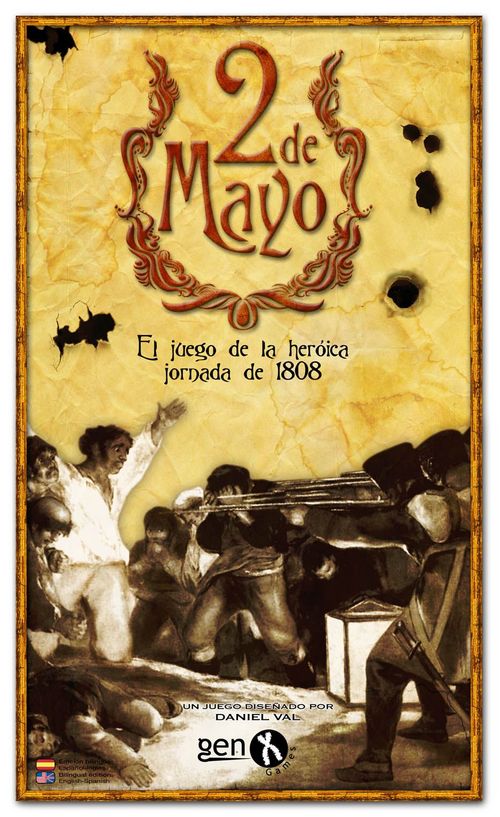
2 de Mayo
2 de Mayo Rulebook
Table of Contents
Table of Contents
A Note on History
In 1808, the Bourbon King, Carlos IV, sovereign of Spain, had transferred all his governing powers to the Valido, or Favourite, Manuel Godoy. Napoleon's promise of a kingdom in the Algarve (Portugal) convinced Godoy to sign the Treaty of Fontainebleau between Spain and France, binding the Spanish Kingdom to allow free passage to French troops on their way to Portugal, a traditional British ally. On the basis of this treaty, an unopposed Imperial Army gained control of numerous strategic points all over the Iberian Peninsula.
Napoleon Bonaparte's real plans were to conquer Spain and begin a new Dynasty, headed by his elder brother, Jose Bonaparte. The entire Spanish Royal Family was gradually taken to the French city of Bayonne where it was kept prisoner. Among them was the heir to the Throne, Fernando VII, known as "El Deseado" ("the Desired").
In the meantime, tension rose between the civil population and the occupying force as time passed, and it became evident that the French troops were not merely on their way to Portugal. In Madrid, Marshall Joachim Murat, head of the French army, had deployed 10,000 men, with other 20,000 in the nearby villages, to take control of the town, which then had an estimated population of 160,000 people. Many reported incidents took place between the Spaniards and the French until finally, on May 2nd 1808, the tension reached its climax.
That morning, Royal coaches were pulled outside the Royal Palace. Their purpose was to take to France the remaining members of the Spanish Royal Family, María Luisa Josefina de Borbón, Queen of Etruria, and the son of the King, Francisco de Paula. José Blas Molina y Soriano, a locksmith who witnessed the event, suspecting the intentions of the French authorities, cried out to the people gathered around: "Treason! They are taking away the son of the King! Treason!" The revolt of the Spanish people was ignited precisely with that cry.
Murat himself, billeted in the nearby Grimaldi Palace, sent General La Grange to find out what went on in the Plaza de Oriente, in front of the Royal Palace. La Grange faced a very angry mob of Spanish citizens and was ultimately saved from being lynched by a Spanish Officer of the Royal Walloon Guards. A more unfortunate French soldier was hunted down and killed by the mob. At around 10.00 am, the Imperial Guards' Grenadier battalion deployed its men and cannons in Plaza de Oriente and opened fire without warning on a group of 400-500 people.
This news spread by word of mouth across Madrid, suddenly a city booming with artillery shots. Many Spanish civilians took to the streets with the intention of killing every Frenchman that should cross their path. People were armed with sticks, knives, kitchen hardware, stones, axes, old shotguns and ancient swords from a military ancestor… Disorder and confusion reigned supreme in the streets and French soldiers who lost contact with their units had to face the fury of enraged Spaniards. Some people gathered around leaders that emerged spontaneously, while others seem to have been preparing in advance for this scenario and, accordingly, had an action plan: to obtain weapons, to prevent more French troops from entering Madrid, or to confine French soldiers to their quarters.
Not everyone rose up in revolt. Some Spaniards even longed for the French to take over Spain. They identified France with the coming of modern times, with a new regime, and above all, with the end of an indolent Monarchy. Others simply feared French retaliation, others had much to lose: a family, a business or a privilege. It is estimated that no more than 3,000-4,000 residents actually fought in the streets on that memorable day.
The French plan to suffocate the rebellion was clear-cut. The troops were to advance towards the centre of the city along its main axes, all converging on Puerta del Sol and Plaza Mayor, sweeping off all the agitators as they marched. Many of the couriers carrying the orders, however, failed to reach their destinations, delaying the execution of the plan. For instance, the cavalry, camped in the nearby Parque del Buen Retiro, joined the fray late in the day.
In the meantime, the Spanish Army, following orders issued by the Commander in Chief of Madrid, remained inside its quarters. Most of the Spanish troops stationed in Madrid, a force 4,200 strong, counting soldiers and officers, were really a Court service corps rather than a force fit for the discipline of combat. Nevertheless, there were also 4,600 troops belonging to different, more operative units of the Spanish Army, such as small detachments from the State Volunteers, the King's Dragons, the Marine's Grenadiers, or the Hussars of María Luisa. Some soldiers, disobeying orders, escaped from their quarters in order to supply weapons and ammunition to civilians and to join them. Some officers decided to follow suit and supported the revolt. Such were the cases of Captain Luis Daoiz and Captain Pedro Velarde who, having captured some French soldiers in the Artillery Park of Monteleón, armed as many civilians in the surroundings as they possibly could.
Fierce, brutal combats ensued in other parts of the city. There were truly heroic episodes: the charge of the Mameluke cavalry in Puerta del Sol could not force the people to retreat; women in Puerta de Toledo, in contempt of their own lives, threw themselves under the horses of French cuirassiers, wounding the animals with knives and scissors and making the riders fall down. Even the inmates of the Court's Jail asked to regain their freedom to combat "for the sake of Spain", under oath of returning to jail once the fight had ended. Only one of them would later be declared fugitive.
In spite of the valour and determination showed by the people of Madrid, the revolt was gradually quelled due to the vast French superiority in military terms. Several batteries were placed in Plaza Mayor, Plaza de Santa Cruz and Plaza de Antón Martín, barring access to Atocha street: the city was thus divided into two unconnected sections, north and south. Combats around Puerta del Sol and Puerta Cerrada still raged but the main concern of the French was that the Spaniards still held the Artillery Park.
At Monteleón, the Spanish officers, Daoiz, Velarde, Ruiz and others, tried to quickly organize groups of people lacking any military experience with the purpose of defending the artillery Park. Several attempts failed to take it by storm, the French suffering almost unbearable casualties. The cannons of the Park used up the scarce ammunition available and the French charges were once more repelled. After several hours of combat, Monteleón stood as the only spot still unsettled. Almost out of ammunition, the defending forces of the Park were finally overwhelmed and the officers in command were killed. They were to be remembered, along with those who fought side by side with them, as the heroes of that day.
In the afternoon, groups of French and Spanish officers appeared in the streets in an effort to calm down the people, waving white handkerchiefs and repeating the slogan "Peace, peace, everything's been settled…" Murat then ordered many people to be shot, though in fact firing squads had already been carrying out executions since the morning of that day. Many Spaniards paid with their lives for carrying a knife in their pocket—a widespread habit at the time—, a pair of scissors, or needles to sew sacks. If a French soldier was found dead at the threshold of a house, the dwellers could be held responsible. If a man simply looked suspicious to the French, he could be taken prisoner forthwith. In unfair reprisal for the revolt, the Imperial Army engaged in systematic looting and a series of assassinations and atrocities were committed by the military. Goya, one of the great masters of Spanish painting, captured for posterity one of the most terrible episodes: the executions by French firing squads that took place at Mount Principe Pío during the early hours of May 3rd. Juan Suarez, a man who was to be shot, amazingly escaped his execution and later told the sad tale of that night.
The news of the revolt and of the brutal French retaliation quickly spread all over Spain. In Móstoles, a nearby village southwest of Madrid, Lieutenant Jacinto Ruíz, a survivor of the Park of Monteleón, informed Juan Pérez Villamil, Secretary of the Admiralty, of the situation in the capital. It was from the latter that Andrés Torrejón, a man of 82 and Mayor of Móstoles, learned of the events upon returning from farming the land. In an act of boldness that was to impress future generations of Spaniards, he decided to send emissaries across the country with a true declaration of war against France. The War of Independence, and with it the tragic birth of modern Spain, had started.
Rules
The Game Dos de Mayo is a historical simulation of the events of May 2nd, 1808. On this day, civilians in Madrid—and a few Spanish army units—rebelled against the French occupation troops of Napoleon.
Dos de Mayo is a game for two players. One player controls the Spanish forces, while the other player controls the French forces. The game lasts 10 turns and takes about 30 minutes to play. (Historical note: Each turn represents about 30 minutes of real time). Each turn is divided into four phases: Preparation, Orders, Movement, Resolution.
At the end of Turn 10, the French player wins if all of the following apply: All Spanish forces (cubes) have been eliminated. All access areas to Madrid (Areas 1, 6, 16, and 20) are occupied by at least one French cube. The French player has not lost four or more cubes (This last condition is subject to modification by event cards). If any of these do not apply by the end of Turn 10, the Spanish player wins.
Components
- A board showing the old map of Madrid, divided in 21 areas or zones. Note: Areas 14, 15, and 16 are considered special for French movement purposes.
- The arrows outside the city walls indicate the entrances into the town for the corresponding French forces (starting with Turn 3). There are two arrows outside of Area 6 for historical accuracy only. This does not indicate any additional capability or limitation for the French forces outside of Area 6.
- 41 wooden cubes: 30 blue (representing the French troops), 10 red (representing the Spanish civilians and troops), and 1 unpainted used as the turn marker.
- 22 event cards, 11 French (blue back); and 11 Spanish (red back).
- 2 player aid cards.
- 1 turn track card.
- This rulebook.
Definitions
- One wooden cube will be referred to as a unit.
- One or more cubes of the same colour in one area will be referred to as a "group".
- The French player controls the blue groups and the Spanish player controls the red groups.
- If the cards and the basic rules contradict each other, the text on the cards takes precedence.
- A contested area is an area with both French and Spanish cubes.
- Unless specifically stated in a card, after it is played, it is discarded.
- There is no limit to the number of cards a player may hold in his hand or play in a given turn, provided the conditions on the cards are met, and the cards are played in the appropriate phase of each turn.
- Discarding cards in a player's hand is not permitted, unless an event card states so (i.e. Colaboración con los franceses).
Getting Started
Place starting forces as follows:
French Forces (blue cubes):
- 2 cubes in Area 1
- 2 cubes in Area 6
- 1 cube in Area 10
- 2 cubes in Area 11
- 2 cubes in Area 19
Additional French forces placed outside Madrid:
These cubes cannot be given orders or moved until Turn 3. Starting with Turn 3, they may be given orders and move into Madrid by moving into their corresponding adjacent areas.
- Adjacent to Area 1, 5 cubes
- Adjacent to Area 6, 5 cubes
- Adjacent to Area 16, 5 cubes
- Adjacent to Area 20, 5 cubes
Spanish Forces (red cubes):
- 1 cube in Area 4
- 1 cube in Area 8
- 1 cube in Area 9
- 1 cube in Area 10
- 1 cube in Area 12
- 1 cube in Area 15
- 1 cube in Area 17
- 1 cube in Area 20
(The additional one blue cube and two red cubes are set aside and may enter play as a result of the play of certain recruiting event cards during the game.)
Place the unpainted wooden cube on Turn 1 space of the turn track card. The Spanish player picks the card José Blas Molina y Soriano, as his action during the Preparation Phase for the first Turn. The French player chooses between the Artillery or Mariscal Murat cards and keeps one, putting the other card back in his deck.
Each player shuffles the opponent's deck. If the French player has chosen Artillery and wants to play it right away, he must show it now and leave it visible for the rest of the game. After that, the game continues to the Orders Phase of the first Turn.
Sample Turn (description of the four phases)
Phase 1) Preparation
During the Preparation Phase, both players may draw a card from their event card deck. (Remember that on Turn 1, the French player chooses between the Artillery or the Mariscal Murat cards and the Spanish player gets Jose Blas Molina y Soriano instead of the normal drawing as explained in the "Getting started" section above.) If one of the players has three less (or four, or five less, etc.) cards than his opponent, that player can deny his opponent the option to draw a card.
Note: If a player has exactly three less cards than his opponent, he either draws a card (and his opponent can draw a card) or denies his opponent the benefit of drawing a card.
Note: Cards that state "Play Immediately" must be played as soon as they are drawn.
Phase 2) Orders
During the Orders Phase, each player secretly writes down movement orders for their forces on a piece of paper. Unless an event card states differently, the rules governing movement are:
- Write down orders stating the departure area, an arrow pointing right, and then the destination area. For example, to move a group from Area 4 to Area 5, a player would write down 4-5.
- Groups move from the area they currently occupy to any adjacent area(s) on the map. For example, a cube or a group of cubes in Area 4 can move to any of the following: 3, 2, 8 and 5. It would not be able to move, on this turn, to Area 7 or 9, because they are not adjacent to Area 4.
- Spanish groups CANNOT move to two different destinations. In other words, once together, Spanish cubes cannot split up (Exception: the card "La Turba se Dispersa" allows this to happen once).
- A French group is allowed to split and move to several different areas from the same departure area.
- All written orders must be fulfilled. If a player makes a mistake and cannot execute all of the written orders, the whole set of orders is cancelled.
- The Spanish player may plan and execute movements for every Spanish group on the board. The French player can only plan and execute movements FOR ONLY TWO of his groups. This limitation does not apply to French groups whose movements originate from Areas 14, 15 and 16. For example, if the French player had groups in Areas 6 (2 cubes), 20 (4 cubes), 19 (2 cubes) and 14 (3 cubes), the following set of orders would be legal: 6-5, 20-17, 14-7, 14-12, 14-15. Remember that movements from (not to) Areas 14, 15 and 16 do not count towards the maximum number of two movements the French player can plan and execute.
- Each movement order counts as moving a group. For example, if the French player writes down the orders 5-7 and 5-9, this would constitute all of the French player's two movement orders for the turn.
- Moving French forces from outside of Madrid into their corresponding entry area counts as a movement order.
- Players are only required to write down the origin and destination of their movements, not the number of cubes performing the movement. In the case of the Spanish player, since his groups cannot be split, he normally moves with all his cubes from the departure area to the destination area.
Note: For the event card La turba se dispersa, the Spanish player must write down the number of cubes executing the split move. For example, if the Spanish player had 3 cubes in Area 5, he should write: 2 cubes 5-4, 1 cube 5-9.
Phase 3) Movement
During the Movement Phase, both players simultaneously reveal their written orders. Then players may play event cards they wish to play in this phase. Then the movement orders are executed.
For practical reasons, the Spanish player usually executes his movements before the French player, although he is allowed to see what movements the French has planned and play cards accordingly.
- When moving out of a contested area, a Spanish group must leave at least half (rounded up) his cubes in that area behind.
- A French group may NEVER leave a contested area.
- The French player chooses the number of cubes executing each individual order after the Spanish movement orders are complete. For example, a French group on Area 14 with 6 cubes with the following orders: 14-7, 14-9, 14-15 could move one cube to area 7, another one to area 9 and the rest to area 15. Or, for example, one to Area 7, two to Area 9, and one to Area 15, leaving two cubes in Area 14. Invalid movements would be to move one cube to Area 7, five to Area 9 and none to Area 15, because all written orders must be fulfilled with at least one cube.
- If two opposing groups move to the area each is moving from (for example, if a French group in Area 2 plans a move to Area 3, where there is a Spanish group, which has the order of moving to Area 2), only one of the groups will fulfill its movement order. It will be the one executing the movement with more cubes. This way, the smaller group will remain in its area, and the bigger group will execute its movement order. For example: A French group of three cubes in Area 2 plans a movement to Area 3, where there is a single Spanish cube, which has a movement order to Area 2. The French player decides to move to with two cubes. The result is the Spanish group (of one cube) remains in Area 3, and the two French cubes enter area 3.
- In the aforementioned case, if both groups are of the same size, the tie breaker goes to the side holding the initiative.
- The initiative is held by the side that has eliminated more of his opponents' cubes. In case of a tie, the Spanish player is considered to have the initiative.
- A Spanish group can leave a contested area (an area with both French and Spanish cubes), but must leave at least HALF (rounded up) its cubes behind.
- A French group CANNOT leave a contested area.
- Cubes may not move more than once per turn (exception: the French card Caballeria). In other words, the orders 4-5, 5-7 could not move two cubes from Area 4 to 5 and then move the same two cubes from Area 5 to Area 7.
Phase 4) Resolution
Due to previous movements, there can be areas with both French and Spanish cubes. These areas are called contested areas. During Phase 4, there may be casualties (removed cubes) in these Contested Areas. After resolving the casualties, the current turn is over and the turn marker moves to the next space. If the turn marker is already on the Turn 10 space, the game is over and a winner is declared.
- In the Resolution Phase, players calculate the strength of groups in contested areas.
- The strength of each group equals its number of cubes, plus the value of any cards being played.
- If a group has one more Strength Point than his opponent's group, but less than twice as many Strength Points than his opponent's group in a contested area, a cube is subtracted from the weakest group.
- If a group has twice the strength of an opponent's, two cubes are removed from the weakest group.
- If a group has three times the number of cubes, then three cubes are removed and so on.
- If the groups have the same number of cubes, neither group suffers elimination of any cubes.
- Resolution occurs in an area even if no groups moved into or out of that area on a particular turn as long as there cubes from both sides in an area at the start of Phase 4.
Event Cards
Event cards may be played during the phase(s) indicated on the individual cards. If no phase is specified, the card may be played at any time its conditions are fulfilled. There is no limit to the number of cards a player may play in one turn or during any one phase. Cards with the statement "Play this card immediately" must be played immediately in the Preparation Phase when drawn.
End of the Game
At the end of Turn 10, check the victory conditions under "Winning Dos de Mayo".
Designer's Comments
The game Dos de Mayo (May 2nd) is based on the events that took place in Madrid on May 2nd 1808. It is not intended to be an exact, completely accurate re-creation of historical facts as they occurred on that day. French superiority in terms of training, arms and command was actually so overwhelming that pious devotion to the historical record could hardly produce an interesting game. A board game must sometimes simplify reality for the sake of playability, if it is to be entertaining and offer chances of victory to both sides. Therefore, we have tried to strike a balance between historical accuracy and the need to keep chances open to the last turn, all in a brief playing time.
All the events referred to in the cards were real and will now be commented on. However, neither the initial deployment of troops nor their movements across different areas of Madrid are in the game exactly as they were in reality. Deployment and movements, though, do intend to reflect the tactics used by the French to suffocate the revolt. On May 2nd 1808 the Spaniards, contrary to the rules of this board game, did not have a unified command, nor did the French know Spanish movements beforehand.
Our hope is that all its elements, in combination, make for an interesting game and prompt players to take an interest in that memorable date, read about it, walk along the streets where combats were fought, discuss single events of the day after playing this little game and even reflect upon the significance of this date in the history of Spain. If the pleasure of playing the game is enhanced by our modest effort to spread historical knowledge, we shall be satisfied and consider our task fulfilled.
On Various Elements of the Game
The Map: It represents quite accurately the city of Madrid in 1808, save the Parque del Buen Retiro, where many troops camped. The French plan was to march along the main avenues from the outskirts, converging in the city centre, at Plaza Mayor or Puerta del Sol. Moreover, as a precaution against the possibility of many Spaniards coming down from mountain villages to reinforce the city, the Imperial army took care that the main gates giving access to Madrid were defended.
The Cubes: In the first war themed boardgames of the nineteenth century, red and blue were the colors used to identify each of the contending armies. Every French cube in Dos de Mayo represents around 1,000 soldiers, whereas Spanish cubes represent between 300 and 500 civilians each.
Rules on Movement: The main advantage enjoyed by the Spanish player—one the Spanish side did not have when the real events took place—is a "unified command": Spanish forces move as decided by the directing mind of the Spanish player.
In addition, Spanish forces have superior mobility for three reasons: their knowledge of terrain is better, they are grouped in smaller units and they must not stop and wait for orders. As a result, the French side enjoys more limited mobility, although is capable of taking the enemy by surprise using cards such as Murat and Caballería (Cavalry). The French player should not give up the idea of taking Zones 14, 15 and 16, as well as the main avenues and squares of the city, from which French movements are faster and give effective control over the urban area.
The Terms of Victory: That the Spanish player should win defeating French forces in military terms is not even considered in the game. The Spanish people were bound to be overwhelmed on that fateful day. However, in order to provide an incentive to play the game, the rules establish that the Spanish side wins if it improves the historical record. This task is formidable, for the valour shown by the people of Madrid impressed even Napoleon who, in his confinement in Saint Helena, stated: "The Spaniards, revolting en masse, behaved like a man of honour".
It has been estimated that the revolt lasted approximately from 10.00 am to 15.00pm. Therefore, each of the 10 turns represents more or less 30 minutes. If the Spanish side succeeds in resisting with some strength for more than 5 hours, the outcome is considered to be better than the real one.
The number of casualties on both sides is still a source of dispute among historians. The real figures are very likely to remain veiled in mystery forever. The French were always unwilling to acknowledge the strong resistance put up by a small number of civilians who were poorly armed and badly organized. Figures oscillate between 200 and 1,800 dead soldiers, to whom the lost and the wounded should be added. The Spaniards too silenced their casualties, as a means to prevent French retaliation on the victims' families. A figure of 400 dead civilians is estimated, not counting the high number of executions that took place after the revolt had been quelled.
Spanish Event Cards
José Blas Molina y Soriano: This is the man who started the revolt. Later, managing to avoid French troops, he took a large group of people to the Park of Artillery in order to provide them with weapons. He fought in the defense of Monteleón and, after May 2nd, he took to the hills. He engaged in guerrilla warfare until the end of the War of Independence. King Fernando VII would not grant him a paltry pension.
Luis Daoiz: Artillery Captain, and a bold, courageous officer. Torn between the need to obey the orders of submission to the French given by his commanders and his will to defend both civilians and Spanish national honor, he ended up losing his life in combat during the defense of the Park of Artillery. He died among the cannons set out at the entrance of the barracks.
Pedro Velarde: Artillery Captain. Determined from the start to fight the French, he was under the illusion that the rest of the army would support the revolt in the end, for he imagined the Spanish military to be men of honor as courageous as himself. He died defending Monteleón side by side with his friend Luis Daoiz.
Jacinto Ruiz: Artillery Lieutenant. He too defended Monteleón and was later an invaluable witness of the facts. On that very day, he informed the authorities in Móstoles of the events in Madrid. He was badly injured in the Park and died the following year in Trujillo, Cáceres, as a result.
El Alcalde de Móstoles (The Mayor of Móstoles): His name was Andrés Torrejón. At 82 years of age, returning home from farming the land, he was told of the revolt in Madrid by Juan Pérez Villamil, Secretary of the Admiralty. In an act of vehemence and boldness, he immediately signed a declaration of war against France, which he then ordered to be sent to the farthest corner of the country.
Los Presos de la Cárcel de la Corte (The Inmates of the Court Jail): Fifty-six out of the ninety-four inmates of the Court Jail wrote their Warden asking for permission to go out "to risk our life against the foreigners and for the benefit of our country" and gave their word to return to jail once the combats had ended. Quite exceptionally, permission to leave the jail was granted. The capture of one French cannon in Plaza Mayor stands out among the great deeds performed by this remarkable group. Operated by the inmates, the cannon actually fired grapeshot at some bewildered French soldiers. All of them went back to prison on the following day, with three exceptions: one inmate had been killed, another had been wounded and yet another was declared the sole fugitive of the group. They were men of their word after all.
Los soldados se escapan de sus cuarteles (Soldiers flee their barracks): In spite of strict orders of non intervention, many Spanish soldiers could not contain themselves and supported the people of Madrid. Some joined the groups of civilians, while others provided the rebels with arms and ammunition.
Las "Manolas" de la Puerta de Toledo (The Manolas in Puerta de Toledo): Many lower-class women from the southern part of Madrid sacrificed their lives throwing themselves under the horses of the French cavalry that was trying to enter the city. The women slashed the bellies of the huge animals, causing the fall of the riders who, once on the ground, saw with horror the enraged civilians stab them through the joints of their cuirasses.
Un tiesto mata al hijo del General Legrand (A flowerpot kills the son of General Legrand): It happened in Infantas Street. It gives an idea of the kind of weaponry employed on May 2nd by the people of Madrid. There were other episodes of this sort: the bricklayers working at Santiago Church flung tools and stones at the French troops passing below; from many houses people shot their rifles or threw furniture, burning oil or stones at enemy units.
Órdenes interceptadas (Intercepted orders): Many French liaisons were killed as they tried to bring Murat's orders to the troops. As a result of that, the French cavalry, camped in the Parque del Retiro, did not go into action until noon.
Las heroínas del Dos de Mayo (The heroines of May 2nd): Manuela Malasaña, Clara del Rey, Benita Pastrana… The number of women who fought side by side with men was very high. They proved their valor and their love of freedom.
French Event Cards
Mariscal Joachim Murat (Marshall Joachim Murat): He was Duke of Berg and son-in-law of Napoleon Bonaparte. According to some sources, Napoleon ordered him to exasperate the people of Madrid and prompt them to rebel. The ensuing revolt was to be bloodily suffocated and a regime of terror would follow, as it had happened in Lisbon, Milan, Rome or Cairo. Murat was disappointed when the Emperor did not make him King of Spain, though he received the Kingdom of Naples in compensation. After the Russian campaign and the Battle of Leipzig he retired to his kingdom, which he tried to save by negotiating a separate peace agreement with Austria and Great Britain. He died before a firing squad in Naples in 1815.
Órdenes de Napoleón (Napoleon's orders): Napoleon had seen the possibility of revolt and, according to some sources, would have instigated it. Foreseeing this scenario, the Emperor had his own spies who provided him with invaluable information about those who had led the revolt.
Artillería (Artillery): The French deployed their batteries in key points of Madrid: Plaza de Oriente, Plaza Mayor, Antón Martín, etc. As a result of that, they were able to divide the city into two sections, with the axis formed by Atocha street and Mayor street as the dividing line.
Caballería (Cavalry): Almost 3,000 horsemen entered Madrid through Alcalá street and Carrera de San Jerónimo, coming from the Parque del Retiro and the Quarters of El Pósito. This force included the Egyptian Mameluke troops, famous for their brutality. Also, 2,000 cuirassiers, who were heavy cavalry troops that had ravaged Europe, entered Madrid from the Carabancheles through Puerta de Toledo, where they met heavy opposition, and Portillo de Embajadores.
Colaboración con los franceses (Collaboration with the French): Not everyone in Madrid was against French occupation. Some considered the French invasion as an opportunity to climb the social ladder if they secured the approval of the new masters. Thus many people reported their neighbors for having taken part in the revolt, although sometimes this was only a means to settle old scores. There was also a group of enlightened people who were sincerely convinced that the political regime that the French intended to establish would be a step forward for Spain. They were contemptuously called afrancesados (frenchified) or josefinos (josephins), both derogatory terms.
Tropas de Elite (Elite troops): Most of the troops sent to Spain by Napoleon were not veterans, but all the officers and several corps were part of the elite of the French army, such as the battalions of Westfalia, Ireland or Prussia, the Grenadiers or the horsemen of the Imperial Guard.
Fuego Cerrado (Fire on my order): Contrary to the insurgents, who lacked any military discipline, the French closed columns, when they opened fire, were able to create veritable walls of lead that proved to be lethal in the narrow streets and squares of Madrid.
La Turba se Dispersa (The Mob Breaks Up): This card is one of the two "traps" laid for the French player in his own deck. The unpredictable behavior of the mob may in certain situations help the Spanish side.
Fusilamientos (Executions by Firing Squads): This is the second trap in the French deck. The cruel executions by firing squads, as well as the looting by French troops, became known all over Spain and even Europe. Many Spanish corpses were left in the streets for days, in compliance with Murat's explicit orders, a measure of intimidation and retaliation. These events undoubtedly worked in favor of the declaration of war against France and inclined Europe to support the Spanish cause. In designing the game, the testimony of Lieutenant Ruiz about the heroic deeds of the Parque de Monteleón has been considered as a window of hope among all the dreadful events of the day.
Desorden (Disorder): Being what they were, the Spanish "forces", after all mere civilians who lacked military training, moved sometimes without precaution or without a clear objective.
"Paz, paz, que todo está compuesto" ("Peace, peace, everything's been settled"): In the afternoon, groups of French and Spanish officers went all over Madrid waving white handkerchiefs and calling people to calm down. Unfortunately, some gullible people lost their lives when peace was restored: many were arrested and killed for carrying a knife—a common habit of the times—or for carrying needles or a pair of scissors, often working tools of the arrested.
Example of Play
Turn 1
After setting up the game, Phil and Karsten are randomly assigned each side. Phil receives the Spanish forces, and therefore picks the card José Blas Molina y Soriano from his deck. Karsten chooses Artillería. After shuffling the decks, Karsten announces that he is playing Artillería, and leaves the card in a visible space next to the board.
In the Orders Phase, each player writes down the following:
| Isma (Spanish) | Karsten (French) |
|---|---|
| 9-14 | 6-7 |
| 15-14 | 19-16 |
| 12-14 | |
| 17-15 |
This reminds us that the French player has his movements limited to a maximum of two, unless they originate from Areas 14, 15 or 16, clearly noticeable on the map.
In the Movement Phase, both players reveal their orders and they are executed. Therefore, the Spanish cubes in Areas 9, 12 and 15 all converge in Area 14, and the one in Area 17 goes to Area 15. Besides, Phil plays the card José Blas Molina y Soriano, and uses it on his cube in Area 10. This card's effect extends to the Movement Phase in the next turn, so he leaves the card in plain view as a reminder. Karsten moves two cubes from Area 6 to 7, and two more from Area 19 to 16.
In the Resolution Phase, the only contested Area is number 10, but thanks to the card played by the Spanish player, there is no casualty assigned to the Spanish group (Remember the French strength in that Area amounts to 3, due to the card Artillery).
Turn 2
In the Preparation Phase, both players decide to draw a card. Phil gets Las Manolas de la Puerta de Toledo, so he is happy to have maintained a cube in Area 20. Happiness does not last long because Karsten draws Colaboración con los Franceses, which is immediately played, and makes the Spanish player discard his only card.
In the Orders Phase, each player writes what follows:
| Phil (Spanish) | Karsten (French) |
|---|---|
| 10-17 | 16-15 |
| 8-9 | 11-12 |
| 14-12 | 7-9 |
In the Movement Phase orders are revealed, and the Spanish player, Phil, moves his cube in Area 10 to 17 (Note: this is only possible thanks to having played the card José Blas Molina y Soriano in the previous turn, because normally half the cubes rounded up must be left behind when leaving a contested area by the Spanish groups), the cube in Area 8 to Area 9, and the three cubes in Area 14 to Area 12. This last move is lucky, for it "guesses" the French movement.
The French player, Karsten, seeing this decides to carry out the order 11-12 with only one cube from Area 11. He also moves two cubes from Areas 16 to 15, and two from Area 7 to Area 9. Therefore there are three contested areas (9, 15 and 12).
In the Resolution Phase, Strengths in each contested area are calculated, and casualties are delivered. In Area 9, the French has Strength 2 (for having two cubes) while the Spanish, only Strength 1. Therefore, the Spanish loses his cube. The same happens in Area 15. In Area 12, on the contrary, the Spanish player has Strength 3 (for having three cubes) and the French only 1 (for only one cube), and therefore the French cube is eliminated.
Turn 3
In the Preparation Phase both players decide to draw cards. Phil gets Un tiesto mata al hijo del General Legrand, and Karsten "Paz, Paz…que todo está compuesto".
In the Orders Phase each player plans the following:
| Phil (Spanish) | Karsten (French) |
|---|---|
| 12-11 | -16 |
| 17-9 | 9-15 |
| 20-17 |
In the Movement Phase, the Spanish moves his three cubes from Area 12 to 11, one from Area 17 to 9, and the one in Area 9 to 15. The French player moves two cubes from Area 9 to 15, and the five outside Madrid, adjacent to Area 16, to Area 16. (Note: Remember it is turn 3 already, and therefore forces outside Madrid are allowed to move already). It is interesting to note that due to simultaneous French control of Areas 15 and 16 and being the card Artillery in effect, the Spanish player cannot enter those areas, unless they become vacant or due to the effect of Los Presos de la Cárcel de la Corte.
In the Resolution Phase, the French cube in Area 11 is eliminated.
Turn 4
In the Preparation Phase, both players decide to draw a card. Phil gets Capitán Luis Daoíz, while Karsten gets La Turba se dispersa. This last card must be played immediately to allow the Spanish player to split the group in Area 11.
In the Orders Phase, the following orders are given:
| Phil (Spanish) | Karsten (French) |
|---|---|
| 2 cubes 11-14 | -1 |
| 9-7 | 16-15 |
| 17-18 | -6 |
In the Movement Phase, Phil moves two cubes from Area 11 to Area 14 (he is able to split this group thanks to the event card La Turba se dispersa), the cube in Area 17 to 18, and the one in Area 9 to Area 7. Then, five French cubes come into Area 1 and other five to Area 6 from outside Madrid. From Area 16, Karsten decides to move three cubes to Area 15.
There are no contested areas, so there are no conflicts to be resolved.
Turn 5
In the Preparation Phase, Phil draws a card, Los Presos de la Cárcel de la Corte. Karsten decides not to draw a card.
In the Orders Phase these are the orders issued:
| Phil (Spanish) | Karsten (French) |
|---|---|
| 18-19 | 15-14 |
| 11-13 | 15-9 |
| 14-12 | 6-7 |
| 7-5 | 6-5 |
In the Movement Phase, Phil carries out his orders, and with that in mind, Karsten moves one cube from Area 6 to 7, three from Area 6 to 5, one from Area 15 to 9, and five from 15 to 14.
In the Resolution Phase, only Area 5 is contested, and a Spanish cube is eliminated.
Turn 6
In the Preparation Phase Karsten decides to not draw a card again, while Phil gets El Alcalde de Móstoles. Now the French player has three less cards than the Spanish player. Unless Phil plays one of his cards, Karsten could negate Phil the option to draw a card in the next Preparation Phase.
In the Orders Phase, each player plans the following:
| Phil (Spanish) | Karsten (French) |
|---|---|
| 12-15 | 1-2 |
| 4-3 | -20 |
In the Movement Phase, Phil plays the card Los Presos de la Cárcel de la Corte, in order to move to Area 15, because Artillería is in play. He also moves the cube in Area 4 to Area 3. Karsten moves five cubes from outside Madrid to Area 20, and six cubes from Area 1 to Area 2.
In the Resolution Phase, a French cube is eliminated in Area 15, and this cancels the effects of Artillery for Areas 15 and 16, because they are no longer simultaneously under French control. If they ever revert to French control, the effects of Artillería will again be applied to Areas 15 and 16.
Turn 7
In the Preparation Phase, Karsten sees his plan of denying the Spanish drawing more cards fail, because Phil played a card on the previous turn, and as a consequence, he only holds two more cards than the French. In spite of this, Karsten decides not to draw again, while Phil gets Los Soldados se escapan de los cuarteles, which is no longer playable because it is already Turn 7.
In the Orders Phase, more orders are written down:
| Phil (Spanish) | Karsten (French) |
|---|---|
| 15-16 | 16-19 |
| 13-16 | 20-18 |
| 19-16 | 14-15 |
| 2-3 |
In the Movement Phase, the Spanish player moves two cubes from Area 15 to 16, and one from Area 13 to 16. The order 19-16, on the other hand, is not fulfilled, because the French player moves two cubes from Area 16 to 19 (and therefore "pushes back" the Spanish only cube). Besides that, Karsten moves five cubes from Area 14 to 15, six from Area 2 to 3, and four from Area 20 to 18.
In the Resolution Phase, two Spanish cubes are eliminated, one in Area 3, even when the Spanish player plays the card Capitán Luis Daoíz, and another one in Area 19.
Turn 8
In the Preparation Phase, the Spanish player draws a card (he is able because, again, he played a card last turn, and therefore he does not have three more cards than the French player). The card is Teniente Jacinto Ruiz. Since three French cubes have already been eliminated, and since the Spanish player can also play the card El Alcalde de Móstoles, Phil plays both cards, and the Spanish side achieves victory.