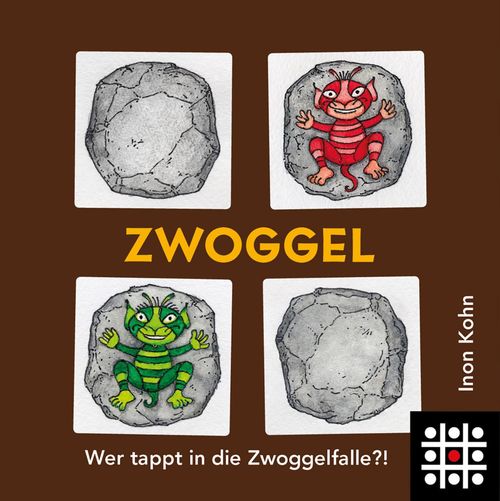
Zwoggel
Zwoggel Rulebook
Table of Contents
Table of Contents
Game Materials
- 64 mini cards (in two colours)
Object
The aim of the game, as far as possible, is never to reveal the cards so that three unicolor Zwoggels are face upwards next to each other.
Preparation
Shuffle the cards, face down, and arrange them in one or more stacks alongside the game area. Set out four cards in a square at the middle of the table. Choose a player to start the game.
Play
The first player flips over two of the four cards from the middle of the table to reveal the hidden Zwoggel.
Then, he/she draws three cards from the stack and looks carefully at the Zwoggel, but without the opponent seeing them. Then he adds the three cards, face down, to the table.
A card can be added to the table in a horizontal, vertical or diagonal direction next to any other card.
When the player has added all three cards, the turn passes to the next player.
Until the end of the match, the players take their turns and proceed as follows:
Flip over two cards in the game area – draw three cards (from the stack), look at them and add them, face down, to the table.
Caught in the Trap
A player who flips over a card and completes a horizontal, vertical or diagonal sequence comprising three Zwoggels of the same color, must keep the last card that was flipped over, and place it beside him. The two remaining Zwoggels of the triple remain in position.
Any player who accumulate three Zwoggels beside him must retire from the game. The player's turn ends, and he draws no more new cards.
Game End
A player wins in a duo match as soon as his opponent collects his third Zwoggel. In a match for three or four players, the winner is the last remaining player.
If the stock of cards is used up before any player has won, the match continues. Now, the players take turns to flip over one card until there is a clear winner.
The Art of Setting Traps / A Strategy Tip
Setting traps is crucial for the Zwoggel game. The player who sets the trap must have a good memory: some newly placed cards may look like traps, but they are harmless, and the player who knows this is on safe territory. Confused?! It's quite simple: the following game scenario provides an example.
(Diagram captioned "initial situation".)
Hannah is on turn: she must place her three cards. Of course, she can arrange them in any random pattern, e. g. as follows:
(Diagram showing Hannah's three placed cards.)
Hannah would be doing Nils a favor because he could flip over all three cards without any risk. There is no way that three unicolor Zwoggels could form a triple.
Of course, this is exactly what Hannah would like to happen to Nils, so that he must keep a Zwoggel as a penalty. Therefore, she places her three cards in positions that are risky for Nils when he flips them over.
(Diagram with the trap cards numbered 1, 2 and 3.)
Two of these cards are genuine traps (1 and 2). Whoever flips them over forms a triple and must take one penalty card.
Although the position of Hannah's other card (3) looks like a trap, it's harmless because here she has placed one differently coloured Zwoggel. Hannah should remember her pretend trap. She can reveal this harmless card herself later when she has run out of other options.