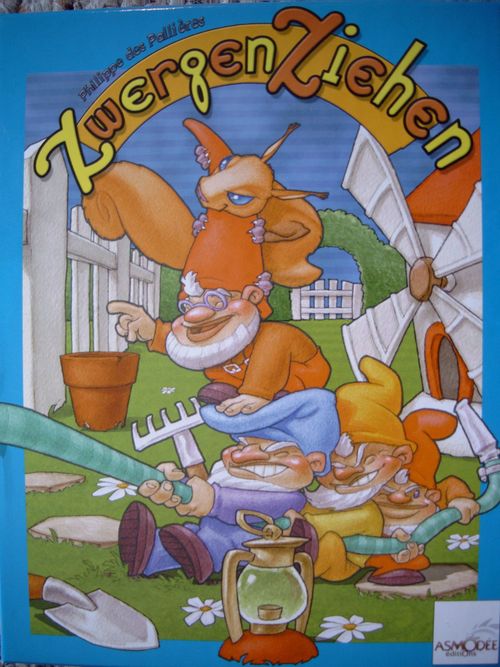
Zwergen Ziehen
Zwergen Ziehen Rulebook
Table of Contents
Table of Contents
Introduction
Zwergen Ziehen (Gnome Tug-of-War) — Asmodée, 2002; designed by Philippe des Pallières; translated by Pitt Crandlemire.
Each night, in two neighboring gardens in a sleepy suburb, an astonishing spectacle takes place: Colorful garden gnomes awaken from their statuesque slumber, straining and stretching themselves in order to move their stiff limbs. They form two teams and with the help of a garden hose that they place under a fence, the gnomes organize a Tug-of-War. They shout, moan, swear, and insult each other. Sweat streams down in large drops from under their gnomish hats. They try to pull together at the fence. Squirrels from the neighborhood hurry to gather there. They can't sleep with all the noise and they gather at the garden's edge in order to watch the spectacle.
Contents of the Game
A gameboard with a sliding track, 55 cards, and 28 playing pieces (7 in each color, these are the Gnome hats)
Goal of the Game
Two teams pull on a garden hose that leads under a fence.
If a the team is pulled by the opposing gnomes into the fence, it loses that round. The team that first wins two rounds wins the game. That is very important: A complete Tug-of-War is only won when two rounds have been won by the same team. You will soon understand why....
Set-up
(for 2 players)
- Place the gameboard program in the middle of the table as shown in the illustration.
- Shuffle the 55 cards and place them next to the gameboard as a draw deck.
- The playing pieces (Gnome hats) are kept in the box; they will come into play later in the game.
- Each player draws 5 cards as his starting hand and looks at them.
- The players then simultaneously and secretly each selects a Gnome hat of any color as their starting playing piece. These Gnome hats are placed on the gameboard in the space farthest away from the fence on the respective sides of the board (see illustration below).
- Each space can only hold one (1) Gnome.
- The smallest player begins play.
Course of the Game
On his turn, a player plays one card. This card is discarded after its effect is executed. Afterwards, the opponent takes his turn and plays a card.
As soon as a player has played his last card, he draws five new cards. Thus, a player can first draw five new cards first when he has no more cards in his hand.
Instead of playing a card, a player can also discard part or all of his hand and draw replacement cards (Example: a player with 3 cards in his hand discards two of them and draws two new cards in their place). When a player discards and draws cards instead of playing a card, his Gnomes are momentarily disrupted in their rhythm and, as a result, the opponent may move the track one space in his direction.
End of a Round
A round ends as soon as a Gnome is pulled into the fence.
Example: (illustration)
The opponent has won the round and the players begin a second round. They keep the cards remaining in their hands. No cards are drawn to supplement their existing hands (one tactic is to choose to intentionally lose a round where you have no chance of winning in order to start the next round with good cards). The loser of the previous round begins the next round.
Explanation of the Cards
There are three types of cards:
- Add a new Gnome to the team
- The Gnomes pull on the garden hose
- The Squirrels interfere
1) Add a New Gnome
By playing this card, a player supplements his team by adding a Gnome in the color shown on the card. If the card is multicolored, the player adds a Gnome in the color of his choice. If there is no available Gnome of the color shown on the card in the stock in the box, the player adds a Gnome in the color of his choice. The Gnome is placed down on the last (closest to the end) free space on his side of the fence (see illustration below).
Note: When a new Gnome joins a team, he first creates confusion. That means that the opposing team pulls the rope two spaces further toward their side.
2) Movement
When this type of card is played, the players determine the strength of the two teams. Each dwarf, whose color is not modified by the card, counts 1 strength point.
- A Gnome of a color that is shown on the card with a 0, counts 0 strength points.
- A Gnome of a color that is shown on the card with a 2, counts strength 2 points.
- If the Gnome hat shown on the card is multicolored, the player playing the card determines the color involved.
- All Gnomes of the same color on both teams get the same strength.
- The strength of a team is the sum of all points that its Gnomes have on the card just played.
- The stronger team pulls the opposing team a number of spaces in its direction equal to the difference between the two team strengths.
If both teams are equally strong, nothing happens.
In example 1, the team on the left team has a strength of 5 and the team on the right has a strength of 3. The team on the left pulls the rope two spaces in their direction.
In example 2, both teams have a strength of 3. The rope does not move.
In example 3, the team on the left has a strength of 1 and the team on the right has a strength of 5. The team on the right pulls the rope 4 spaces in their direction.
3) The Squirrels
Squirrels are always looking to get involved in the fun. They climb down from the dense foliage in their trees and interfere in the contest. The player who plays a Squirrel card can move the rope as many spaces in his direction as shown on the card (1, 2 or 3 spaces).
In this example, the team on the left can use the Squirrel card to move the rope two spaces in its direction.
The Four Player Game
With four players, players form two 2-player teams. Teammates sit on the same side of the board. At the beginning of each round, each player secretly selects a Gnome in the color of his choice (after all players have looked at their cards) and places it on the board on the last free space on his side of the fence. The players may not show their cards to each other.
The strength of a team is always determined by all the Gnomes on that team. Players always play in alternating order in the sequence shown below. The smallest player begins.
Pro Version
These rules should be used only after players have played several games.
Contra
If an opponent supplements his team by adding a new Gnome (don't forget to move the rope two spaces in your direction) and you have the same card in your hand (or you have an multicolored "add a new Gnome" card), you can play this card during your next turn and announce "Contra". The opposing team immediately loses the newly added Gnome but the track remains in place. By taking this action, you have caused the opposing team to lose two spaces. You may, of course, also play the card as normal without announcing "Contra" to simply supplement your team by adding a Gnome.
In this example, the team on the left loses their yellow Gnome, since the team on the right announced "Contra".
Re
If your opponent has responded to you having added a new Gnome to your team by announcing "Contra" and you have another "add a new Gnome" card of the same color (or a multicolored "add a new Gnome" card), you can play that card and announce "Re" on your next turn. You may then add two Gnomes of that color to your team and move the rope two spaces in your direction**.
You may, of course, also play the card as normal without announcing "Re" to simply supplement your team by adding a Gnome.
In this example, the team on the left adds two yellow Gnomes as reinforcements and loses only two spaces.
Herbert*
If an opponent announced "Re" and you have another "add a new Gnome" card of the same color (or a multicolored "add a new Gnome" card), you can play that card and announce "Herbert" on your next turn. The two Gnomes which your opponent just added to his team come over to your team. Take those two Gnomes and place them on your side of the fence. The rope is not moved. The player who lost the two spaces at the beginning of the Contra-Re-Herbert sequence doesn't get them back.
You may, of course, also play the card as normal without announcing "Herbert" to simply supplement your team by adding a Gnome.
* You have certainly noticed that we have borrowed "Contra" and "Re" from Skat. The continuation after that is different from region to region, so we have decided in favor of "Herbert". Herbert is one of the most famous German garden Gnomes and has won many Tugs-of-War.
[**Trans. note: the rules for "Re" above regarding moving the track contradicts the text in the "Re" example and in the rules for "Herbert". Both of those indicate that the track doesn't move, i.e. in a "Re", the player ends up gaining two Gnomes but only loses 2 spaces instead of 4; in a "Herbert", the players loses both new Gnomes as well as the 2 spaces. Since two of the three rules indicate that the initial lost spaces are never recovered, that's the way we play - PC]