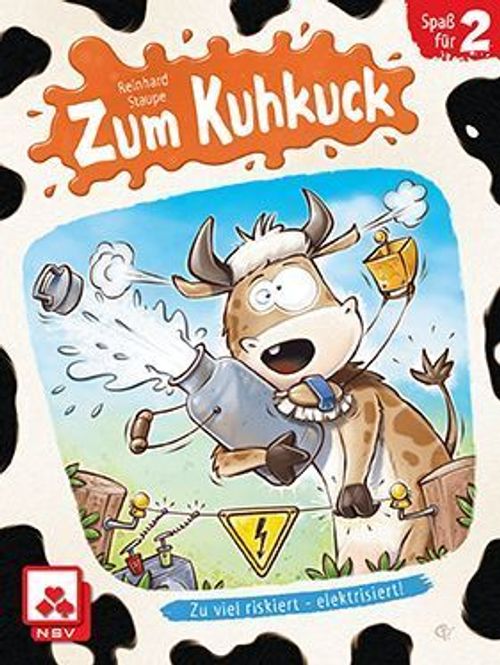
Zum Kuhkuck
Zum Kuhkuck Rulebook
Table of Contents
Table of Contents
Contents
- 54 collectible cards (11 each of boots, bell, milking stool, milk churn and 10 brushes)
- 5 electricity cards
- 1 info card
- 1 score pad
Overview
All 59 playing cards are placed face down as a wild pile in the centre of the table. Both players alternately take a card into the hand — the more the better, since more points can be scored that way.
But careful: If a player draws an electricity card, he must hand back all his cards and begin collecting again. Bad luck! The game ends, as soon as a player has scored just once in each of the five colours.
Game set-up
The info card is placed at the edge of the table for both players to see. The 54 collectible cards are placed face down in the centre of the table, together with the 5 electricity cards, and are shuffled thoroughly. The 59 cards remain as a wild pile face down on the table. One player acts as score-keeper. He takes a sheet from the score pad and enters the name of both players in the score sheet.
Game procedure
Lots are drawn to decide who begins. When it is a player's turn, he draws exactly one card from anywhere in the pile and takes it into his hand. That was it, now it's the other player's turn. Play continues in this way: draw one card, next player — draw one card, next player, etc. Each player may determine his risk level for himself and decide freely, how many cards he wishes to collect: 5, 9, 11, 14, … The maximum number is 20 cards. If a player holds 20 cards, he must announce a points score, when it is his turn.
Announcing a points score
If a player has less than 5 cards in hand, he may not under any circumstances announce a score. As soon as a player has 5 or more cards in hand, he must from then on, when it's his turn, decide whether he wants to draw another card or whether he wants to make exactly one score announcement. It is not permitted to do both in one turn, i.e. first draw a card and then immediately report the number of points — either, or. Announcing a score is done as follows:
The player must place all his cards face up on the table in front of him. Now he announces, loudly and clearly, for which colour he would like to announce score points (he may not score for more than one colour at the same time).
The player receives points for the total number of all his cards (the number of points is stated on the info card). In addition to that, he also receives 2 points for each card in the colour announced. The total is noted down on the score sheet. All discarded cards are placed face down on the discard stack.
Example: It is Tim's turn and he has 9 cards in hand. He does not wish to draw another card and says: "I'd like to announce points for yellow!" He lays all 9 cards face down in front of him on the table. He receives 12 points (as per info card) for his 9 cards. He also receives an additional 2 points for each of his three yellow cards. Altogether, 18 points (12+6) are noted down on the score sheet for his score for yellow. Tim puts all his cards aside. It is now Mia's turn.
If a player has announced his points and has put all his cards aside, he begins collecting cards all over again in his next turn.
Attention: In order to score points for a specific colour, the player must have at least one card of this colour. So it is not permitted for example to report points for red, if you don't have a single red card in your hand. Scoring points may not be corrected after points have already been announced once. For example, if a player has announced 20 points for blue, he may not subsequently announce any further points for blue.
Bad luck, unfortunately — an Electricity card has been drawn!
If a player draws an Electricity card from the pile, he must immediately put all his cards (including the Electricity card) face down onto a discard pile. The next player now takes a turn.
Example: Mia has 8 cards in hand and draws an Electricity card. She must immediately put all 9 cards to one side. It is now Tim's turn.
Attention: If a player draws an Electricity card and has discarded all his cards as described, he begins collecting cards all over again on his next turn.
Re-shuffling the cards
As soon as there are only two cards left in the centre of the table, the game is immediately briefly interrupted. Both players retain the cards they have in hand at that moment. Now, all the cards from the discard pile are placed face down in the centre of the table together with the two already lying there. All these cards are shuffled thoroughly and remain face down on the table as a wild pile. The game then continues.
End of the game
The game ends as soon as one player has announced his scoring points exactly once in each of the five colours. The cards held by the other player at this time are of no relevance and must be discarded.
Adding up the score
Before the players add up their scores, bonus points are awarded. In each colour in which both players have announced scoring points the player with the highest number of scoring points receives 10 bonus points.
Attention: In colours, in which only one player has announced points, no bonus points are awarded. The 10 bonus points are noted down directly on the score sheet. The player with the highest total score is the winner.
Example: Tim has announced scoring points for all five colours. The game ends immediately. Both have announced points for red. Since the number of scoring points announced by Mia is higher, she receives 10 bonus points. Both players have also announced points for blue. Here, Mia's scoring points were also higher and she receives 10 bonus points. For green, the number of scoring points announced by Tim is higher. In this case, he receives the 10 bonus points. Now, all announced scoring points and bonus points are added up. Tim wins with a score of 89 to 80 points.
Notes
The per-card point values referred to as "the info card" (for example, 12 points for 9 cards) are printed on the physical info card component, which is not part of this PDF. The example in the rules above (9 cards = 12 points) is the only value given in the rulebook text.