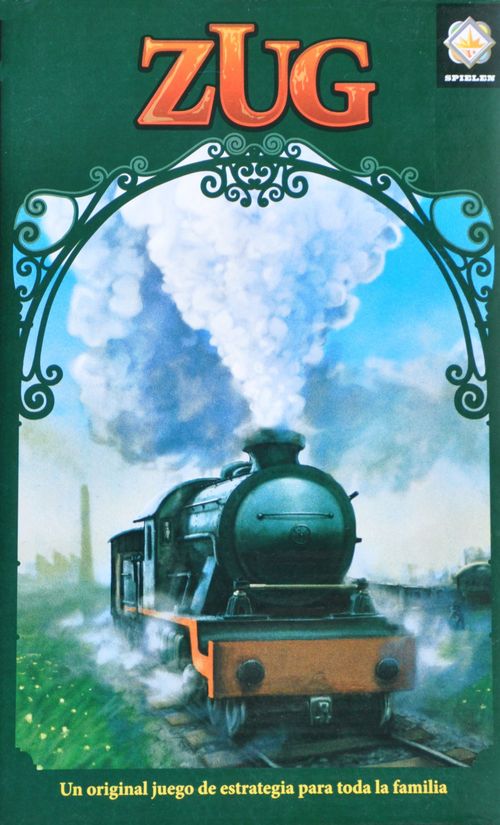
Zug
Zug Rulebook
Table of Contents
Table of Contents
Introduction
In this original tile-based strategy board game, players must build a railway system that allows them to carry the sugar, produced in their factories, to the cities. Players cooperate among them to build railway lines, curves, bifurcations, T-junctions and railway stations and, at the same time, they compete to be the ones who sell the most sugar to the cities.
Game description
Players must place tiles representing factories, railway tracks, railway stations or cities on the board. As the game progresses, a railway system connecting cities and factories is built. Once all the tiles have been placed, the sugar production is carried from the factories to the cities through the allowed railways. The player who scores the most will be the winner.
Game content
The game contains the following items:
- 90 railway and city tiles
- 75 plastic counters of 5 different colours
- 1 scoring board
- 1 rulebook
Fig. 1 shows the different tiles that compose the game.
Fig. 1. Tiles that make up the game. Some tiles differ slightly in some of their details.
| Tile | Quantity |
|---|---|
| Straight line | 6 tiles |
| Line with factory | 12 tiles |
| Line with locomotive | 3 tiles |
| Curve | 6 tiles |
| Curve with factory | 9 tiles |
| Double curve | 3 tiles |
| Bypass | 9 tiles |
| Double bypass | 3 tiles |
| Bifurcation | 3 tiles |
| T-junction | 3 tiles |
| Railway station | 15 tiles |
| City | 18 tiles |
Game set up
A T-junction tile must be placed in the middle of the table. The rest of the tiles are shuffled and placed face down for the player to draw from. There should be enough space for the board to be expanded.
Each player chooses one-colour counters. On the scoring board, they place one counter on the space signalled with an arrow. Then they decide who will start the game.
Fig. 2. How to place, step by step, the tiles on the boards. On factories, each player has placed his own counters.
Beginning of the game
In each turn, the player makes two moves:
- He draws a tile and places it on the table.
- If there is a factory, a locomotive or a railway station in the tile placed, the player should place a counter of his colour on that tile.
Tiles must always be placed adjacent to tiles that are already face up in a way that expands the railway tracks already formed or creating new ones. This is illustrated in figure n°2.
The tiles placed cannot block any segment of the railway line (Fig. N°3).
It can be the case that a tile is impossible to place in a given moment. That tile should be shuffled with the rest of the tiles and the player should draw a new one.
Fig. 3. Forbidden movement. Pieces placed on the board must not block any stretch of the existing lines.
Railway stations
For a railway line to be allowed, there must be a railway station on each extreme of the line. The stretch from one station to another one will be called "allowed line" (Fig. N° 4).
An allowed line can also have a unique station from which the railway comes and goes. (Fig. N°5).
Each time a player places a station tile, he must also place a counter of his colour on it.
An allowed line may have bypasses and/or bifurcations. A new allowed line can be created by means of a bypass or a bifurcation. There can be as much allowed lines as possible, where a station or a stretch of line can be part of one or more allowed lines. (Fig. N°6).
Fig. 4. Two station connected by a line constitute an allowed line. In the example the railway runs from left to right; however, it can be the other way round too.
Fig. 5. An allowed line can hold a unique station, if it is a close route.
Fig. 6. A new allowed line is created when a new station is placed on a bypass.
It must be taken into account that a railway can only run straight from station to station, without going backwards or changing position to reach a station. A stretch of line where a railway cannot run straight, cannot be considered an allowed line. (Fig. N°7).
It is not necessary for a station to be always placed on an existing line; it can also be placed on other lines foreseeing future lines, as long as they do not obstruct any existing line (Fig. N°8).
Fig. 7. Lines stretches that require the locomotive to run backwards or change position do not constitute an allowed line.
Fig. 8. Stations, as well as lines, can be placed anywhere as long as they do not block any stretch of existing lines.
Cities
City tiles are placed on the board in the same way as line and station tiles are; that is to say, without obstructing the existing lines. The player must place the cities adjacent to stations and foreseeing future lines, since a city which is next to a station is connected to the railways too, thus scoring more. (Fig. N°9).
When two or more city tiles are placed together, they make a unique city. A city may hold more than one station; in the same way, a station can be shared by two or more cities. (Fig. N°10).
Counters must not be placed on city tiles.
Fig. 9. Example of cities being placed adjacent to railway stations.
Factories
For scoring, the player must install factories, build railway lines and place cities and factories so as to connect, through the railway, their factories to the cities.
There is no limit to factories, cities, stations or railway installing.
Lines can hold as many factories, and from any player, as possible. Cities can be as big and hold as many railway stations as possible. Lines belong to all the players. One station's player can be used by all the other players.
It could be the case that a player has already placed all his counters on the board and has no one left. In that case, and if the player needed more counters, he could take one of it placed previously on another tile and place it on a new one. The tile where the counter used to be does no longer belong to the player and can not be used by any other player either.
Fig. 10. On the image, three cities can be seen: two of them, located to the left, are realised by single city tiles and share the same station; one third city to the right, is made up by four city tiles and they hold two stations.
Sugar selling
When the last tile has been placed on the board, the next player starts the sugar selling. In this stage of the game, each player, during his turn, takes a counter from his factory and carries it, through an allowed line, to the station, and from there to the adjacent city. (Fig. N°11).
If the player goes along a station belonging to another player, that other player scores 1 point. For doing so, he moves their counter one space on the scoring board.
On each city tile can be placed only one counter, of any colour. If the city is made up of more than one tile, a counter can be placed on each of the tiles that make up the city.
It must be taken into account that for a counter to move from a station to a city, the railway line must be allowed.
Fig. 11. The player, in his turn, takes a counter placed on one of his factories and carries it, through an allowed line, to a city tile.
Scoring
When the counters have been placed on all the cities or when there are no more counters to move, points are awarded. Those counters that have not been moved from the stations, whether because the railway lines were not allowed or because the cities were occupied by other players, will be removed from the game.
In the same way, the counters placed on stations which do not constitute an allowed line will be removed.
Points will be awarded in the following way:
a) For each counter placed on a city, the player scores 3 points.
b) For each counter placed on a locomotive on an allowed line, and if both stations belong to the same player, he scores 3 points.
c) For each counter placed on a railway station on an allowed line, the player scores 1 point.
The points awarded for each player are marked on the scoring board by moving the pieces on it. At the end of the game, the player with the most points wins the game.