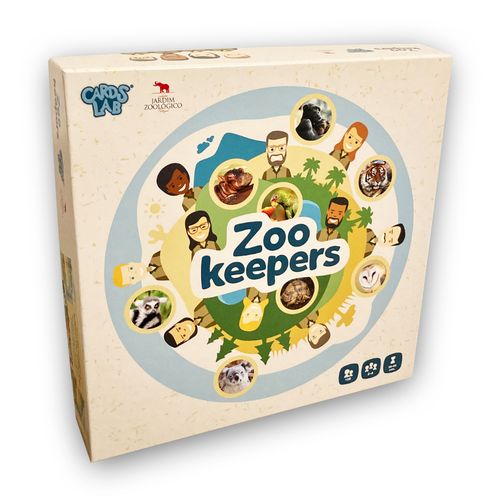
Zookeepers
Zookeepers Rulebook
Table of Contents
Table of Contents
Game Objective
In Zookeepers, you will manage a Zoo with the mission of hiring zookeepers and saving some of the species that are in danger of extinction! But beware, the species that give you the most points are also the most difficult to save and other zoos may ask for your help. Will you take this challenge?
The game ends when a player saves his 6th or 9th specie, depending on the game mode, winning the player with most victory points.
Contents
4 Zoos / 6 Zoos. Each player will receive a gameboard, representing their Zoo, which must be placed in front of them. Each board has one side for normal mode and the other for fast mode.
- Normal mode board shows: quarantine zones, keeper houses, saved species counter, conservation fund.
- Fast mode board shows: quarantine zones, keeper houses.
60 Species. Species are the main game element. The deck is composed by 30 mammals, 18 birds and 12 reptiles. Each species card shows: victory points, resources needed to save it, diet, class, origin(s), habitat(s), and name.
55 Resources. Resources are used to save species and may vary depending on their weight, diet and conservation status. There are 3 types:
- 20 red cubes (meat/fish — for carnivorous or omnivorous species)
- 20 green cubes (plants — for herbivorous or omnivorous species)
- 15 white cubes (medical kit — for the most threatened species or for use in the conservation fund)
4 Rules cards. Rules cards summarize each turn's available actions and final scoring calculation.
24 Keepers. It is through the zookeepers that players will be able to save the different species, up to a maximum of 3 per card. Each keeper card shows: name, victory points, and the objective (type and number of species to be saved).
8 Secret objective cards. These cards are only used in the advanced mode and allow the players to obtain additional victory points at the end of the game.
4 Player tokens. The player tokens are used to indicate the number of species saved by each player in their Zoos.
1 Bag. The bag is used to store and obtain resources during the game.
Fast Mode: Setup
- Each player receives a gameboard.
- Deal a 1 point keeper card to each player, who places it in any of the keeper houses. Put the remaining 1 point keeper cards back in the box. These keepers can save any species in the game. Each house can only have 1 keeper.
- Shuffle the 2 and 3 point keeper cards to form a deck. Deal one card to each player, who places it in any of the keeper houses. The 4 and 5 point keeper cards are not used in this mode.
- Shuffle the species cards to form a deck faced down.
- Deal the first six cards face up on the table next to the deck.
- Each player chooses his token and places it in the saved species counter, in the position "0" at the gameboard.
- Give the following resources to each player: 4 red, 4 green, 3 white.
- Place the remaining resources in the bag.
- Give each player a rules card.
Fast Mode: How to Play
Zookeepers is played in turns, clockwise, starting by the player who has been to the Lisbon Zoo most recently. During their turns, the players can choose any free actions and one of the four main actions:
Action I: Save Species
You can save a species from the table or save a species from one of your quarantine zones in the game board. Pay the amount of resources indicated in the card by returning them to the bag and place the species beneath the keeper. Be aware that each keeper can only save up to 3 species and that they have to match his objective. Saved species can't be later moved.
Example: Player A decides to save a species from the table. The player returns the necessary resources to the bag, places the species under his zookeeper and moves his token in the saved species counter to "1". Player B decided to save a species from his quarantine. The player returns the necessary resources to the bag, places the species under his zookeeper and moves his token on the saved species counter to "1".
New species. Whenever one or more species leave the table, the grid is refilled with cards drawn from the deck.
Complete a zookeeper. A zookeeper is completed when there are 3 species associated that fulfill his objective. From that moment on, it will not be possible to associate more species and the card is turned upside down.
Action II: Collect Resources
Without looking, take resources from the bag, equal to the number of saved species (associated to your keepers). If there are not enough resources in the bag, draw only those you can.
At the end of your turn, if you have more than 12 resources and/or more than 5 white resources, return any excess to the bag.
Example: Player C decides to collect resources and takes 2 from the bag (as many as the number of species he has on his zookeepers).
Action III: Discard or Put Species in Quarantine
You can discard up to 2 cards from the table to the bottom of the deck or send up to 2 species to your quarantine zones (as long as the species' habitat matches them) or make a combination of the two, as long as the 2 cards are not exceeded.
Example: Player A decides to move 2 species. He sends one to his quarantine zone and the other to the bottom of the deck.
Note: species on your quarantine zone can't be moved or discarded (they can only be saved). Each quarantine zone can only have 1 species and the one from the top doesn't have any habitat restrictions.
Action IV: Manage Keepers
You can replace one of your zookeepers with another one from the top of the corresponding deck. The discarded zookeeper must be placed at the bottom of the deck. All saved species from this zookeeper are discarded and placed at the bottom of the species deck (the saved species counter is adjusted accordingly).
Free Action: New Species
Once per turn you can pay 1 resource to replace the cards at the table with 6 new species from the deck.
Note: In the other actions, whenever one or more species leave the table, the grid is refilled with cards drawn from the deck.
Normal Mode: Setup
- Each player receives a gameboard.
- Deal a 1 point keeper card to each player, who places it in any of the keeper houses. Put the remaining 1 point keeper cards back in the box. These keepers can save any species in the game. Each house can only have 1 keeper.
- Shuffle the zookeeper cards and form 4 piles with 5 cards facing down.
- Shuffle the species and deal the first 12 cards. Place them on the table as the image shows (cards on the last row should be facing up). The remaining ones will form the game deck and are placed face down.
- Each player chooses his token and places it in the saved species counter, in the position "0" at the gameboard.
- Give the following resources to each player: 4 red, 4 green, 3 white.
- Place the remaining resources in the bag.
- Give each player a rules card.
Normal Mode: How to Play
Zookeepers is played in turns, clockwise, starting by the player who has been to the Lisbon Zoo most recently. During their turns, the players can choose any free actions and one of the four main actions:
Action I: Save Species
You can save a faced up species from the table or save a species from one of your quarantine zones in the game board. Pay the amount of resources indicated in the card by returning them to the bag and place the species beneath the keeper. Be aware that each keeper can only save up to 3 species and that they have to match his objective. Saved species can't be later moved.
Example: Player A decides to save a species from the table. The player returns the necessary resources to the bag, places the species under his zookeeper and moves his token in the saved species counter to "1". Player B decided to save a species from his quarantine. The player returns the necessary resources to the bag, places the species under his zookeeper and moves his token on the saved species counter to "1".
New species. Every time a species is removed from the table, the next player moves the column of cards down so that new species are visible. The grid is not refreshed with new cards from the deck.
Complete a zookeeper. A zookeeper is completed when there are 3 species associated that fulfill his objective. From that moment on, it will not be possible to associate more species and the card is turned upside down.
Bonus (asking a Zoo for help). If any player has more saved species than you at the beginning of your turn, you may send him one faced up species from the table to one of his free quarantine zones. The opponent chooses the quarantine zone to place it and can only receive the species if it complies with the zone's habitat.
Example: In the situation shown, while still on his turn, Player B can send a species to a quarantine of Player A's choice, since Player A had more species saved at the start of the turn.
Action II: Collect Resources
Without looking, take up to 6 resources from the bag, equal to the number of saved species (associated to your keepers). If there are not enough resources in the bag, take only those you can.
At the end of your turn, if you have more than 12 resources and/or more than 5 white resources, return any excess to the bag.
Example: Player C decides to collect resources and takes 2 from the bag (as many as the number of species he has on his zookeepers).
Action III: Discard or Put Species in Quarantine
You can discard up to 2 cards from the table to the bottom of the deck or send up to 2 species to your quarantine zones (as long as the species' habitat matches them) or make a combination of the two, as long as the 2 cards are not exceeded.
Example: Player A decides to move 2 species. He sees one of the available cards and sends it to his quarantine. Then, he picks another card and sends to the bottom of the deck.
Note: species on your quarantine zone can't be moved or discarded (they can only be saved). Each quarantine zone can only have 1 species and the one from the top doesn't have any habitat restrictions.
Action IV: Manage Keepers
As a way of managing your goals and strategies, you will be able to Hire, Replace or Dismiss a zookeeper:
- Hire: choose one of the cards from the top of the available decks and place it in an available zookeeper house on the board.
- Replace: choose and discard one of your zookeepers to replace it with another one from the top of one of the available decks. The discarded zookeeper must be placed at the bottom of the same deck and all associated species with it are placed at the bottom of the species deck.
- Dismiss: choose and discard one of your zookeepers and place it at the bottom of one of the zookeeper decks. All saved species from this zookeeper are discarded and placed at the bottom of the species deck (the saved species counter is adjusted accordingly).
Example: Player B decides to replace his zookeeper. He places it at the bottom of a zookeeper deck and places the species associated with it at the bottom of the species deck. He then draws a new one from the top of same zookeeper deck and places it on the zookeeper house.
Free Action: Conservation Fund
During your turn, you can freely access the conservation fund, which allows to use resources in different ways.
-
When saving species, you can use one or more medical kits (white cubes) in place of vegetables (green cubes) and / or meat (red cubes). Each white cube is equal to 2 red cubes or 2 green cubes. There is no return of resources (for example, if a species needs 1 red cube to be saved and you use 1 white cube, you will not receive the extra red cube).
-
At the start of your turn, return any of your resources to the bag and take new ones, without looking, in a 2 for 1 ratio.
Example: At the beginning of his turn, Player C decides to take 4 resources from the bag, without looking. He then chooses the resources he wants to keep and returns 8 to the bag.
Free Action: New Species
When there are only 2 columns of species on the table, you can freely discard them and place 12 cards from the top of the deck. Replaced cards (if any) are placed at the bottom of the species deck. This action is mandatory if there are no species on the table.
Example: Player C decides to move a species to his quarantine zone. Since only 2 columns of species remain at the table, he opts to replace all cards. He then moves another species to another quarantine zone.
Advanced Mode
On this mode, two rules are added to the normal mode.
Secret Objectives
Deal 1 secret objective card to each player at the start of the game.
These cards allow you to obtain additional victory points when saving certain kinds of species. The objective depends on the total victory points of your zookeepers (completed or not) at the end of the game.
Each secret objective card shows: the total zookeeper victory points threshold in the Zoo board, the species types to save depending on those points, and the extra victory points obtained for each saved species.
Note 1: The colors refer to the species conservation status.
Note 2: During their turn, players will also be able to discard this card and buy a new one from the top of the pile. This counts as an action.
Species Protection Rule
In the Bonus rule (asking a Zoo for help), you can now discard cards from the opponents' quarantine zones, in case they cannot receive any card from the table. In this situation, you can choose and discard one of the opponents quarantined species before you complete the bonus action. Place the discarded card at the bottom of the deck.
To protect your quarantined species, during your turn you can place any of your resources on top of them. The following rules apply:
- Resources must comply with the species diet (for example, you cannot place red cubes on herbivores).
- You cannot exceed the limit of the species resources (for example, you cannot place 3 green cubes in a species that only needs 2).
- You can place up to 3 resources per species.
- Conservation fund rules apply (that is, you can put white resources instead of green or red ones).
- Once placed, resources can't be moved from species to species. However, they can be used to save the species below them.
If an opponent discards a species that you are protecting, you'll receive twice as much the resources placed on top of it. You receive the resources back + exactly the same resources, taken from the bag.
If the bag does not have the necessary resources, take only those you can.
Example: Player B saved a species during his turn. Since Player A has more species saved, Player B decides to trigger the bonus action. In this situation, since Player A cannot receive any other species from the table, Player B decides to discard the card shown in the figure to the bottom of the deck and move the card from the table to Player A's quarantine. Since the discarded card was protected with 1 white resource, Player A receives 2 white resources (1 that was on the card + 1 from the bag).
Teams Mode
This game variant allows to play in groups of 2 and collect victory points together. It has the same rules of the other modes, with the following differences:
- On action III, you can now move a species to any teams member quarantine.
- Players must seat alternately, to prevent 2 consecutive turns from the same team.
- In advanced mode, each team member has its own secret objective and is visible to each other.
Note: It is not allowed to exchange keepers, resources or species between team members.
5-6 Player Mode
By joining two copies of Zookeepers, you can play with up to 6 players! The components for 5-6 players consist of: 77 resources (28 red, 28 green and 21 white), 60 species cards, 20 keeper cards (of 2-5 points), 5-6 keepers (of 1 point), 8 secret objective cards, 5-6 Zoos and 5-6 player tokens. Remaining rules apply.
End of the Game and Scoring
Fast mode: The game ends when one of the players saves 6 species and the remaining players finish their turns.
Normal and advanced mode: The game ends when one of the players saves 9 species and the remaining players finish their turns, although it is not allowed to use the Bonus option (asking a Zoo for help) on these last turns.
For 5 and 6 players, the game is immediately ended if at some point both these conditions are met:
- There are no species on the table and deck.
- A player can't save any of the quarantined species because they are not compliant with his zookeepers objectives.
In advanced mode, players must also check their objective card level and add the extra victory points obtained.
You win the victory points from the saved species and completed zookeepers. You lose 2 victory points for each unsaved species at your quarantine zone. The player with the most victory points wins the game.
Example scoring: Secret objectives 5+5 = 10. Species 6+1+3+4+1+1+6 = 22. Quarantined species -2-2 = -4. Zookeepers 5+5 = 10. Total = 22 (Species) + 10 (Zookeepers) - 4 (Quarantined species) + 10 (Secret objectives) = 38.
Additional Information
Habitats
Aquatic, Desert, Mountain, Prairie, Savanah, Temperate, Tropical.
Class
Bird, Mammal, Reptile.
Diet
Carnivore, Herbivore, Omnivore.
Origin
AF Africa, AM America, AS Asia, EU Europe, OC Oceania.
Objectives
Objectives with the "+" sign mean that the species will have to fulfill both criteria. Objectives with the "/" sign mean that the species must meet at least one of the criteria.
Objectives with the "any species, any combination" symbol mean the player can save any species in any combination.
At the back of each zookeeper card you can find the minimum number of available species in the game that match his objective.
Resources
The number of resources needed to save a species is directly related to its weight (green and red cubes) and its conservation status (the more critical it is, the more white cubes will be needed).
- Meat/Fish (red cubes): For carnivorous or omnivorous species.
- Plants (green cubes): For herbivorous or omnivorous species.
- Medical Kit (white cubes): For the most threatened species or for use in the conservation fund.
Conservation Status
The species cards have a specific color, depending on their conservation status and in accordance with the IUCN (International Union for Conservation of Nature). Species with a more critical conservation status will give more victory points. In this game, 5 different statutes were considered from the existing 9 defined by the IUCN:
Not Evaluated, Data Deficient, Least Concern (1 point), Near Threatened (1 point), Vulnerable (3 points), Endangered (4 points), Critically Endangered (6 points), Extinct in the Wild, Extinct.