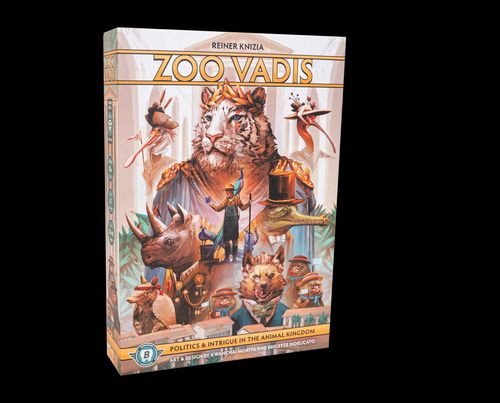
Zoo Vadis
Zoo Vadis Rulebook
Table of Contents
Table of Contents
Objective
Earn laurels as you navigate and negotiate your animals into the Star Exhibit. The game ends immediately once all the spaces in the Star Exhibit are filled. Whoever has the most laurels at the end of the game wins and is declared the Zoo Mascot, but your laurels are worth nothing unless at least one of your animals reaches the Star Exhibit.
Components
- 42 animal figures (6 per species): Rhino, Crocodile, Marmoset, Ibis, Hyena, Tiger, Armadillo
- 6 peacock figures
- 14 ability tiles (2 per species)
- 1 double-sided board
- 7 player screens
- 1 cloth bag
- 102 laurel tokens (60x I, 4x II, 4x II Zoo Keeper, 3x II Peacock, 4x II Ability, 12x III, 9x IV, 6x V)
- 1 Zoo Keeper token
Setup
- Place the game board in the center of the play area with the side face-up that matches your number of players.
- Place one peacock figure on each space of the game board that depicts the matching number of players for this game. Return any remaining peacock figures to the box.
- Place the "I" laurel tokens in a pile beside the game board. Mix all other laurel tokens (values 2-5) in the cloth bag. Randomly draw and place one laurel token face-up from the cloth bag onto each designated space of the board.
- Stack the Zoo Keeper token face-up on top of the laurel token that is directly below the Star Exhibit.
- Each player selects an animal species and takes the associated animal screen, two ability tiles, and six animal figures. Stand your screen in front of you. Place your six animal figures in front of your screen; your animal supply should be visible to all players. Slot your two ability tokens on top of your screen.
- Each player takes two "I" laurel tokens from the supply and places them behind their screen.
- The player who most recently visited a zoo is the starting player. (Or randomly select a starting player.)
Gameplay
Play begins with the starting player, and turns proceed clockwise until the game end. On your turn, you must take one action. Your options are the following:
- Add an animal to the zoo
- Advance one of your animals
- Advance a peacock
- Move the Zoo Keeper
These action options are detailed below.
Add an Animal to the Zoo
Take an animal from your supply and place it on any open space in one of the four exhibits at the bottom of the board. You cannot select this action if all of the four exhibits at the bottom of the board are already full.
Advance One of Your Animals
Advance one of your animals from one exhibit up a path to the next exhibit. You cannot advance an animal unless:
- You have the majority support of the exhibit that you are trying to leave
OR
- The Zoo Keeper token is on the path that you want your animal to advance along
Voting
Voting is the means by which you may obtain majority support to advance your animal. For each animal you have in the exhibit that you are trying to leave, you get one vote. For each animal another player has in the exhibit that you are trying to leave, they may offer one vote, or they may withhold their support. If you are in a one-space exhibit, getting a majority vote is automatic. For three, five, and seven-space exhibits, you may have to get votes from other players and/or peacocks in order to leave. Two votes are required to leave a three-space exhibit, three votes are required to leave a five-space exhibit, and four votes are required to leave a seven-space exhibit.
Note: The vote requirement is determined by the number of spaces in the exhibit area, not the number of animals actually in the exhibit. Your animal may leave the exhibit even before it is full of animals; all you need is the required number of votes.
Example: You have two animals in a five-space exhibit. Another player has one animal in the same exhibit. The remaining two spaces in the exhibit area are vacant. You want to advance an animal up to the next exhibit. In order to move the animal, you need three votes because it is a five-space exhibit. While you have the most animals present, you must still get the support of the other player. Otherwise, your animal may not move from this area.
Note: If a player selects this action but is unable to obtain the majority vote needed to advance their animal, then they may attempt to advance an animal in a different exhibit or select a different action entirely.
Making Deals
Sometimes you can obtain majority votes by having enough of your own animals in the exhibit. Other times you will have to make deals with other players and/or bribe the peacocks to get the required votes.
Players can trade laurels, promises of votes, promises of moving or not moving animals or the Zoo Keeper, promises to save or use animal abilities, or any other promises referring to the current turn or future turns. Promises that can be redeemed within the same turn must be kept. All other promises may be broken or kept at the player's discretion.
Negotiations and deals are allowed between any number of players at all times during the game, even if none of those players are currently taking a turn. No player is ever forced to negotiate a deal with other players, much less accept any offer.
Hint: Players who make more trades and deals are generally more likely to win. You may be helping others, but you are also helping yourself!
Example: You have two animals in a five-space exhibit. One other player has one animal in the same area. You need three votes to move, so you make a deal with the other player. You offer to give her two laurels right away and to support her with the vote of one of your animals later (when the other player calls upon you). The promise to hand over the two laurels must be kept during your current turn. The promise to give a supporting vote at a later time may be broken.
Bribing Peacocks In Your Exhibit
In order to obtain a vote from a peacock, you must bribe it. Each peacock only accepts a bribe of a value "II" laurel token or higher; giving up two "I" laurel tokens does not suffice! Your paid bribe is placed in the game box.
You are allowed to bribe more than one peacock in the same exhibit.
Advancement Rules
The basic rules of advancing animals are simple:
- You can only advance your own animals
- You may never move an animal backwards (away from the Star Exhibit)
- Animals must advance along paths (not tunnels) and cannot bypass an exhibit
- An animal cannot advance into an exhibit that is already full
- An animal may take any path leading up from an exhibit, regardless of which space the animal occupies in the exhibit.
In some cases, you will not be able to advance any of your animals. This will happen when all of the exhibits above your animals are full.
Normally, it does not matter which empty space you place your animal on when entering an exhibit. However, when entering the Star Exhibit, spaces should be filled in numerical order, starting with space 1. This is important for determining the winner of an end-game tiebreaker, if necessary.
Collecting Laurels
When you move an animal from a three, five, or seven-space exhibit, you may collect the laurel token along the path the animal takes. Then replace it with another token randomly drawn from the cloth bag. Place the new token face-up on the laurel space on the given path.
Keep all of the laurel tokens you earn and collect behind your player screen, where they are hidden from the view of other players.
You can also earn laurels by helping another player advance an animal. Whenever an animal has needed and gained votes from other players, those players are rewarded with a "I" laurel token from the supply for each vote they gave in support. These tokens are granted in addition to any payments agreed between the players, but only while supplies last. If the moving animal garnered more votes than necessary, only the votes needed for the majority earn tokens; the player who moved the animal gets to decide who receives them.
Note: You are not allowed to make change with your laurel tokens using "I" laurel tokens from the supply. But you can try to negotiate with other players and make change using their tokens.
Advance a Peacock
Peacocks are known to roam freely throughout the zoo or into various exhibits at their leisure. This is because they are not dangerous to guests or animals. Peacocks may advance into the Star Exhibit, possibly blocking out other players, and this may even trigger the game end.
Advance a peacock from one exhibit up a path to the next exhibit. Peacocks follow the same advancement rules (see Advancement Rules) as other animals with the following exceptions:
- Peacocks may always leave an exhibit without the majority support of the other animals, thus no votes take place. There must still be an empty space in the exhibit the peacock is advanced to.
- Peacocks never collect laurel tokens when they advance. However, each time you advance a peacock, you get a "I" laurel token from the supply.
Normally, advancing a Peacock counts as your action. However, if you collect one of the special "II" Peacock tokens when one of your animals advances from one exhibit to the next, you may advance a Peacock at the end of your turn as a one-time bonus action. (Don't forget to collect a "I" laurel token for moving the Peacock!) Because your animal is advancing, only you can collect this special laurel token and only you can take the bonus action of Advancing a Peacock. This feature is not transferable, but how you use it (which peacock you advance, and where) is of course negotiable. If the token is traded away thereafter, the feature does not activate again.
Move the Zoo Keeper
Details are sparse on how exactly the animals grew in intelligence and gained control of the zoo. All we know is that only one human employee has been allowed to stay: the friendly old Zoo Keeper.
Move the Zoo Keeper to any other laurel token on the board. Stack the Zoo Keeper on top of the laurel token that you have moved it to.
The Zoo Keeper has two effects on play:
- The Zoo Keeper's presence on a path means that an animal may advance along that path without the majority support from the exhibit they are leaving.
- The Zoo Keeper covers the laurel token, so a player advancing an animal along that path does not collect the laurel token as they pass by. Note: You may always look at the token underneath the Zoo Keeper at any point during the game.
Normally, moving the Zoo Keeper counts as your action. However, if you collect one of the special "II" Zoo Keeper tokens when one of your animals advances from one exhibit to the next, then you may move the Zoo Keeper at the end of your turn as a one-time bonus action. Because your animal is advancing, only you can collect this special laurel token and only you can take the bonus action of Moving the Zoo Keeper. This feature is not transferable, but how you use it (where you move him to, if at all) is of course negotiable. If the token is traded away thereafter, the feature does not activate again.
Animal Abilities
The following rules apply to using your animal ability tiles:
- You cannot transfer your ability tiles to other players. They are your animal's abilities!
- You cannot apply the power of your own ability tiles to yourself, only to other players.
- You may even apply the power of your own ability tiles to a peacock, but only when another player is advancing the peacock. The active player retains the right to accept or reject your power when advancing a peacock.
- It is possible for multiple players to use ability tiles in a single turn.
- After one of your ability tiles has been used, remove the tile from on top of your screen and lay it behind your screen.
- When another player takes their turn, they can ask you — or you can offer — to use your ability tile. In addition to whatever you agreed as compensation from the other player, if any, you always receive the number of "I" laurel tokens from the stock indicated on your ability tile (0, 1 or 2). Note that generally weaker abilities come with more "I" laurel tokens so that you can offer the use of weaker abilities even for free to other players and still be rewarded. Stronger abilities should give you plenty of opportunities to demand lucrative compensation from the other players.
Hint: Make sure that your ability tiles get used, and try to gain maximum benefits from them.
Normally, you can use your ability only twice during the entire game (once for each tile). However, if you collect one of the special "II" Ability tokens when one of your animals advances from one exhibit to the next, then you may immediately recover one of your used ability tiles by slotting it back on your screen. Because your animal is advancing, only you can collect this special laurel token and only you can recover one of your ability tiles. This feature is not transferable. If the token is traded away thereafter, the feature does not activate again.
Details and clarifications for the animal abilities are provided on the animal screens and at the end of this rulebook.
Ending and Winning the Game
The game ends immediately when all the spaces in the Star Exhibit are filled.
At this point, all the players who have at least one animal in the Star Exhibit compare the number of laurels that they have collected. The animal species that has collected the most laurels is declared the winner and becomes the Zoo Mascot.
In the event of a tie for victory, the tied species that reached the Star Exhibit first wins. Remember: The spaces in the Star Exhibit are filled in numerical order, making it simple to keep track of who arrived there first.
Example: Tiger advances into the last empty space of the Star Exhibit (space 5) and the game ends immediately. Now Rhino, Crocodile, and Tiger reveal and compare their laurel tokens. Rhino has 24 laurels. Both Crocodile and Tiger have 28 laurels. Although Armadillo has 31 laurels (the most of any species), they did not advance into the Star Exhibit, so they are disqualified from victory. So Crocodile and Tiger are tied for 1st place, but Crocodile wins the game because they entered the Star Exhibit before Tiger. Crocodile is officially elected Zoo Mascot!
Classic / Beginner Variant
This variant is recommended for those who wish to play the original, simpler design, Quo Vadis?, or for those who are novice negotiators.
- Do not play with the animal ability tiles. Instead, leave them in the box.
- If a player collects a "II" laurel token with an animal ability symbol, simply treat it as a regular "II" laurel token.
- Although peacocks were not in the original design, this new element tailors the game board to all player counts. We strongly recommend that peacocks still be used for this variant.
Animal Ability Clarifications
HYENA — Allow an additional action to move the Zoo Keeper. The other player may move the Zoo Keeper before or after taking their regular action.
TIGER — Allow an animal moving over the Zoo Keeper to collect the laurel. After the other player collects the token, replace it with a new token from the bag. Remember: You may always look at the token hidden under the Zoo Keeper.
MARMOSET — Allow a moving animal to collect a different laurel token from the board. When a player is advancing over a laurel token, this lets them collect a different token. After the other player collects any laurel token from the board, replace it with a new token from the bag.
CROCODILE — Allow an animal to advance again after it enters a 1-space exhibit. When another player moves an animal into a 1-space exhibit, this ability allows the player to move the same animal again, like a normal advance. This ability can even be used on a player who took an "Add an animal to the zoo" action by adding their animal to a 1-space exhibit at the bottom of the board.
IBIS — Allow a moving animal to enter a full exhibit. This ability applies to exhibits of all sizes. The ability is often used most effectively to allow a second animal into a 1-space exhibit.
Important: No more than one extra animal may occupy an exhibit at any time. Note that the other player must be able to move the animal into the new exhibit in its own right — this ability does not give the other player any votes to advance. Adding an animal to an exhibit in this fashion does not change the number of votes required to leave the exhibit. When another animal later leaves the exhibit, the additional animal takes its place, and the exhibit is still full. Crocodile's ability can be combined with this ability.
ARMADILLO — Allow an animal to advance through a tunnel without majority support. This ability allows the other player to use their turn to leave an exhibit from which a tunnel originates without the majority support from the exhibit. The animal moves to the exhibit at the end of the tunnel, provided there is an empty space. Crocodile's ability and/or Ibis' ability can be combined with this ability.
RHINO — Allow a moving animal to move any second animal with it. Note that the other player must be able to advance the first animal in its own right. This ability does not give the other player any votes to advance the first animal. It merely allows the other player to move any second animal from the same exhibit together with their first animal. The second animal may belong to the other player, to a different player, or even to the Rhino player. It may also be a peacock. The owner of the second animal usually benefits, but in any case, cannot refuse and does not collect a laurel token for advancing. The use of this ability requires two empty spaces where both animals are moved to.
Ibis' ability can be combined with this ability, but remember that no more than one extra animal may occupy an exhibit at any time. Crocodile's ability can be combined with Ibis' and Rhino's, but the second animal would be left behind in the 1-space exhibit unless a second Crocodile's ability tile was used. Armadillo's ability can also be combined with Rhino's ability.