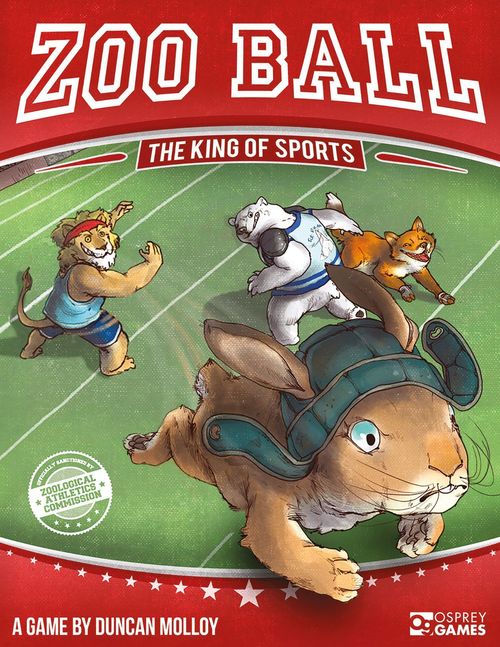
Zoo Ball
Zoo Ball Rulebook
Table of Contents
Table of Contents
The Pre-Season Draft
Good afternoon all, Rhonda & Ryan here with your latest pre-season update for Zoo Ball. Nothing gets us buzzing quite like seeing the pitch freshly mowed for another tense season of multi-animal sporting. It looks like they've even managed to regrow the patch from that notorious Barnstormers game last season!
With up to four teams playing in this season's tournament, it's hard to tell which players will end up making the cut. Will they be kept with their regular habitats, or will they be divided in the draft? We'll just have to wait and see...
Before you play the game for the first time, you'll need to stick your choice of characters onto the playing pieces. Make sure that each team colour has three blockers (larger animals with a white background) and one scorer (smaller animals with an orange background). There are only four teams in the game, but we have included extra character stickers for you to customise your copy of Zoo Ball. The characters on your sticker sheet have already been divided into groups, but feel free to mix and match to find your perfect squad.
How to Play
Zoo Ball is a dexterity game for two or four players (though it could be two or four teams if there are loads of you). Each player will control a team of zoo animals as they compete to be the pride of their city. Each team has three blocker pieces and one scorer piece. Lay the play mat on the table, making sure it's even and there are no obvious bumps in it. Then have everybody grab a team of four, and you're all set!
The rules are simple - to score a point, simply land your scorer fully inside the opposite goal. Being partially inside doesn't count - you must be fully inside the lines to get the point. When moving a piece, any one-fingered flick or nudge is acceptable. You cannot touch a piece with more than one finger though.
Is your scorer in the goal touching the edge? If you can't see the white line, then it's not a point! If you can see the white line you've scored.
Each turn you'll have a choice - either move your blockers, or move just your scorer. You can move all three blockers in one turn, though you may choose not to move some of them. Your blockers can be used defensively or aggressively, blocking shots on your own goal or clearing a path for your scorer, but they cannot score themselves. Only your scorer can get points.
Whenever a scorer is in their target goal, that's a point scored. Yes, even if you accidentally knock your opponent's piece in with your blockers! No, you can't 'take it back'.
Of course the reverse is true too: you can earn points by knocking your scorer into the goal with a blocker! It has to be said, there ain't a feeling quite like kicking your own teammate in the hiney.
Side-Lines and Leaving the Mat
If a piece strays into the side-line, move it back to the play area. Put it as close as possible to where it stopped without moving any other pieces. It must be touching the edge of the side-line. If a piece leaves the mat, reset it according to the rules of that matchup.
The 'off-the-side' rule is a new addition to the sport. Each team has one or two home sides depending on the type of match, and whenever a player leaves the field on an opposite side they have to run around the pitch back to their home side.
If your piece strays into the side-line, move it directly back into the play area. If any part of the piece is off the edge of the mat, it counts as having left the mat.
If your pieces ever leave the mat they will be reset in the playing area touching a side-line. Which side-line depends on which version of the game you are playing. If another piece is in the way, replace the piece as close as possible to where it should be.
If something weird happens, like a piece flipping upside down, or landing on another piece, reset it as close as you can to where it landed without moving any other pieces. If the players can't agree on a location, flip the piece in question as a tiebreaker.
Pieces reset after every move, even if you're moving multiple pieces on your turn.
Head-to-Head (2 Players)
In a two-player game you'll lock horns in an effort to be the first to three points. Each player will be defending one of the circular goals and trying to score in the opposite goal. Young or inexperienced players should use the outer circle as their target, while seasoned veterans should use the inner circle. The triangles in the corners have no effect in this version of the game.
You could even have the two players use different sized goals if you want to give one side a handicap.
Formations
Flip a playing piece to decide who will be the starting player. The starting player sets up their blockers anywhere on their side of the halfway line, in any formation. Once all three blockers have been placed, the other player sets up their blockers in response. Both scorers are placed on the stars in their respective goals.
Once both teams are set up the starting player takes their turn, and play will alternate until a goal is scored. Whenever a player scores, the pieces are reset in this manner, with the person scored against taking the role of starting player.
Off-the-Side
If it goes off the mat on your opponent's end, reset it at the equivalent point on your end. If it goes off the mat at any other point, reset it where it went off.
- When a piece leaves the sides of the board (A), it reappears by the side-line roughly where it left (B).
- When a piece leaves the board at the opponent's end (C), it reappears at your end in line with where it went off (D).
- When a piece leaves the board at your end (E), it reappears by the side-line roughly where it left (F).
The side-line refers to the white border closest to the edge of the mat. The playing area refers to everything inside that border.
Rumble (4 Players)
Four players compete to crown a king in the jungle! In this version of the game you'll be playing from a corner of the mat, defending the goal that matches your team colour and trying to score in the triangular goal diagonally opposite you. Ignore the circular goals. The first player to score a point wins, so you will end up having to defend other players' goals to make sure you have a chance!
Randomly decide who goes first, and play will continue clockwise. In this version everyone's starting formation is set up simultaneously. Your pieces can be in any orientation within the semi-circle in front of your goal. It's even allowed to have them over the edge, as long as the piece is touching the white line. The pieces can start anywhere partially inside the semi-circle.
Off-the-Side
Now that you're playing out of the corner, there are two edges which count as your side of the mat. If your piece goes off the mat on either of the sides closest to your own goal, reset the piece where it went off. If your piece goes off either of the other two sides, reset it at the equivalent point on the opposite side.
For example, if you are defending the blue goal and your piece goes off the mat at either point A or point B, it will reset at point C.
You can make use of the 'Hilda Gambit', deliberately going out of play to line yourself up for a clearer shot from further away.
A Note on the Playing Field
The playing mat is not suitable for ironing. Should your mat develop a crease, simply fold the mat in the reverse direction to even it out.