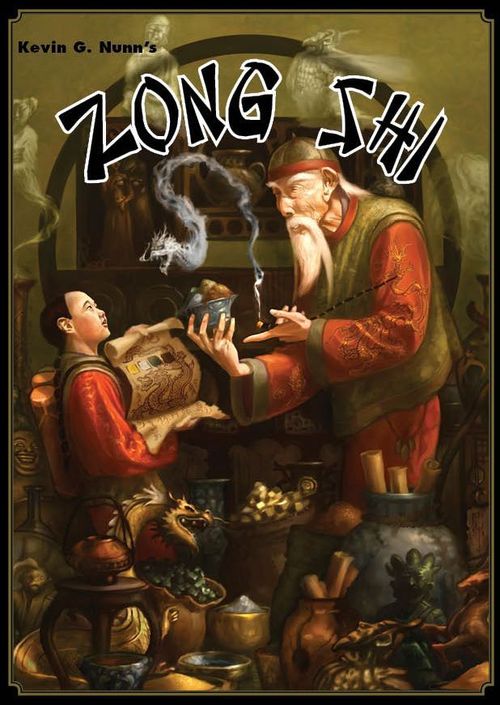
Zong Shi
Zong Shi Rulebook
Table of Contents
Table of Contents
Components
- 36 Scrolls of Fortune Cards
- 5 Townsfolk Award Tiles: Free Scroll, Free Exchange Tile, Random Material from Bag, Free Respectful Visit, Free Material from Bins
- 24 Pawn Shop Exchange Tiles: Gold/Ivory, Ivory/Jade, Gold/Jade, Bronze/Jade, Ivory/Bronze, Gold/Bronze
- 5 Player Reference Cards
- 32 Project cards, each showing: Victory Points, Time Required, Project Name, Material Required, Project Use
- 12 Masterwork Project cards, each showing: Victory Points, Time Required, Material Required
- 5 Player Workshop Boards, each showing: Material Storage, Exchange Tiles Storage, Time Track for Projects in Progress, Completed Projects, Projects in Progress
- 5 Master Pawns in 5 player colors (Ivory, Blue, Green, Natural, Orange)
- 5 Apprentice Pawns in 5 player colors
- 20 Respectful Visit Tiles (4 in each player color numbered 1, 2, 2, 3)
- 40 Boxes (Plastic Tiles) of Material (10 each of Jade, Bronze, Ivory, Gold)
- 1 Chinese Bag
- 1 Jade Buddha - the start player marker
- 1 Game Board, showing the Respectful Visits area (Scholar, Official, Elder, Merchant), the Masterwork Deck and Masterwork Project spaces, the Marketplace, the Pawn Shop, and the Temple
Objective
Score the most victory points by managing your resources to complete artistic projects and complete respectful visits to the town elders.
Game Board Setup
Place the game board in the middle of the table, within easy reach of everyone.
Shuffle the Scrolls of Fortune deck and place it in the Temple.
Shuffle the deck of Masterwork Projects and place it face down onto its space on the game board. Draw the top two Masterwork Projects from the deck and place them face-up in the spaces provided next to the draw deck.
Shuffle the five Townsfolk Award tiles and place one tile face down on each of the four boxes in the Respectful Visits area of the board. Return the remaining Award tile to the box, unseen.
Choose a start player randomly and give this player the Jade Buddha — the start player marker.
Place Project cards and Exchange tiles in the quantity shown below onto the appropriate spaces of the game board. You may return any extras to the box as they will not be needed.
| Number of Players | Number of Project Cards | Number of Exchange Tiles |
|---|---|---|
| 3 | 3 of each | 2 of each |
| 4 | 3 of each | 3 of each |
| 5 | 4 of each | 4 of each |
Player Setup
Each player picks a color and takes the following items in their color:
- One player Workshop and Reference Board
- One Master pawn
- One Apprentice pawn
- Four Visit tiles numbered 1, 2, 2, 3
Place the Master pawn, Apprentice pawn and Visit tiles in your workshop.
Draw Scrolls of Fortune cards and Material Tiles in the quantities shown below. Place the scrolls face up on the table and place the material tiles next to the scrolls.
| Number of Players | Number of Scrolls | Number of Material Tiles |
|---|---|---|
| 3 | 3 | 6 |
| 4 | 4 | 8 |
| 5 | 5 | 10 |
Beginning with the player to the right of the start player and continuing counter-clockwise, players take turns choosing either one box of material or one scroll. Continue around the table three times, so that every player begins the game with a combination of three boxes and scrolls; a little bit to get them started.
- When you choose material, put it into the material storage area of your player board workshop.
- When you choose a scroll, keep it face down in front of you. You are free to read your scrolls at any time but you should not reveal them to other players.
Finally, fill the bins in the Marketplace on the main board by drawing random boxes of material from the bag. The large bin gets one more box than the number of players. The small bin gets one fewer box than the number of players.
| Number of Players | Large Bin Gets | Small Bin Gets |
|---|---|---|
| 3 | 4 Material | 2 Material |
| 4 | 5 Material | 3 Material |
| 5 | 6 Material | 4 Material |
A Round of Play
Each round of play has four steps:
- Step 1: Player Turns
- Step 2: Distribute Materials
- Step 3: Advance Projects and Score
- Step 4: End of Turn
Complete each step before moving on to the next step.
Step 1: Player Turns
Beginning with the start player and continuing clockwise around the table, every player takes a turn, using either their master or their apprentice. Proceeding around the table a second time, each player takes another turn with the one which remains. In this way, each player takes two turns during Step 1.
You may take either your master turn or your apprentice turn first and then take the other turn second. In this way, you can influence the flow of the game.
When taking your turn, you must do exactly one of these:
- A. Begin a project, or
- B. Go to a location, or
- C. Pass
A. Beginning a Project
Completing projects is the key to proving that your master is the best candidate. Impress the villagers with your creations and they will make you the Zong Shi!
Only your master has the skill to take on projects. Choose this option only if you are taking your "master turn."
In addition to their victory point value, most projects enhance your abilities, preparing you to take on even bigger projects.
Here is an example of a project—Merchant Statue. To build it, you must have one box of ivory, one box of jade and two boxes of gold. Building it takes two turns. Completing it scores 2 victory points. In addition, for the rest of the game, you'll immediately draw a bonus box of material every time your master goes to the marketplace.
When you choose to begin a project, immediately announce the project you intend to take on. Show everyone that you have the materials needed for the project and return them to the bag. Place the project in the Projects in Progress area of your player board and place your master pawn on your player board's timing track (time required) in the space matching the time indicated on the project.
Example of Beginning a Project: Joy has announced that she wishes to make a Merchant Statue. She takes the project tile from the game board and puts it into her Projects in Progress space. Then she returns to the bag of material one box of ivory, one box of jade and two boxes of gold. Finally, she puts her Master Pawn on the time-required = 2 space in her Workshop.
If you begin a masterwork project, draw and reveal a new one to replace the one you took.
You may only work on one project at a time. Even if you have sufficient materials for two projects, you still may only do one at a time. Only through the use of the scroll Follow the Twofold Path, may you ever have two projects in your Projects in Progress space at once.
Once a project has begun, it must be completed before that pawn may move on to anything else. Projects may not be abandoned, nor may you halt work on one and return to it later.
B. Going to Locations
There are four locations on the board to which your pawns may go—the Marketplace, the Temple, the Pawn Shop and Respectful Visits. Simply place your pawn in the appropriate area of the board and announce what action you'll take there.
Going to the Marketplace:
When you choose this action, place your pawn in one of the two bins/jars at the marketplace and leave it there. You will get a share of the materials in this bin during Step 2 of the round.
Going to the Temple:
When you choose this action, put your pawn on the temple and immediately draw one Scroll of Fortune card.
Your master may draw more Scrolls of Fortune if you make a donation to the temple by returning boxes of material from your workshop to the bag before you draw any scrolls. For each box of material you donate in this way, you may immediately draw an additional scroll. Your apprentice may not draw additional scrolls in this manner, only your master.
You are limited to holding no more than four scrolls at a time. If after drawing you hold more than four, you must discard down to four before ending your turn.
Scrolls of Fortune are single-use cards that create a specific effect described on the card. Some effects—like Fortune Brings Opportunity—happen immediately. Others last until the end of the turn. Each scroll indicates when it may be played. While some scrolls may be played at any time, most must be played at the beginning of your master's turn. In this case, all scrolls must be played immediately before choosing between Beginning a Project, Going to a Location, or Passing. Once you have finished playing scrolls, discard the ones you played into a discard pile, face up and next to the draw pile. If the deck of scrolls becomes exhausted, shuffle the discard pile into a new draw deck. Over the course of the round, you may play as many scrolls as you wish but every scroll you play during the round must be different.
Going to the Pawn Shop:
The Pawn Shop lets you exchange one type of material for another. Each exchange tile you possess represents your ability to exchange the two materials shown on the tile for one another when satisfying a project's formula or paying respectful visits.
Example: You possess the ivory-jade exchange tile shown and you have two boxes of gold and two boxes of ivory in your material storage. With this combination of material, you could build Merchant Statue by announcing that you are exchanging one of the boxes of ivory for a box of jade.
Exchange tiles do not operate in "chains," however. If you have the ivory-jade exchange tile and the jade-gold exchange tile, this does not give you the ability to transform ivory into gold.
To claim an exchange tile, place your master or apprentice in the Pawn Shop, select an available exchange tile and turn in one of each of the two materials shown on the tile. You may immediately place the tile on your player board. At the end of the game, this will score 1 victory point.
If you send your apprentice to the Pawn Shop, you may only claim one exchange tile. If you send your master, you may claim as many exchange tiles as you can afford with the material you have.
In addition, if you acquire all six of the exchange tiles, you will score 2 additional victory points at the end of the game.
Paying Respectful Visits:
Perhaps as important as the projects you complete is the impression you make on the townsfolk. Visit them and pay your respects with a gift to earn their good will, making it more likely you'll be selected as the next Zong Shi.
When you choose this action, put your pawn in the Respectful Visits area of the board.
There are four different townspeople you may choose to visit—the Scholar, the Official, the Elder, and the Merchant. Each one expects that you'll bring a gift appropriate to his status within the community.
When you make your visit, you should immediately choose one of the four people, place one of your numbered visit tiles on that person and make your gift to him by returning the appropriate material tile from your workshop to the bag. The type of material you return is determined by the person you visit. The amount of material you return is set by the number on the tile that you use.
Example of making a Respectful Visit: Gene announces that he'll be visiting the Scholar. He places his apprentice pawn on the Respectful Visits area of the game board and places one of his "2" tokens in the Scholar's area. Then he returns 2 boxes of jade to the bag.
Your apprentice may only visit one group each time he visits the townsfolk but you may choose to have your master visit more than one person at a time. In this case, the people visited will expect a greater tribute to make up for your decision to divide your time between them. Thus, if you choose to visit more than one person on a turn, you must give up one extra material for each person visited, as noted in the example on the following page.
Example of visiting multiple townsfolk: Gene announces that his master will be visiting both the Scholar and the Official. This time he places one of his "2" tokens in the Scholar's area and his "1" token in the Official's area. Then he returns 3 boxes of jade and 2 boxes of bronze to the bag.
Over the course of the game, you may visit each townsperson only once and you may use each visit tile only once. However, the order in which townsfolk are visited and tiles that are used are entirely your decision.
Townsfolk appreciate it when the master comes early and in person. If your master is the first one to visit a person, you may immediately draw the townsfolk award tile in that area, carry out its effect, and discard it. The award tiles are:
- Draw a Scroll of Fortune.
- Pay one of the two material boxes shown on an available exchange tile and claim it. If you can not or choose not to pay the one material box cost for this award, simply discard it.
- Draw two random boxes of material from the bag and add them to your material storage.
- The townsfolk return your gift of material to you. Return any material boxes you were giving this person back to your material storage.
- Take one box of material from anywhere in the marketplace and add it to your workshop's material storage.
In addition to rewarding the first master to visit them, the townsfolk will also support those who make an effort to visit them throughout the game. At the end of the game, the size of this reward depends on the number of persons visited.
| Visits Made | Bonus |
|---|---|
| Visit one person | 1 Bonus Point |
| Visit two persons | 2 Bonus Points |
| Visit three persons | 4 Bonus Points |
| Visit all four persons | 8 Bonus Points |
C. Passing
If you pass on one of your turns, that pawn does nothing else this turn. You may pass any time you wish. You must pass if the pawn is currently working on a project.
Step 2: Distribute Materials
During this step, players who chose to send pawns to the marketplace get a share of the material in the bin they chose.
Begin by dividing up the material in the large bin and then divide up the material in the small bin.
If your master is the only pawn in a particular bin, take all the boxes of material from it and put them in your workshop.
If more than one master chooses the same bin, they will take turns, selecting one box at a time, until all the material has been claimed. Order of selection begins with the start player and proceeds clockwise from there.
Apprentices may also claim material but not as much as the masters do. If your apprentice is in a bin, he may take only one box of material and must wait until all of the masters in that bin have made one selection first.
If you don't get everything you need, you are free to return to the marketplace for more material next round.
But beware! The storage space in your workshop is limited. It can only accommodate five boxes of material at a time. Should you ever have more than five boxes, you must discard down to five before moving on in the round.
Step 3: Advance Projects
During this step, each player's pawn that is working on a project moves one step down the time track. When you reach zero, your project is finished. Score its victory points and move the project from "Projects in Progress" to one of the "Completed Projects" spaces in your workshop.
Every pawn working on a project advances during this step, including those that began the project during this round. This means that projects with a time required of 1 finish in Step 3 of the round they were begun, projects with a time required of 2 finish in Step 3 of the following round, and so on.
Once you have completed a project, you may begin using its game effects. If a player completes their sixth project, go immediately to the section entitled Game End.
Step 4: End of Turn
At the end of each turn you will return pawns, check for game end, refill bins and pass the start player marker.
If any of your pawns are on any game board location—in the Marketplace, the Temple, the Pawn Shop or paying Respectful Visits, return them to your workshop. Now check for game end. The game ends the round after any player completes a sixth project. If any player has completed six projects, go directly to Game End and The Final Round.
If the game has not ended, return any remaining materials in either of the marketplace bins to the supply bag. Then restock bins in the marketplace to their initial levels, as per the chart below:
| Number of Players | Large Bin Gets | Small Bin Gets |
|---|---|---|
| 3 | 4 Material | 2 Material |
| 4 | 5 Material | 3 Material |
| 5 | 6 Material | 4 Material |
Finally, pass the start player marker to the next player on the left, who begins the next round of play.
Game End
The game ends the round after any player completes a sixth project. All players that complete their sixth project in that round get a two-point bonus for triggering the endgame.
There will now be one final round of play before final scoring. Complete the End of Turn step and proceed to The Final Round.
The Final Round
The round after any player completes a sixth project is the final round.
During the final round, most players may take all the same actions they would normally. However, any players that have completed six projects may only choose to Go to a Location or Pass. All of their projects are completed and there is no room for another.
The final round is shorter. The game is over at the end of Step 3: Advance Projects and Score. If you are still working on a project when the game ends, you will receive a partial score for it during Final Scoring.
Final Scoring
The winner is the master that most impresses the townsfolk through his creations and his behavior.
Your final score is the total value of all your completed projects and exchange tiles added to the value of the townsfolk you visited, any project you were working on but did not complete, and any unused material or scrolls. Add an extra two points if you have acquired all 6 of the exchange tiles. Also add an extra two points if you finished six projects before the start of the final round.
Scoring Townsfolk Visits
You receive victory points for the number of townspeople you visited (see the Respectful Visits chart above).
Scoring Incomplete Projects
If any projects remain in your Projects in Progress space—projects you began but did not complete—you receive partial victory points depending on the amount of time remaining.
| Time Left | Victory Point Penalty |
|---|---|
| 1 | Reduce VP value by 1 |
| 2 | Reduce VP value by 3 |
| 3 | Reduce VP value by 5 |
Scoring Unused Material & Scrolls
Any boxes of material in your material storage and unused Scrolls of Fortune are now worth one victory point for every full three scrolls or material boxes remaining. Scrolls and material boxes are added together when determining this bonus.
Victory
The winner is the player with the highest score. In the case of a tie, the winner is the player that completed the greatest number of projects. In case that number is also tied, you share the victory and the village now has two new master craftsmen sharing the title of Zong Shi!
The Scrolls, in Detail
Pawn Shop Owner's Gift: Play this scroll and pay the material cost to immediately claim one available exchange tile from The Pawn Shop. Playing this scroll does not require that you actually send your master to The Pawn Shop. (x2)
Apprentice is Gaining Experience: Your apprentice may begin a project this turn (using the listed time required). Your apprentice does not, however, profit from Blacksmith Tools or from any of the Mastery… projects. This scroll cannot be used to have your apprentice build a Masterwork.
There is not sufficient room in your workshop for both master and apprentice to build at the same time. This scroll may not be played if your master is currently working on a project. Your master may not begin a project if your apprentice is already working on one. (x2)
Artistic Subtlety: Reduce the material cost of a project you begin this round by one material box of your choice. Unlike the Masterful Use of… scrolls, this scroll does not help you satisfy the material cost of a townsfolk visit or an exchange tile. (x2)
An Ear to the Wall: For this round, you may use a project another player has completed as if it were your own. You may only play this scroll to use a project that you yourself have not built. (x3)
Follow the Twofold Path: You may begin work on two projects this turn, using the greater time required of the two projects. In the special case that you only have one space left in your completed projects area, you will only score one of these projects but may count the other one as a tie breaker. (x1)
Fortune Brings Opportunity: Take one box of material out of a bin in The Marketplace, and put it into your workshop. If you now have more than your material storage limit, you must discard down to your storage limit before continuing. Playing this scroll does not require that you actually send your master to The Marketplace. (x3)
A Gift From the Priests: Draw one random box of material from the bag and put it into your workshop. If you now have more than your material storage limit, you must discard down to your storage limit before continuing. (x3)
Host a Town Meeting: Play this scroll to allow your master to visit two groups of townsfolk this turn without paying the normal +1 material to each group. If you choose to visit three groups, this scroll has no effect whatsoever. (x2)
Lessons of the Past: Take a Scroll of Fortune from anywhere in the discard pile and add it to your hand. You are not required to play the scroll immediately. (x3)
A Lucky Discovery: Draw two random boxes of material from the bag and put them into your workshop. If you now have more than your material storage limit, you must discard down to your storage limit before continuing. (x2)
Privileged Treatment: If your master goes to the Marketplace this round, he will have the right to pick material first, immediately ahead of the start player. Continue otherwise in the normal order around the table from the start player, with you continuing to pick immediately before the start player. (x1)
Swift Fingers, Sure Fingers: Reduce the time needed for any project your master begins this round by 1 turn (to a minimum of 1 turn). (x3)
Writ of Authority: Until the end of this round, your apprentice has all the abilities of your master when visiting locations but still may not begin projects. This scroll does not enable your apprentice to play scrolls which read "master turn only." (x1)
Masterful Use of Bronze: Reduce the material cost for your master of a single project, respectful visit, or exchange tile by one box of bronze. (x2)
Masterful Use of Jade: Reduce the material cost for your master of a single project, respectful visit, or exchange tile by one box of jade. (x2)
Masterful Use of Ivory: Reduce the material cost for your master of a single project, respectful visit, or exchange tile by one box of ivory. (x2)
Masterful Use of Gold: Reduce the material cost for your master of a single project, respectful visit, or exchange tile by one box of gold. (x2)
The Projects, in Detail
Once you have completed a project, you may use its game effects. If you complete two or more of the same project, the advantages it provides are additive. For example, if you have completed two of "Merchant Statue" then you will draw two boxes of material every time your master goes to The Marketplace; if you have completed two of "Bronze Mastery" then your master may ignore two of the Bronze that appear in the material cost of a project.
Larger Workshop: You are normally limited to holding five boxes of material in your material storage. Each Larger Workshop you have built allows you to store two more boxes of material.
Blacksmith Tools: For each Blacksmith Tools you have completed, reduce the time your master needs for any project by one turn (to a minimum of 1 turn).
Temple Offering: Every time your master goes to the temple, you receive one extra Scroll of Fortune for each Temple Offering you have completed. You may also now hold 5 scrolls at a time rather than the usual limit of 4.
Merchant Statue: Every time your master goes to the marketplace, you will draw one random box of material from the bag for each Merchant Statue you have completed. If this causes you to hold more material than your material storage can hold, you must discard down to your limit immediately and return any extra to the bag.
Gold Mastery: For each Gold Mastery you have completed, your master may ignore one Gold from the material cost of every project. This discount does not apply toward the material cost for an exchange tile or a townsfolk visit.
Bronze Mastery: For each Bronze Mastery you have completed, your master may ignore one Bronze from the material cost of every project. This discount does not apply toward the material cost for an exchange tile or a townsfolk visit.
Jade Mastery: For each Jade Mastery you have completed, your master may ignore one Jade from the material cost of every project. This discount does not apply toward the material cost for an exchange tile or a townsfolk visit.
Ivory Mastery: For each Ivory Mastery you have completed, your master may ignore one Ivory from the material cost of every project. This discount does not apply toward the material cost for an exchange tile or a townsfolk visit.