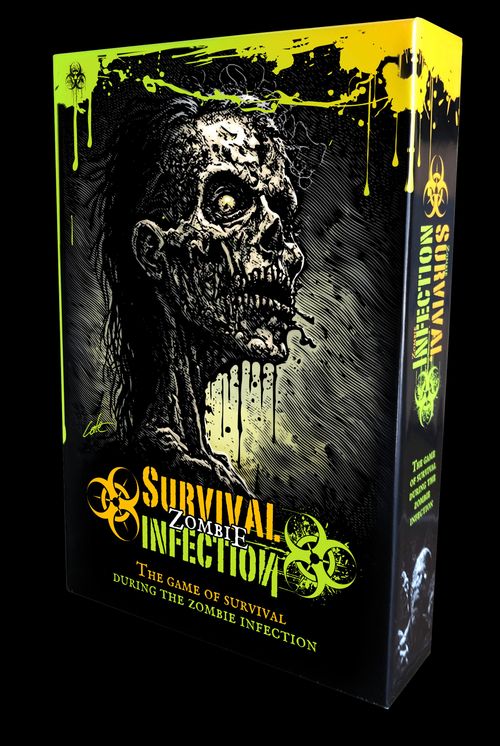
Zombie: Survival Infection
Zombie: Survival Infection Rulebook
Table of Contents
Table of Contents
The Objective
The object of the game is to outlast the zombies while protecting yourself from the treachery of your fellow Camps. Will you try to build alliances, keep your head down, or take advantage of others' weaknesses? Dealing with the living can be just as deadly as fighting off hordes of the undead during the zombie apocalypse.
If at any point only one Camp has Characters and/or Survivors remaining they are the winner. However, if the zombies manage to wipe out all remaining Camps all at once the ZOMBIES WIN!
Game Components
- 85 Survivor/Zombie Chips (Survivor side and Zombie side)
- 6 Survival/Infection Phase Cards
- 6 Starting Hideout Cards
- 6 No Hideout/Zombie Cards
- 90 Survival Infection Cards
- 3 Dice: the black Base Die, the orange Survival Die, and the green Infection Die
Game Setup
Starting Camps
Each player is given a Phase Card, an Apartment Building-Starting Hideout card, and a No Hideout-Zombie card as well as a 10 Survivor Chip. These components are arranged in front of each player to form their Starting Camp, with the starting Apartment Building card covering the No Hideout card (Hideout side up) and the Phase Card next to them (survival side up). Return all unused Phase, Starting Hideout, and No Hideout cards to the box.
2-3 Player Setup
In a 2-3 player game only cards with the open symbol in the bottom left corner are used. Return the cards with the closed symbol to the box.
Set the Hidden Bite card aside. Shuffle and deal 5 Survival Infection cards to each player. Then split the remaining cards into two approximately equal facedown piles. Next, shuffle the Hidden Bite into the second pile. Finally, place the first pile on top of the second forming the draw deck. This puts the trigger for the Infection Phase somewhere randomly in the second half of the deck.
Place all of the Survivor/Zombie Chips in the center of the table, Survivor side face up. Leaving room next to the Draw Pile for a Discard Pile. For each player under 6, flip over one 10 and three 5 chips to their Zombie side. This forms the City Center.
4-6 Player Setup
Set the Hidden Bite card aside. Shuffle and deal 5 Survival Infection cards to each player. Then, split the remaining cards into 2 approximately equal facedown piles. Next, shuffle the Hidden Bite card into the second pile. Finally, place the first pile on top of the second forming the draw deck. This puts the trigger for the Infection Phase somewhere randomly in the second half of the deck.
Place all of the Survivor/Zombie Chips in the center of the table (Survivor side up). Leave room next to the Draw Pile for a Discard Pile. For every player less than 6, flip over one 10 and three 5 Chips to their Zombie side. This forms the City Center.
Game Play
The game is played in 2 phases with every Camp starting in the Survival Phase. Each phase has its own rules and phase die (Survival Die & Infection Die). To help keep track of which phase your Camp is in, everyone is given a double-sided Phase Card that also includes quick turn order rules. Play goes clockwise around the table with each player taking their turn according to their current phase.
Starting the Game
The player who has most recently watched a zombie movie or won the previous game becomes the starting player. The starting player is given the Base and Survival Dice.
Player Turns
A player's turn consists of 4 steps done in the following order, after which play moves clockwise to the next player:
- Survival or Infection Roll (depending on the phase the Camp is in)
- Redraw
- Take Action
- End of Your Turn
Survival Roll
A. Roll the Base Die and the Survival Die (if you have it).
B. Calculate the Result by adding the numbers shown on the die (or dice) to any Survival modifiers shown on your Hideout and/or Characters (e.g. Survival +3). If you have the Survival Die, also include any Survival Die modifiers showing on your Hideout and/or Characters (e.g. Survival Die +3). When the Survival Symbol is rolled calculate the dice and modifiers as normal then double the result. A positive result is the total number of new Survivors gained from the City Center. A negative result is how many Survivors are returned to the City Center.
Example 1: Sara has the Base Die and the starting Apartment Building. She rolls a 3 and adds the Survival Phase modifier of +1 bringing her total to 4. Sara takes 4 Survivors from the City Center.
Example 2: Shawn has the Base Die, the Survival Die and the starting Apartment Building. He rolls a 2 and the Survival Symbol. He adds the Survival Phase modifier of +1 and the +1 Survival Die modifier to the Base Die result of 2 which brings his total to 4. Shawn then doubles it bringing his total to 8. Shawn takes 8 Survivors from the City Center.
Example 3: It is Amy's turn. She has the Survival Die but, unfortunately, has No Hideout. She rolls just the Base Die and does not roll the Survival Die as per the no No Hideout. She rolls a 1 then applies the -2 modifier for having No Hideout giving her a -1. Amy returns 1 Survivor to the City Center.
C. Pass the Survival Die if you have it to another Camp in the Survival Phase. If there are no other eligible Camps, retain the Survival Die.
Infection Roll
A. Roll the Base Die and the Infection Die (if you have it).
B. Calculate the Result by adding the numbers shown on the die (or dice) to any Infection modifiers shown on your Hideout and/or Characters (e.g. Infection +2). If you have the Infection Die include any Infection Die modifiers showing on your Hideout and/or Characters (e.g. Infection Die +3). When the Infection Symbol is rolled, calculate the dice and modifiers as normal. Then, double the result. A positive result is the total number of Survivors killed by the undead. Flip the correct amount of chips over to the Zombie side and return them to the City Center. A negative result is how many Survivors are gained from the City Center.
Example 1: Rene only has the Base Die and the Emergency Shelter Hideout. He rolls the die and gets a 1 and adds +2 from his Hideout's phase modifier, ignoring the +3 Infection Die modifier because he does not have it, giving him a total of 3. Rene flips 3 Survivor Chips to their Zombie side and returns them to the City Center.
Example 2: It is Kat's turn and she has the Base and Infection Die. She rolls the dice and gets the Blank on the Base Die and the Infection Symbol. Her Hideout is The Prison so she has a -2 Infection Phase modifier. Subtracting 2 from the blank (0) equals -2. When doubled, this gives her a total of -4. In the Infection Phase a negative score is a good thing. The City Center has 3 remaining Survivors that migrate to her Camp. The 4th is ignored because there are no more Survivors left in the City Center.
C. Pass the Infection Die to another Camp of your choice.
Redraw
Draw until you have 6 cards in your hand. If you need to draw a card and there are none left, shuffle the Discard Pile to reform the Draw Pile.
Take Action
If an Event is drawn, it MUST be played. This takes the place of the drawing player's Take Action. If no Event is drawn, do one of the following:
Play 1 Action, Character, or Hideout card on a Camp:
- An Action Card can be played on any Camp including your own. Reactions may be played in response to Actions and other Reactions. For more info on Reactions see p. 15. Once an Action Card and any following Reactions are resolved, they are discarded.
- A Character card can be played on any Camp by placing it face up in front of the target Camp.
- A Hideout card can only be played on your own Camp or the Camp of another without a Hideout.
Discard up to 2 cards from your hand without redrawing.
Trade Survivor(s), Characters, and or Hideouts with another Camp. Only the active Camp may initiate a Trade, only one Trade may be made and both Camps must agree to the Trade. If a Trade cannot be agreed upon, the active Camp may take a different action. Trades can be Survivor(s) for Character(s), Character(s) for Character(s), or an exchange of Hideouts. Only cards and chips already in play on the table may be Traded.
Pass and do nothing.
End of Your Turn
Pass the Base Die to the player on the left. Any Hideout or Character cards that take effect "at the End of Your Turn" happen before you Pass the Die. Once you Pass the Die your turn is over, and it is now the next player's turn no matter what phase they are in.
Winning & Losing
Winning
Play continues until there is only one Camp with Survivors and/or Characters. The remaining player is the Winner!
Losing - Undead Reckoning
If at any point a Camp has 0 Characters/Survivors they can no longer win as a Survivor. They must immediately discard their hand. Their Hideout is Destroyed and they return their Phase Card to the game box. They then flip their No Hideout card to its Zombie side. If they have the Base Die, they give it to the next player. If they have the Survival or Infection Die, they pass it to the eligible Camp of their choice. They are no longer considered a Camp but will continue to play as the undead.
A player who has joined the undead will roll the Base Die without any modifiers on their turn. The number they roll represents the number of Survivors killed in the other Camp(s). The Survivors can come from one or multiple Camps, as chosen by the undead player. Once all Survivors from all Camps are gone the undead player starts killing Characters. In the same manner, it is the undead player's choice which Camp and which Character. Afterward, the Base Die should be passed to the next player.
If the last remaining Camps are knocked out via Undead Reckoning on the same roll the Zombies Win! Humanity is wiped out...
Example: In a 4-player game, Jon is the first Camp to get wiped out. On his turn, he rolls a 3 on the Base Die. Since Rene was responsible for his defeat, Jon chooses to eliminate Rene's last remaining Survivor leaving him with only Characters. As Ken was often allied with Rene, Jon decides to remove the remaining 2 Survivors from Ken's Camp.
The Cards
There are 5 different types of Survival Infection cards: green-framed Actions and Reactions, black-framed/green bordered Events, and orange-framed Character and Hideouts. After being resolved, Action and Reaction Cards are discarded while Events are removed from play. Orange cards, remain in front of the Camp they were played on until they are killed/destroyed. When they are, they are removed from play.
Whenever the Draw Pile is depleted and a card must be drawn, shuffle the Discard Pile to reform the Draw Pile.
If a card's text conflicts with the core game rules presented here, the card text is to be followed.
The card layout diagram on this page labels the card's parts: Card Type Icon, Title, Description, # of Players Symbol, and Card Type.
Event Cards
When an Event card is drawn it must be played immediately. This takes the place of the Camp's Take Action. Event cards can not be modified or affected by other cards. Once an Event is played it is removed from the game. The core game has only one Event card, the Hidden Bite.
Action Cards
Action Cards represent the bad and occasionally the good things that can happen to a Camp during the zombie apocalypse. Action Cards can be played on any Camp. The most basic Actions (-X Survivors) kill off Survivors, gain (+X Survivors) from the City Center or move them from one Camp to another. Rarer cards destroy Hideouts, attack everyone and even move the Phase Dice!
As a player's Take Action the active player places the card on the table, names the card's Target(s), and reads aloud the title and description. Once an Action and any subsequent Reactions are resolved, it is discarded. Camps that are immune to an Action cannot be targeted by that card.
Reaction Cards
Reaction Cards can only be played in response to an Action Card or another Reaction. Some Characters and Hideouts also provide an opportunity for Reactions. Once resolved, all Reaction Cards are discarded. A Reaction that will not affect the outcome can not be played.
Example: Gabriel has Run, They Are Inside played against him which destroys his Hideout but does not kill any Survivors. He can not play a gratuitous Shotgun Reaction because no Survivors were killed.
When an Action is played, the target(s) have the chance to play a Reaction first. After that, all Camps have the opportunity to play Reactions. If multiple Camps want to play Reactions at the same time, whoever's card hits the table first takes precedence. Each Camp can play more than one Reaction, but they must be played one at a time, allowing other players to react to the first before playing a second.
Reactions can also be played for other Camps. If a Reaction has any requirements, as long as either the player's Camp or the target's Camp meets them, the card's conditions will be met.
Example: Lynn has a Zombie Apocalypse (-4 Survivors) played on him. Christine offers to help with the First Aid Reaction. Lynn has the Doctor Character who 'doubles the effectiveness of First Aid' so he only loses 2 Survivors instead of 4.
Escape
Some Reactions allow a Camp to Escape an Action. An Escaping Camp that is the single Target of an Action is considered unaffected by the Action and any Reaction modifications. If the Action targets two Camps and one Escapes, the Action fails to affect either. When a Camp Escapes an Action that targets all or "all other" Camps, the remaining Camps are still affected by the Action Card. Once a Camp plays an Escape, no more Reactions may be played for or on the Escaping Camp.
Character Cards
Characters have a skill that makes them more exceptional than the average Survivor. Characters are played out in front of the Camp they belong to. Characters remain in play until killed. Characters can be traded, moved, and killed by card effects; however, they cannot be voluntarily discarded.
A Camp can have any amount of Characters. Once a Camp runs out of Survivors the remaining Characters become Survivors for the sake of losses from die rolls, Action, Event, and Reaction Cards. Killed Characters are removed from play and placed in the game box. The player playing the card or rolling the dice which results in a Character death decides which Character is killed. In the rare case that a Character is moved to the City Center, any Camp can acquire them just like they would acquire any other Survivor.
Some Characters have an ability that can only be used once. If the description says 'rotate the card 180°' after using the power, the card stays rotated for the remainder of the game even if moved to another Camp. If the description says 'sacrifices self' the Character is killed after the cards are resolved.
Hideout Cards
All Camps begin the game with an Apartment Building - Starting Hideout and a No Hideout card underneath it. Anytime a Camp's Hideout is destroyed their No Hideout card becomes visible. While visible this Camp suffers its full effects until it is covered by a new Hideout. While a Camp has no Hideout other players may play a Hideout on that Camp as their Take Action.
A Camp cannot Abandon a Hideout without a replacement, even if having No Hideout is more beneficial. It's human nature to seek shelter, especially in a crisis.
Abandoned Hideouts go in the Discard Pile. Destroyed Hideouts are removed from play and placed in the game box.
To play a Hideout card when you have no Hideout, place the card in front of you with your No Hideout card underneath it.
To play a Hideout when you already have one, discard your current Hideout and replace it with the new one from your hand, this is known as Abandoning.
To play a Hideout on another Camp that does not have one simply place their No Hideout under the new Hideout you are giving them. It cannot be refused.
Some Hideouts have an ability that can only be used once. If the description says 'rotate the card 180°' after using the power the card stays rotated for the remainder of the game even if moved to another Camp. Unless it is Abandoned and then later brought back into play, in this case it is placed in its starting orientation.
The Survivor / Zombie Chips
Survivors are a finite resource and the Survivor Chips represent all the remaining humans in the city. The starting amount of Survivors varies by the number of players, (see Game Setup p. 4, 5). If a dice roll or an Action Card would cause a Camp to gain Survivors and there are none remaining in the City Center, then the result is ignored. Once a Camp no longer has Survivors but still has Characters, any card effect or dice roll that would cause them to kill or lose Survivors now affects their Characters.
When Survivors are killed (-X Survivors) flip over the appropriate number of Survivors to their Zombie side and return them to the City Center. When making change take care to keep the count of the remaining Survivors correct as they are a finite resource.
Returned and moved Survivor Chips are kept Survivor side faceup.
The Dice
Rolling the green or orange dice can produce incredible results. This is why you get to choose who you pass them to. These dice are tools to help make alliances, find help, make enemies, or get some sweet revenge. Any promises made to convince another player to give or not give you one of the phase dice are non-binding.
Base Die
The black 6-sided Base Die has two 1s, two 2s, one 3, and a single Blank (equal to 0) side.
Survival Die
The orange 6-sided Survival Die has two 1s, two 2s, one 3, and one Survival Symbol. When the Symbol is rolled it doubles the result of the Survival Roll plus Survival Phase and Survival Die modifiers.
The Survival Die can not be passed to a Camp that is in the Infection Phase. If the active Camp is the only one still in the Survival Phase they retain the Survival Die.
Infection Die
The green 6-sided Infection Die has one 1, one 2, two 3s, and two Infection Symbols. When the Symbol is rolled it doubles the result of the Infection Roll plus Infection Phase and Infection Die modifiers.
The Infection Die enters the game when the Hidden Bite Event card is played on a Camp. When a Camp is given the Infection Die for the first time, they turn their Phase Card to the Infection Side. If they have the Survival Die they must give it to an eligible Camp. If there is no eligible Camp, the die is removed from the game.
The Survival / Infection Phases
The two phases are similar to acts in a zombie movie. The Survival Phase is the point in the movie just after the initial outbreak when humans start banding together for mutual protection. During this phase, your Camp will most likely focus on attracting as many Survivors to your Camp as possible in hopes of surviving the inevitable...
The Infection Phase is the point in the movie when someone has been bitten, hides it, comes back into Camp, and eventually turns. This is when all hell breaks loose and now, instead of attracting people, you are just doing your best to mitigate your losses while fighting the undead. A Camp does not enter the Infection Phase until the first time they are given the Infection Die. Once a Camp is in the Infection Phase there is no going back to the Survival Phase.
Survival Rolls
A positive result is the number of Survivors gained from the City Center. A negative result is the number of Survivors returned to the City Center.
Infection Rolls
A positive result is the number of Survivors killed. A negative result is the number of Survivors gained from the City Center.
If a Camp is wiped out in either phase before the end of the game, they come back as the zombies. This different state is similar to a phase but has its own rules. See Losing - Undead Reckoning p. 9.
Camp vs. Player
A Player is a Camp while they still have Characters/Survivors. If they are brought down to zero of both they stop being a Camp and have become just a player. Once a player is no longer a Camp they are still in the game, however, now they are playing as the zombies. See Losing - Undead Reckoning p 9.
Glossary
Abandoning - When a player discards and replaces their current Hideout with one from their hand.
Base Die - Black D6 that is rolled at the beginning of each player's turn.
Blank - The side with no markings on the Base Die (black). When calculating the result the Blank is equal to 0.
Camp - A player controls a group of Survivors known as their Camp.
Character - Exceptional humans with skills setting them apart from generic Survivors. When a Camp no longer has Survivors any remaining Characters are also considered Survivors for being affected by cards and dice rolls.
Chips: Survivor/Zombie - The Survivor Chips represent the last remaining humans left in the city. Anytime a Survivor is killed (-X Survivors) flip the appropriate number of Survivors over to their Zombie side and return them to the City Center.
City Center - The center of the table where the Zombies and remaining unclaimed Survivors are kept.
Destroyed - When a Hideout is Destroyed it is removed for the remainder of the game.
Escape - An Escape allows a Camp to completely ignore an Action Card. Once an Escape is played no more Reactions can be played on the Escaping Camp.
Event - As soon as an Event is drawn it must be played taking the place of that Camp's Take Action.
Immune - When a Camp is Immune to a particular card they can not be targeted by that Action.
Infection Die - The green die that is introduced into the game when the Hidden Bite Event is played.
Infection Phase - A Camp enters the Infection Phase once they are given the Infection Die. A Camp stays in the Infection Phase until they win or their Camp is destroyed.
Killed - Killed Survivors (-X Survivors) are flipped to their Zombie side and returned to the City Center. Killed Characters are returned to the game box for the remainder of the game.
Pair/ Paired - To play a Character that requires Pairing, place it under an existing Character in a Camp, with its Description visible. Once Paired, the 2 Characters function as a single unit and cannot be separated except by death. Any effect that Kills a Character, including Sacrifice, Kills the Character on the bottom first. Any effect that moves a Character will move both together.
Pass the Die - The Survival and Infection Dice are passed to the Camp of your choice after rolling and calculating the results. The Base is passed to the player to the left at the End of Your Turn.
Reaction - Reaction cards can only be played in response to an Action or other Reaction cards.
Sacrifice - A Character with this ability kills themselves to Escape an Action.
Starting Camp - Each player starts with a Survival/Infection Phase Card, an Apartment Building Starting Hideout card, and a no Hideout/Zombie card plus a 10 Survivor Chip.
Survival Die - The orange die that is given to the starting player, then passed to the Camp of their choice as long as they are in the Survival Phase.
Survival Phase - All Camps start in the Survival Phase. Once they are given the Infection Die they enter the Infection Phase and can never return.
Target - Camp(s) chosen to be affected by an Action card.
Trash - When a card it is trashed it is returned to the game box for the remainder of the game.
Undead Reckoning - As the zombies, players roll the Base Die without any modifiers on their turn. The number they roll represents the number of Survivors killed in other Camp(s).
Zombie Card - The reverse side of a No Hideout card, revealed when a Camp is destroyed. This card outlines the turn order for a player controlling the zombies.
Zombie Strain Card - One of six types of zombies your Camps will fight during a game. One side of the card details any setup or gameplay rule changes, while the other side provides special rules for players controlling the zombie.
Undead Reckoning Expansion
Undead Reckoning adds a new type of card to your game, the ZombiE Strain card. These cards allow players to choose which strain of zombies they will face.
To add Undead Reckoning to your game, choose one of the six ZombiE Strains, take all of their matching cards, and form a pile next to the draw pile with the GAME SETUP/GAME PLAY rules face up. Return the other unused ZombiE Strain cards to the game box.
During setup, read aloud and follow the GAME SETUP/GAME PLAY rules changes on the chosen ZombiE Strain card.
ZombiE Strain Cards
The six ZombiE Strain cards are: Bioengineered, Ghouls, Returned Dead, Runners, Walkers, and Saprophytes. Each card's zombie-side text, as printed on its face:
- Bioengineered: When you roll a Blank, place a Zombie Chip in a Camp.
- Ghouls: When you roll a Blank, Kill 1 Character.
- Returned Dead: When you roll a Blank, draw and discard until you draw an Action that Kills Characters, Survivors or Destroys a Hideout. Then play that card.
- Runners: Take possession of the Infection Die. Roll both dice and Kill Survivors equal to the total. Pass the Infection Die to the Camp of your choice.
- Walkers: When you roll a Blank, Destroy a Hideout then Kill 1 Survivor from each Camp.
- Saprophytes: When you roll a Blank, Kill 1 Survivor for each Zombie Chip in the Sporocarp Mass. If it is empty add 1 Zombie Chip per remaining Camp.
Game Setup Changes
These are changes to how the game is setup. Follow the normal setup rules except when called out on the chosen ZombiE Strain card.
Game Play Changes
These changes modify the way turns are taken. Follow these when applicable.
Winning & Losing Changes
Losing - Undead Reckoning: Once a Camp is brought to both 0 Survivors and Characters they follow the normal rules of Undead Reckoning. They then draw a ZombiE Strain card and place it zombie art side up in their play area. On their turn, they follow the steps on the Zombie card along with the modifications on the ZombiE Strain card.
If an expansion card's text conflicts with the core game rules, the card text is to be followed.
Transcription gap: The reverse (GAME SETUP / GAME PLAY) rules-change text printed on the ZombiE Strain cards, and the body text of the Zombie Card (the undead turn-order card), are reproduced in the source PDF only as low-resolution raster images that could not be read reliably. They are not transcribed here. The Strain card names and face text above are complete. Consult the printed cards or the publisher for the reverse-side and Zombie Card text.
Mortal Reckoning Expansion
Mortal Reckoning adds enough Survivor Chips, Starting Hideouts, No Hideouts, and Phase Cards to expand the game for up to 8 players. It also includes new Characters, Hideouts, Actions, and Reactions for all player counts.
Cards from the Mortal Reckoning expansion are marked with a solid triangle inside the symbol in the top-right corner. This makes it easy to separate them from the core game cards.
The page shows sample cards carrying the labels "Include in All Games", "Remove for 2-3 Players", and "Remove for 2-3 and 4-6 Players". The new cards' own text is printed on the card faces and is not reproduced on these pages.
Game Setup Changes
7-8 Player Deck Setup: Include all the Survival Infection cards when forming the draw deck for a 7-8 player game.
4-6 Player Deck Setup: Remove the Survival Infection cards with the background colored circle over the icon in the bottom left corner when forming the draw deck for a 4-6 player game.
2-3 Player Deck Setup: Remove the Survival Infection cards with the colored and black circle over the icon in the bottom left corner when forming the draw deck for a 2-3 player game.
All Player City Center Setup: When placing the Survivor Chips in the center of the table, for every player less than 8 (instead of the 6 written in the core rules), flip over one 10 and three 5 Chips to their Zombie side. This forms the City Center.
Alternate Rules
Allied Camps
Alternate 2-3 Player rules
GAME SETUP Changes
Each player controls 2 separate Camps. Arrange these Starting Camps around the table in alternating order. Example: Player 1's Camp A, Player 2's Camp A, Player 1's Camp B, Player 2's Camp B.
When creating the draw deck, use the same cards as in a 4-6 player game.
Each player is dealt a single hand of 5 cards, which will be used for both of their Camps.
GAME PLAY Changes
When passing the Survival or Infection Dice, a player cannot pass either die to the other Camp they control unless it is the only eligible option.
Each of a player's Camps operates independently during it's turn.
WINNING Changes
The game continues until both of a player's Camps are destroyed. The player with at least one surviving Camp is the winner.
New Victims
Alternate 2-6 Player rules
GAME SETUP Changes
Replace some of the Characters and Hideouts in the smaller player decks with those from higher player counts. It is recommended to replace them one-for-one to maintain game balance.
Adding extra Characters or Hideouts may unbalance gameplay. If you decide to include additional cards, consider also adding more cards that Kill Characters or Destroy Hideouts to maintain balance.
Frequently Asked Questions
Can I play a card on another camp?
YES. Any card can be played on any Camp unless another card specifies they have an Immunity. The only exception is that a Camp cannot be given a Hideout if they already have one.
Do the Cop or other character abilities affect all camps?
NO. Character abilities and modifiers only affect your camp unless you're playing an Action or Reaction card with a requirement that the target camp or reacting camp satisfies. (See Reactions, p. 13.)
If I draw the Hidden Bite, do I have to play it on myself?
NO. Like any card, it can be played on any Camp. The only exceptions are:
- If the Carrier character is in play, the Hidden Bite must be played on their Camp.
- If the Research Doctor is in play, the Hidden Bite cannot be played on their Camp—unless they also have the Carrier.
Can my camp refuse a Reaction?
NO. Other camps can intervene in devious ways, such as saving the life of a Know It All you just tried to eliminate with Wait, It's Not a Bite. The only way to stop this is to negate the Reaction with a card like F.U.B.A.R.