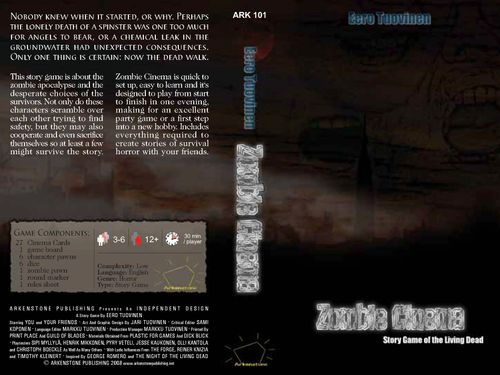
Zombie Cinema
Zombie Cinema Rulebook
Table of Contents
Table of Contents
Components
- 1 game board (10 cards)
- 1 zombie token
- 1 turn marker
- 1 rules sheet
- 27 cinema cards (9 of each colour)
- 6 character tokens (coloured)
- 6 dice (coloured)
Overview
Zombie Cinema is a story game in which the participants create a narrative of ordinary people harassed by the undead.
Each player invents a character whose thoughts and actions they portray. Each player defends the interests of their character and collaborates on the shared narration. Everyone wins together by telling a good story.
George Romero's pioneering zombie film Night of the Living Dead is the model for our one story: people with different experiences find themselves prey to the deadly appetite of the zombie threat. Terror, despair and the constant fight for survival push toward decisions in the moment about life, death and what really matters.
Goal of the Game and Advocacy
The players do not compete for victory. Their goal is to have fun creating a story together. The fun of this game, however, is building a narrative without needing to reach consensus. Instead, each player has a character whose cause they advocate in the story: the player describes the thoughts and actions of their character to the other participants and lets the character struggle for its own good. The story is created effortlessly through the conflicting interests of the characters.
Advocacy means that the player makes the intentions of their character explicit and lets the character do everything possible to achieve them.
Nevertheless, the player must remain impartial and cooperate with the others. In particular, most characters strive to avoid zombies and save their own skin. Meanwhile, the player tries to create an interesting story, which might for example involve making their character a sympathetic protagonist or a vile and pitiable antagonist. The players cooperate; the characters struggle.
Having the Last Word
Playing Zombie Cinema is a constant back-and-forth between players who tell a story together. The rules, however, assign final responsibility for each narrative decision to a single player, who is said to have the last word.
When a player has the last word at a certain moment of the game, the other players are free to make suggestions and discuss the situation. This privilege is not a test of creativity: it is entirely acceptable to choose the best suggestion of the group.
The last word cannot be contested, except if it runs against all the other players, who may then reject it. When that happens, the group will do well to discuss the reasons why the decision was not acceptable: the rejection is a clear signal of expectations that were disappointed, which must be negotiated before the game continues.
Sometimes the rules temporarily give a player the powers of the narrator, who always has the last word on everything that happens until those powers expire.
Starting the Game
Prepare the board as follows: place the zombie token on the Zombie Start space. Place one character token per player on the Character Start space. Each player takes a die of the colour matching their token.
Before the game begins, the players must agree on the context of the story. This choice determines where and when the narrative takes place. A good default choice is "our town, tonight", but experienced players may prefer to choose another era or another location.
Next, each player creates their character for the game by drawing a few cinema cards. The classic choice is to draw one of each colour, but players are free to take more or fewer cards, or to exchange them for others until they are satisfied. The player describes their character using the cards as a source of inspiration. They invent the character's appearance, attitude and history, and possibly a name if they wish.
A few sentences are enough to define the context and the characters. Setting a starting situation can help get the game going: for example, the players could agree that all the characters happen to be at the supermarket when the zombie outbreak begins.
Finally, the first player must be chosen; players who have experience with the game or who like zombie films are a good choice. The first player takes the turn marker.
Phases and Turn Order
A turn is divided into four phases:
- Scene Framing
- Free Narration
- Conflict Resolution
- End of Scene
Turns proceed clockwise until the end of the game. The player whose turn it is is called the active player.
During a turn, the order in which players speak generally does not matter. Sometimes, however, it is not clear whose turn it is to speak. In that case, refer to the play order: pass from one player to the next clockwise, counting from the active player, until one of them decides to act. This can be useful, for example, when it is important to know whether a player wants to sacrifice their character to save another, and if so, who. It is also good practice to verify that everyone has had a chance to speak before closing a scene.
Scene Framing
Each turn begins with scene framing, which develops the story. The active player has the last word on the time, the place and the characters present in the scene, describing the scene as a shot in a film. A scene usually includes one or more player characters, but it is also permitted to stage only secondary characters or even no characters at all.
A character may find itself in a difficult situation at framing if the character's player allows it. It is also possible to continue the story directly from where the last scene stopped. A player may pass their turn if they have no good idea for a scene: do not slow the game down by thinking for too long, just pass.
Free Narration
All players may freely describe what happens in a scene. Their main task is to describe the actions and thoughts of their character. Players may suggest ideas to one another and narrate the actions of secondary characters, but the active player has the last word on everything except the characters of the other players. Each player has the last word on the actions and thoughts of their own character.
Player characters cannot be permanently removed from the story during the free narration phase. All players have the right to bring their character into a scene after it has been framed; they have the last word on this point. The active player closes the scene when it reaches its end, which in general happens after five to ten minutes.
Conflict Resolution
When player characters have a conflict of interest (of whatever size) during free narration, one of the participating players may place their die in the middle of the table. When a conflict is declared, the challenged player must either withdraw from the dispute or accept the conflict by placing their own die as well. If the conflict is not resolved by the withdrawal of the challenged player, it is necessary to proceed to resolution.
All other players now have the opportunity to renounce, ally or support with their die. To renounce, one hides one's die. To ally, one places one's die next to the die with which one is allied. To support, one places one's die on top of the one being supported. In this way, the dice taking part in the conflict form opposing groups.
- A player may renounce only if their character is not involved in the conflict.
- A player may ally only if their character helps the character of the player they are allying with.
- It is always possible to support someone, no matter what their character does or thinks; support expresses our sympathy for a character as a spectator.
Once all players have renounced, allied or supported, the participants in the conflict (the initiator, the challenged player and their respective allies) roll their dice, along with the dice lent to them in support.
The highest result of this roll is called the dominant die. The player who obtained the dominant die narrates the resolution of the conflict in favour of their side. They have the last word on everything in this end-of-scene, including the actions of the player characters, in order to resolve the conflict. These characters may, because of the stress and tension of the conflict, do things they will later regret. For this reason, the narrator may go against the wishes of those characters' players.
- The tokens of the characters on the losing side each move back one space toward the zombie token.
- The winners each advance one space.
- Players who passed or supported do not move their token.
If there is a tie of dominant dice within the winning side, the tied players collaborate on the narration. In case of disagreement, the active player has the last word. If there is a tie of dominant dice between the two sides, the zombie token advances one space instead of moving the character tokens. The active player becomes the narrator and describes how the zombies interrupt the conflict, leaving it unresolved. In this case, the active player also takes the turn marker.
End of Scene
If there is no conflict in a scene, the active player closes the scene when its content has been explored to satisfaction. If a narrator was designated during the scene, that narrator closes the scene after narrating its end.
Closing the scene ends the turn. The game continues with the player to the left of the last active player.
Sacrifice
A player may decide to sacrifice the position of their character's token on the board in favour of other character tokens: for each space that their token moves toward the zombie token, they may advance another player's token by one space.
The sacrificing player immediately becomes the narrator and describes how their character saves the other character. If the sacrifice takes place between two scenes, they may frame a scene for this purpose.
A sacrifice interrupts any other game procedure, including death & escape: for example, a player may sacrifice to save a character who was about to die. Characters may escape thanks to the result of the sacrifice. Afterwards, the game continues normally from the point where it was interrupted.
The Zombie Token
The position of the zombie token indicates the current role of the zombies in the story. Each space on the board describes some zombie actions which will likely dominate the story at that moment.
Any player may describe the actions of the zombies, respecting the indications on the space occupied by the zombie token. If two players disagree, the proposal that describes the action corresponding to the space nearest the zombie token is kept. The active player has the last word between two descriptions of equal severity. If a proposal describes actions more severe than the space on which the zombie token sits, then any player may veto it by invoking the board. A veto overrides the usual free narration.
In addition, the zombie token devours character tokens. When a character token and the zombie token end up on the same space, the character's token is removed from the board. This announces the character's death in the story.
The zombie token advances one space on the board in case of tied conflicts, and immediately before the turn of the player holding the turn marker.
Zombie conflicts: a player may declare a conflict against the zombies instead of declaring it against another player's character. The active player then advocates for the zombies and rolls the dice for them as if they were a character in a conflict. The other players may ally and support normally, including in favour of the zombies if they wish. The zombie token behaves normally in this type of conflict, advancing only on a tie of dice. The purpose of conflicts against the zombies is to allow the characters to advance without turning against one another.
End of Game
The game ends when all the player characters are either dead or safe. The player of the last surviving character narrates the final scene. Afterwards, all players may join in the closing credits.
Death & Escape
A player character can never be permanently removed from the story during free narration or as a result of a conflict. This happens only if the character's token is devoured or if it escapes.
When the zombie token devours a character token, that character dies and can reappear only as a zombie. If a token reaches the Escape space of the board, the character is safe: the character may not be happy, but it survives the story.
The player of a character that dies or escapes immediately becomes the narrator, describing to the others how their character leaves the story. Then they close the scene. If the death or escape takes place outside a scene, the player frames the scene, immediately narrates the events, then closes it. The game resumes its normal course after the interruption.
Players Without a Character
When a player's character dies or escapes, the player continues to play normally, except that they no longer advocate for a specific character. Instead, this player may ally in conflicts by temporarily advocating for a secondary character, or support normally with their die.
When a player without a character becomes the active player, the other players may declare a conflict against the zombies instead of declaring it against another player's character. The active player then advocates for the zombies and rolls the dice for them as if they were a character in a conflict, as described under Zombie conflicts above.
Components Not Transcribed
Pages 3–8 of the French PDF contain the printed game board's track spaces (the numbered zombie-track descriptions and the Zombie Start, Character Start and Escape spaces), and the cinema card faces with their character-type, trait and drama prompts, together with d20 tables. These pages are graphic layouts whose text cannot be reliably mapped to board positions or card faces from the PDF's text layer, so they are not transcribed here. The rules themselves are complete on pages 1–2.