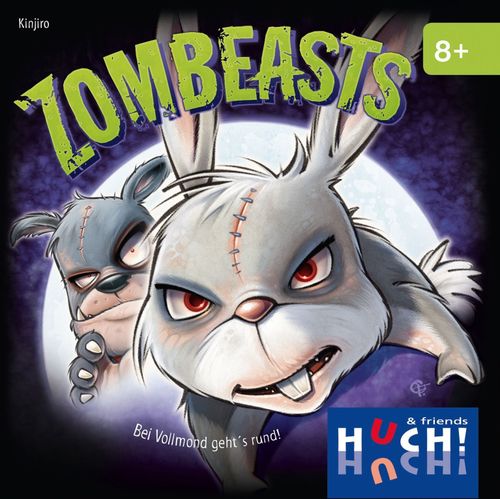
Zombeasts
Zombeasts Rulebook
Table of Contents
Table of Contents
Contents
- 90 Zombeast cards
- 2 legend cards for the Zombeast master (game variation)
- 1 set of playing instructions
The 90 cards consist of 80 cards in the colours blue, orange, red and green, and 10 white joker cards.
Card diagram labels as printed: Icon (for the game variation), Number on black, Victory points.
Getting started
Shuffle the Zombeast cards face down and place them in the middle of the table as a draw pile well within everyone's reach. Each player receives 3 face-down cards. Then, lay down 3 cards face up next to the draw pile as an open stock.
Aim of the game
Whoever has the most points at the end of the game wins.
Order of play
The youngest player starts. On your turn, play one of your cards to try to form a full moon and earn points.
1. Play a card to form a full moon
On your turn, play one card to try to form one or more full moons with 4 cards of a single colour (blue, green, orange, red). You can play a card to begin a new moon, or add it to another moon of the same colour that you have already started.
The colour white is a joker; it can be combined with any other colour to form a full moon. You can also form a full moon by using 4 jokers.
Note: You can only form 1 moon per colour at any one time. That means, each player can have up to 4 moons started at a time, or 5 including a white moon of joker cards. An incomplete moon of white joker cards can be transformed into a different colour, as long as no other moons of the same colour have already been started.
Zombeast attack: If a player lays a Zombeast (dog, cat, rat, rabbit) to one of his started moons that already has one or more of the same Zombeast, he gets to play one more card, either by forming a new moon or adding it to one of the moons he has already started. If he lays down the next card in a moon that also already has the same Zombeast, he gets to play another card. This also applies if he was able to form a moon with the help of the Zombeast attack.
Example: Nick plays a joker and adds it to his blue moon. Since his blue moon already has a cat, he gets to play a second card.
Joker (white cards): A player can play a joker card in his own moon or exchange it from his hand for a card from one of the other players' moons that he needs. The exchanged card must be played immediately in one of the player's moons and counts instead of the joker card played.
Completed full moon: Once a moon has been completed, turn over the cards so that they're facing down to form a pile. The victory points on these cards are counted at the end of the game. A new moon can now be started for the colour of the moon that was just completed.
Bonus: If you complete a full moon with 4 different Zombeasts, pick up one of the cards from the open stock and add it to your pile of victory point cards in addition to the 4 cards from the completed moon.
2. Replenishing your hand
At the end of your turn, draw as many cards as indicated by the number (with the black background) on the card that you played last. You can draw your cards from three different sources of your choice:
- from the open stock
- from the draw pile
- from another player's hand, max. 1 card per player
The open stock is only replenished once a player has finished his turn.
Note: If you exchange a joker for another player's card, and place this card in one of your moons, the number (with the black background) of this card indicates how many cards to draw! If this triggers a Zombeast attack, the number on the black background of the last card played indicates how many cards to draw.
Example: Marie last played the orange cat, which shows a 2 (black background). She has to draw 2 cards. She takes a card from one of the other players' hands and a card from the open stock.
What to do if you don't have any cards left in your hand, or if you can't play a card
- If at any time a player has no cards left in his hand, he immediately draws the top 3 cards from the draw pile. This can happen if another player takes your last card, the last card you played is a joker (number 0 on black background), or with your last card you trigger a Zombeast attack. In the case of a triggered Zombeast attack, you can immediately continue your turn with the newly drawn cards.
- If your last card played is not a joker, and you don't trigger a Zombeast attack, draw as many cards as indicated on the last card played (number on black background) from the draw pile, the open stock or other players.
- If you can't play any card because your cards can't be added to one of your moons according to the rules, lay your full hand face up next to your pile of victory point cards. These cards count as minus points at the end of the game! Now draw 3 new cards from the draw pile and immediately continue your turn according to the rules.
End of game
Once the last card has been drawn from the draw pile on a player's turn, all other players get one last turn before the game is over. Now's your chance to complete your moons. No more cards are drawn in this last round.
Counting score
All the cards from incomplete moons are not counted, but gathered and put into a discard pile. Each player counts his victory points and subtracts his minus points, if he has any. The player with the most points wins.
Game variation for Zombeast masters
The game proceeds as described above with the following additions: Some of the Zombeasts have their favourite toy with them that can give the player special powers, when played. He can also make use of these special powers if he first exchanges a joker card for a card with a special symbol and then plays it. The symbols cannot be combined with a Zombeast attack!
If a player lays a card with a symbol, he has to decide if he wants to use the function of the symbol or, when possible, if he prefers to play a Zombeast attack.
Carrot (rabbit) – exchange 1 card from one of your moons with 1 card from your hand. The card from the moon is added to your hand.
Example: Marie plays the blue rabbit with a carrot in her blue moon where she already has another rabbit. If she does not choose the Zombeast attack, she can now exchange any card from one of her moons with a card from her hand. She chooses the green dog with the number 4 on the black background (1 victory point) from her moon.
She changes the dog with her green rat with the number 1 on the black background (4 victory points) in her hand.
Since the green moon already has a rat Zombeast, she triggers a Zombeast attack and gets to play another card from her hand. She chooses the green dog that she just finished exchanging and draws 4 cards.
Mouse (cat) – pick up 1 extra card from the open stock and add it to one of your moons. If the card can't be added to a moon, or if there are no cards left in the open stock, the special power is forfeited.
Bone (dog) – play 1 extra card from your hand.
Paw (rat) – all players must have 5 cards in their hands. If you have more than 5 cards in your hand, you have to discard the rest onto a discard pile; players with less than 5 have to pick up cards from the draw pile until they again have 5 cards in their hands.