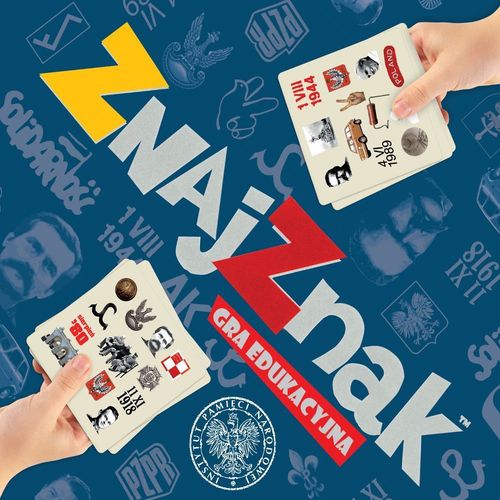
ZnajZnak
ZnajZnak Rulebook
Table of Contents
Table of Contents
Components
- 132 game cards. The front (awers) shows the symbols as pictures; the back (rewers) lists each symbol's name in bold, with an additional explanatory description, its number, and its chronological marking.
- 133 auxiliary cards with symbol descriptions (karty pomocnicze). The front (awers) shows the symbol picture; the back (rewers) gives the symbol name, an additional explanatory description, a short historical outline, the symbol number, the chronological marking, and a QR code linking to the IPN education portal on that topic.
The individual symbol descriptions printed on the card backs are reference content and are not transcribed here. The rules are complete.
How to Read the Cards
Game card (back):
- Symbol miniatures (miniaturki symboli): small pictures of each symbol shown on the card.
- Symbol name (nazwa symbolu): printed in bold.
- Additional explanatory description (dodatkowy opis wyjaśniający): printed after the name.
- Card set marking (oznaczenie zestawu kart): a letter, e.g. set A.
- Symbol numbers (numery symboli): three-digit numbers, e.g. 002.
- Chronological marking (oznaczenie chronologiczne): three period fields, II RP (1918–1939), II wojny światowej (1939–1945) and PRL (1944/45–1989). A coloured field means the symbol relates to that period.
Auxiliary card (back):
- Symbol name and additional explanatory description (nazwa symbolu i dodatkowy opis wyjaśniający).
- Short historical outline (krótki rys historyczny).
- Symbol number (numer symbolu): printed on the card edge to make searching easier.
- Chronological marking (oznaczenie chronologiczne), as on the game card.
- QR code (kod QR) leading to the IPN education portal on the topic.
Rules: Warm-up (Rozgrzewka), 2–8 Players
- The cards are dealt out evenly among the players. Each player places their cards in front of them as a stack, face up.
- The youngest player places the top card of their stack in the middle of the playing area. From this moment, all players simultaneously look for a symbol that the top card of their own stack shares with the card in the middle.
- The player who finds a common symbol and is the first to say its name aloud places their card on top of the stack in the middle, and the game continues. (If they do not know the name, they must spend precious seconds turning the card over and checking the correct name, printed in bold on the back.)
- The game ends when someone gets rid of their last card.
Rules: Duel (Pojedynek), 1 to 13 Pairs of Players
- The players sit next to each other. Each player receives five cards and holds them as a stack, face up.
- The players simultaneously lay the card from the bottom of their stack on the table. The two cards on the table are the ones in which the players look for a common symbol.
- The player who first finds the common symbol says "STOP", points to the symbol on their card and names it.
- Illustration caption: "STOP!" "Christmas tree" (Choinka bożonarodzeniowa).
- After naming the symbol (or saying "I don't know"), the player turns over their card and reads the name of the common symbol aloud from the back, where it is printed in bold.
- Illustration caption: "3rd Carpathian Rifle Division" (3. Dywizja Strzelców Karpackich).
- If the player did not correctly name the symbol (or said "I don't know"), they take their card from the table, place it face up on top of their stack, and then place a new card from the bottom of their stack on the table. The game continues.
- Illustration caption: "WRONG!" (ŹLE!).
- If the player correctly named the symbol, they give their card to the opponent, who places it face up on top of their own stack. The player who correctly named the symbol then places a new card from the bottom of their stack on the table, and the game continues.
- Illustration caption: "RIGHT!" (DOBRZE!).
- The game ends when one of the players has no cards in hand and is the first to point to a common symbol on their last card. That player does not have to name it.
Rules: Multiplayer Variant (Wariant wieloosobowy), 3–8 Players
- Each player receives five cards and lays them in front of them as a stack, face up. The players should sit so that they can see the cards of the player on their left. Each player covers their stack with their hand.
- On the command "start", the players take their hands away and all simultaneously look for a common symbol between the top card of their own stack and the top card of the stack of the player on their left.
- The player who first finds a common symbol says "STOP", points to the symbol and names it. Meanwhile, all other players except the one on the left cover their cards with their hand.
- Illustration caption: "This is..." (To jest...).
- After naming the symbol (or saying "I don't know"), the player turns over their card and reads the name of the symbol aloud from the back, where it is printed in bold.
- If the player did not correctly name the symbol (or said "I don't know"), they move the top card of their stack to the bottom of the stack, say "start", and the game continues.
- Illustration caption: "WRONG!" (ŹLE!).
- If the player correctly named the symbol, they give the top card of their stack to the player on their left. That player places it at the bottom of their own stack, says "start", and the game continues.
- Illustration caption: "RIGHT!" (DOBRZE!).
- The game ends when someone points to a common symbol on their last card. That player does not have to name it.
Notes:
- a) If a player makes a mistake and says "STOP" while pointing to a symbol that is not common to both cards, they must wait as a penalty until someone else says "STOP".
- b) If two players say "STOP" at the same time, the youngest player has precedence.
- c) Before the game, a timer may be set for 10 minutes. If nobody has got rid of all their cards when the time runs out, the winner is the player with the fewest cards in hand. In case of a tie, the youngest player wins.
Teacher's Notes (Wskazówki dla nauczyciela)
- The chronological markings follow the colour scheme of the chapters in the book Od niepodległości do niepodległości (From Independence to Independence) and of the IPN online portal www.Polska1918-1989.ipn.gov.pl.
- The Duel variant (Pojedynek) is the best variant for play during a lesson. If the group has more than 26 people, only four cards are dealt to each player during setup.
- The cards are divided into 13 sets (letters A to N on the back of each card). In the Duel variant, using the cards from one set during play lets students become familiar with the largest possible number of new symbols. When running a tournament, try to ensure that players do not play twice with the same set of cards, as far as possible.
- The auxiliary cards can be used for a follow-up quiz that checks the knowledge gained while playing ZnajZnak. The quiz may cover only selected symbols. For example, the group can be divided into two teams; the leader shows an auxiliary card with a chosen symbol and hands it to the team that first correctly names the symbol. The team that collects more cards wins.
- The auxiliary cards can also be used for the workshop "Połącz symbole" (Connect the symbols). Each player receives one auxiliary card from the leader. The cards may be drawn at random or according to a set key, such as people, symbols related to the Second World War, or events in the PRL. The players read the information on the backs of the cards and look at the symbols on their cards, then form groups of related symbols. The criteria are up to the players: they may be symbols on one subject or symbols that look alike. The leader asks each group to briefly say what symbols its members have and by what key they formed the group. If the players do not find a connection, the leader helps them join another group or form their own, explaining the key that can be used. If players link cards that seem to have nothing in common from a historical point of view, the leader does not interfere: this may help them remember the symbols. The leader may only show the players other possible connections.