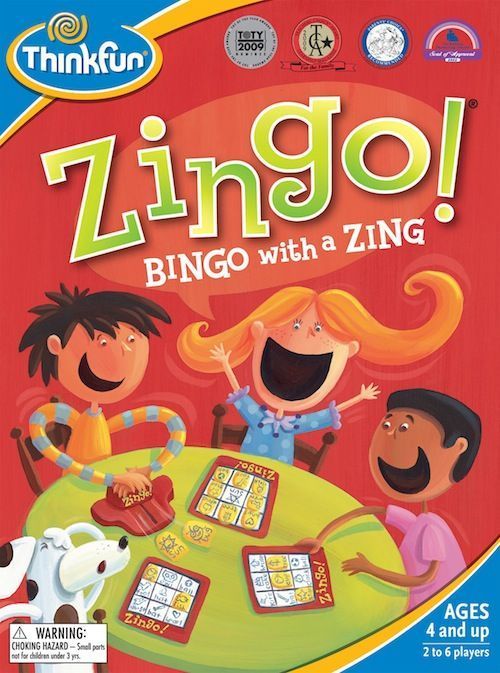
Zingo!
Zingo! Rulebook
Table of Contents
Table of Contents
ZINGO! Skills
Playing ZINGO! will help children develop these important learning and social skills:
- Image and Word Recognition
- Matching
- Spanish Vocabulary
- Observation and Perception
- Concentration and Memory
- Letter/Sound Relationships
- Fine Motor Skills and Coordination
- Following Instructions
- Taking Turns
- Winning and Losing
Contents
Includes:
- 72 two-sided Spanish-English tiles (RED side: Spanish, GREEN side: English). Each image appears on 3 tiles, with Spanish on one side and English on the other.
- 6 Spanish-English bilingual cards.
The tile images, shown in the Includes illustration with their English names, are: clock, dog, smile, cake, star, rocket, ghost, foot, heart, shoe, ball, house, cat, bunny, train, tree, bird, sun, fish, owl, apple, cup, kite and worm.
Reloading ZINGO! Tiles
- Remove cover to reload tiles when Zinger is less than half-full.
- Reload tiles through cover slots when Zinger is more than half-full.
Instructions
Objective
Be the first to cover all the spaces on your card with matching tiles.
Setup
- Scramble the 72 tiles.
- Remove the cover from the Zinger, load the tiles in two equal stacks and replace the cover. If playing in Spanish, load tiles with Spanish side facing up. If playing in English, load the tiles with English side facing up.
- All players should have a clear view of the Zinger before play begins.
- Each player selects a card. Use the red side to play in Spanish, or flip to the green side to play in English. Players should all have the same colored side facing up.
How to Play
Simple steps to play:
- One player can serve as dealer and operate the Zinger for the entire game, or players can pass the Zinger each turn, giving everyone a chance to operate the device in the game. We recommend choosing an adult or older child as the first dealer.
- The dealer slides the Zinger forward and back to reveal two tiles.
- When a player sees a tile that matches an image on their card, the player calls out the image name, takes the tile and covers the printed image on their card. The dealer slides any unclaimed tiles back into the Zinger through the reload slots at the top of the device. Reload tiles Spanish side up if playing in Spanish, English side up if playing in English.
- If two or more players need the same tile, it goes to the player who calls for it first. In the case of a tie, the dealer places the tile back in the Zinger.
- If a player calls for a tile they don't need, the tile goes to the next player to correctly call it.
- The first player to cover all 9 spaces on their card shouts "ZINGO!" and wins.
- The winner starts the next game as the dealer.
Game Variations
Once you've played the original ZINGO!, try out one of these variations.
Mini-ZINGO!: The first player to match three images in a row (across, up, down or diagonally) is the winner!
Zany ZINGO!: Select a pattern below to match. The first player to match the pattern is the winner. The four patterns are "Picture Frame", "X Marks the Spot", "Four Corners" and "Z is for ZINGO!". Each pattern is shown as a diagram on the printed page.
Bilingual ZINGO!: Each player selects a card and places it green (English) side up. Load tiles into the Zinger with the Spanish side facing up. During game play, players call for tiles using the Spanish name to match the English equivalent on their card. The first player to fill their card wins. Play in reverse by matching red (Spanish) cards with tiles with the English side facing up.
Parent's Guide
With its zany Zinger and fast-paced matching, ZINGO! helps young children build image-word association and vocabulary through an engaging and fun play experience.
Beginning around age 3, children are particularly drawn to matching activities and are developmentally able to begin building reading skills. As they grow, they become increasingly interested in playing with language and storing new words in their mental dictionary. ZINGO! draws upon this natural love of matching games and growing interest in word play to create a fun-filled, enriching play experience.
Moreover, games like ZINGO! provide children with frequent and varied opportunities to test their abilities and support their cognitive and social development that will serve children throughout their life.
Tips on How to Use ZINGO! to Improve Your Child's Thinking Skills
- Know your game: It's important for children to have a chance to familiarize themselves with the game components before playing. Reloading the tiles into the Zinger is so much fun for children, and they also love sliding it forward and watching the tiles magically appear. Encourage your child to read the images on the tiles and practice matching them to a card.
- Build memory and concentration skills: Encouraging players to study their ZINGO! cards before the game begins helps them to focus on the specific images they need to match. At the start of a round and throughout the game, ask players to name the tiles they are looking for so that they think about their goal.
- Gain a competitive edge: ZINGO! can be used to practice healthy competition! Remind your child to pay attention not only to the images on their own card, but also to the images on other players' cards so they know which images they have in common. That way, they are likely to be speedier when calling for those tiles.
- Support early readers: The ZINGO! tiles and cards have been designed to show familiar images along with words to help young players begin to make associations between the two. To reinforce the text-image connection, slide the Zinger slowly, stopping once the word at the base of the tile is revealed but not the image. Challenge your child to match the word to the correct image on their card!
- Encourage word play: Your child's language skills are developing rapidly, and playing ZINGO! is a fantastic opportunity to help them increase vocabulary. Encourage your child to make a sentence with their new words and use the printed text to point out spelling patterns and letter sounds. They will learn different sounds in English and Spanish and will understand how letters combine to show various sounds.
- Practice good sportsmanship: From age 4 on, children are just beginning to move away from parallel play and becoming comfortable playing competitive games. Learning to take turns, have patience and celebrate the success of other players takes practice. ZINGO! helps players experience these highs and lows in a safe, fun environment. Talk to your child about how it feels both to win and lose, and encourage them to consider the feelings of others when playing.