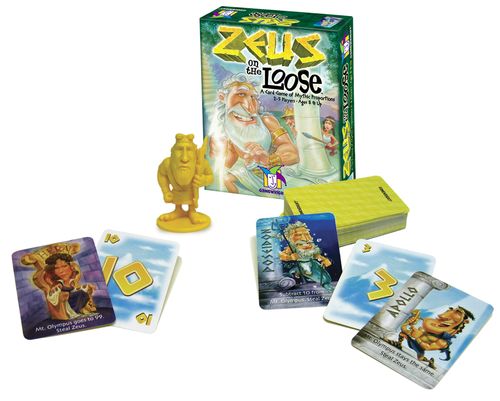
Zeus on the Loose
Zeus on the Loose Rulebook
Table of Contents
Table of Contents
Object
Be the first player to spell Z-E-U-S over several rounds by holding onto the Zeus figurine each time Mount Olympus reaches 100.
Contents
56 cards:
- 4 each of 1-10
- 3 Poseidon
- 2 Aphrodite
- 2 Apollo
- 2 Ares
- 2 Artemis
- 2 Athena
- 2 Hermes
- 1 Hera
Zeus figurine
Setup
Before playing, take a few moments to get familiar with the eight Greek gods and their respective powers (See "Greek God Card Powers" below.) Shuffle the deck and deal four cards to each player. (Look at your cards but keep them secret from opponents.) Stack the remainder of the deck face down in the center of the playing area to form a draw pile. Place the Zeus figurine next to the draw pile.
How to Play
Zeus on the Loose is played in rounds, starting with the person whose first name is closest to Z.
On each turn, play one card from your hand face up onto a discard pile next to the draw pile (here forward referred to as Mount Olympus). If you play a number card, add it to the previous Mount Olympus total and announce the new total out loud to the group. For example, if Mount Olympus is 35 and you play a 6, say "41". (At the beginning of the game, Mount Olympus equals zero.) If you play a Greek god, perform the action(s) written on the card and announce the new Mount Olympus total. Either way, end your turn by drawing the top draw pile card, bringing your hand back up to four cards. Play continues to the left.
Stealing Zeus
Grab and hold onto the Zeus figurine any time you play a card that:
- makes the Mount Olympus total add up to a multiple of 10 (10, 20, 30, 40, 50, 60, 70, 80, 90 or 100), or
- is an identical match to the number card on top of Mount Olympus played by an opponent (See "Same Number Sneak"), or
- is a Greek god that says, "Steal Zeus" on the card.
Same Number Sneak
Any time an opponent plays a number card on top of Mount Olympus that matches a number card in your hand, you may immediately play the match on top of the pile and steal Zeus. (For example, an 8 on top of an 8.) This is the only time you can play a card out of turn. Don't forget to announce the new Mount Olympus total. Play continues to your left, skipping over any player who should have had a turn before you. Note: You cannot play a matching number on top of a number card that you just played.
Drawing Back up to Four Cards
Don't forget to draw back up to four cards at the end of every turn or else you must play the rest of that round short of a full hand. In other words, if you only have three cards when the next player takes a turn, you must continue to play with three cards instead of four. If you forget to draw again after another turn, you're down to only two cards in your hand, so be careful!
Ending a Round
A round may end in one of four ways:
- If you play a card that makes Mount Olympus add up to exactly 100 on your turn, steal Zeus and win the round.
- If you play an exact matching number card that makes Mount Olympus equal to or exceed 100, steal Zeus and win the round.
- If you play a card that makes Mount Olympus add up to more than 100, the person who already has Zeus wins the round.
- If the draw pile runs out, whoever has Zeus wins the round (even if Mount Olympus doesn't reach 100).
Whoever wins the round gets the first letter of the word ZEUS. (Keep track of scores on a piece of paper if helpful.) The winner then collects all the cards, shuffles and deals a new round. The player to the left of the dealer starts the next round.
Ending the Game
Play rounds until someone completes spelling ZEUS. That player wins the game.
For Younger Players
Eliminate the "Same Number Sneak" rule as well as enforcing penalty for not drawing back up to four cards.
Greek God Card Powers
Aphrodite — Round to nearest multiple of 10. Steal Zeus. For example, any number whose one's digit is between zero and four, round down (22=20, 64=60). Any digit between five and nine, round up (37=40, 98=100). Note: If Mount Olympus is at a multiple of ten when you play this card, it stays at that number.
Apollo — Steal Zeus. Mount Olympus value stays the same.
Ares — Mount Olympus goes to 50. Steal Zeus. For example, Mount Olympus could be at 30 or 80. Either way goes to 50.
Artemis — Steal Zeus. Mount Olympus value stays the same.
Athena — Skip the next player. Mount Olympus value stays the same. (In a two player game, simply take another turn.)
Hera — Mount Olympus value goes immediately to 99. Steal Zeus.
Hermes — Reverse Mount Olympus digits. For example, 37 becomes 73. Note: If Mount Olympus is between 1 and 9 when card is played, value becomes that number's multiple of 10. For example, 3 becomes 30.
Poseidon — Subtract 10 points from Mount Olympus value. Steal Zeus.
Greek Mythology
The nine gods featured in the game were all members of the Olympians, the principal gods in the pantheon of Greek mythology. They were all said to have lived atop Mount Olympus, the highest mountain in Greece, in lavish palaces. Here are a few highlights about each god:
ZEUS (zoose), was the supreme ruler of the Olympians and greatest of all the Greek gods. He was often portrayed holding a bolt of lightning as he ruled the sky and controlled thunder, lightning and rain. In addition to fathering many of the deities featured in the game, Zeus had many mortal offspring, most notably the heroes Perseus and Heracles as well as Helen of Troy.
APHRODITE (a-fro-DYE-tee), whose name means "born of the sea foam," was the goddess of love, beauty, and fertility. In Roman mythology, she appears as Venus along with Cupid and inspired famous works of art such as the Venus de Milo statue and Botticelli's painting The Birth of Venus.
APOLLO (uh-POL-oh), son of Zeus and Leto, and the twin brother of Artemis, was the god of light, music, and healing. Apollo is frequently shown playing an instrument called the lyre. During a music contest between Apollo and Pan, King Midas said he liked Pan's performance better, so Apollo turned the king's ears into donkey ears.
ARES (AIR-eez), son of Zeus and Hera, was the god of war and heroes. Although immortal, he was almost killed when giants put him into a jar. Ares is often depicted as an attractive, but brutal and fierce warrior.
ARTEMIS (AR-tuh-mis), daughter of Zeus and Leto, was the goddess of the hunt, animals, fertility, and childbirth. According to some myths, she assisted her mother in the delivery of her twin brother, Apollo. She was also a skilled archer and is often depicted holding a bow and arrow.
ATHENA (uh-THEE-nuh) was the goddess of wisdom, justice, crafts and the domestic arts. She was considered Zeus' favorite child and was said to have been born directly from his head. Athena is the patron diety of Athens, the capital city of Greece.
HERA (HEE-ruh), the goddess of marriage, sacrifices, and fidelity, was Zeus' wife and Queen of the Olympians. Greeks everywhere worshipped her as their reigning goddess and their adulation predated her marriage to Zeus.
HERMES (HUR-meez), son of Zeus and the nymph Maia, was the messenger of the gods. He was also god of shepherds, land travel, merchants, weights and measures, oratory, literature, athletics and thieves. Known for his swiftness and athleticism, Hermes was given credit for inventing foot-racing and boxing.
POSEIDON (puh-SYE-dun), brother of Zeus, was principally known as the god of the sea. However, he was also the god of earthquakes as well as the god of horses. Although officially one of the supreme gods of Mount Olympus, Poseidon spent most of his time under water in a palace made of coral and gems.
Sources: mythweb.com, pantheon.org and wikipedia.com. For more information about Greek Mythology and the Olympians, check your local library.
A Word from Gamewright
Did you know that, in addition to their supreme powers, the Greek gods were endowed with the special ability to change the course of card games? Well, at least that's the case in Zeus on the Loose! As you figure out how to harness the strengths of the various gods within, you'll sharpen strategic thinking along with valuable addition and subtraction skills. A quick warning about Hera: Though she may be the most powerful goddess in the game, don't get on her bad side or else she might wind up helping an opponent steal Zeus and win!
Game by Jason Schneider Title and basic concept by Denise Evarts Illustrations by Gary Locke
© 2006 Gamewright, a trademark of Ceaco. All worldwide rights reserved.