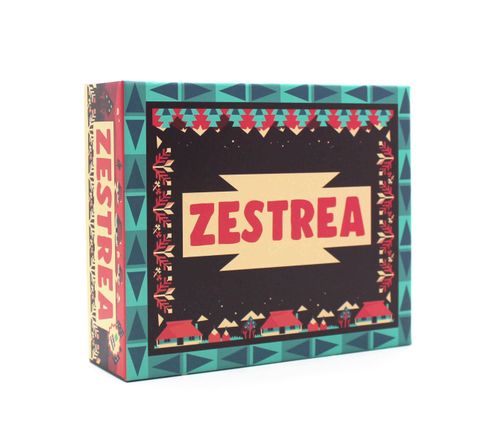
Zestrea
Zestrea Rulebook
Table of Contents
Table of Contents
Game Contents
- 80 Zestre and Land cards
- 84 villagers (Lads and Maidens)
- 35 Fate cards
- 3 Good Times cards
- 14 Hard Times cards
- 6 Boyar cards
- 6-sided die
- Instructions Book
Introduction
Zestrea is a game about marriages and negotiations for 3-6 players. You take the role of Boyars, nobles from Romania. Each Boyar owns an Estate, and takes care of the villagers who live there and work the Land. The goal of the game is to have the most Zestre after the Hard Times have passed.
The villagers work the Boyar's Land to produce Zestre, and they can also make babies (Lads and Maidens).
In Romanian, Zestre means Dowry, the Maiden's wedding gift.
The village is about to be hit by Hard Times, and the villagers' Fate is in the Boyar's hands.
Villagers eat food every turn, but only married Couples produce Zestre. Therefore, you can attempt to arrange marriages with villagers from other Boyars, in order to make them productive.
Example: An Estate with two Couples, two Lads and a Maiden.
The game is played over several turns. Each turn is divided into 5 steps each, as seen in Game Steps, or on the Boyar cards.
Setup
Every Player chooses a Boyar card to represent who they are in the game. You start the game with one married Couple (a Lad and Maiden on top of each other), and 3 Lands.
Next, extract 5 Hard Times at random from the box, and place them in a stack in the middle of the table, face down. Add the 3 numbered Good Times, in order, on top of the stack. For longer games, you can add one or two more Hard Times.
The other cards: place the Fate cards, villagers and Zestre in stacks next to the Hard Times. These stacks belong to the State.
State setup: Hard Times, Fate, Villagers, Zestre.
Boyar setup: Boyar card, Couple, Land.
Game Steps
I. Hard Times Every turn, reveal a card from the Hard Times stack. Read it aloud and follow the instructions on it.
II. Production Boyars can choose to roll the die for any Couple that has a Land. They produce Zestre and babies.
III. Auction Reveal a Fate card from the State pile. The Boyars read and auction it for Zestre. The first Boyar who places the highest bid wins.
IV. Weddings and negotiations This step is the main part of Zestrea. Here, Boyars can negotiate, play Fate cards, attempt marriages, in any order they want. When all the Boyars are ready, they go to the Food step.
V. Food Boyars pay for the villagers' Food.
I. Hard Times
The first 3 turns are always Good Times (their order is written on the back) followed by 5 random Hard Time cards. The Good/Hard Time card is revealed at the beginning of every turn, and the Boyars must follow the instructions on the card.
Example Good Times card — GOOD TIMES: Every Boyar receives +1 Fate card.
Example Hard Times card — BEATEN BY FATE: All the Fate cards from the Boyars' hands are collected, shuffled and redistributed equally. If you don't have enough cards to do so, draw some more until all Boyars have equal amounts. If the deck does not contain enough cards, leave them in the deck, and the surplus goes to the State. Min. 1 Fate card per Boyar.
II. Production
Each Boyar has the option to roll the die once for every Couple that has a Land under their feet, or skip some Couples if they don't want to roll for them. The Couples produce Zestre and babies, according to the Production Table (also found on the Boyar cards).
In the unlikely event that the State runs out of Zestre, you can flip the Zestre cards and count one Land in hand as 4 Zestre.
Production roll chart
| Die roll | Zestre | Baby |
|---|---|---|
| 1 | +1 | +1 |
| 2 | +2 | +1 |
| 3 | +2 | +1 |
| 4 | +2 | — |
| 5 | +2 | — |
| 6 | +3 | — |
Place babies sideways, because you do not have to feed them for one turn and they cannot marry. Newborn babies grow up at the end of the turn, after the Food step. If you have 7 single villagers (babies or adults) you cannot make any more babies at Production.
Example: Two Couples with Land, one without Land, a single Lad and two babies (Lad and Maiden).
III. Auction
Reveal one Fate card, read it out loud, and start bidding. If a Boyar bids one Zestre, any other Boyar can bid 2 or more to take it. The highest bid is paid to the State. The buyer can play the card immediately or keep it for later. If nobody wants it, discard it and continue.
Keep in mind Fate cards can be bought for 2 Zestre, in the Weddings and Negotiations step. Read more about how to play Fate cards below.
IV. Weddings and Negotiations
Boyars can try to marry two villagers of the opposite sex, from different Boyars only. Certain Fate cards allow same-sex marriages.
Wedding attempts cost 2 Zestre per die roll, payable to the State. The Boyars can decide, per attempt, if they pay one Zestre each, or one of them pays both Zestre.
After the Zestre is paid to the State, the Boyars roll the die, to see if the villagers want to get married. If the die roll is (1, 2) [one or two], the wedding is a success!
The Boyars cannot get their Zestre back after paying it. If the wedding fails, they can pay for another attempt, or give up.
After a successful wedding, the Maiden always goes to the Lad's Estate to form a Couple. The Boyar who gave away the Maiden draws a Fate card.
For same-sex Couples you must decide in advance which Boyar gets the Couple. The other Boyar gets the Fate card.
The base wedding chance is (1, 2) [one or two], and it can be increased or decreased by Fate cards.
Wedding chances add up. For example, a Musician at the wedding would add (+1), therefore the die roll could be (1, 2, 3) [one, two or three] for a successful wedding. With two Musicians, (1, 2, 3, 4) and so on. Cards like the Evil Eye (-2) decrease the wedding chances.
In this step, the Boyars can also buy or play Fate cards, buy Land from the State, or adopt villagers from the State. They may also trade Fate cards with other Boyars, or give and receive gifts of Zestre or Fate (but not Land or villagers).
- Wedding Attempt = 2 Zestre
- Adoption = 2 Zestre
- Buy Fate card = 2 Zestre
- Buy Land = 4 Zestre
Fate cards cost 2 Zestre each. They can be revealed to other players or kept secret, and they can be played once, anytime, in the Weddings and Negotiations step. After playing Fate cards, discard them in a pile, face-up.
Timing is important! If you want to play a Fate card that affects the chances of a wedding, you must do so before the Boyars roll the die!
All Fate cards have instructions on them.
Some Fate cards have an extra band under the title. These are Roles. They can be attached to any villager in the game, including other Boyars' villagers. A villager can have multiple Roles, which stay attached for the villager's life.
When the Fate cards in the pile run out, the game carries on without them. Discarded Fate cards must not be reshuffled.
A villager can be adopted from the State (never from other Boyars). Adoptions cost 2 Zestre and can take place anytime during the Weddings and Negotiations step. Adopted villagers are adult from the start, can get married right away and must be fed in the current turn.
Boyars can buy extra Land for 4 Zestre. You can only buy Land during the Weddings and Negotiations step. Land cannot be sold. You can only have maximum 5 Lands, and minimum one Land.
Fate card examples
- Rumpled Clothes (-1) — Role. A Maiden/Lad does not iron their clothes and wears them inside out. -1 Wedding Chance.
- Musician — Role. The Boyar appoints any villager to become a musician. At every wedding, the musician can be used (or rented by other Boyars for money or favors) to add 1 Wedding Chance.
- Extended Vacation — Permanently send a single Lad/Maiden of your choice from your domain to another Boyar.
- The Village Preacher — Role. The Boyar choses a Lad/Husband with a calling to become the Village Preacher. The Boyar with the Village Preacher earns +1 Zestre from the State for every villager that dies. The Preacher does not earn Zestre from deaths that happen on his domain.
V. Food
Each turn ends with Boyars paying for the villagers' food.
The villagers (or Couples) with Land under their feet are considered fed. Then, the Couples with no Land eat a single unit of food each (one Zestre per Couple, paid to the State), and so does each single villager (one Zestre per single villager).
Babies born in the current turn do not have to eat, instead they grow up (turn their cards upright).
Example: The first two Couples eat from the Land, the Couple and Lad are fed with 2 Zestre. The Zestre goes to the State.
Example: The Boyar has no more Zestre and must feed the Maiden. They exchange one Land for one Zestre to pay for the Maiden's food.
If a Boyar does not have enough Zestre to feed all their villagers, they are forced to lose as many plots of Land as they have villagers (or Couples) that did not eat. If there still are unfed villagers, they die of hunger.
As a rule, a Boyar cannot lose their last remaining Land.
Therefore, the last Couple of any Boyar can never be lost or separated.
Final Turn
In the final turn, after the last Hard Time card was drawn and played, you cannot buy any more Fate cards. You can still play the ones in your hand, or get them from weddings.
After the final Food step, points are calculated as follows:
- Count your remaining Zestre.
- Flip your Land cards and count them as one Zestre each.
- The Boyar with the most Couples gets +5 Zestre when counting the points. If there is a tie for the most Couples, nobody gets the +5 Zestre.
The Boyar with the most Zestre wins. Congratulations!
In case of a draw, the Boyar with the most villagers on their domain wins.
For more Zestrea lore, guides and resources, funny stories from ourselves and our players, Alex's Tinder profile, Romanian cocktail recipes, Maria's art, doodles and fisksoppa, Horaţiu's jazz bar in Copenhagen and Laura's dragons - visit www.zestrea.net
The Hard Times have passed and everybody rejoices. Life goes on... but before long, the Hard Times will come again.
Thank you for playing!