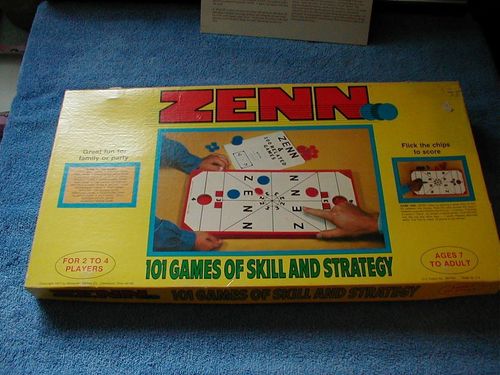
Zenn
Zenn Rulebook
Table of Contents
Table of Contents
- Playing Pieces
- Technique
- The Playing Board
- Basic Rules of Play
- 1 - ZENN
- 2 - BLOCK ZENN 1
- 3 - BLOCK ZENN 2
- 4 - BLOCK ZENN 3
- 5 - BLOCK ZENN 4
- 6 - ZENN ZENN
- 7 - DOUBLE RICOCHET ZENN
- 8 - CORNER ZENN
- 9 - CORNER BLOCK ZENN
- 10 - SUDDEN DEATH ZENN
- 11 - SECTION ZENN 1
- 12 - SECTION ZENN 2
- 13 - SECTION ZENN 3
- 14 - SECTION ZENN 4
- 15 - LAST ZENN
- 16 - POSSESSION ZENN 1
- 17 - POSSESSION ZENN 2
- 18 - POSSESSION LETTER ZENN
- 19 - IMITATION ZENN
- 20 - BACKCOURT ZENN
- 21 - BIG BACKCOURT ZENN
- 22 - LINE-UP ZENN
- 23 - RICOCHET POINT ZENN
- 24 - RICOCHET SECTION ZENN
- 25 - LUCK-OUT ZENN
- 26 - BACK-BUMPER ZENN
- 27 - SOLO-21 ZENN
- 28 - 20 SHOT ZENN
- 29 - RAPID FIRE ZENN
- 30 - RACE HORSE ZENN
- 31 - FLIP-O-CHET ZENN
- 32 - BIG CHIP ZENN
- 33 - CENTER BOARD ZENN
- 34 - LIP-IT ZENN
- 35 - SIDEWINDER ZENN
- 36 - DODGE-EM ZENN
- 37 - AROUND THE BLOCK ZENN
- 38 - THE GREAT COVER-UP
- 39 - SHUFFLE BOARD ZENN
- 40 - BUMPER ZENN 1
- 41 - BUMPER ZENN 2
- 42 - BUMPER ZENN 3
- 43 - BUMPER ZENN 4
- 44 - BUMPER ZENN 5
- 45 - BUMPER ZENN 6
- 46 - BUMPER ZENN 7
- 47 - TRAFFIC JAM ZENN
- 48 - PURE ZENN
- 49 - DEFENSIVE ZENN
- 50 - DEFENSIVE POINT ZENN
- 51 - DAVID AND GOLIATH ZENN
- 52 - STREAK ZENN
- 53 - TRAP ZENN 1
- 54 - TRAP ZENN 2
- 55 - SMACK ZENN 1
- 56 - SMACK ZENN 2
- 57 - HOT HAND ZENN
- 58 - HOCKEY ZENN 1
- 59 - HOCKEY ZENN 2
- 60 - HOCKEY ZENN 3
- 61 - THE WALL 1
- 62 - THE WALL 2
- 63 - LETTER ZENN
- 64 - NON-DEFENSIVE LETTER ZENN
- 65 - REFLECTION ZENN 1
- 66 - REFLECTION ZENN 2
- 67 - REFLECTION ZENN 3
- 68 - REFLECTION ZENN 4
- 69 - REFLECTION ZENN 5
- 70 - KNOCK ZENN 1
- 71 - KNOCK ZENN 2
- 72 - KNOCK ZENN 3
- 73 - WAR ZENN 1
- 74 - WAR ZENN 2
- 75 - WAR ZENN 3
- 76 - BASKETBALL ZENN 1
- 77 - BASKETBALL ZENN 2
- 78 - REBOUND ZENN 1
- 79 - REBOUND ZENN 2
- 80 - REBOUND ZENN 3
- 81 - REBOUND ZENN 4
- 82 - REBOUND ZENN 5
- 83 - POOL ZENN 1
- 84 - POOL ZENN 2
- 85 - POOL ZENN 3
- 86 - POOL ZENN 4
- 87 - POOL ZENN 5
- 88 - POOL ZENN 6
- 89 - POOL ZENN 7
- 90 - POOL ZENN 8
- 91 - POOL ZENN 9
- 92 - POOL ZENN 10
- 93 - BOWLING ZENN
- 94 - STRATEGY ZENN 1
- 95 - STRATEGY ZENN 2
- 96 - STRATEGY ZENN 3
- 97 - REBOUND CORNER ZENN 1
- 98 - REBOUND CORNER ZENN 2
- 99 - ESCAPE ZENN
- 100 - AMBIDEXTROUS ZENN
- 101 - MARATHON ZENN
- Team Zenn (Four Players)
- Three Player Zenn
- Conditioning of the Game Board
Playing Pieces
Eight large chips (4 blue and 4 red) and eight small chips (4 blue and 4 red) are the playing pieces.
Technique
Before any of the games are played you may wish to practice shooting the chips. The most effective way of shooting or propelling the chips is to use your index finger (or any other finger which may feel more comfortable) in a flicking motion (Fig. 1A). For shorter shots a slight bump applied to the chip may be more effective (Fig. 1B).
The Playing Board
The printed diagram labels the following areas: 1 point section; 2 point section; 3 point section; center circle; side bumper; corner block; Zenn line; back bumper; baseline; 2 point section / corner line; 3 point section; middle line. (The diagram itself is not reproduced in text.)
Basic Rules of Play
The following rules are to be applied to all games unless otherwise indicated:
- Players alternate shots.
- The chip is to be shot from where it lies on the board. If the chip is against a side, block, or corner (or on it), one may place the tip of the finger on top of the chip in order to propel it. This is the only time "top shooting" is allowed.
- A chip which is shot off the board is to be placed in the center circle (Fig. 2).
- Before each game a player decides which basket (cup) he will be shooting for, i.e. the basket he will attempt to sink the chip into. His opponent, for the duration of the game, will shoot for the other basket.
- "Zenns" count as 3 points unless otherwise stated (See Game 1 - ZENN for meaning of "Zenn").
1 - ZENN
Recommended for beginners.
Players flip a coin. Loser of the flip places a small chip between his own Zenn blocks and behind the Zenn line. He then attempts to shoot (a chip is shot or propelled by a flicking of one's index finger) the chip between his opponent's Zenn blocks into the basket (Fig. 3A). If successful, the player receives 3 points. This 3 point play is called a "Zenn". If the player fails to score a "Zenn", his opponent then attempts to shoot a basket from wherever the chip lies. If successful, he receives 1 point. He receives 3 points if he scores a "Zenn" (a basket that is scored by going between the Zenn blocks).
Play continues with players alternating shots until a 1 or 3 point score is made. The player scored against resumes play by replacing the chip between his Zenn blocks and attempting a "Zenn". The game ends when a player reaches 10 points (or any agreed-upon score). A player must win by 2 or more points.
Notes: (1) A chip which is partly between your opponent's Zenn blocks (overlaps the Zenn line - Fig. 3B) and is shot between those blocks into his basket does not count as a "Zenn". (2) If a player scores against himself, one or three points (shoots his chip into his own basket), he does not shoot again, but rather his opponent then attempts a Zenn from between his Zenn blocks.
(Figs. 2, 3A, 3B and 4 are diagrams and are not reproduced.)
2 - BLOCK ZENN 1
Recommended for beginners.
This game is played the same as Zenn, but if a player hits his opponent's Zenn blocks he is entitled to another shot. However, only one extra shot per turn is allowed. Hence, on one's initial shot it would be good strategy to rebound the chip slightly off the Zenn blocks to "set up" for an easy Zenn.
3 - BLOCK ZENN 2
This game is played like Zenn, but players try to avoid hitting their opponent's Zenn blocks. One point is awarded to the opponent if the player hits his Zenn blocks. One point is still given for a normal basket, but 6 points are given for a "Zenn" (the chip may hit the Zenn blocks on a "Zenn"). If a player scores a basket by ricocheting the chip off his opponent's Zenn blocks no point is scored by the shooter, and the opponent places the chip between his Zenn blocks and play continues.
4 - BLOCK ZENN 3
The game is played like Zenn, but points are scored by "Zenns" or by hitting your opponent's Zenn blocks. The Zenn blocks must be hit by ricocheting the small chip off any of the four sides of the board (Fig. 4). Three points are given for a "Zenn", and 1 point is given for hitting the blocks. No points are given for baskets other than "Zenns". After a "Zenn" the chip is placed between the Zenn blocks of the player scored upon. That player then attempts a "Zenn". After a single point is scored, the player scored upon shoots the chip from where it lies. A chip which is shot into the basket is placed between the Zenn blocks of the player whose turn it is to shoot next.
5 - BLOCK ZENN 4
The game is played like Zenn, but points are scored by "Zenns" or by hitting the BACK of your opponent's Zenn block without putting the chip into the basket. If the chip is shot into the basket (other than by a "Zenn") your opponent receives 1 point. Two points are given for hitting the BACK of your opponent's Zenn block (Fig. 5), and 3 points are given for a "Zenn". After a score (either 3, 2, or 1 point score) the small chip is placed between the Zenn blocks of the player scored upon. That player then attempts a "Zenn".
6 - ZENN ZENN
Recommended for beginners.
The game is played like Zenn, but points are scored only when "Zenns" are made. One point is awarded for a "Zenn". If a player fails to at least hit his opponent's Zenn blocks, his opponent then gets two consecutive shots to score a "Zenn". The first shot need not hit the blocks. No points are awarded for any non-Zenn baskets. After a score or a non-Zenn basket, the chip is placed between the Zenn blocks of the player who was not the last to shoot. That player then attempts a "Zenn".
7 - DOUBLE RICOCHET ZENN
The game is played like Zenn, but points are scored only by "Zenns" or double ricochet baskets. These are baskets which are scored by ricocheting the chip off 2 sides (Fig. 6A) or a side and a block (Fig. 6B). Three points are given for "Zenns" and 1 for double ricochet baskets. No other baskets count. After a score or an illegal basket, the chip is placed between the Zenn blocks of the player who was not the last to shoot. That player then attempts a "Zenn".
8 - CORNER ZENN
The game is played like Zenn, but only "Zenns" and baskets which ricochet off the corner blocks count as scores (Fig. 7). No other baskets count. Three points are given for "Zenns" and 1 point for corner baskets. After a score or an illegal basket, the chip is placed between the Zenn blocks of the player who was not the last to shoot. That player then attempts a "Zenn".
9 - CORNER BLOCK ZENN
The game is played like Zenn, but only "Zenns" or baskets scored from ricochets off the corner blocks or off the Zenn blocks earn points (see Fig. 6B and Fig. 7). No other baskets count. Three points are given for "Zenns" and 1 point for corner or Zenn block baskets. After a score or an illegal basket, the chip is placed between the Zenn blocks of the player who was not the last to shoot. That player then attempts a "Zenn".
10 - SUDDEN DEATH ZENN
The game is played with 1 small chip. The first player to score a "Zenn" via a ricochet wins the game (Fig. 8). Players alternate placing the small chip anywhere on the center line and attempting ricochet "Zenns".
11 - SECTION ZENN 1
Recommended for beginners.
The game begins like Zenn and is played with one small chip, but the 12 sections which divide the board play a part in this game (See The Playing Board). The chip will land in various sections after unsuccessful scoring attempts. Each section has a corresponding point value. A basket scored from a given section receives the point value of that section. A "Zenn" scored from a given section receives twice the point value of that section. Thus, a "Zenn" scored from between the Zenn blocks would be worth 6 points since it would have been shot from a 3 point section. If a chip lies in more than one section (Fig. 9) only 1 point is given for a basket and 3 points for a "Zenn". Games are up to 100 points with players alternating shots. Remember, chips shot off the board are placed in the center circle (Fig. 2).
12 - SECTION ZENN 2
Recommended for beginners.
The game is played like Section Zenn 1, but if the chip lies in two or more sections a player receives the sum of the point values of the sections for a basket and twice the sum for a "Zenn". Thus, a "Zenn" from the center of the board would be worth 40 points [OCR of the scan reads "lfO"; 40 is twice the 20-point total] since the chip would be located on 8 sections worth a total of 20 points (Fig. 10). Games are up to 200 points.
(Figs. 5, 6A, 6B, 7, 8, 9, 10 and 11 are diagrams and are not reproduced.)
13 - SECTION ZENN 3
Recommended for beginners.
The game begins like Zenn, and it is played with one small chip. The chip will end up in various sections after unsuccessful scoring attempts. The first player to score a basket from each of the 12 sections wins the game. If a player scores a "Zenn" (from anywhere on the board), he may count it as having been scored from any section of his choice. If a basket is scored by a chip lying in more than one section, the player may choose from those sections the one he wishes the basket to count for.
14 - SECTION ZENN 4
The game is played like Section Zenn 3 with the exception that if a chip is in two or more sections, the player must shoot for a "Zenn". The chip must lie entirely in one section for a basket to count for that section, but as in Section Zenn 3, any "Zenn" scored may count as a basket from any section of the player's choice.
Note: In all Section Zenn games players alternate shots, and after a player has scored the chip is placed between the blocks of his opponent. The opponent then shoots.
15 - LAST ZENN
The game is played like Zenn, but the winning points must be scored via a "Zenn". If a basket other than a "Zenn" is made, which normally would win the game, no points are awarded.
16 - POSSESSION ZENN 1
Recommended for beginners.
The game is played like Zenn, but after a player scores, he places the chip between his own Zenn blocks and then tries for a "Zenn".
17 - POSSESSION ZENN 2
The game is played like Possession Zenn 1, but, instead of placing the chip between one's own Zenn blocks after scoring, the chip is placed anywhere in the 4-point section by one's basket (Fig. 11). The player may then attempt a "Zenn" or a 1 point play.
18 - POSSESSION LETTER ZENN
The game is played like Zenn, but, if the chip stops on any part of a letter, the player shooting may again try to score from that position on the board. Every time the chip lands on any part of a letter, an extra shot is taken.
19 - IMITATION ZENN
Recommended for beginners.
This game is played with a single small chip, and the winner of this game will be the player who can successfully imitate his opponent's shots. Play begins by a player placing the chip anywhere on the board and attempting to shoot the chip into his opponent's basket. Before the shot is made, however, the player must "call" his shot; i.e. he must declare to his opponent how many ricochets (if any) the chip will make, what sides, corners, and/or blocks it will hit and the order in which the chip will strike these boundaries. If the player, after "calling" his shot, is successful in making the basket, his opponent must then attempt to score a basket by placing the chip on the same original position, and shooting it so that it hits the same sides, etc. If he fails to make the basket or makes the basket but does not successfully imitate the way it was made, he receives a letter "Z". If the first player did not make a basket or made a basket which was not made the way he called it, the second player may then place the chip anywhere and call his shot. If successful, his opponent must imitate. Whenever a player fails to imitate his opponent's successful shot, he receives a letter beginning with "Z", then "E", "N", and finally another "N". If a player is successful in his imitation, he has earned the right to call a shot which his opponent must imitate. The game continues until a player receives the four letters spelling "ZENN". That player loses the game.
20 - BACKCOURT ZENN
The game is played with one small chip. One player places the chip anywhere in his own 4 point section. He then attempts to either "Zenn" or shoot the chip entirely into his opponent's 4 point section. If a player shoots the chip into his opponent's basket (without "Zenning") the opponent receives 2 points. The opponent receives 1 point if he fails to shoot the chip entirely into his opponent's 4 point zone. If a player scores a "Zenn" he receives four points. Thus, the only ways of scoring are as follows: a) "Zenning" - 4 points; b) Failure of opponent to shoot the chip entirely into the 4 point zone - 1 point; c) Shooting of chip by opponent into a basket - 2 points.
Note: Players alternate shots; after any basket the chip is placed in the 4 point zone of the player scored upon. If the chip does not go into a basket or off the board it is shot from where it lies. The game is played up to 21 points but a player must win by 2 points.
21 - BIG BACKCOURT ZENN
This game is played with one big chip, and it is similar to Backcourt Zenn. But, the big chip has to only partially end up in the opponent's 4 point zone. If the big chip is shot entirely into the 4 point zone, the shooter receives 4 points. At the beginning of the game and after the chip falls into a basket or off the board the chip is placed anywhere in one's 4 point zone. The scoring in this game is similar to that of Backcourt Zenn.
22 - LINE-UP ZENN
This game is played with four small chips. A player places his four small chips directly behind each other with the closest chip to him lying between his Zenn blocks (Fig. 12). He then flicks that chip, hence propelling all four chips toward his opponent's basket in an attempt to "Zenn" as many as possible. He now has three more shots to sink as many chips as he can from the position they assume after each shot. Three points are awarded for Zenns and one point for other baskets. After his three additional shots are completed, the player's turn is over. A game consists of five turns per player. A player's point total is the sum of his points in each turn.
23 - RICOCHET POINT ZENN
This game is played like Zenn, but single and triple ricochets are worth 2 and 3 points respectively, while double ricochets are worth 1 point. A direct shot basket and 4 or more ricochets are worth 4 points. A "Zenn" is worth 3 points.
24 - RICOCHET SECTION ZENN
This game is played like Zenn, but the section in which the chip lies dictates the number of ricochets needed to score. If the chip lies in more than one section the basket will count if the number of ricochets equals the number of either of the sections. If a basket is made with an unallowable number of ricochets, no points are awarded, and the chip is placed in the center circle.
Note: "Zenns" may be scored any time.
25 - LUCK-OUT ZENN
Recommended for beginners.
This game is played like Zenn, but after each shot a coin is flipped to determine the player who is to shoot the next shot.
26 - BACK-BUMPER ZENN
This game is played like Zenn, but if at any time during the game a player scores a basket by ricocheting the chip off his own back-bumper he is at once declared the winner (Fig. 13).
27 - SOLO-21 ZENN
Recommended for beginners.
This game starts by having a player place a small chip between his Zenn blocks. He then tries for a "Zenn" and continues shooting until he scores ("Zenn" or 1 point basket). After a score, he places the chip between his Zenn blocks and continues the process again. Play continues until 21 points are scored. The total number of shots needed to reach 21 is the player's score. His opponent then goes through the same process. The player with the least number of shots is the winner.
28 - 20 SHOT ZENN
Recommended for beginners.
This game begins with a player placing the small chip between his Zenn blocks. The game is played like Solo-21 Zenn, but after the player has taken 20 shots his turn is over. His opponent, in a similar manner, then takes his 20 shots. The player with the most points is the winner.
29 - RAPID FIRE ZENN
Recommended for beginners.
This game is played like 20 Shot Zenn, but a player is given 1 minute instead of 20 shots to complete his turn. Thus, the player who has scored the most points in his one minute of shooting is the winner.
30 - RACE HORSE ZENN
Recommended for beginners.
This game starts with the player placing the chip (may be large or small) on the #4 behind his basket. He then attempts to circle the board 5 times in as few shots as possible (Fig. 14). The player taking the fewer number of shots is the winner. Penalties: Going off the board or falling into a basket -- two shots. In these cases the chip is placed nearest the spot where it left the surface of the board.
(The "#4" is printed as a symbol in the source and is transcribed as printed; the source does not define it in text.)
31 - FLIP-O-CHET ZENN
This game is played like Zenn, but a player has the option of either placing the chip between his Zenn blocks after a score or placing the chip on the edge of his back bumper behind his basket and flicking it towards his opponent's basket (Fig. 15). If he flicks it into his opponent's basket he has made a "flicking Zenn" worth 4 points. If the chip is flicked off the board, the opponent has the option of putting the chip in the center circle or flicking the chip from his own back bumper.
32 - BIG CHIP ZENN
Recommended for beginners.
One big chip is used. A player starts at the center of the board with the big chip and attempts to score a basket. If successful, his opponent places the chip at the center of the board and attempts a basket. All baskets are worth 1 point, and the first player to reach a score of 10 is the winner. A player must win by at least 2 points.
33 - CENTER BOARD ZENN
Recommended for beginners.
This game is played with one small chip. Placing the chip at the center of the board (in the center circle) a player attempts to shoot a "Zenn" - worth 2 points. If successful, he places the chip on any one of the 8 letters designated by his opponent and tries for a basket from that letter worth 1 point. A player's turn terminates when he fails to make a "Zenn" from the center circle. The game is played up to 21 points, and one must win by at least 2 points with both players having completed an equal number of turns.
Note: If after a successful "Zenn" a player fails to make his 1 point basket he still is allowed to attempt a "Zenn" from the center circle.
34 - LIP-IT ZENN
One big chip is used. A player starts at the center circle and shoots the chip towards his opponent's basket attempting to "hang" the chip over the lip of the cup (Fig. 16). If successful, he receives 1 point. However, if the chip falls into the cup the opponent receives 1 point, and the chip again is placed in the center circle and play continues. Players alternate shots from wherever the chip lies. A player must win by 2 points, and the game is played to 21.
35 - SIDEWINDER ZENN
This game can be played with a small chip or a big chip. The game is scored and played like Big Chip Zenn (Game 32), but before each shot the opponent designates one of the two long sides that the shooter must hit in order to score. If the shooter also hits the other sides, corners or blocks a point is scored provided the chip enters the cup. If a player fails to hit the side that is designated by the opponent and makes a basket, no point is awarded. After each score the chip is placed at the center of the board. The only "Zenns" that can be scored (if the small chip is used) are those via a ricochet off a designated side.
(Figs. 12, 13, 14, 15 and 16 are diagrams and are not reproduced.)
36 - DODGE-EM ZENN
This game is played like Big Chip Zenn (Game 32), but players must avoid hitting the Zenn blocks. If a player hits a Zenn block, whether or not he makes a basket, his opponent receives 1 point. Three points are awarded to a player who scores a basket without hitting the Zenn blocks. No points are awarded to a player who scores a basket but hits the Zenn blocks.
37 - AROUND THE BLOCK ZENN
Play starts with the big chip at the center circle. A player attempts to shoot the chip around his opponent's Zenn blocks (Fig. 17). The chip must come around the other side of the blocks and at least touch the Zenn line. If this is done successfully, the player receives 1 point. Whether successful or not, the opponent then shoots the chip where it lies and tries to shoot the chip around the other player's Zenn blocks. If a player sinks the chip in a basket, his opponent receives 1 point. If the chip goes off the board or into a basket, it is placed in the center circle. The first player to reach 10 points is the winner.
(Figs. 16 and 17 are diagrams and are not reproduced.)
38 - THE GREAT COVER-UP
One large chip is used in this game. Each play starts anywhere on the center line. A player must ricochet the chip off any of the corners or either of the back bumpers and try to make the chip land on one of the letters on the board (Fig. 18). As soon as a player has made the chip at least touch the four letters "Z", "E", "N", "N", he wins the game. The order in which he obtains the letters does not matter. If a player has at least one letter and then makes a basket, he loses a letter. If a player at any time covers up some letter entirely, he wins the game.
39 - SHUFFLE BOARD ZENN
Recommended for beginners.
One large chip is used. A player begins by shooting the chip from his own Zenn line towards his opponent's back bumper. The chip must bounce back and come to rest entirely in one section on the board (Fig. 19). The player receives the point value of that section. No points are given if the chip overlaps two or more sections. If the chip bounces back and lands in one's own basket, 5 points are awarded. If the chip lands in the opponent's basket, the opponent receives 5 points. Players alternate shots beginning on their Zenn lines. Games are played up to 10 points.
(Figs. 18 and 19 are diagrams and are not reproduced.)
40 - BUMPER ZENN 1
Recommended for beginners.
Eight large chips are used. Player A places his 4 chips on the letters "Z", "E", "N", "N", closest to his basket. Player B does the same. The player with the red chips shoots first. The object is to be the first one to sink all four of your chips into your opponent's basket before your opponent sinks his four chips into your basket. Players alternate shots. If one's chip is sunk in one's own basket it is removed and placed on the center line. Choice of position is made by the opponent. Chips knocked into either basket by opponent's chips count as being sunk.
41 - BUMPER ZENN 2
Recommended for beginners.
The game is played like Bumper Zenn 1, but as soon as a player has sunk all of his chips his opponent continues to sink his remaining chips. The number of shots that it takes to sink these remaining chips is the winner's score for that round. As soon as a player has amassed a total of 11 points, the game is over.
42 - BUMPER ZENN 3
The game is played like Bumper Zenn 1, but a player has two options:
- To try to shoot his own chip into his opponent's basket.
- To try to "clear" or shoot his opponent's chip away from the basket.
Either of the two options constitutes a player's turn. Also, if a chip is entirely in a given section, a player receives the point value of that section if he sinks the chip. If a chip overlaps in two or more sections, 1 point is given for sinking the chip. If a player takes the second option of shooting his opponent's chip and sinks this chip his opponent receives the appropriate point value for the shot. The player with the most points is the winner. The game ends when one player has no more chips to sink.
43 - BUMPER ZENN 4
The game is played like Bumper Zenn 3, but each player plays with 2 big and 2 small chips. The positioning of these chips on the letters is left up to the discretion of each player. When the big chips are sunk, twice the normal point value is given. This game can also be played without the option of shooting your opponent's chips (Option #2 in Game 42).
44 - BUMPER ZENN 5
The game is played like Bumper Zenn 1 but with the options that Bumper Zenn 3 offers. Each player plays with 3 big and 1 small chip. The small chip must be sunk last. If a player sinks his small chip before sinking all of his large ones, he instantly loses. Part of the strategy of this game would be to try to knock your opponent's small chip with one of your own chips into your basket. But, if a player uses his turn to shoot his opponent's small chip and if his opponent's small chip lands in either basket, the player who shot the chip loses the game. This game can also be played without the option of shooting your opponent's chips.
45 - BUMPER ZENN 6
The game is played like Bumper Zenn 1, but the 8 small chips are used.
46 - BUMPER ZENN 7
The game is played like Bumper Zenn 2, but the 8 small chips are used.
47 - TRAFFIC JAM ZENN
Recommended for beginners.
This game can be played like Bumper Zenn 1, 2, or 3, but all 16 chips are used. Player A places his 4 big chips on the letters "Z", "E", "N", "N" closest to his basket. He places his 4 small chips on the numbers "3", "2", "2", "3" that half surround the center circle closest to his basket. Player B does the same with his chips. The player with the red chips shoots first.
48 - PURE ZENN
Recommended for beginners.
The game is played like Zenn, but after each shot the chip is placed between the Zenn blocks (whether a "Zenn" is made or not). Making "Zenns", worth 1 point, is the only way one can score.
49 - DEFENSIVE ZENN
Recommended for beginners.
The game is played like Zenn, but, before a player shoots for a basket, his opponent may place a large chip anywhere on his Zenn line and shoot it toward the small chip in order to prevent a basket from being made (Fig. 20A). The large chip may hit the small chip and vice versa. However, if the large chip knocks the small chip off the board or into either cup 3 points are awarded to the player whose small chip was hit. When the small chip is being shot from between the Zenn blocks, the defensive player must bounce the big chip off one of the side bumpers in order to block the shot of the small chip (Fig. 20B). After every shot of the small chip the large chip is removed from the board. Players alternate shooting the large and small chips.
50 - DEFENSIVE POINT ZENN
Recommended for beginners.
The game is played like Defensive Zenn, but if a player shoots from entirely within a point section and makes a basket, he receives the point value of that section. If the chip is in two or more sections, and a player makes a basket, he is awarded either 1 point or 3 points (if a "Zenn" was made). If a player shoots a "Zenn" when the chip was entirely within a point section, he receives 6 points. This rule, however, does not apply to those "Zenns" which are shot from between one's Zenn blocks. "Zenns" which are scored from between the Zenn blocks are still worth only 3 points.
(Figs. 20A and 20B are diagrams and are not reproduced.)
51 - DAVID AND GOLIATH ZENN
This game is played with one big chip and one small chip. Players flip a coin. The winner chooses to play with the big chip (Goliath) or the small chip (David). The player with the small chip positions his chip between the Zenn blocks while the big chip is placed in the center circle. The small chip is then shot at the big chip in an attempt to knock the big chip into one of the baskets. After 4 shots by the small chip's player, the big chip is then shot at the small chip by the other player. This player tries to knock the small chip into either one of the baskets with his big chip. The big chip must succeed in knocking the small chip into the basket 5 times before the small chip succeeds once. If a player should happen to shoot his own chip into the basket that chip is considered to have been knocked in by his opponent. In summary, the player with the small chip gets 4 shots for every one shot that the big chip's player gets. The small chip must be sunk 5 times before the big chip is sunk once. If this does not happen the small chip's player wins. Otherwise, the big chip's player wins. When the small chip is sunk, play continues as at the start of the game. This game may also be played by playing a specified number of rounds, with players at the end of each round trading roles of David and Goliath.
52 - STREAK ZENN
Recommended for beginners.
This game is played with one small chip. Each player gets 50 consecutive shots, each shot originating from between his Zenn blocks, attempting to score a "Zenn" on each shot. The winner is the player with the longest "run" of consecutive "Zenns" within those 50 shots. Thus, the winner would not necessarily be the player with the most "Zenns".
53 - TRAP ZENN 1
Recommended for beginners.
This game is played with 3 big chips and 1 small chip. Players flip a coin, winner choosing to be the trapper (3 big chips) or the fugitive (1 small chip). Play starts with 3 big chips anywhere on the trapper's Zenn line and the small chip in the center circle. Shooting first, the trapper has 15 shots to trap the little chip in either of the backcourt zones (areas behind the Zenn lines - 3 and 4 point sections by either basket) (Fig. 21A). The big chips are shot with the intention of hitting the little chip into a backcourt zone. The trapper may shoot 1, 2, or all 3 of his chips on a turn. He may not shoot the same chip twice on the same turn. Whenever the small chip is knocked into a backcourt zone (entirely), the fugitive must use his turn (after the trapper has used his turn) to shoot the small chip out of the backcourt zone (partially out of the zone is acceptable). The fugitive has only one shot per turn. If on this shot he hits a big chip which lies at least partially in the backcourt zone in which the small chip lies, or if he fails to shoot out of the zone (at least partially), then he loses the game, i.e., he is "trapped". If the player with the small chip shoots his chip into either basket he is also "trapped" and loses. If the trapper fails to trap the small chip in 15 shots or less, or if he knocks the small chip into either one of the baskets, he loses. If one of the big chips is sunk it is placed in the center circle. If the fugitive shoots out of one backcourt zone into another, he is not trapped (Fig. 21B); but if he shoots from a backcourt zone off the board, he is trapped.
Note: If a big chip knocks the small chip off the board, the small chip is placed in the center circle and play continues.
54 - TRAP ZENN 2
Recommended for beginners.
The game is played like Trap Zenn 1, but players alternate being the trapper and the fugitive. The game is not stopped if the fugitive is not trapped within 15 shots. Play continues until the fugitive is trapped. Players then switch roles. The player taking the fewer number of shots to trap his opponent is the winner.
Note: If a big chip knocks the small chip into a basket the small chip is placed in the center circle, and 5 additional shots are added to the offender's total number of shots.
(Figs. 21A and 21B are diagrams and are not reproduced.)
55 - SMACK ZENN 1
The game is played like Zenn, but the small chip is propelled by knocking it with a big chip. Each player has a different colored big chip, and the small chip is placed in the center circle at the start of the game. The two players place their big chips anywhere on their Zenn lines (Fig. 22). One player then shoots his big chip and tries to hit the small chip into either of the baskets. If a player fails to hit the small chip with his big chip, his opponent receives 2 consecutive shots. Players alternate shots with the exception just mentioned. After a score, play continues as at the start of the game.
(Figs. 22 and 23 are diagrams and are not reproduced.)
56 - SMACK ZENN 2
The game is played like Smack Zenn 1, but if a player knocks the small chip for a "Zenn", he immediately wins the game.
57 - HOT HAND ZENN
Recommended for beginners.
The game is played with 4 small chips. One player places a small chip between his Zenn blocks and attempts a "Zenn". If unsuccessful he removes the chip from the board. He goes through the same process with the other 3 chips. All successful "Zenns" are left in the basket. His first round is over after he shoots the 4 chips. The same player now takes the chips that he did not sink in his first round and attempts to score "Zenns" with these chips (or chip). All unsuccessful "Zenns" are removed from the board while all successful "Zenns" are left in the basket. If there are still some chips that need to be "Zenned", round 3 is played in a similar fashion to the first 2 rounds. The process continues until all of the chips are "Zenned". The number of rounds it takes to "Zenn" all of the chips is the player's score. Now it is the other player's turn. He likewise goes through the same process. The player with the lowest score wins. Thus, it pays to have a "hot hand" and sink your 4 small chips early in the game. Chips which go off the board are shot again in the next round from between the Zenn blocks. The game can also be played with 5, 6, 7, or 8 small chips.
58 - HOCKEY ZENN 1
Recommended for beginners.
Each player places 2 big chips near his basket (goal) and a third big chip on the center line between the "E" and the "N" (3 red chips are used by one player while 3 blue are used by the other). A small chip (the puck) is placed in the center circle (Fig. 23). The player who starts the game (determined by a flip of a coin) attempts to shoot the small chip (puck) into his opponent's basket (goal). He may hit the big chips. Players alternate shots either attempting to make a "goal" on his opponent or attempting to reposition his defensemen (the big chips). A player may propel the small chip by hitting it with a big chip. If a big chip is knocked into a basket or off the board it is removed from play until a goal is scored. If a big chip overlaps the basket (See Fig. 16), the player may use his turn to shoot his other big chips or the small chip. But, if, after his turn, a big chip still overlaps a basket, it must be removed from the board until a goal is scored. After a goal is scored, the player scored upon shoots the small chip from the center circle with the big chips placed as described for the start of the game. The first player to score 10 goals wins, and players must win by 2 goals. Thus, if more than 10 goals are needed to win the game, the game can be considered being sent into overtime. All of the Hockey Zenn games are especially suited to being timed, and 3 periods of equal time are suggested.
Note: A "Zenn" goal is worth just 1 goal.
(Figs. 16 and 23 are diagrams and are not reproduced.)
59 - HOCKEY ZENN 2
Recommended for beginners.
The game is played like Hockey Zenn 1, but each player uses 4 large chips. Each player places 2 large chips on either side of his basket and places the other 2 on (must at least touch) his "E" and "N" next to the middle line. The small chip is placed in the center circle (Fig. 24).
(Figs. 24 and 25 are diagrams and are not reproduced.)
60 - HOCKEY ZENN 3
Recommended for beginners.
The game is played exactly like Hockey Zenn 1 or Hockey Zenn 2, but a "Zenn" goal is worth 2 goals instead of just one goal.
61 - THE WALL 1
Recommended for beginners.
Players alternate setting up a "wall" of big chips and attempting to penetrate it and score a basket. The game may be played with from 5 to 8 big chips and 1 small chip. The winner is the player who scores a basket in the fewer number of shots of the small chip. Play starts with a player setting up a "wall" of large chips anywhere on his side of the center line without any chip overlapping the basket. The player trying to penetrate places the small chip between his Zenn blocks and shoots towards the "wall" (Fig. 25). After the small chip is shot, the player with the large chips shoots one of his chips, but he must propel it initially forward (towards his opponent's basket). The large chip is allowed to ricochet off the back and bounce back towards the player's own basket. Players alternate shots. If a big chip goes off the board it stays off. If the small chip goes off the board it is placed between the Zenn blocks of the player shooting the small chip. All chips may hit each other. If the small chip is knocked in, or is shot into the basket of the player shooting the small chip, the small chip is placed between the Zenn blocks of the player shooting the small chip. A shot is added to his total number of shots needed to score a basket.
(Fig. 26 is a diagram and is not reproduced.)
62 - THE WALL 2
Recommended for beginners.
The game is played like The Wall 1, but the player with the big chips may propel them forward or backward. This exception makes it much more difficult to penetrate the wall and score a basket.
63 - LETTER ZENN
Recommended for beginners.
The game is played like Zenn, but after a player scores at least 3 points (4 or 5 points if a "Zenn" is scored) he tries to earn a letter by placing the small chip on his own "Z". His opponent then places a big chip anywhere on his Zenn line and shoots the big chip towards the small chip in order to prevent a direct shot on the basket (Fig. 26). The big chip may hit the small chip, but if it knocks it completely out of the section the large chip is removed from the board and the small chip is placed in the center circle. The player with the small chip then attempts a basket. If successful he obtains the letter "Z". If unsuccessful the player must again score 3 (4 or 5) points by playing ZENN. When he has again scored 3 points he may again try for a "Z". He may try for an "E" if he was already successful on his "Z" attempt. Play continues with players alternating shots and then attempting a letter as soon as one has amassed a total of at least 3 points. The first player to obtain the four letters "Z", "E", "N", "N" is the winner.
Note: A player who has gotten 4 or 5 points gets 2 or 3 shots respectively to obtain his letter. If the big chip knocks the small chip into a basket the player automatically receives the letter that the chip was on.
64 - NON-DEFENSIVE LETTER ZENN
Recommended for beginners.
The game is played like Letter Zenn, but no large defensive chip is used. Thus, only 1 small chip is used in this game.
65 - REFLECTION ZENN 1
Recommended for beginners.
A small chip is placed in a player's 4 point section. The player then attempts to sink the chip into the other basket. After the shot his opponent attempts a shot from his 4 point section. It is the first player's turn again. He places the chip in the 3 point section nearest his basket. He then attempts a basket. His opponent does likewise. Play continues in this fashion with players alternating shots after placing the chip in successive areas on the board. The game ends when both players have taken their 12 shots from the 12 different sections on the board. All baskets are worth 1 point, and the player with greater point total wins.
66 - REFLECTION ZENN 2
Recommended for beginners.
The game is played like Reflection Zenn 1, but points are given according to the point value of the section from which the chip was shot.
67 - REFLECTION ZENN 3
Recommended for beginners.
The game is played like Reflection Zenn 1 or Reflection Zenn 2, but if a player misses a shot his opponent may attempt to score a basket from wherever the chip lies after the missed shot. If this shot is successful he receives 1 point. The player then is allowed to take his regular shot from the proper section on the board.
68 - REFLECTION ZENN 4
Recommended for beginners.
The game is played like Reflection Zenn 1, 2 or 3, but thrice the point value will be given if a basket is made by way of a "Zenn".
69 - REFLECTION ZENN 5
Recommended for beginners.
The game is played like Reflection Zenn 1, 2, 3 or 4, but if a "Zenn" is made the player may shoot again from the same section. Thus, by "Zenning" a player maintains possession of the chip. However, he is allowed only 3 consecutive "Zenns" from any one section before yielding possession.
70 - KNOCK ZENN 1
Player A starts with his large chip behind his Zenn line by his own basket while Player B starts with his large chip (different color) behind his Zenn line. A small chip is placed in the center circle (Fig. 27). The object of the game is to knock the small chip into one's OWN basket by using the large chip as a "knocker". One point is given for this score. If Player A knocks the small chip into Player B's basket, Player B gets 1 point. If Player A knocks Player B's large chip into either basket, 2 points are given to Player A. If Player A shoots his own chip (large) into either basket, Player B gets 2 points. After each score, play begins as it did in the beginning of the game. The game is played to 20.
71 - KNOCK ZENN 2
The game is played like Knock Zenn 1, but 5 points are given if the small chip is knocked into the basket by "Zenning" it.
72 - KNOCK ZENN 3
The game is played like Knock Zenn 1 or Knock Zenn 2, but if the small chip is entirely in one section one receives the point value of that section.
(Figs. 27 and 28 are diagrams and are not reproduced.)
73 - WAR ZENN 1
The game is played with 8 small chips and 2 big chips. Each player's king (the big chip) is placed behind the Zenn line closest to one's own basket (3 and 4 point sections - the king's castle). The other 4 small chips are placed on the 4 ZENN letters closest to one's basket (Fig. 28). The object of the game is to knock your opponent's entire army (the 4 small chips) into either one of the baskets. If the king is knocked into a basket the game is over, and the army whose king went into the basket is the loser. If the king leaves his "castle" (3 or 4 point section by the basket) the opponent receives an extra shot, and the next shot by the offender must be one that shoots the king back into the "castle". If a player fails to shoot his king back into the "castle" he must try again on his next turn, and he must continue to try until he is successful. Note: A king may be shot only as indicated above; or if an opponent's chip is in his castle, the king may attempt to sink that chip.
74 - WAR ZENN 2
The game is played like War Zenn 1, but the king may leave his "castle" and may be utilized in knocking large or smaller chips into the baskets.
75 - WAR ZENN 3
The game is played like War Zenn 1 or War Zenn 2, but the game is not over until all of the opponent's pieces (army and king) are in the baskets.
(Figs. 29A and 29B are diagrams and are not reproduced.)
76 - BASKETBALL ZENN 1
Recommended for beginners.
A player places a small chip behind his own basket and attempts to shoot it past the center line (Fig. 29A). The opponent then places a big chip anywhere on his Zenn line or baseline, or between them (See THE PLAYING BOARD-pg. 4) and shoots the big chip towards the small chip without hitting it out of the section in which it lies (Fig. 29B). If the small chip is past the center line, the player shooting the small chip may then attempt a basket worth 2 points (even if it is "Zenned"). If the small chip does not land in the opponent's basket, the opponent then shoots the small chip (after removing the big chip from the board) past the center line, and the other player then gets to use his big defensive chip in the same manner described above. After a basket is scored the chip is placed behind the basket of the one scored against, and play continues. A player making his first shot from behind his basket may not use the corner blocks for ricocheting. Whenever the small chip hits the big chip, or the big chip knocks the small chip out of a section, a foul is called and the player fouled against (player whose chip was hit) is awarded 2 foul shots. A foul shot is made by placing the chip behind the center line and shooting it between the Zenn blocks into the basket. One point is awarded for each successful foul shot. When the small chip hits the big chip, the 2 foul shots are attempted immediately thereafter. When the big chip hits the small chip out of a section, the player with the small chip may still attempt a basket from where the small chip lies, with the big chip remaining on the board. If, on this attempt, the small chip hits the big chip, no foul or basket is allowed. After this attempt, whether successful or not, he may then take his 2 foul shots. An exception to these rules occurs when the big chip hits the small chip, at least partially, on either "Z" or either "N" closest to a side bumper. If this happens, a "stolen ball" occurs, the big chip is removed, and the player who shot the big chip may then attempt to score a basket, even if the small chip is behind the center line. If a basket is not made, this shot is treated as a first shot in attempting to cross the center line as described above. If one shoots the small chip onto one of these "stolen ball" letters, he also loses possession, and his opponent may attempt a basket. If a player shoots a small chip on either "E" or either "N" closest to the center circle, he maintains possession of the chip. His opponent, however, is allowed to shoot 1 big chip for each successful "pass".
Notes: If a player fails to cross the center line on his first shot, his opponent may shoot 2 big chips. Following this, a basket may be attempted. If a basket is made on a player's first shot from behind the center line (except on a "stolen ball") his opponent receives 2 points. Also, a player, on his first shot, may attempt a basket if the small chip is past the center line. A big chip which "lips" the basket must be removed (Fig. 16). Finally, if a big chip knocks the small chip into either basket two points are awarded to the offended player, and he also is given 2 foul shots.
77 - BASKETBALL ZENN 2
Recommended for beginners.
The game is played like Basketball Zenn 1, but 3 point plays can be made by scoring from the center circle on shots other than foul shots.
78 - REBOUND ZENN 1
Recommended for beginners.
The game is played with 1 big chip and 1 small chip. A player begins the game by shooting his big chip from the center line and rebounding it off the back bumper by his opponent's basket attempting to make it stop on the center line (Fig. 30). If successful, the player then places the small chip in the center circle and attempts to make a "Zenn" (See Fig. 10). One point is received for a successful "Zenn". A player's turn continues until he fails to make the big chip stop on the center line. When a player's turn is over his opponent goes through the same procedure (i.e. takes his turn). The game is over after each player has had 10 turns.
79 - REBOUND ZENN 2
Recommended for beginners.
The game is played like Rebound Zenn 1, but after a player has made a successful rebound he has the option of either trying for a "Zenn" or a bank shot from the center circle. A "Zenn" counts as 3 points, and a bank shot (shot ricocheted off the sides) counts as 1 point.
80 - REBOUND ZENN 3
The game is played like Rebound Zenn 1, but two big chips are used. The second big chip is used to try for the point from the center circle (by way of a bank shot) instead of the small chip (Fig. 31).
(Figs. 30 and 31 are diagrams and are not reproduced.)
81 - REBOUND ZENN 4
Recommended for beginners.
The game is played like Rebound Zenn 2 or 3, but a defensive chip (a big chip) may be employed by the opponent. The opponent places his defensive chip anywhere on his Zenn line and shoots it towards the small chip (big chip if playing Rebound Zenn 3) in an attempt to prevent an easy shot by the player attempting to score a basket (Fig. 32).
Note: A defensive chip is used only after a successful rebound shot has been made. The chips may hit each other with no penalty resulting. However, if the defensive chip knocks the other chip into a basket, 5 points are awarded to the player whose chip was knocked into the basket.
82 - REBOUND ZENN 5
Recommended for beginners.
The game is played like Rebound Zenn 1, 2, 3 or 4, but the player shooting the large chip for the rebound must call which of the 3 lines (center line or either of the 2 Zenn lines) he will make his large chip stop on. If he successfully calls his opponent's Zenn line (Fig. 33A), he receives the normal amount of points if successful on his second shot for a basket. If he successfully calls the center line (See Fig. 30), he receives twice the normal amount of points if he is successful on his second shot for the basket. If he calls the third line (his own Zenn line) (Fig. 33B) and is successful with his rebound and his following shot, he receives 3 times the normal amount of points.
(Figs. 32, 33A and 33B are diagrams and are not reproduced.)
83 - POOL ZENN 1
The game is played with 4 small chips and 1 big chip (cue ball). The 4 small chips are placed on the 4 letters on one side of the board. The big chip is placed in the center circle. Player A then tries to sink all 4 small chips into either basket by shooting the big chip at the smaller ones (Fig. 34). Thus, one utilizes the large chip as a cue ball. If the large chip is either shot off the board or into either basket, a two shot penalty is assessed. The large chip is then placed in the center circle. If a small chip is shot off the board, no penalty shots are assessed, but the opponent may place the small chip on any of the unoccupied letters on the board. The total number of shots it takes to sink all 4 chips is Player A's score. Player B then takes his turn to sink the 4 small chips. The player with the fewer number of shots is the winner.
84 - POOL ZENN 2
The game is played like Pool Zenn 1, but if a small chip is sunk by knocking it between the Zenn blocks 3 shots are deducted from the player's score (Fig. 35).
(Figs. 34, 35 and 36 are diagrams and are not reproduced.)
85 - POOL ZENN 3
The game is played like Pool Zenn 1 or 2, but 2 small red and 2 small blue chips are used. The red and blue chips must be sunk alternately. If 2 red or 2 blue chips are sunk successively the second chip must be replaced on a letter of the opponent's choice (The letter may not have a chip already on it.).
86 - POOL ZENN 4
All 8 small chips are placed on the 8 letters on the board. The large chip is placed in the center circle with players alternating shots at the chips. The game is over when all 8 chips have been sunk. The player to sink the most chips is the winner. In case of a tie another round is to be played. If a player sinks the big chip into either basket, or shoots it off the board, he must place a small chip that he has already sunk (or if he has not sunk any, he must replace the first chip that he sinks) back onto a letter of his opponent's choice.
Note: Again, the big chip is being utilized as the cue ball.
87 - POOL ZENN 5
The game is played like Pool Zenn 3, but all 8 small chips are used and placed on the 8 letters in the beginning of the game.
88 - POOL ZENN 6
The game is played like Pool Zenn 4, but the first player to sink 21 chips (or any other predetermined number) is the winner. When there is only 1 small chip left on the board the other seven chips are replaced on any 7 of the 8 letters on the board by the player whose turn it is to shoot. The big chip is placed in the center circle, and play continues (Fig. 36).
89 - POOL ZENN 7
The game is played like Pool Zenn 6, but if a player sinks a small chip he gets another shot. His turn continues until he fails to sink a small chip or until he "scratches" (sinks his big chip or shoots it off the board).
90 - POOL ZENN 8
The game is played with 5 small chips (4 of one color and 1 of another) and one big chip. The 4 small chips of the same color are placed on the 4 letters spelling "Zenn" on one side of the board while the other colored chip is placed on the "Z" on the other half of the board. The big chip is placed in the center circle. The game is played like Pool Zenn 7 where if a player sinks a chip he gets another shot, but in this game the odd-colored chip must be the last one to be sunk. The player who sinks the odd-colored chip before all the other 4 chips are sunk loses, or the player who sinks the odd-colored chip last is the winner. Thus, the player who sinks the most chips in this game does not necessarily win.
91 - POOL ZENN 9
The game is played with 8 small chips and 1 big chip. The small chips are placed on the 8 letters on the board in such a manner that no two chips of the same color are next to each other. The big chip is placed in the center circle (Fig. 37). Players may either alternate shots, as in Pool Zenn 4, or continue shooting after sinking a chip, as in Pool Zenn 7, but all the small red chips must be sunk first (and then the blue). If a player sinks a blue chip before all the red chips have been sunk, his turn ends, and his opponent places that blue chip on a letter of his choice.
92 - POOL ZENN 10
The game is played like Pool Zenn 4, 6, 7, or 9, but points are awarded for each small chip sunk in the following manner: 1 point if the small chip lies in more than 1 section before being sunk; the point value of the section is awarded if the small chip lies entirely in that section before being sunk. All shots must be CALLED beforehand. No points are awarded to chips which are sunk and not called beforehand. Those chips are replaced back on a letter of the opponent's choosing. Games are played up to a predetermined score.
(Fig. 37 is a diagram and is not reproduced.)
93 - BOWLING ZENN
Recommended for beginners.
The game is played with one small chip. The chip is placed in Zenning position between the Zenn blocks. This side of the board we will call the shooter's side. The other side we will call the pin side. Each frame for a Zenn "bowler" consists of one (if he strikes) or two shots (three if he is in the 10th frame and strikes on the first shot). The first shot is an attempt at a Zenn. If successful a strike is recorded. Spares are made by Zenning the second shot from where the chip lies. If a player sinks the chip on the second shot, but does not Zenn it, only 9 pins are considered down for that frame. If a player does not score a basket on his second shot his score for that frame is the number of pins down on his first shot. The following tells the number of pins down depending upon where the chip stops after the first shot:
- 9 pins - the 3 pt. section by the cup on the pin side;
- 8 pins - the two 2 pt. sections on the pin side;
- 7 pins - the two 3 pt. sections that contain the "Z" or "N" on the pin side;
- 6 pins - the two 2 pt. sections on the shooter's side;
- 5 pins - the 4 pt. section on the pin side;
- 4 pins - the 3 pt. "Z" section on the shooter's side;
- 3 pins - the 3 pt. "N" section on the shooter's side;
- 2 pins - the 3 pt. section by shooter's cup;
- 1 pin - the 4 pt. section on shooter's side;
- 0 pins (gutter ball) - the chip stops entirely in the center circle or falls into the shooter's cup or is shot off the board.
Ten frames are bowled, and conventional bowling scoring rules are used.
Note:
- A chip which stops between the opposite Zenn blocks (pin side) may be shot into the cup from there and still be considered a spare (9 pins would have been considered down on the first shot).
- A Zenn "bowler" always receives credit for the higher amount of pins down if the chip overlaps more than one section.
- A "split" occurs when a player must ricochet the chip off a side or a block to obtain a Zenn (a spare).
- A 300 game is obtained when a player shoots 12 consecutive Zenns (12 consecutive strikes).
94 - STRATEGY ZENN 1
Recommended for beginners.
This game is played with the 8 small chips. They are placed on the 8 letters on the board with the colors alternated (Fig. 38). The player using the 4 red chips shoots first. One point is awarded to the player who shoots his chip into his opponent's basket while 2 points are received if the chip enters the cup by going through the Zenn blocks. Players alternate shots, but a player may not shoot a chip if it is not lying on a line or a letter. If the player with the red chips has all of his chips off lines and letters then his opponent will be the only one allowed to shoot, unless one of the red chips is knocked back onto a line or a letter (Fig. 39) (The same rule applies for the player with the blue chips.). Also, if a chip is not shot onto a new line or a new letter by another chip it may not be shot again. This rule prevents one from "edging" his chip down the middle line towards his opponent's basket. It is usually good strategy to knock your opponent off the middle line if he is in good "Zenning" position. Remember, if your chip fails to stop on a new line or a new letter it may not be shot again. But, it may be worth the gamble to try to knock your opponent off a line (or a letter). The scoring is done in this fashion. After a round (a round is over when neither player can shoot any more chips), the points are determined by subtracting the lower score from the higher score (i.e. If Player A scored 5 points and Player B scored 3 points, Player A would receive 2 points for that round). If both players scored the same amount of points then both would receive 0 points for that round. The game is over when one player receives 10 or more points.
Note: If a chip is sunk in one's own basket or if it is shot off the board, it remains out of play for that round.
95 - STRATEGY ZENN 2
Recommended for beginners.
This game is played the same as Strategy Zenn 1, but instead of playing up to 10 points, 5 or 10 rounds are played.
96 - STRATEGY ZENN 3
Recommended for beginners.
This game is played like Strategy Zenn 1 or 2, but a chip may be shot again only if it stops on a letter (not a line). "Zenns" count for 3 points.
(Figs. 38, 39 and 40A are diagrams and are not reproduced.)
97 - REBOUND CORNER ZENN 1
The game uses 4 small chips. Start by placing a small chip on your Zenn line and shoot toward your opponent's left corner block. The object is to make the chip ricochet off the two opposite corner blocks and come to rest back into your basket (Fig. 40A). You receive 10 points for "Zenning" (Fig. 40B). 5 points for shooting the chip into your basket, 4 points if the chip comes to rest entirely in your 4 point section, 3 points if it comes to rest in the 3 point section by your basket, 2 points if it stops in your "E" or "N" zone (2 point section), 1 point if it stops in your "Z" or "N" zone (3 point section) (Fig. 40C). Chips which overlap one or more sections receive the lesser point value. No points are given for chips which stop between the center line and the opponent's Zenn line. The 4 chips are shot consecutively, and any chip may bump any previously shot chip into a higher scoring section or into the basket. If a chip does not hit the right corner block it is removed from the board for that round.
Penalties: A 4 point penalty is given if you shoot the chip into your opponent's basket (4 points are subtracted from your score). A 2 point penalty is given if your chip fails to go past your opponent's Zenn line (Fig. 40D). This chip is then removed from the board. Player A shoots his 4 chips and tallies his score. Player A's chips are then removed from the board, and Player B goes through the same procedure. One round is over when both players have shot their 4 chips. The player with the highest score after 10 rounds is the winner. The game can also be played up to 100 points. For an easier game shots may originate from the center line instead of one's Zenn line (Fig. 40E).
(Figs. 40B, 40C, 40D and 40E are diagrams and are not reproduced.)
98 - REBOUND CORNER ZENN 2
The game is played like Rebound Corner Zenn 1, but, instead of one player first shooting his four chips and then the other player shooting his four, players alternate shots (i.e. Player A shoots then Player B shoots etc.). Thus, at the end of the game there could be 8 small chips on the board. Remember a chip is to be removed if it is in the minus 2 point zone.
Note: Both players shoot at the same corner block.
99 - ESCAPE ZENN
Recommended for beginners.
Three big chips and 1 small chip are used. The small chip is placed in the center circle. The 3 big chips are placed on Player A's Zenn line with the middle chip directly in front of the Zenn blocks (Fig. 41). Player A shoots the big chips at the small chip while Player B shoots the small chip. The object of the game is for Player A to sink the small chip by hitting it with one of the big chips into Player B's basket before Player B shoots the small chip into Player A's basket. The middle big chip must be shot first. Players then alternate shots. An escape is made when the small chip is shot into the opponent's basket (Player A's basket). Five turns are taken, and the player with the most escapes wins. One turn consists of the players playing both roles (shooting the big chips and then the small chip).
(Fig. 41 is a diagram and is not reproduced.)
100 - AMBIDEXTROUS ZENN
This game is played like any of the games 1 to 99, but a player must make consecutive shots with different hands. Thus, if a player's first shot is made with his right hand, his second shot must be made with his left hand, his third shot with his right hand, and so on.
101 - MARATHON ZENN
Recommended for beginners.
Player A and Player B each choose 20 games. Some of Player A's games may be the same as Player B's games, but each list of 20 games may not have 2 of the same game. The first game played is the first one on A's list; the second game played is the first game on B's list; the third game played is the second game on A's list; and so on until the 40th game is played (the 20th game on B's list). The winner of the game (MARATHON ZENN) is the player who has won more games. In case of a tie, a single game of ZENN (Game 1) will be played to determine the winner. A more strategic way of playing MARATHON ZENN is to use this alternate scoring procedure: The winner of the first game receives 1 point; the winner of the second game receives 2 points, and so on, with the winner of the 40th game played receiving 40 points. Thus, it is strategically wise for a player to list those games in which he is most proficient at the end of his list.
Team Zenn (Four Players)
Team Zenn is played with 4 players, two on Team A and two on Team B. Four single Zenn games (Game #1) are played: Player A1 plays Player B1, A2 plays B1, A1 plays B2, and A2 plays B2. Each player contributes to his team the points he scored in his singles Zenn game. However, the winner of a singles game receives 3 extra points. Thus, if A1 defeated B1 by a score of 10 to 7, Team A would receive 13 points (10 + 3) and Team B would get 7 points for that particular singles game. After the four singles games are played one doubles game is played. A doubles game consists of the players (all 4) alternating shots i.e. A1, B1, A2, B2, etc. Regular Zenn rules apply, and the game is timed for 5 minutes. The winner of the doubles game receives 5 extra points. Thus, if Team A won 56 to 44, Team A would be credited with 61 points (56 + 5). The winner of the entire Team Zenn Match is determined by adding up the points of the 4 singles games (including the 3 points extra for winning) and the points of the doubles game (including the 5 points extra for winning).
Note: Many of the other games can be adapted to four players in a similar manner.
Three Player Zenn
Call the three players A, B, and C. A and B first play C in a game of Zenn (game #1), i.e., A shoots, C shoots, B shoots, C shoots, A shoots, C shoots, B shoots, C shoots etc. Assume A and B defeat player C by a score of 10 to 6. A and B would receive 10 points while C would receive 6 points. A and C then would play player B. After that game B and C play player A. The first round is then over. Each player totals the points that have been scored in the three games (2 games with a partner and one alone). The player with the most points after 3 rounds is the winner.
Note: Many of the other Zenn games in this booklet can also be adapted to three players similar to that described above.
Conditioning of the Game Board
For maintaining a quick and exciting slide of the chips, as well as protecting the surface of the board, it is recommended that the playing surface of the game be waxed periodically.