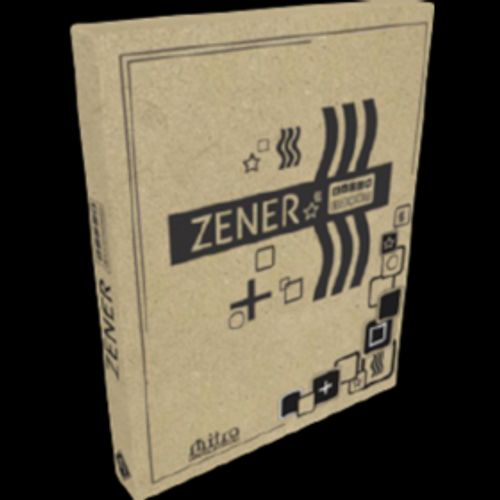
Zener
Zener Rulebook
Table of Contents
Table of Contents
Game Components
- A board with 35 houses (5 wide by 7 high)
- 5 white pieces (circle, cross, waves, square and star)
- 5 black pieces (circle, cross, waves, square and star)
About Zener
Zener is a logic and strategy game for 2 players, created by Carlos Seabra in 2017. The matches last an average of 10 minutes, which invites replayability and allows use in tournaments and championships.
The pieces use the symbols created by Zener in 1920 for the extrasensory perception test deck and the game mechanics uses innovative logic that takes interesting situations of playful reasoning.
Without luck, it allows the discovery of many game strategies. For lovers of games like go, chess, checkers, Zener can be played by children, young people and adults, from 6 years old.
Game Preparation
Each player chooses the pieces to play with, black or white. In the case of successive matches, players must alternate the use of colors between themselves, as white, like in chess, is always the starting piece of the game.
The initial position of the pieces follows the sequence of lines contained in each symbol. Thus, in the first place the circle is placed, in the second the cross, in the third the waves, in the fourth the square and in the fifth the star.
circle | cross | waves | square | star
Players can also shuffle the pieces and place them with the face hidden, positioning them before turning them over, thus being in random order.
Moving the Pieces (1)
The player with the white pieces is the first to play. He can choose any piece and move it a single square in the orthogonal direction (that is, any square, except diagonals). The piece can move to any adjacent square, either sideways, forward or backward — either to a square that is free or to a square that is occupied by another piece, yours or the opponent's.
It is the other player's turn then, who must move the piece with the same symbol that his opponent just moved.
For example, if the first player moved the piece of waves, the second player must move the same piece of his color.
Moving the Pieces (2)
After making the mandatory feedback move, the player must make his second move, free, being able to move any other piece of his choice (just not being the same one that just moved).
In his turn, the other player follows the same logic: she or he is always obliged to move the same piece that his opponent just moved, in the mandatory movement, and then she or he has a free movement to choose from (except the piece that has just moved obligatorily).
Attention: the mandatory movement refers only to the piece to be moved, as its movement will be free, with limitation of always being to an adjacent house.
Locking Pieces
When a piece falls on top of a square that contains another piece, it is blocked and until it is free again (if the other, which is on top, moves, unlocking it) it is as if it were not in play.
If a player is without a piece that the opponent has moved, due to the fact that it is blocked, he has no mandatory feedback movement to do, leaving only the free movement of any other piece.
If the player has the mandatory movement piece, he must always move it, being able to do it even to the house where another piece of his is; in which case the piece will be blocked just as if it blocked one of the opponent.
Goal and Victory
The game ends when one of the players manages to pass any square in the last row (the starting row of his opponent's pieces) or when only he has free pieces on the board.
Therefore, a piece in the last square of the opponent's starting row is not yet a victory, it may still be blocked; it only wins when it leaves the board for any of these squares.
Note:
All the squares on the board are numbered, from A1 to G5, to allow the recording of matches.
How to Record Movements and Matches
To enable registration and annotation of matches, all squares on the board are numbered, from A1 to G5.
The white pieces (white) are designated from W1 to W5, the black pieces (black) from K1 to K5, according to the number of lines that make up the symbols (circle, cross, waves, square and star).
- W1 / K1 — circle
- W2 / K2 — cross
- W3 / K3 — waves
- W4 / K4 — square
- W5 / K5 — star